Nhập khẩu hương trầm vào châu Âu 2026: Hướng dẫn đầy đủ CITES và bán buôn
Cứ vài tuần lại có một nhà nhập khẩu châu Âu hỏi cùng một câu theo cách hơi khác: tôi có cần giấy phép CITES để nhập lô này không? Câu trả lời thành thật là quy định nhập khẩu hương trầm vào châu Âu tách ra theo một ranh giới mà hầu như không nhà cung cấp nào giải thích, và ranh giới đó đi qua bao bì chứ không phải sản phẩm.

Tác giả
Wang Jianyu
Founder & Chief Sourcing Officer, AgarwoodTown
15+ years hands-on experience grading plantation agarwood, sourcing directly from Dianbai and Maoming districts in Guangdong — the world's largest Aquilaria sinensis cultivation region. Wang has personally inspected thousands of CITES export shipments and holds plantation certification from China's National Forestry and Grassland Administration. He advises GCC, European and East Asian wholesale buyers on grade selection, CITES compliance and supply chain due diligence.
Đạt chứng nhận CITES
Trong bài viết này
- Nhà bán lẻ châu Âu thực sự nhập gì
- Ba truyền thống hương, ba chuỗi cung ứng
- Vì sao tìm "hương Nhật bán buôn" thường bế tắc
- Phân cấp: bạn thực sự trả tiền cho điều gì
- Quy trình mẫu trước đơn bán buôn đầu tiên
- CITES và nhập khẩu EU: chuỗi chứng từ
- Chú thích #14 — ranh giới bao bì
- Vì sao EU nghiêm hơn CITES
- Bán lại thương hiệu hay mua trực tiếp
- MOQ, giá và thời gian giao hàng
- Nhãn riêng: từ mẫu đến lô hàng
- Điều này có nghĩa gì cho đơn hàng tới
- Câu hỏi thường gặp
1. What European Retailers Actually Import
Anyone planning an oud incense import Europe programme runs into the same surprise. European demand is real but narrow. It splits between wellness retail, niche fragrance boutiques, and a smaller ceremonial segment.
Yet the sourcing question that reaches us is almost never about scent. It is about paperwork and minimum order quantity.
That is the useful signal. A buyer asking about burn time has a product question. A buyer asking whether the shipment needs a permit has already decided to buy.
Three Incense Traditions, Three Supply Chains
Buyers routinely treat "incense" as one category. In sourcing terms it is three, and they do not substitute for each other.
Japanese koh (香) is a pressed blend — agarwood powder bound with makko bark and other aromatics, extruded without a bamboo core. Roughly 70% of Japan's incense is manufactured on Awaji Island in Hyogo Prefecture.[1] Notably, most of the raw ingredients in Japanese incense are imported from China and India — the wood travels to Japan, not the finished stick.
Arabic bakhoor is a wholly different product: resin-soaked wood chips burned on charcoal, not a stick. It serves the GCC hospitality and majlis market — our premium bakhoor blends ship on a wholly different spec sheet. We cover its sourcing standards separately in our bakhoor sourcing reference.
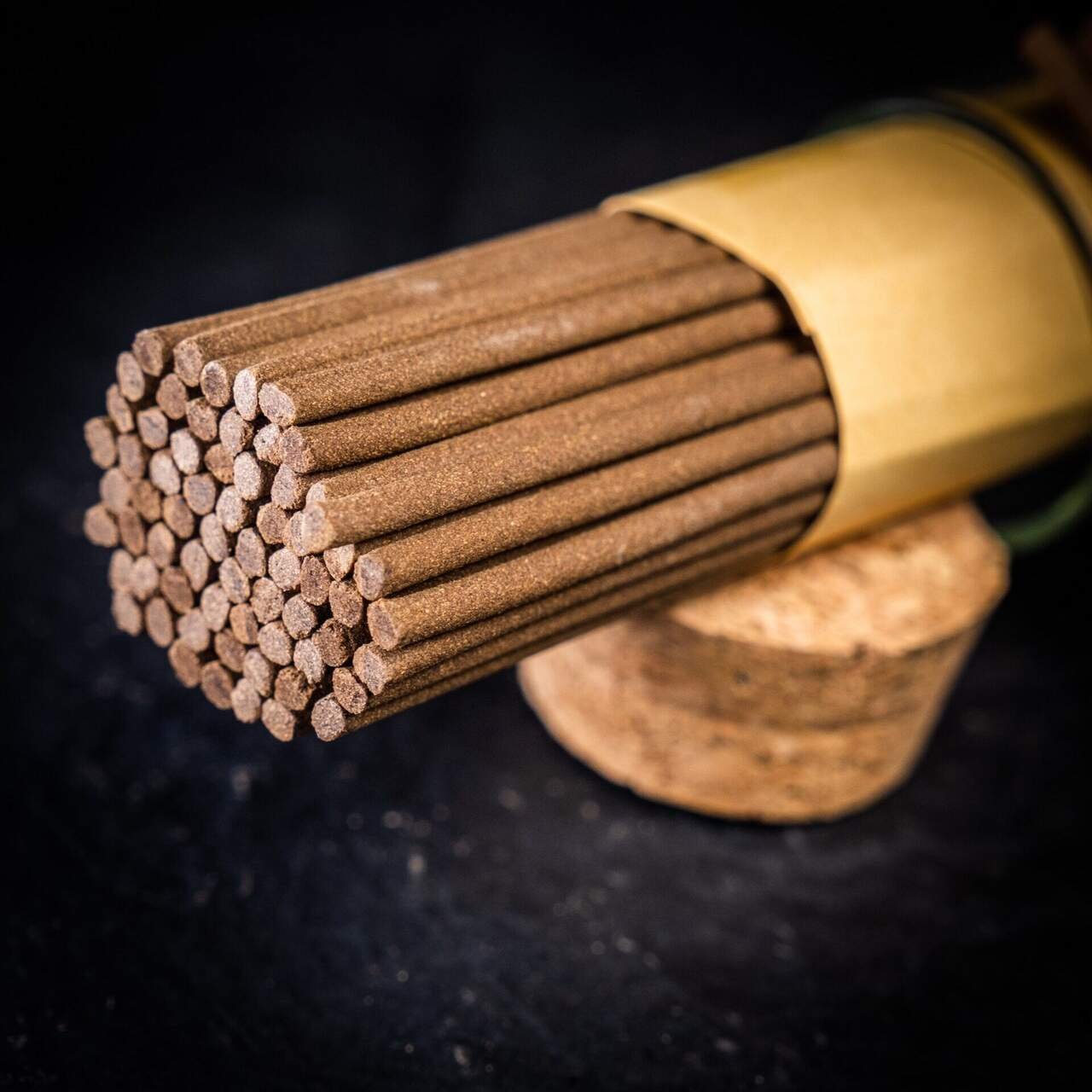
Chinese-tradition stick incense — what we produce at our Dian Bai plantation in Guangdong — uses plantation Aquilaria sinensis in both cored and coreless forms. Our standard agarwood incense sticks run 21 cm, roughly 2,000 sticks per kilogram.
Why "Japanese Incense Wholesale" Usually Dead-Ends
A recurring search pattern among German and Austrian retailers is some variant of Nippon Kodo Großhandel für Händler — looking for trade terms on a Japanese brand. In practice those enquiries stall, for a structural reason.
Japanese incense houses run closed distribution. Their blending recipes and their six-tier agarwood grading system (伽羅, 羅国, 真那伽, 真南蛮, 寸門多羅, 佐曾羅) are the core assets of the business. They are not licensed out, and European trade terms are typically routed through a single national distributor with protected margins.
Therefore the realistic options for a European retailer are two: buy through that distributor and accept the margin structure, or source the raw material upstream and build your own blend. Moreover, the second path is the one the Japanese makers themselves use — they buy wood, not sticks.
2. Grading: What You Are Paying For
| Grade | Resin content | Burn character | Typical use |
|---|---|---|---|
| D | Entry tier | Light, short throw, ~25 min | Volume retail, daily-use lines |
| C | Moderate | Balanced, ~35 min | Mid-market retail, gift sets |
| B | High | Layered, sweet mid-note, ~45 min | Specialist boutiques |
| A | Very high | Deep resinous base, ~55 min | Premium retail, ceremony |
| AAA | Sinking-grade stock | Complex, long fixative tail | Collector and ceremonial tiers |
| Kynam (奇楠) | Exceptional | Cooling, numbing top note | Allocation only, not stock-held |
Resin density drives every other property. Grades below are our internal plantation scale; they are not a CITES or ISO standard, and other suppliers grade differently.

Two practical notes for buyers evaluating a first sample. First, burn time is the cheapest proxy for resin content. Light one stick, time it, and compare against the supplier's claim.
Second, resin density decides whether a stick holds its scent through a European winter shipping cycle. Low-resin sticks that sat in a cold container arrive noticeably flatter.
Sample Protocol Before an Oud Incense Import Europe Order
Our sample pack is 100 g at $450 for the standard agarwood line and $300 for the bakhoor-style line. It contains three grades so you can compare side by side.
Those prices sit deliberately above unit cost. A paid sample filters out catalogue collectors, and we credit it against a first production order.

Quy trình từng bước
3. CITES and EU Import: The Documentation Chain
Establish which annotation applies
All Aquilaria spp. have been listed in CITES Appendix II since 2004 and carry annotation #14. That annotation — not the Appendix listing alone — sets what needs paperwork. Verify the current text before every shipment; annotations are revised at Conferences of the Parties.
Classify your shipment: retail-packaged or bulk
Annotation #14 exempts finished products packaged and ready for retail trade, but explicitly excludes woodchips, beads, prayer beads and carvings. Retail-ready incense sticks fall inside the exemption. Loose bulk sticks intended for repacking in Europe do not.
If not exempt: obtain the export permit at origin
We apply through the Chinese CITES Management Authority. The permit references the plantation source, species (Aquilaria sinensis), quantity and the importer of record. Allow 15-25 working days; this sits on the critical path, not alongside it.
Apply for your EU import permit
This is the step most non-EU suppliers fail to mention. Aquilaria sits in Annex B of Council Regulation (EC) No 338/97, and the EU requires an import permit for Annex B species even though baseline CITES does not require one for Appendix II. You apply in your own member state — the BfN in Germany.
Present both documents at the customs office of introduction
The importer submits the signed original import permit together with the origin export permit at the designated point of entry. Incense sticks classify under HS 33074100. A mismatch between permit quantity and invoice quantity will hold the shipment.
Archive for audit
Keep the permit pair with the trade invoice and packing list. EU member-state authorities can request the chain after the fact, and a gap in it complicates every later application you file.
The packaging line, stated plainly
Two shipments of the same blend of incense can face completely different rules:
- Retail-packaged sticks — boxed, labelled, ready for shelf sale. Exempt under annotation #14.
- Bulk sticks — loose in a 1 kg carton for you to repack under your own brand. Not exempt. Full permit chain applies.
- Incense wood / chips — controlled in every case. The annotation excludes woodchips even when retail-packaged.
This is a business decision, not just a compliance detail. Bulk gives you a lower unit price and brand ownership; retail-packaged gives you a materially simpler customs path. We quote both because the right answer depends on whether you have a customs broker on retainer.
Annotation texts change at CoP meetings. Confirm the current wording with your national CITES Management Authority before committing to an order structure.
Why the EU Is Stricter Than CITES
A supplier telling you "Appendix II does not require an import permit" is quoting the Convention correctly and giving you the wrong answer for Europe.
The EU implements CITES through Council Regulation (EC) No 338/97, which sorts species into Annexes A to D rather than Appendices I to III. Annex B absorbs the CITES Appendix II species — including Aquilaria — and the EU layers an additional import-permit rule on top.[2]
Consequently a shipment that clears without incident into a non-EU market can be stopped at an EU port under the same CITES listing. In practice this catches first-time importers who took a supplier's word rather than checking their own member-state rules.
4. Reselling a Brand vs Sourcing Direct
| Đặc điểm | Reselling an established brand | Plantation-direct sourcing |
|---|---|---|
| Unit cost | Distributor margin already embedded | Ex-plantation, no middle layer |
| Brand ownership | None — you resell their label | Your label, your positioning |
| Minimum order | Often low; case quantities | 1 kg (~2,000 sticks) per SKU |
| CITES paperwork | Handled upstream, invisible to you | Yours to manage — or exempt if retail-packaged |
| Traceability | Brand attestation only | Named plantation, species, harvest window |
| Recipe control | Fixed | Blend, length and resin grade adjustable |
| Time to first shipment | Days | 45-60 days including permits |
5. MOQ, Pricing and Lead Times
| Item | Terms |
|---|---|
| Minimum order | 1 kg per SKU (~2,000 sticks at 21 cm) |
| Paid sample | 100 g — $450 agarwood line, $300 bakhoor line, credited against first order |
| Production lead time | 20-30 days after artwork and blend sign-off |
| CITES export permit | 15-25 working days, runs in parallel with production |
| EU import permit | Applicant-dependent; budget 3-6 weeks in your member state |
| Source | Plantation Aquilaria sinensis, Dian Bai, Guangdong |
| Certification | CITES Appendix II documentation on non-exempt shipments |
Indicative terms for first orders. Kynam-tier stock is allocated, not stock-held, and is quoted per enquiry.
Sourcing for a European retail line?
If you are comparing a retail-packaged programme against bulk private label, we quote both structures side by side so you can see the landed-cost difference before committing. Browse our agarwood incense wholesale range → or compare the resin-graded oud wood chips used as feedstock.
6. Private Label: From Sample to Shipment
Most European private-label programmes we run follow the same arc, and the timeline is dominated by decisions on your side rather than production on ours.
The blend decision comes first
Resin grade sets the ceiling on everything downstream. A D-grade blend cannot be rescued by packaging, and an A-grade blend sold in generic packaging leaves margin on the table. We send three grades in the sample pack for exactly this reason.
Packaging sets your customs path
If your artwork produces a retail-ready unit at our facility, the shipment is likely exempt under annotation #14. If you repack in Europe, it is not. Deciding this early changes both your permit workload and your unit economics, so we raise it before artwork rather than after.
Regarding EU labelling: incense is not a cosmetic product, but member states differ on required consumer information and language. We print to your supplied artwork and do not warrant its compliance — that verification sits with you or your customs broker.
Watch: Plantation to Finished Stick
Agarwood incense production at our Dian Bai plantation — from graded chips to finished 21 cm sticks
Production footage coming soon.
7. What This Means for Your Next Order
Three things decide your landed cost, in this order: resin grade, packaging format, and whether you hold the permits or we ship exempt.
Get the packaging decision right and the compliance workload largely disappears. Get it wrong and a 1 kg carton can sit at a European port while you file an application you did not know you needed.
Request a wholesale quote → — tell us your target grade and whether you intend to repack in Europe, and we will quote both structures. For background on how we evaluate incoming resin stock, see our agarwood incense sticks reference.
Câu hỏi thường gặp
It depends on packaging, not composition. Annotation #14 on the Aquilaria Appendix II listing exempts finished products packaged and ready for retail trade, which covers boxed retail incense sticks. Loose bulk sticks intended for repacking are not exempt and require both an export permit from the country of origin and an EU import permit. Woodchips are controlled in every case, retail-packaged or not.
The EU implements CITES through Council Regulation (EC) No 338/97, which uses Annexes A to D instead of the Convention Appendices. Annex B covers CITES Appendix II species including Aquilaria, and the EU adds an import-permit rule that baseline CITES does not impose on Appendix II material. This is why a shipment that clears elsewhere can be stopped at an EU port.
Our minimum is 1 kg per SKU, which works out to roughly 2,000 sticks at our standard 21 cm length. Paid samples are 100 g at $450 for the agarwood line and $300 for the bakhoor-style line, credited against a first production order. Kynam-tier material is allocated rather than stock-held and is quoted per enquiry.
You can buy the raw material Japanese makers use. Around 70% of Japanese incense is produced on Awaji Island, and most ingredients are imported from China and India. Japanese houses do not license their blends or their six-tier agarwood classification. If you want a Japanese-style pressed koh product, the realistic path is sourcing graded agarwood powder and developing your own blend.
Budget 45 to 60 days for a non-exempt shipment. Production runs 20 to 30 days after blend and artwork sign-off. The CITES export permit takes 15 to 25 working days and runs in parallel with production rather than after it. Your EU import permit filing is the variable — allow three to six weeks depending on your member state.
Incense sticks classify under HS 33074100, covering agarbatti and other odoriferous preparations that operate by burning. This is the tariff classification only. It is separate from CITES documentation, which is triggered by the species listing and annotation rather than by the customs code, so satisfying one does not satisfy the other.
Burn time is the most accessible proxy. Light one stick and time it against the supplier claim — our D grade runs roughly 25 minutes and A grade roughly 55 minutes at 21 cm. Also check scent persistence after the stick extinguishes; higher resin content leaves a fixative tail in the room, while low-resin sticks stop almost immediately.
At equivalent resin grade the sesquiterpene and chromone profiles are broadly comparable, which is why plantation material has replaced wild stock in most commercial incense. The practical differences are consistency and documentation: plantation batches are repeatable and carry CITES papers you can trace, whereas wild-sourced material is neither reliably available nor straightforward to document.
Yes. Coreless extrusion binds agarwood powder with makko rather than coating a bamboo core, which removes the burning-bamboo note that some European buyers object to in cored sticks. Coreless production is slower and carries a higher unit cost, and minimums are set per blend rather than per SKU. Specify the format at sample stage.
The usual cause is a mismatch between permit and invoice quantity, or a missing EU import permit on a non-exempt shipment. Holds are resolved by supplying the missing document, but the shipment sits in bonded storage at your cost meanwhile. This is the practical argument for retail-packaged programmes on a first order, before you have a broker relationship established.
Tài liệu tham khảo
- 1CITES Secretariat. Appendices I, II and III — Aquilaria spp. (Appendix II, annotation #14). Convention on International Trade in Endangered Species of Wild Fauna and Flora, 2025.Xem nguồn
- 2European Commission. Wildlife trade — implementation of CITES through Council Regulation (EC) No 338/97. European Commission, Environment, 2025.Xem nguồn
- 3Liu Y.Y., Wei J.H., Gao Z.H., Zhang Z., Lyu J.C.. A Review of Quality Assessment and Grading for Agarwood. Chinese Herbal Medicines, 2017.Xem nguồn
Mọi tài liệu khoa học được công bố nhằm bảo đảm minh bạch. AgarwoodTown tổng hợp các nghiên cứu đã được phản biện chỉ phục vụ mục đích giáo dục.
Bài viết liên quan
Incense
Agarwood Incense Sticks Guide 2026: Bakhoor, Kyara & Kynam — 5 Proven Uses
20 min read
Sourcing Reference
Bakhoor Sourcing 2026: 7 Premium Standards GCC Luxury Brands Use to Evaluate Source Suppliers
14 min read
Education
Agarwood Price Per Kg 2026: Wild vs Cultivated Kynam & Oud Wood Guide
16 min read
Yêu cầu giá sỉ
Sẵn sàng đặt hàng sỉ?
MOQ từ 100g · Đã bao gồm hồ sơ CITES · DHL & vận tải biển toàn cầu. Giá trực tiếp từ nhà máy Quảng Đông của chúng tôi.