Agarwood Bracelet Wholesale (2026): Wild vs Cultivated Agarwood Price
Sourcing agarwood bracelet wholesale stock for retail in 2026? Sourcing an agarwood bracelet for your retail store or brand in 2026 looks nothing like it did five years ago. Commercial jewelry buyers have basically left wild agarwood behind, and for good reason. The wild material is gorgeous, but the math punishes B2B buyers in three ways: supply you cannot forecast, yields measured in grams not kilos, and an agarwood price that moves with whichever forest find hits the market that month. The cultivated market grew up to plug exactly that gap, with denser resin and a wholesale price you can quote a buyer next quarter. Below we walk through how wild and cultivated oud wood actually compare, and which one belongs in your inventory.

Written by
Wang Jianyu
Founder & Chief Sourcing Officer, AgarwoodTown
15+ years hands-on experience grading plantation agarwood, sourcing directly from Dianbai and Maoming districts in Guangdong — the world's largest Aquilaria sinensis cultivation region. Wang has personally inspected thousands of CITES export shipments and holds plantation certification from China's National Forestry and Grassland Administration. He advises GCC, European and East Asian wholesale buyers on grade selection, CITES compliance and supply chain due diligence.
CITES Certified
In this article
- Where Wild Agarwood Comes From
- Growing Conditions & Resin Formation
- Wild vs Cultivated: Product Fit
- Cultivated Bracelets for Beginners
- Hand-Craftsmanship Process
- Wild Bracelets as Collector Asset
- Price, Aroma & Resin Comparison
- 2026 Wholesale Price Reference
- 12 Agarwood Bead Shapes
- Avoid Fake Wholesale Bracelets
- CITES Legal Compliance
- FAQ
1. Where Does Wild Agarwood Come From?
For most of agarwood's commercial history, wild was the only option on the table. It forms by accident when a forest tree gets hit by lightning, snapped by a typhoon, or bored into by insects. Decades of heavy cutting have left the genuine wild stock close to gone.
Wild agarwood breaks down into two globally recognised fragrance systems, and any serious B2B buyer needs to learn the distinction. Both terms still drive price negotiations and show up on certificate paperwork in 2026:
Major Wild Agarwood Producing Regions
| Fragrance System | Key Producing Countries | Signature Aroma Profile | Market Status |
|---|---|---|---|
| Hui'an System (惠安系) | Vietnam, Cambodia, China (Hainan) | Sweet, floral, cooling, fruity | Functionally depleted. Mostly found in antique collections. |
| Xingzhou System (星洲系) | Indonesia (Tarakan, Kalimantan), Brunei, Malaysia | Earthy, medicinal, milky, rich | Highly scarce. Extremely high agarwood price. |
Both systems sit under CITES Appendix II, with A. malaccensis added in 1994 and all Aquilaria spp. covered from 2004. Authenticated wild material in wholesale volume is not realistically on the market today; what changes hands as "wild" is, in the great majority of cases, mislabelled plantation stock.
2. Growing the Agarwood Tree: Conditions & Resin Formation
To overcome the wild shortage, the industry turned to agricultural science. However, growing an agarwood tree (Aquilaria) is incredibly difficult.
Strict Growing Conditions
These trees demand a strict tropical environment. They require high humidity, well-drained soil, and temperatures that absolutely never drop below 0°C (frost will kill the tree). This makes regions like Guangdong, China the epicentre for premium plantations.[5]
How Resin Is Formed
Plantation trees do not naturally produce resin; they must be provoked. Modern high-end plantations use the Physical Drilling Method. Workers bore precise holes deep into the heartwood of grafted Kynam trees.[15] The tree's immune system floods these wounds with dense, oil-rich resin over several years.
This is a different approach from the older fungal-injection technique used on standard plantations, it produces denser, oilier core resin and is the reason cultivated Kynam bracelets can compete with wild material on aroma intensity. For the full breakdown of plantation grafting, drilling cycles, and harvest timelines, see our Cultivated Agarwood production guide.
3. Wild vs. Cultivated Oud Wood: Product Suitability
Why can't we just use wild wood for everything? It comes down to structure.
Wild Agarwood: Because trauma happens randomly, wild resin forms in twisted, unpredictable, and hollow shapes. It is incredibly difficult to find a solid block large enough to cut a round bead. Therefore, wild wood is best suited for raw display pieces, master carvings, and high-end incense.
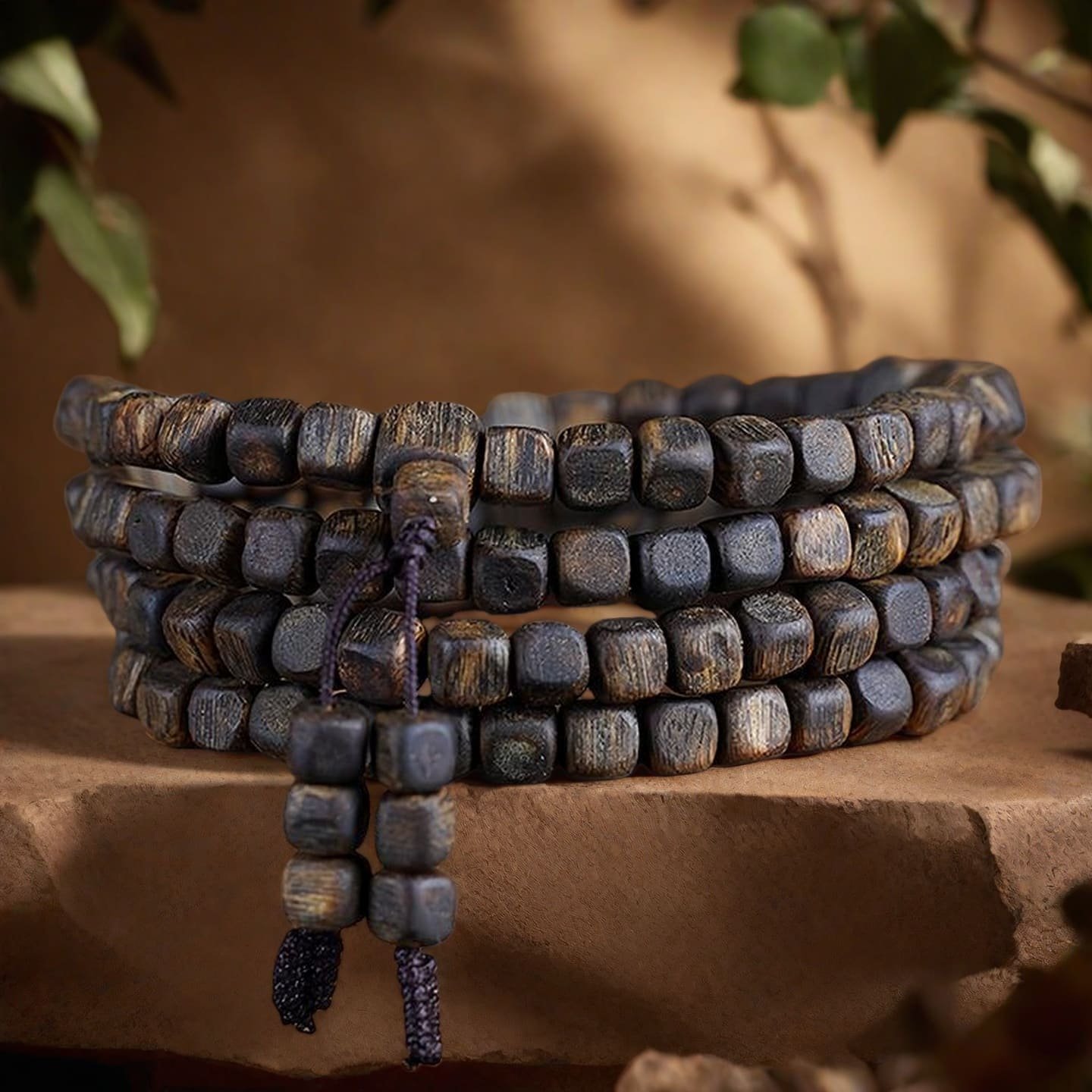
Cultivated Agarwood: Because we control where the drill holes go, the tree produces resin in thick, solid blocks. This structural integrity makes cultivated oud wood the absolute best material for standardized jewelry like agarwood bracelets and pendants.
4. Why Cultivated Bracelets Are Perfect for Entry-Level Buyers
For customers new to oud, a cultivated agarwood bracelet is usually the smartest product you can put in front of them. Three reasons it works as an entry SKU:
- Aroma you can smell at room temperature. Wild wood often needs heat to release its scent. Cultivated Kynam carries a sweet-cooling aroma that the wearer notices on the wrist, no warming required.
- Visual appeal. The drilling method produces dark resin lines that read clearly on the bead surface, which photographs well and sells well.
- Stable wholesale pricing. The agarwood price on cultivated stock holds steady enough to quote a customer next quarter, instead of moving with whichever forest find hits the market that month.
Browse our full range of agarwood bracelets wholesale: 8 mm to 14 mm bead sizes, Grade B through AAA, 18-bead and 108-bead mala formats, with full CITES documentation on every order.
5. Craftsmanship: From Raw Log to Masterpiece Bracelet
Behind every premium agarwood bracelet there is a 4-step manual workflow we have refined over decades of doing this. Machine processing burns the resin and destroys the aroma; only strict hand-craftsmanship preserves the wood's fragrance integrity. Here is how AgarwoodTown converts raw plantation logs into finished wholesale-grade bracelets at our Guangdong workshop:
Behind-the-scenes look at a wholesale agarwood bracelet being hand-crafted at AgarwoodTown's Guanzhu Town workshop in Guangdong, China. Watch the artisan turn a resin-rich plantation Aquilaria sinensis block into a perfectly round bead under strict low-temperature conditions — the manual process that preserves fragrance density and earns Grade AAA sinking-grade certification.
Precision Log Cutting & Core Extraction
Master craftsmen evaluate the natural resin veins of the log, making highly calculated cuts. Like peeling an onion, the valueless, odorless white wood is stripped away, preserving only the dense, resin-rich core — the only part with genuine agarwood benefits and fragrance.
Hand-Carving & Resin Extraction
Using specialized carving knives, artisans manually scrape away the light-coloured wood fibres entangled within the dark resin. This critical step exposes the pure "black resin lines" to the air — the hallmark of genuine high-grade agarwood visible under any magnifying glass.
Low-Temperature Bead Turning
The selected resinous blocks are cut into precise cubes and fed into precision lathes to form perfectly round beads. Friction temperatures are strictly monitored to prevent even a single drop of precious essential oil from evaporating — a detail that directly affects fragrance retention for the end buyer.
Hand-Polishing & Finishing
We strictly prohibit the use of chemical varnishes or glues. Each bead is repeatedly hand-polished using progressive grits of sandpaper until it radiates a natural, oily lustre — the zero-chemical standard we apply to all AgarwoodTown products.

6. The Ultimate Collection: Wild Agarwood Bracelets
This does not mean wild agarwood bracelets have no value. The yield of solid wild wood suitable for beads is close to zero, which is exactly what makes an authentic sinking-grade wild bracelet a museum-level artifact.
These are no longer consumer goods. They function more like collector-tier alternative assets, and the material gets scarcer every year. If you source an authentic wild bracelet, treat it like one. Keep it in a collector's vault, not on a wrist where sweat will damage it.
For B2B wholesale programs, wild bracelets work as halo SKUs (one or two pieces in a high-end boutique to anchor brand prestige) rather than inventory you turn over. Lead time is "whenever a piece becomes available", typical wholesale price floors at USD 8,000–25,000 per bracelet for verified sinking-grade material, and CITES documentation is the gating constraint.
7. Price, Aroma, and Resin: The Ultimate Comparison
| Feature | Cultivated Agarwood Bracelet | Wild Agarwood Bracelet |
|---|---|---|
| Agarwood Price | Highly accessible — excellent profit margins for retail and spiritual jewelry shops | Astronomical — requires massive capital, very low inventory turnover |
| Aroma Profile | Loud & direct — sweet and highly fragrant at room temperature | Subtle & complex — requires body heat to slowly release deep notes |
| Resin Density | Engineered density — drilling method easily achieves high oil density and sinking grades | Natural variance — uniform resin across every bead is incredibly rare |
| Supply Stability | Consistent annual harvest from 600+ acres of Guangdong plantations | Unpredictable — entirely dependent on forest finds |
| CITES Documentation | Government-issued export permit on every shipment | Rarely obtainable; high risk of forgery and customs seizure |
| MOQ Flexibility | From 50 bracelets per grade | Spot market only — no MOQ logic |
| Lead Time | 15–30 days standard; 30–45 days custom carving | No guarantee — months to never |
| Counterfeit Risk | Low — traceable plantation origin, verifiable | Extremely high — authentication requires expert physical inspection |
For 95%+ of B2B retail and gifting programs in 2026, cultivated bracelets are the rational sourcing choice. Wild bracelets serve a separate market: collector-grade alternative assets at investment-asset price points.
8. 2026 Agarwood Bracelet Wholesale Price Reference
| Bead Size | Grade B (Commercial) | Grade A (Premium) | Grade AAA (Sinking) |
|---|---|---|---|
| 8 mm round | USD 4–10 / bracelet | USD 25–60 / bracelet | USD 180–400 / bracelet |
| 10 mm round | USD 10–25 / bracelet | USD 60–150 / bracelet | USD 450–1,200 / bracelet |
| 12 mm round | USD 22–55 / bracelet | USD 140–350 / bracelet | USD 1,200–4,000 / bracelet |
| 14 mm round | USD 45–110 / bracelet | USD 300–700 / bracelet | USD 3,000–10,000+ / bracelet |
| 10 mm abacus | USD 8–20 / bracelet | USD 50–120 / bracelet | USD 350–900 / bracelet |
| 10 mm irregular | USD 6–15 / bracelet | USD 35–85 / bracelet | USD 250–700 / bracelet |
| Raw material (per kg) | USD 80–200 / kg | USD 300–800 / kg | USD 1,500–6,000+ / kg |
Prices shown are FOB Guangzhou wholesale indicative ranges per bracelet (18-bead standard), based on AgarwoodTown current pricing. Sinking Grade (AAA) commands a geometric premium due to extreme raw material rarity. Contact us for volume tiered pricing.
9. The Aesthetics of 12 Agarwood Bead Shapes
| Bead Shape | Core Symbolism | Crafting Features & Target Audience |
|---|---|---|
| Round | Perfection & Harmony | Highest waste rate (>70%). The ultimate hard currency for top-tier collectors and corporate gifting. Most popular globally. |
| Old-Style | Modesty & Wisdom | Slightly rounded drum without sharp edges. Ideal for mature, seasoned business elites. Strong demand in Japan and China. |
| Cylinder | Stability & Strength | Flat tops and bottoms, projecting a bold look. A staple for male entrepreneurs in Gulf and Southeast Asian markets. |
| Abacus | Wealth Accumulation | Flat and comfortable on the wrist. Highly favoured by finance professionals and female buyers — top seller in Saudi Arabia. |
| Bamboo | Career Advancement | Carved to resemble bamboo joints. The perfect gift for corporate climbers and officials. Popular in China and Taiwan. |
| Jujube | Early Success | Oval with pointed ends. Great for young professionals or newlyweds. Good entry-level price point for new wholesale accounts. |
| Apple | Peace & Health | Plump and apple-shaped. A favoured pendant for elders and frequent travellers, often given as a personal heirloom. |
| Pumpkin | Abundance & Family | Features evenly carved grooves. Highly artistic, suited for buyers valuing family heritage. Good for gift boutiques. |
| Irregular | Nature's Flow | Follows the natural resin shape. Every piece is unique; loved by artists and younger generations. Strong in UAE boutiques. |
| Slice | Absolute Authenticity | Visually proves the natural resin veins. The safest, most transparent choice for beginner buyers and retail verification. |
| Carved | Custom Protection | Hand-carved with motifs (e.g., Lotus, Pixiu). The pinnacle of bespoke luxury jewelry. Requires longer lead time — 4–6 weeks. |
| Burl | Resilience | Crafted from healed tree wounds featuring rare wavy grains. The holy grail for hardcore collectors — extremely limited supply. |
The shape of the bead (the "cutting style") dictates material waste rate and spiritual symbolism. Use this guide to match bead shape to your target customer demographic — a detail that drives repeat orders in wholesale markets.
10. Sourcing Guide: Avoid Fake Wholesale Bracelets
The biggest mistake buyers make is purchasing machine-processed beads. Cultivated Kynam is incredibly sticky and oil-rich. Standard factory machines generate heat that literally burns the wood and destroys the aroma, a bracelet that looks identical to the hand-finished version on day one will be scentless within 6–12 months.
Always demand strictly manual crafting. Look for transparent factories where human artisans hand-turn and polish each bead, preserving the wood's pure energy and fragrance.
Beyond manual processing, the four most common counterfeits a B2B buyer encounters are "Boiled Oud" (high-pressure synthetic oil injection — emits a harsh chemical scent and looks dead-black), "Painted Lines" (resin veins drawn on cheap wood), "Metal Weighting" (lead or steel pellet inserted to fake sinking-grade density), and plantation material relabelled as wild. The macro-lens inspection below shows the visual signature of the genuine product versus a typical boiled-oud counterfeit.


For counterfeits using "Painted Lines" or "Metal Weighting", simply shine a bright flashlight down the drilled hole of the bead. If the inside is pure white or reflects metal, it is a guaranteed scam. Genuine sinking-grade beads are uniformly dark throughout the cross-section.
For large wholesale orders, request a material density test: genuine sinking-grade beads sink in fresh water. If a supplier refuses this basic test, walk away. AgarwoodTown provides certified density testing documentation for all Grade AAA sinking orders.
11. Legal Compliance & CITES Certification: What B2B Buyers Must Know
All Aquilaria species are listed under CITES Appendix II, meaning commercial export requires a government-issued CITES permit in addition to standard trade documents.[1][8] This applies equally to bracelets, chips, and raw logs, any agarwood product crossing international borders. Customs seizures, fines, and reputational damage await importers who source without proper documentation.
Key compliance documents for agarwood bracelet imports:
- CITES Export Permit — issued by the exporting country's CITES Management Authority (China: National Forestry and Grassland Administration). Processing time: 15–30 business days.
- Phytosanitary Certificate, required by most countries for wood products. AgarwoodTown arranges this as part of standard export documentation.
- HS Code for agarwood bracelets: 4420.90 (wood articles, decorative) or 7117.19 (imitation jewelry — other); confirm with your customs broker as country-specific classification may vary.
- Species Certificate, confirms Aquilaria sinensis origin from a legally registered plantation (China Forestry Bureau plantation registration number).
AgarwoodTown's cultivated agarwood originates from legally registered plantations in Guangdong. We provide the full CITES Appendix II documentation package for all commercial export orders above 500 g. For buyers importing to the UAE, Saudi Arabia, USA, EU or Japan, we have established customs documentation templates for each jurisdiction.
CITES Compliance: Do Not Risk Your Import License
Customs authorities in the UAE, EU, USA and Japan routinely inspect agarwood shipments. In 2023–2024, multiple agarwood shipments were seized at Dubai and Frankfurt customs for missing or invalid CITES documentation. The consequences include: goods confiscation, import ban for repeat offenders, and potential criminal prosecution under national CITES implementation laws. Never source from a supplier who cannot provide a valid CITES export permit. Request the permit number before payment, AgarwoodTown shares permit details in advance for verified wholesale partners.
Ready to Source? Get a Wholesale Quote in 24 Hours
AgarwoodTown supplies Grade B, Grade A, and Grade AAA sinking agarwood bracelets direct from our Guangdong plantation network. All orders include: species certificate (A. sinensis), CITES export documentation, factory audit report on request, DHL/sea freight worldwide. MOQ from 50 bracelets per grade.
→ Request your wholesale price list and sample kit
For external reference, see Wikipedia: Aquilaria for the underlying species and historical context.
For trade-policy reference, see CITES Appendix II — Aquilaria spp..
Frequently Asked Questions
Our standard Minimum Order Quantity is 50 bracelets per grade/size combination for Grade B and Grade A. For Grade AAA sinking bracelets, the MOQ is 10 pieces due to limited raw material availability. For custom carved or burl bracelets, MOQ is 20 pieces with 4–6 weeks lead time. We support initial sample orders of 3–5 pieces per SKU before committing to bulk.
Standard terms: 30% deposit to confirm order, 70% balance before shipment. For verified repeat buyers with 3+ order history, we offer 30-day net terms (subject to credit review). We accept T/T wire transfer, PayPal (orders under USD 2,000), and LC for orders above USD 20,000. All prices are quoted FOB Guangzhou unless otherwise specified.
CITES export permits are issued by China's National Forestry and Grassland Administration. Standard processing time is 15–30 business days. We initiate the CITES application as soon as your deposit is confirmed, so permit and goods are ready simultaneously. For time-sensitive orders, we can apply for expedited processing (additional fee applies). The permit is valid for 6 months from issue date and covers the specific shipment it was issued for.
Yes — we encourage sample orders. Sample kits of 3–5 bracelets per grade (B, A, and AAA sinking) are available at retail price with full documentation. Sample cost is deducted from your first bulk order if placed within 60 days. Samples ship DHL Express within 5–7 business days from Guangdong. Note: CITES documentation for sample quantities (under 50g) uses a simplified process and is typically processed within 5 business days.
Yes. We offer custom gift boxes (velvet-lined, with magnetic closure), custom card inserts, Arabic/English/Japanese/Chinese product descriptions, and OEM branding. Minimum 100 pieces for custom packaging. For private label (your brand name on the box and certificate), MOQ is 200 pieces per SKU. Custom packaging lead time adds 7–10 business days to standard production time. Popular for Gulf buyers who resell in luxury boutiques.
Grade B: light, fresh woody fragrance noticeable when warmed by body heat — suitable for retail customers who want authentic agarwood benefits at accessible price. Grade A: rich, deep woody-resinous character, clearly fragrant on the wrist throughout the day, visible dark resin veins under inspection — the most popular wholesale grade globally. Grade AAA (sinking): intensely fragrant, complex resinous depth, sinks in water (density >1.0 g/cm³), visually black with almost no visible white wood fibers — the pinnacle grade sought by Gulf collectors and serious buyers. The scent of Grade AAA improves further with wear, developing a personal patina over months.
The scent of high-grade agarwood comes from deep internal resin and never truly disappears. If fragrance seems faint, a "patina" (hardened oil and sweat) has likely sealed the surface pores. Simply place the bracelet in a sealed jar with a slightly damp cotton cloth overnight to rejuvenate the aroma — the humidity helps open the wood pores. Grade A and AAA bracelets actually improve in fragrance character with years of wear as body oils interact with the wood resin.
Keep them sealed and away from heat, direct sunlight and moving air. Resin volatiles are what you are selling, and an open display shelf under warm lighting will thin the scent within weeks. We ship in individually sealed sleeves for this reason. For retail display, use one demonstration piece and keep the saleable stock sealed until purchase.
References
- 1Barden A., Anak N.A., Mulliken T., Song M.. Heart of the Matter: Agarwood Use and Trade and CITES Implementation for Aquilaria malaccensis. TRAFFIC, Cambridge, UK, 2000.View source
- 5Chhipa H., Kaushik N.. Fungal and Bacterial Diversity Isolated from Aquilaria malaccensis Tree and Soil, Induces Agarospirol Formation within 3 Months after Artificial Infection. Front. Microbiol., 2017.doi:10.3389/fmicb.2017.01286
- 8
- 15Liu Y., Chen H., Yang Y., Zhang Z., Wei J., et al.. Whole-tree Agarwood-Inducing Technique: An Efficient Novel Technique for Producing High-Quality Agarwood in Cultivated Aquilaria sinensis Trees. Molecules, 2013.doi:10.3390/molecules18033086
- 20CITES Secretariat. Appendix II Listing — Aquilaria spp. and Gyrinops spp.. Convention on International Trade in Endangered Species of Wild Fauna and Flora, 2004.View source
- 21
All scientific references are provided for transparency. AgarwoodTown summarises peer-reviewed findings for educational purposes and does not claim to provide medical or regulatory advice.
Wholesale Catalog
Buy the products discussed in this article


Related Articles
Source Direct from Origin
Discuss Your Requirements with Our Team
We respond within 24 hours. Share your target grade, quantity and destination — we'll send current pricing, a sample pack option, and CITES documentation details.