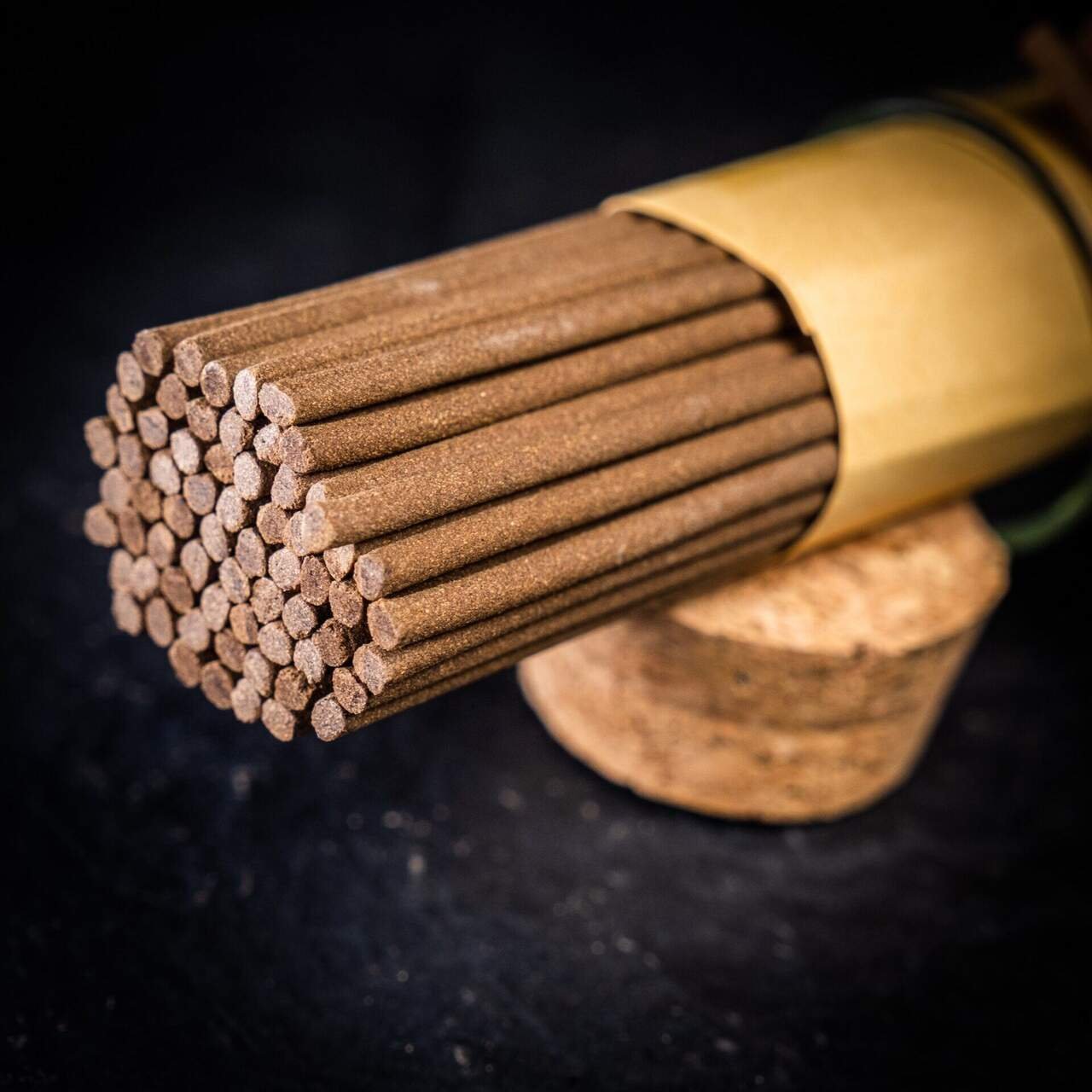
Agarwood Incense Sticks: Kyara vs Plantation Grades, Scent, How to Burn and 2026 Prices
You probably landed here for one of three reasons related to wholesale agarwood incense sticks. Maybe you're sourcing agarwood incense sticks wholesale and trying to work out why two boxes that look identical on the shelf can differ by a hundred dollars. Maybe you've smelled real kyara incense once and want to know if cultivated kynam can come close (short answer: it can, mostly). Or you're stocking a wellness boutique and you need a straight answer on why bakhoor incense sticks from the Gulf burn so differently from Japanese koh. This 2026 buyer's guide handles all three, plus the practical stuff: scent profiles, the 8-step factory process, a 5-point sampling protocol, B2B pricing tiers, and what we've learned shipping oudh incense and agarwood incense to wholesale buyers across 32 countries over the last decade.

Written by
Founder & Chief Sourcing Officer, AgarwoodTown
15+ years hands-on experience grading plantation agarwood, sourcing directly from Dianbai and Maoming districts in Guangdong — the world's largest Aquilaria sinensis cultivation region. Wang has personally inspected thousands of CITES export shipments and holds plantation certification from China's National Forestry and Grassland Administration. He advises GCC, European and East Asian wholesale buyers on grade selection, CITES compliance and supply chain due diligence.
CITES Certified
In this article
- Why Agarwood Incense Matters in 2026
- What Is Agarwood Incense? (Oud, Aloeswood, Agar Tree)
- 1. Composition: Kyara vs Global Blends
- Regional Tradition Deep Dive
- Watch: Agarwood Incense Sticks in Action
- 2. Spiritual & Metaphysical Scenarios
- Bakhoor, Mabkhara & Charcoal: The Arabic Way to Burn
- Cultivated Kynam vs Wild Oud — Direct Comparison
- 3. Scent Profile Breakdown
- 4. Crafting Process of Pure Agarwood Incense
- Common Adulterants to Avoid
- 5. Sourcing Quality Incense in Bulk
- 2026 B2B Wholesale Pricing Tiers
- Storage, Shelf Life & Packaging
- FAQ
Why Agarwood Incense Matters in 2026
By 2026 the global agarwood incense market is on track to clear USD 1.4 billion. Three things are pulling it there at once: the wellness category in North America and Europe; a quiet revival of Japanese kōdō ceremony among younger meditators; and a Gulf majlis tradition that, far from fading, has gotten sharper as GCC buyers chase heritage materials over mass-market perfumery.
The wild supply, meanwhile, is gone. More than 95% of the premium incense moving through wholesale channels this year is made from plantation Aquilaria sinensis or grafted kynam stock out of Guangdong, Hainan, and northern Vietnam. AgarwoodTown's own wholesale agarwood incense sticks come from that same belt.
For B2B buyers (boutique owners, perfumery houses, spa chains, temple suppliers, online wellness brands), two things follow. The supply chain is finally stable enough to plan a year of inventory without wild-supply shocks. And the gap between an honest factory and a "marketing factory" has gotten harder to spot, because plantation incense looks identical to wild on the shelf even when it burns nothing like it.
What you'll get out of this guide: a working vocabulary for what's actually in a stick, a framework for matching grade to use case, an 8-step factory checklist that lets you audit any supplier, and a 2026 wholesale price reference broken out by grade and length.
What Is Agarwood Incense? (Oud, Aloeswood, Agar Tree — All the Same Thing)
Before we go any further, let's clear up the naming, because new buyers spend more time confused by it than they should. Agarwood, oud, aloeswood, gaharu, jinkoh, and the wood from the agar tree all refer to the same thing: the dark, resin-saturated heartwood produced by stressed Aquilaria species (most commonly Aquilaria sinensis and Aquilaria malaccensis). Different regions, different names, one material.
So is agarwood oud? Yes. Is aloeswood the same wood used in oud perfume? Yes. The agar tree in Malaysia and the chénxiāng tree in China are both Aquilaria. What people call oud wood in Dubai is the same chip you'd see labelled agarwood at a Hong Kong tea-merchant shop. Once that part is settled, the rest of the category becomes much easier to read.
An agarwood incense stick is then any stick whose primary aromatic material is this resin-saturated wood, ground to powder and bound into a stick shape. The stick can come from three traditions:
- Japanese koh / aloeswood incense, purity-focused, very light binder, designed for low-heat appreciation. This is what you'll see called jinkoh in Tokyo.
- Arabic oudh incense & bakhoor sticks — heavier projection, often with oud oil or perfume layered on. Most "arabic incense sticks" sold in the Gulf fall here.
- Chinese / Vietnamese pure agarwood incense, sits in the middle, made from plantation Aquilaria sinensis, used in tea ceremony and daily meditation.
Common synonyms you'll see on retail labels and search results, all referring to the same underlying material: oud incense, agarwood incense, aloeswood incense, jinkoh, gaharu, agar incense, oud wood incense. If you've ever asked "what does agarwood smell like" or "what is agarwood used for", the rest of this guide answers both, in detail, using whichever name your supplier prefers.
1. Composition: Japanese Kyara Incense vs. Global Blends
| Feature | Japanese Kyara Incense (Koh) | Traditional Middle Eastern (Oud Bakhoor Sticks) | Chinese / Vietnamese Pure Incense |
|---|---|---|---|
| Core Material | Premium Kyara wood powder (top 0.1% of Aquilaria) | Agarwood chips + Oud oil + perfume base blends | Pure cultivated or kynam-graft Aquilaria sinensis |
| Binders Used | Minimal natural Tabu-no-ki (Machilus thunbergii) — 5–8% | Resins, sugar, ambergris substitutes, essential oils — 30%+ | Natural Machilus or Litsea powder — 8–15% |
| Scent Profile | Subtle, elegant, complex layered notes | Strong, sweet, intense projection that fills a room | Earthy, sweet, medicinal — clean middle notes |
| Smoke Output | Very low — designed for cold-heating | Heavy, perfumed smoke | Light to moderate, translucent |
| Burn Time (per 21cm stick) | 60–75 minutes | 25–40 minutes (perfumed sticks burn fast) | 45–60 minutes |
| Best For | Zen, kōdō ceremony, subtle meditation | Majlis hospitality, large rooms, fabric scenting | Tea ceremonies, daily focus, yoga, spa treatment rooms |
| Typical Wholesale Price | USD 80–600 per box of 40 sticks | USD 8–30 per box of 40 sticks | USD 6–80 per box of 40 sticks |
Two things really decide what's in your stick: the wood itself, and what's holding it together. Some regional traditions use barely any binder (Japan's koh schools sometimes go as low as 5%); others lean heavily on oils, sugars, and resins to compensate for cheaper base material. Side-by-side breakdown below.
Regional Tradition Deep Dive
Japanese koh (香): purity over projection. Japanese incense was refined over 1,400 years, starting in 595 CE when (according to the Nihon Shoki) a piece of fragrant driftwood washed ashore on Awaji Island. The koh-do schools that grew out of that tradition treat fragrance as a meditative discipline, not a perfume. They heat the wood at low temperatures so volatile compounds release without combustion.
That approach only works with very pure wood. Anything above about 10% binder mutes the cold-heat fragrance evolution, which is why brands like Shoyeido, Kyukyodo, and Baieido stick to Tabu-no-ki bark as their sole binder, and source kyara-grade oud wood chips through long-running supplier relationships in Vietnam, China, and Indonesia.
Middle Eastern bakhoor sticks: projection over subtlety. A Gulf incense stick has a different job to do. It needs to fill an entire majlis and cling to dishdasha and abaya before guests head home. Saudi, Emirati, and Omani recipes layer agarwood bakhoor powder with sugar, oud oil, sandalwood, and rose water. The result projects hard, but it also burns hot and fast.
The shift in the GCC over the last few years has been a younger generation of buyers asking for "oud-only" sticks for evening contemplative use. That's pulled demand toward cleaner Chinese plantation supply (the full picture is in our bakhoor sourcing reference).
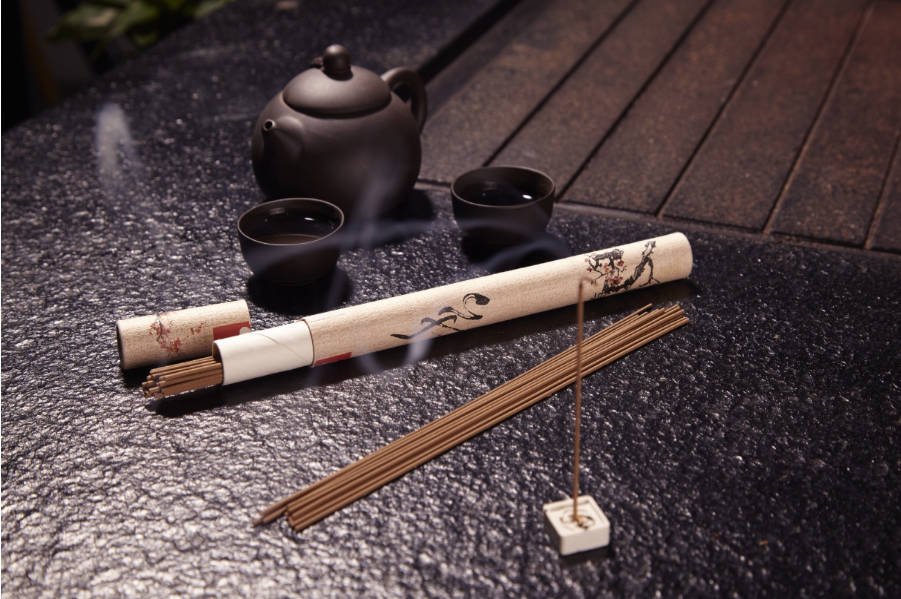
Chinese and Vietnamese pure incense: the daily middle path. Tea-ceremony incense in China and temple incense in Vietnam sit between the two extremes. Pure plantation agarwood, minimal natural binder, no perfume oils, but a slightly higher binder ratio than Japanese koh to keep production costs in line with daily retail pricing.
This is the tradition AgarwoodTown specialises in. Guangdong's Guan Zhu Town (官竹镇) plantation belt is the largest single source of Aquilaria sinensis grafted with kynam stock anywhere in the world, and it supplies both the Chinese tea-merchant market and most of the international wholesale brands you'll recognise on a Western retail shelf.
💡 The Binder Test
A simple, factory-grade quality check: take an unburned stick and break it cleanly in half. The interior should be uniformly dark brown with visible wood texture, not pale, chalky or pasty. Pale interiors mean filler powders (joss powder, sawdust, or worse). A faint sweet-woody smell from the broken end before lighting confirms real agarwood content. This is the single fastest visual screen to perform on any sample box.
Watch: Agarwood Incense Sticks in Action
Two short videos from the AgarwoodTown production floor show what a pure agarwood incense stick actually looks like when lit, the steady ash column, the translucent smoke trail and the resin-rich snap test that distinguishes premium stock from synthetic-perfumed sticks. These are the same visual cues every wholesale buyer should be running on a sample box before placing the first order.
2. Spiritual & Metaphysical Scenarios for Agarwood Incense
| Spiritual Practice | Ideal Incense Type | Metaphysical Purpose | Recommended Placement |
|---|---|---|---|
| Feng Shui (Wealth Activation) | Cultivated Kynam Incense | Clearing stagnant energy (沙气), attracting abundance, opening the wealth axis | Southeast corner of the home or office (Wealth Sector / 财位) |
| Tarot, Oracle & Divination | High-grade Wild Oud or AAA Cultivated | Enhancing intuition, sharpening third-eye clarity, protective field around the reader | On the reading altar, west of the seated reader |
| Deep Meditation / Vipassanā | Japanese Kyara Incense | Grounding the mind, achieving Zen / samādhi state, anchoring breath awareness | Center of the meditation room, 1–2 metres from the cushion |
| Yoga & Pranayama | Daily Cultivated Agarwood (Grade A) | Purifying the air, opening the bronchial passages, relaxing the nervous system | Near the studio entrance, downstream of the airflow |
| Reiki / Energy Healing Sessions | Cultivated Kynam | Clearing the practitioner’s aura before/after each session, cleansing crystals | On the healing-table corner, lit during the 5 minutes before session start |
| Buddhist & Taoist Temple Offerings | Sinking-grade Plantation Agarwood | Honouring the lineage, transmitting prayer intention upward through fragrant smoke | In front of the central altar, three sticks per ritual (天 / 地 / 人) |
| Sleep & Dreamwork | Light cultivated agarwood (Grade B) | Calming the parasympathetic nervous system, supporting lucid-dream entry | Bedroom — extinguish 15–20 minutes before sleep |
Agarwood has been used in spiritual practice for at least two thousand years across Buddhist, Taoist, Sufi, Hindu, and Japanese traditions. Modern wellness retail has its own version: lighting a stick as part of a deliberate practice rather than just for pleasant scent. Different grades suit different practices. Pick by intention and room size, and the SKU performs noticeably better.
How to Match Grade to Use Case
The most common mistake new buyers make is using one SKU for every situation. A premium kyara stick wasted on a yoga studio's morning class is a margin disaster: the fragrance is too subtle to project into a moving 80m² space, so customers never even notice it.
The opposite mistake is just as bad. Burn a cheap synthetic-perfumed bakhoor stick in a small meditation room and you'll trigger headaches inside ten minutes.
The rule of thumb our wholesale clients tend to land on after a season or two: match fragrance projection to room size and intention. Quiet, contemplative practices (kōdō, meditation, sleep) want low-projection, layered profiles, so kyara or fine cultivated kynam. Communal or active-cleansing practices (yoga, Reiki group sessions, majlis) want stronger projection, so Grade A cultivated or oud-bakhoor blends.
For retail boutiques and spas, stocking three grades, entry, mid, and premium — covers about 90% of customer requests and protects gross margin without bloating SKU count.
Bakhoor, Mabkhara & Charcoal: The Arabic Way to Burn Agarwood
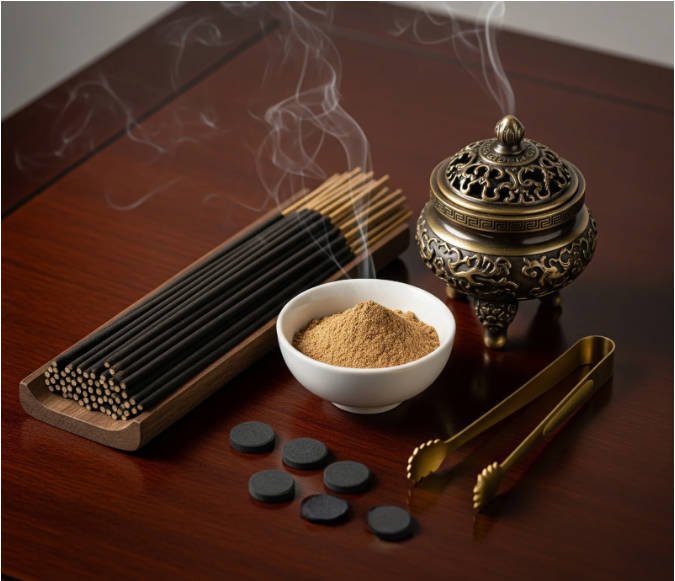
"What is bakhoor?" gets asked roughly twenty times a week by new wholesale buyers. The short answer: bakhoor is an Arabic preparation of agarwood (oud) chips or wood-based blocks that's burned over charcoal rather than lit directly the way a stick is. The longer answer is what makes the category interesting, and why a serious incense catalogue carries both stick and bakhoor lines side by side.
The word bakhoor (بخور) literally means "fumigation". Walk into any majlis from Riyadh to Muscat and you'll see the ritual: scented chips, a glowing charcoal disc, and a mabkhara (the burner itself, often hand-hammered brass or carved wood) being passed around so guests can perfume their dishdasha or hijab before they leave. Bakhoor benefits in this tradition aren't really about meditation — they're about hospitality, scenting fabric, and signaling welcome. That cultural job is why bakhoor projects so much harder than a Japanese koh stick: it has a whole room and a whole gathering to perfume in fifteen minutes.
How to Burn Bakhoor (With or Without Charcoal)
Two methods dominate the Gulf market in 2026, and they produce noticeably different fragrance curves.
Charcoal method (traditional). Light a self-igniting charcoal disc with tongs, hold it over a flame until it sparks across the surface, then drop it into the ash bed of your bakhoor burner. Wait two minutes for the disc to settle into a steady grey glow. Place 1–2 grams of bakhoor chips on top. The chips smoulder for 15–25 minutes and release fragrance in a clear three-phase curve: top notes (sesquiterpenes), mid-notes (chromones), then a long resinous base.[2] This is the method that lets premium chips show their full character.
Electric method (modern). An electric bakhoor burner heats a small metal or ceramic plate to 180–230°C without combustion. You drop the chips on the plate, set a timer, and walk away. Cleaner indoor air, no charcoal smell, no flame to babysit. The trade-off: you lose some of the mid-phase complexity that real combustion produces. Most GCC homes now keep both, charcoal for guests, electric for daily background scenting.
To get bakhoor to last longer, two practical tips that show up again and again in Saudi households: rotate the chip with metal tongs at the 8-minute mark so a fresh face meets the heat, and break larger chips down to 5–8mm so the surface area matches the disc. A 1g portion treated this way runs closer to 25 minutes than 15.
Bakhoor vs Agarwood Incense Sticks. When to Use Which
Both are agarwood. Both perfume a space. They behave differently enough that experienced retailers stock both.
- Use a stick when you want a hands-off, 45–60 minute burn for meditation, yoga, or ambient scenting in a small-to-medium room. Lower projection, longer release, less smoke.
- Use bakhoor on charcoal for hospitality, large-room scenting, fabric and hair scenting (the traditional "pass the burner" ritual), or any moment where you want a strong burst of fragrance in 15 minutes flat.
- Use an electric burner for predictable daily scenting in a home or shop, or when you can't have an open flame (hotel rooms, small offices, baby-friendly homes).
If you're building a retail line, our wholesale clients usually pair a Grade A daily incense stick SKU with a Grade A loose bakhoor oud SKU and one mid-tier bakhoor perfume-style scented blend. That trio covers about 80% of customer requests across both Western wellness and GCC majlis channels. Talk to our bakhoor range if you want a sample-pack covering all three.
Cultivated Kynam vs Wild Oud — A Direct Comparison
| Feature | 🌱 Cultivated Kynam (Grafted) | 🌳 Wild Oud (Natural Formation) |
|---|---|---|
| Formation timeline | 4–6 years from grafting to first harvest | 20–60+ years of natural fungal infection |
| Fragrance character | Cooling, floral, honey-sweet — clean kyara-style top notes | Deep, earthy, animalic — long fermented bottom notes |
| Resin density | 15–35% (Grade A to AAA) | 40–80% (collector-grade) |
| Supply consistency | Year-round, batch-to-batch consistent | Single-tree drops; each batch unique |
| 2026 wholesale price (raw chips) | USD 180–680 per kg | USD 5,000–50,000+ per kg |
| CITES status | Appendix II — plantation source documented | Appendix II — wild-source verification difficult |
| Best application | Daily incense production, 10,000+ stick batch runs | Collector pieces, signature kōdō ceremonies, niche perfumery |
| Sustainability rating | High — plantation lifecycle 8–12 years per tree | Critical — most wild Aquilaria stands now ecologically depleted |
3. Scent Profile: Cultivated Kynam vs. White Wood vs. Wild Oud
Inventory decisions in this category live or die on smell. The oud wood price on a supplier's invoice is, basically, a price for fragrance complexity per gram, and white wood, wild oud, and cultivated kynam sit so far apart on that scale that they should really be treated as three separate products.
White Wood (Bai Mu / 白木)
White wood is the technical name for Aquilaria heartwood that hasn't fully resined up. Most of the time it comes from young trees, or from the sapwood layer of older trees. Burnt on its own, it smells mostly like ordinary hardwood with a vague sweet note.
It does have a place: ground fine, it's used as a low-cost filler in commercial incense, and an honest supplier will label it as such. The problem is when it gets sold as "premium agarwood" with no qualifiers. Reference price for raw chips: USD 8–20 per kg.
Wild Oud
Rare, and priced like it. Wild oud burns with a deep, earthy, sometimes animalic note that hangs in a room for 4–6 hours after the stick is gone. Connoisseurs describe a layered evolution as the wood heats: a sour-sharp opening, an animal-leather middle, then a long resinous-honey base.
The catch in 2026 is that genuine wild oud is collector-tier. CITES Appendix II controls and the depletion of natural Aquilaria stands mean most of what's sold as "wild" on retail platforms today is high-grade cultivated material mislabelled to justify the premium (we cover the diagnostic differences in our wild vs cultivated agarwood guide). Authentic wild stick incense has more or less disappeared from wholesale channels; what's left is chips and oils for the collector market.
Cultivated Kynam (Grafted Qinan)
Cultivated kynam is the more interesting story. Grafting techniques developed in Guangdong over the last twenty years let growers reproduce the resin chemistry of wild kyara on plantation rootstock at roughly 1/30th of the cost.
The basic technique: graft Qinan-line scion onto vigorous A. sinensis rootstock, then induce resin formation through controlled physical drilling. The resulting wood mimics the cooling, floral, honey-sweet notes of wild kyara closely enough that even experienced kōdō practitioners can struggle to tell them apart in a blind burn. Sticks made from cultivated kynam burn clean, leave light grey ash, and project a genuinely complex layered fragrance that holds up in ceremonial and meditative use.
For wholesale buyers searching for kynam agarwood for sale, the cultivated route gives you the best margin and consistent quality across production runs of 10,000+ sticks per month. That's why over 70% of AgarwoodTown's premium incense stick exports in 2025 used grafted kynam stock.
4. The Crafting Process of Pure Agarwood Incense
Pure, binder-light incense is hard to make well. Each of the eight steps below has its own way to fail, and any one of them shortcut will give you a stick that looks fine in the box but burns badly. Wholesale buyers who understand this process tend to ask better questions on factory visits and end up with better suppliers. The 8-step workflow below is the standard one we run at the AgarwoodTown Guangdong production line.
Raw Agarwood Selection
Source CITES-documented plantation Aquilaria sinensis or kynam-graft material in batches of 50–200kg. Reject any batch with visible mould, foreign wood contamination, or insufficient resin saturation (under 10% by visual inspection). Grade and lot-tag every batch with origin, harvest date, and tree-age before milling. Each lot stays traceable through every downstream step.
Cleaning & Impurity Removal
Hand-pick and ultrasonic-clean each piece in deionised water. Remove sapwood, bark, dust, and any soil residue. Any sand, grit, or non-resin wood at this stage permanently degrades the burn quality and ash colour of the final stick — and adulterated batches cannot be salvaged once milled. This is the single most labour-intensive step and the first place dishonest factories cut corners.
Ultra-fine Milling (100+ Mesh)
Cryo-mill the cleaned chips at 0–4°C to 100-mesh or finer (≤150μm particle size). Cold-milling preserves volatile aromatic compounds — sesquiterpenes and chromones — that hot-milling would dissipate. The finer the powder, the smoother the burn and the lower the smoke output. Coarse powder produces choking smoke, uneven combustion, and visibly speckled stick surfaces.
Mixing with Natural Binder Powder
Blend with food-grade natural binders only — typically Machilus thunbergii (Tabu-no-ki) bark powder at 8–15% by weight for mid-range sticks, 5–8% for premium kyara-style. Refuse synthetic glues, sugar, saltpetre, or perfume oils for premium B2B grade. Saltpetre (potassium nitrate) is the most common adulterant: it accelerates burn rate but produces a harsh, peppery smoke and toxic ash residue.
Water Maturation & Kneading
Add filtered, mineral-balanced water and knead for 30–60 minutes until the dough reaches a smooth, plastic consistency. Rest the dough 12–24 hours at 18–22°C so the binder fully hydrates and starches gelatinise — this directly affects burn rate, structural integrity, and the way fragrance releases through the burning tip.
Extrusion & Shaping
Extrude through a precision die into uniform sticks: typical diameters 1.5mm (Japanese-style), 2.0mm (Chinese tea-ceremony style), 2.5mm (Vietnamese temple style), or 3.0mm (Middle Eastern bakhoor style). Cut to length (10cm, 14cm, 21cm, 32cm) using a wet ceramic blade to prevent cracking at the cut points. Reject any stick with a visible seam, kink, or surface bubble — these will burn unevenly.
Natural Air Drying in Shade
Air-dry on bamboo trays in a shaded, well-ventilated room at 22–28°C and 55–65% RH for 48–72 hours. Direct sunlight or kiln-drying causes warping, surface cracking, and volatilises the lighter aromatic compounds — a common shortcut taken by low-grade factories chasing 24-hour turnaround. Sticks dried correctly should have a matte, slightly fibrous surface with a uniform brown colour.
Aging, QC & Wholesale Packaging
Age the cured sticks 14–30 days in temperature-controlled storage (16–20°C, 50% RH) for the resins to settle and equilibrate. Final QC: burn-rate test (target 45–60 minutes for a 21cm stick), ash-colour test (premium grade leaves light grey ash that holds shape), density check (target 0.55–0.75 g/cm³), and sample-burn fragrance evaluation by a trained nose. Pack into airtight wholesale tubes with desiccant and lot/CITES documentation.
⚠️ Common Adulterants — Reject These on Sight
Five adulterants account for over 90% of complaints AgarwoodTown receives from new wholesale buyers who switched from another supplier. If a sample box exhibits any of the following, the supplier is not running a premium-grade line:
- Saltpetre (KNO₃) acceleration, symptom: stick burns in under 30 minutes for a 21cm length, sparks visibly when lit, leaves white-grey speckled ash. Used to mask low agarwood content with a "fast hit" of fragrance.
- Synthetic perfume soaking — symptom: very strong, almost cloying scent at the unburned tip; the fragrance disappears mid-stick because the soak is only on the outer 2mm. Pure agarwood smells faintly woody before lighting.
- Joss powder filler, symptom: pale interior on snap-test, chalky residue, weak burn. Often labelled as "blend" rather than pure agarwood.
- Dyed wood, symptom: hands stain brown when handling unburned sticks, water test releases coloured runoff. Used to make pale white-wood appear resin-dense.
- Sandalwood substitution — symptom: scent leans creamy-buttery rather than woody-resinous; ash is reddish. Sandalwood is a fine wood in its own right, but it is not agarwood and should never be sold as such.
5. Sourcing Quality Agarwood Incense in Bulk
If you run a boutique, a spa chain, a temple supply shop, or an online wellness brand, your incense stick supplier ends up making or breaking your retail margin. Pick wrong and you absorb complaint-rate cost; pick right and the SKU sells itself. When our wholesale clients evaluate a new supplier, they run this five-point sample protocol on any first-sample box. It takes under 30 minutes and surfaces about 95% of supplier issues before any deposit gets wired:
- Snap test. Break a stick cleanly in half. The interior should be a uniform medium-to-dark brown with visible wood fibre. Pale chalky interiors fail.
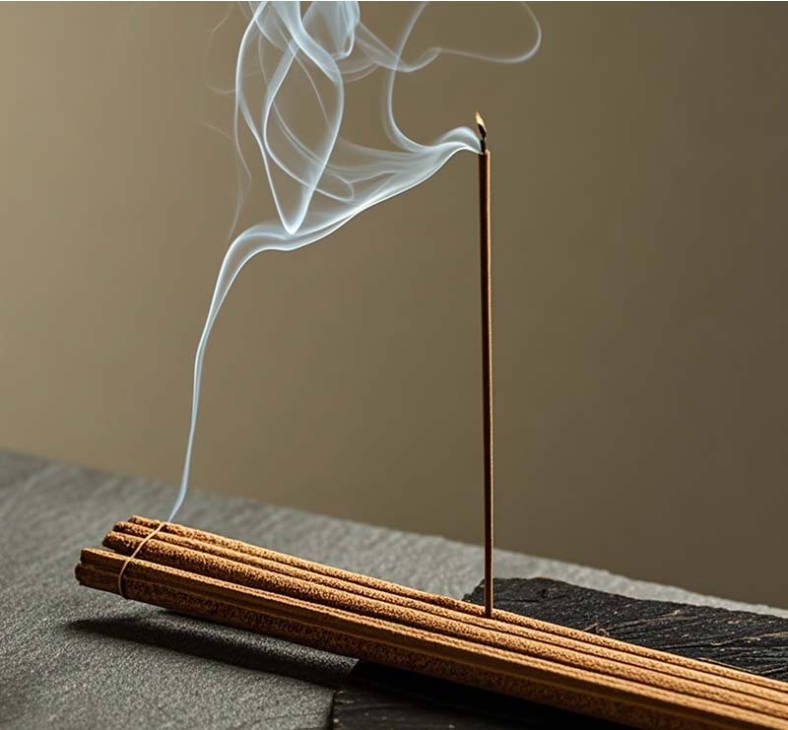
- Burn rate test. Light a 21cm stick in a still room. Pure agarwood burns cleanly for 45–60 minutes with a steady ash column. Anything faster usually means excess binder or saltpetre acceleration.
- Ash colour test. Premium agarwood incense leaves a light-grey ash that holds its shape on the tip and falls in soft cylindrical sections. Black, oily, or crumbling ash means synthetic oils, joss powder, or low-grade binder.
- Smoke quality. The smoke trail should be smooth, almost translucent, not choking. Stand a metre from the burning stick. If your eyes water inside 30 seconds, the stick contains synthetic accelerants.
- Sillage and persistence. A quality stick leaves residual fragrance in the room for 30–90 minutes after extinguishing. Synthetic-perfumed sticks "vanish" the moment the flame goes out.
Past the sample protocol, three commercial things separate a one-off transaction from a long-term wholesale partnership: CITES documentation on every shipment (non-negotiable for EU, US, JP, KR, AU customs clearance); OEM packaging capability if you're a private-label brand; and batch traceability back to the originating plantation lot. Suppliers that can't deliver all three are fine for a one-off order, but they don't scale into a multi-year relationship.
AgarwoodTown ships factory-direct from Guan Zhu Town, Guangdong. Full CITES export documentation comes with every order above MOQ, white-label packaging is available from 5,000 sticks per SKU, and we keep companion products in stock for the buyers who source them together: raw oud wood chips, agarwood essential oil, and bakhoor blends.
2026 B2B Wholesale Pricing Tiers (FOB Guangzhou)
| Grade | Material | Burn Time (21cm) | MOQ | Price per box of 40 sticks (USD) | Recommended Retail Channel |
|---|---|---|---|---|---|
| Grade B (Daily) | Cultivated A. sinensis, 12–15% binder | 40–50 min | 500 boxes | $4 – $7 | Yoga studios, spa chains, daily-use retail |
| Grade A (Premium Daily) | Cultivated A. sinensis, 8–10% binder | 50–60 min | 300 boxes | $8 – $18 | Boutique retail, mid-tier wellness brands, gift packaging |
| Grade AAA (Sinking) | Sinking-grade plantation, 6–8% binder | 60–70 min | 100 boxes | $22 – $48 | Premium meditation suppliers, niche perfumery houses |
| Cultivated Kynam | Grafted Qinan-line, 5–7% binder | 65–75 min | 50 boxes | $55 – $140 | Luxury wellness, kōdō schools, collector market |
| Wild-equivalent (Top AAA) | Hand-selected high-resin plantation | 70–80 min | 20 boxes | $160 – $420 | Connoisseur retail, private-clientele perfumery, temple supply |
Guidance ranges for plantation-source Aquilaria sinensis incense sticks with no synthetic perfume. MOQs are per single SKU; mixed-SKU orders sometimes carry their own per-SKU minimums. Add roughly 8–12% on top for OEM-printed packaging.
Storage, Shelf Life & Packaging
Pure agarwood incense, properly packaged, actually improves with age. The natural resins keep settling and integrating over the first 2–4 years of storage, deepening and rounding out the fragrance the same way a well-rested oud oil or a long-aged Pu-erh tea does. Synthetic-perfumed sticks behave the opposite way: top notes drop off inside six months and the stick smells flat by month nine.
Wholesale clients with strong retail turnover sometimes deliberately hold back a small portion of each premium-grade shipment for 12–18 months before putting it on the shelf. We've seen the difference in blind burns; it's small but real.
Storage conditions for wholesale inventory:
- Temperature. 16–24°C (61–75°F). Sustained exposure above 28°C volatilises top notes.
- Humidity. 50–60% RH. Above 70% the sticks absorb moisture and get harder to light. Below 40% they become brittle and snap.
- Light. Store in opaque or amber containers. UV light degrades surface compounds within 3–6 months.
- Air exchange. Airtight tubes or vacuum-sealed mylar bags with food-grade desiccant. Once a tube is opened, decant the remaining stock into a smaller airtight container to minimise headspace.
Packaging options for wholesale and OEM. Standard B2B packaging at AgarwoodTown is a 40-stick paulownia wood tube with rice-paper inner wrap and a CITES lot card. White-label OEM is available from 5,000 sticks per SKU and covers custom box artwork, foil-stamped logos, multilingual back-panel copy, and EU/US/UK regulatory labelling. Lead time for OEM orders runs about 4–6 weeks from artwork approval.
Final Notes for Wholesale Buyers
The buyers winning in this category right now are the ones treating it as a multi-year inventory plan rather than a quarterly purchase. Plantation supply is finally stable enough that you can lock in pricing across a five-year horizon. The technical knowledge for spotting adulteration is, well, mostly in this guide and a handful of others. CITES is settled and predictable. The remaining variable is whether your factory partner can keep grade consistency at scale and grow with you as wellness keeps expanding as a category.
If you want a sample pack covering all five agarwood incense stick wholesale grades from the pricing table above, or a custom blend tailored to your retail brand, the AgarwoodTown sourcing team replies to wholesale enquiries within 24 hours and ships samples by DHL to any country where CITES Appendix II import permits are issued.
For external reference, see Wikipedia: Incense for the underlying species and historical context.
For trade-policy reference, see CITES Appendix II — Aquilaria spp..
Frequently Asked Questions
Pure agarwood incense has a deep, woody, sweet-resinous scent with subtle hints of honey, leather, and warm spice — distinctly different from sandalwood (creamy-buttery) or palo santo (citrusy-piney). The exact scent profile depends on grade and origin: kyara-grade incense opens cool and floral with a long honey-sweet base; cultivated kynam incense leans floral and slightly fruity; daily-grade Aquilaria sinensis incense smells warm, earthy, and faintly medicinal. Adulterated incense typically smells overwhelmingly sweet or perfumed at the unburned tip — pure agarwood smells faintly woody before lighting and reveals its full character only when heated.
Mostly four things. The big one is meditation and mindfulness, where kyara and cultivated kynam grades show up in Japanese kōdō ceremony, Buddhist Vipassanā practice, and modern mindfulness work to anchor attention. Next is Feng Shui and energy clearing, with sticks burnt in the southeast Wealth Sector to shift stagnant energy. Hospitality is the third, mainly through bakhoor-style sticks scenting rooms and clothing in Saudi, Emirati and Omani gatherings. The fourth is spa, yoga and wellness retail, where daily-grade cultivated agarwood is used to purify air and create a ceremonial ambience. Quieter use cases include sleep preparation, dreamwork, and tarot or divination practice — all common reasons customers buy a stick.
Users typically report three kinds of benefits. Cognitively, many describe sharper focus during meditation or study, which is usually credited to the calming sesquiterpene compounds in agarwood smoke. Emotionally, peer-reviewed work has explored sedative and anxiolytic effects of agarwood vapour (Takemoto et al., 2008), and customers regularly mention lower anxiety and easier sleep onset. Spiritually, across Buddhist, Taoist, Sufi, Hindu and Japanese traditions, agarwood smoke has been treated for centuries as a vehicle for prayer and intention-setting. One important note: AgarwoodTown doesn't market incense as a medical product. The clinical evidence is still developing and individual responses vary, so for respiratory or anxiety conditions, talk to a clinician first. Incense complements professional care, it doesn't replace it.
Kyara is the highest and rarest grade of agarwood — historically the top 0.1% of natural resin formation, characterised by a cooling sensation on the palate and a layered sweet-bitter-spicy fragrance evolution as the wood heats. Kyara incense uses kyara wood powder as the core material and offers a more complex, cooling, and profound scent profile compared to standard cultivated agarwood, making it highly sought after for deep meditation and Japanese kōdō ceremony. Standard agarwood incense is warmer, earthier, and better suited for daily use. In 2026, virtually all commercially available kyara-grade incense uses cultivated grafted Qinan material rather than wild kyara, which is functionally exhausted.
No. High-quality pure agarwood incense without artificial oils actually smells better as it ages — the natural resins settle, oxidise gently, and integrate over 2–4 years, much like fine wine. Store sticks airtight at 16–24°C and 50–60% humidity, away from direct light, and they will continue to improve for at least 3–5 years; well-stored kyara-grade sticks can age 10+ years gracefully. The exception is sticks containing synthetic perfume oils, which do degrade — typically losing top notes within 6–12 months.
The natural infection process required to create wild agarwood takes decades, and the yield is extremely low — under 10% of wild Aquilaria trees ever form usable resin. CITES Appendix II controls add further compliance cost, and increasing global demand against shrinking wild supply has driven a 12–18% annual price increase since 2018. Sustainably cultivated kynam, however, provides a cost-effective alternative with a remarkably similar scent profile, which is why most premium 2026 incense lines now use cultivated material at 1/30th the wild oud wood price.
It's a three-step routine and it should never feel like work. Insert the bare end of the stick into a heatproof holder filled with sand or ash. Don't lean a stick on a flammable surface — that's how house fires happen. Light the tip with a candle or a long lighter; the moment a flame appears, blow it out gently. The tip should glow red and produce a steady, translucent smoke trail. Place the holder in a well-ventilated room and never leave a burning stick unattended. For daily use, Grade A or Grade B cultivated agarwood is built for repeated burning, and most regular practitioners run 1–3 sticks a day for meditation, focus, or ambient scenting. Reserve premium kyara and sinking-grade sticks for ceremonial occasions. If smoke is a problem for you (asthma, allergies, small kids), use a cold-heat electric incense heater instead, which is also the standard kōdō technique. The same lighting routine applies to bakhoor-style oudh incense sticks.
A pure 21cm cultivated agarwood stick burns cleanly for 45–60 minutes in still air. Premium kyara sticks at the same length burn 60–75 minutes due to higher resin density and lower binder content. If your stick burns under 30 minutes, the supplier is almost certainly accelerating the burn with saltpetre (potassium nitrate) — a common adulterant that masks low agarwood content. Burn time is one of the fastest, cheapest QC tests you can run on a sample box before placing a wholesale order.
MOQs depend on the grade. Daily Grade B starts at 500 boxes (40 sticks/box), Grade A from 300 boxes, AAA sinking-grade from 100 boxes, and cultivated kynam from 50 boxes. Wild-equivalent top AAA starts at 20 boxes due to limited supply. For OEM private-label packaging (custom box artwork, foil-stamped logos, multilingual back panel), the additional minimum is 5,000 sticks per SKU. Mixed-SKU orders are possible but typically carry per-SKU minimums; AgarwoodTown can confirm exact terms based on your destination country and target retail price point.
Yes, with proper documentation. Aquilaria species are listed under CITES Appendix II, which means international shipments require both an export permit from the country of origin and an import permit from the destination country. AgarwoodTown provides the CITES export permit, phytosanitary certificate, and HS-code-correct commercial invoice with every export shipment. The buyer is responsible for obtaining the import permit from their country’s CITES Management Authority — common destination countries (US, EU, UK, JP, KR, AU, GCC) all process these routinely within 2–4 weeks.
Many users report calming effects from burning agarwood incense, and several peer-reviewed studies have explored the sedative and anxiolytic properties of agarwood essential oil compounds (notably benzyl acetone and selinene-class sesquiterpenes). However, AgarwoodTown does not market incense as a medical product — clinical evidence for therapeutic claims is still developing, and individual responses vary. We recommend customers approach agarwood incense as a contemplative aromatic complement to existing wellness practices rather than a treatment. Speak to a qualified clinician before relying on incense for any mental health condition.
Three quick checks, takes about half an hour on a sample box. First, break a stick cleanly in half. Pure agarwood has a uniform medium-to-dark brown interior with visible wood fibre; perfumed sticks show pale chalky cores. Second, burn one in a still room. Pure agarwood smoke is translucent and smooth, while perfumed sticks throw thicker, sweeter smoke that gets cloying fast. Third, look at the ash. Light-grey columnar ash that holds its shape means pure wood; black, oily, or crumbling ash means synthetic content somewhere in the mix. Our wholesale buyers run this same protocol on every first sample.
Bakhoor is the Arabic preparation of agarwood: chips, blocks, or scented wood pieces that you burn over a charcoal disc inside a mabkhara (the burner). An agarwood incense stick is the same wood ground into powder, mixed with a small amount of natural binder, and pressed into a stick that lights directly. The difference is mostly cultural and operational. Bakhoor projects harder over 15–25 minutes (built for majlis hospitality and fabric scenting); a stick burns 45–60 minutes with lower projection (built for meditation and ambient daily use). Most serious retail lines now stock both because the use cases barely overlap.
Two valid methods. With charcoal: hold a self-igniting disc with tongs over an open flame until it sparks across the surface, drop it into the ash bed of your mabkhara, wait two minutes for a steady grey glow, then place 1–2 grams of bakhoor chips on top. Without charcoal: use an electric bakhoor burner (around USD 25–80 retail) that heats a small ceramic or metal plate to 180–230°C — drop the chips on, set a timer, walk away. The electric method is cleaner, safer for kids and pets, and produces no smoke; the charcoal method gives you a richer fragrance curve because real combustion releases the heavier resin compounds. For shops and offices we usually recommend electric; for traditional majlis use, charcoal stays standard.
Yes — aloeswood, agarwood, oud (Arabic), oudh, jinkoh (Japanese), gaharu (Malay/Indonesian), and chénxiāng (Chinese) all refer to the same material: the resin-saturated heartwood produced by stressed Aquilaria species, primarily Aquilaria sinensis (China) and Aquilaria malaccensis (Southeast Asia). The naming differs by region, but the wood, the chemistry, and the burning behaviour are the same. "Aloeswood" specifically tends to be used in older English texts and in Japanese kōdō literature; "agarwood" is the modern English botanical name; "oud" is the Gulf and perfumery term.
Three tricks that show up across Saudi and Emirati households. (1) Break large chips down to 5–8mm before placing them on the charcoal — smaller surface-to-mass ratio means slower combustion. (2) Rotate the chip with metal tongs around the 8-minute mark so a fresh face meets the heat. (3) Use thicker, slower-burning charcoal discs (look for 33mm or 40mm coconut-shell discs rather than thin self-igniting tablets). With those three adjustments, a 1g chip portion that normally runs 12–15 minutes will easily push past 25 minutes. For wholesale buyers building gift sets, pairing premium chips with quality charcoal almost always lifts retail review scores noticeably.
Yes. AgarwoodTown offers full white-label OEM packaging from 5,000 sticks per SKU, including custom box artwork (we accept Adobe Illustrator or InDesign files), foil-stamped logos, multilingual back-panel copy in English, Arabic, Japanese, Korean and Spanish, EU CLP and US FDA-compliant warning labelling, retail SKU barcoding, and master-carton labelling for freight. Lead time is typically 4–6 weeks from artwork approval to FOB Guangzhou. We do not require exclusivity, but we do offer territory-protected wholesale pricing for buyers committing to multi-year contracts above a defined annual volume.
References
- 1CITES Secretariat. Appendix II — International Trade Regulations for Aquilaria species. Convention on International Trade in Endangered Species, 2024.View source
- 2Naef R.. The volatile and semi-volatile constituents of agarwood, the infected heartwood of Aquilaria species: a review. Flavour and Fragrance Journal, 2011.doi:10.1002/ffj.2034
- 3Liu Y., Chen H., Yang Y., Zhang Z., Wei J., et al.. Whole-tree Agarwood-Inducing Technique: An Efficient Novel Technique for Producing High-Quality Agarwood in Cultivated Aquilaria sinensis Trees. Molecules, 2013.doi:10.3390/molecules18033086
- 4Takemoto H., Ito M., Shiraki T., Yagura T., Honda G.. Sedative effects of vapor inhalation of agarwood oil and spikenard extract and identification of their active components. Journal of Natural Medicines, 2008.doi:10.1007/s11418-007-0185-0
- 5Hashim Y.Z.H.Y., Kerr P.G., Abbas P., Mohd Salleh H.. Aquilaria spp. (agarwood) as source of health beneficial compounds: A review of traditional use, phytochemistry and pharmacology. Journal of Ethnopharmacology, 2016.doi:10.1016/j.jep.2016.06.055
- 6
All scientific references are provided for transparency. AgarwoodTown summarises peer-reviewed findings for educational purposes and does not claim to provide medical or regulatory advice.
Wholesale Catalog
Buy the products discussed in this article


Related Articles
Source Direct from Origin
Discuss Your Requirements with Our Team
We respond within 24 hours. Share your target grade, quantity and destination — we'll send current pricing, a sample pack option, and CITES documentation details.