Bakhoor Sourcing 2026: 7 Quality Standards GCC Luxury Brands Use to Vet Suppliers
Premium bakhoor wholesale sourcing is a 5-year supplier-relationship decision, not a procurement function. Three or four times a year, we get the same call. It is usually a GCC fragrance house we have not spoken with before. They have just finished pre-Ramadan QC on their bakhoor stock and noticed the burn curve has drifted from last season. The recipe is the same. The supplier is the same. Yet on the charcoal, the fragrance fades by minute twelve instead of carrying through to minute thirty-five. By the time the call reaches us, the buyer has usually figured out what happened: somewhere in their premium bakhoor sourcing chain, the chip base got swapped. This document is the reference we now send to those buyers, and to the newer ones evaluating their first source supplier before that call ever needs to happen.

Written by
Founder & Chief Sourcing Officer, AgarwoodTown
15+ years hands-on experience grading plantation agarwood, sourcing directly from Dianbai and Maoming districts in Guangdong — the world's largest Aquilaria sinensis cultivation region. Wang has personally inspected thousands of CITES export shipments and holds plantation certification from China's National Forestry and Grassland Administration. He advises GCC, European and East Asian wholesale buyers on grade selection, CITES compliance and supply chain due diligence.
CITES Certified
In this article
- Why Bakhoor Sourcing Has Become a Sourcing Problem
- The Material Truth: Bakhoor's Ceiling Is the Wood, Not the Oil
- From Wild to Plantation: The Supply Chain Transformation
- Ma'amoul vs Mabsoos vs Muattar — Decoded for Buyers
- Watch: Bakhoor Burn Test & Mabsoos vs Muattar Comparison
- The 7 Standards Luxury Bakhoor Houses Should Demand from a Source Supplier
- Source Supplier vs Trader — The Distinction That Matters
- Spotting Counterfeits in the Premium Tier
- The Inquiry Process — What to Send for an Evaluation Sample
- FAQ
Why Bakhoor Sourcing Has Become a Sourcing Problem
What happened, almost without exception, is that the buyer's supplier (usually a multi-stop trader, three or four hops upstream from any actual plantation) switched the chip base.[15] Sometimes deliberately, when last season's lot ran out. More often inadvertently: the trader was buying from a different upstream source this quarter and never inspected the substitution, because the chips look broadly similar by eye. The buyer doesn't catch it at wholesale handoff. The buyer's customer catches it on the charcoal.
Gulf demand is daily, not seasonal. According to a 2012 study in Environmental Health Perspectives (Yeatts 2012), 86% of the 628 UAE households surveyed burned incense at least weekly and 44% burned it every day.[61]
This is the practical reason serious GCC fragrance houses have stopped treating bakhoor as a procurement category and started treating it as a sourcing category. Procurement assumes the supply chain is stable; sourcing assumes you have to verify it on every batch. The wild Aquilaria supply that anchored Gulf bakhoor through the second half of the twentieth century had its own problems (scarce, expensive, irregular), but the chip you bought through a trusted broker was at least the chip you thought you bought. That world ended somewhere between 2010 and 2015, when wild stocks of Aquilaria malaccensis collapsed faster than wild prices could rise.[1]
What replaced it works at scale, ships under proper CITES documentation, and is chemically equivalent to wild material at the same resin grade. But the replacement supply chain (plantation Aquilaria sinensis from Guangdong) sits behind several layers of trading intermediaries before it reaches the GCC retail counter. Those intermediaries do not consistently disclose chip origin. They do not consistently disclose resin grade with documentation. They almost never disclose GC-MS chemistry on the oud oil component.[58] And they cannot, because they don't know, tell you whether the same spec will still exist in your next ordering window.
The houses that have stopped getting surprised twice a year by their own products have either built procurement competence that lets them evaluate suppliers on technical merit, or moved upstream to direct plantation relationships and bypassed the trader layer. What follows is the framework we have seen work, written for the buyer who has just discovered that the answer to the burn-curve problem is upstream of the formulation.
The Material Truth: Bakhoor's Ceiling Is the Wood, Not the Oil
There is a piece of received wisdom in the GCC fragrance trade that gets repeated until buyers stop questioning it: it's the oud oil that makes the bakhoor. We hear it from people who have been in the category thirty years. The lab work has been clear for at least a decade about why it's wrong.
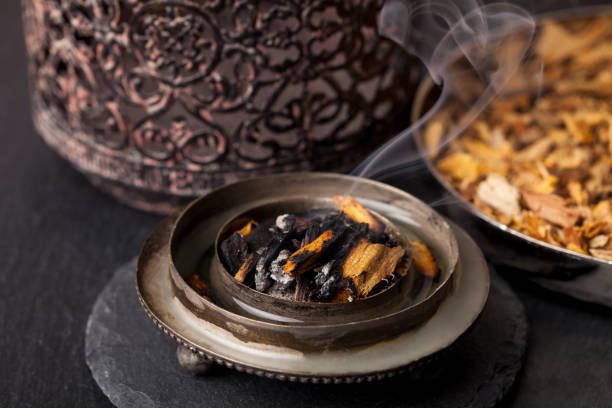
The fragrance signature of agarwood comes from a specific class of compounds, sesquiterpenes (β-agarofuran, agarospirol, jinkohol-related ketones) and 2-(2-phenylethyl)chromone derivatives, embedded in the resin matrix of the wood itself.[58] Under controlled charcoal heat over a thirty to forty-five minute burn cycle, those compounds volatilise progressively: the lighter sesquiterpenes go first, then the heavier chromones, with the resin's slow structural breakdown sustaining release through the back half of the burn. That progression is why a Grade A plantation chip blend evolves on the charcoal the way the category is supposed to evolve. Top notes opening, mid-notes building, woody base coming through at minute fifteen and persisting to minute thirty-five. Synthetic fragrance oil applied to plain wood releases everything in a single curve and burns off in under ten minutes. The progression is gone, and on a knowledgeable nose the difference is obvious.
The oud oil layer matters. It is the most expensive line item per gram in any premium blend. But it amplifies what the chip base is producing; it cannot replace it. We have watched experienced Gulf perfumers spend months tweaking oil ratios on what was, structurally, a Grade B blend trying to push it to perform like a Grade AAA blend. It never gets there. The chemistry isn't available to be amplified.
So the practical version is this: lock in the chip grade decision first, on its own merit, with documented assessment. Layer the oud oil and middle notes on top of a verified base. There is no oil-tier upgrade that compensates for an underspec'd chip; there is no formulation skill that fixes an undocumented chip lot. Most Gulf wholesalers learn this the expensive way over a couple of seasons. Putting it at the front of this document is meant to save the next round of buyers that lesson.
From Wild to Plantation: The Supply Chain Transformation
Bakhoor's raw-material problem is older than the modern fragrance industry. Even back to the Abbasid trade routes of the eighth and ninth centuries, agarwood was rare, slow-forming, and irregularly distributed across Aquilaria trees in the wild, only one to seven percent of trees in any wild stand ever produced commercially meaningful resin.[1] The wild premium was never about romance. It was about scarcity that compounded across centuries of unmanaged extraction, until the supply could no longer carry a commercial bakhoor industry at modern scale.
The shift to plantation began in Guangdong. Aquilaria sinensis had been cultivated in Dianbai and Maoming on a small farmer scale since the 1990s, but the inflection came when artificial inoculation matured — particularly the whole-tree agarwood-inducing technique (WTTI) validated in 2013[15], and harvests reached commercial scale around 2012 to 2015. The cultivar mix that emerged is what serious bakhoor buyers should know by name: 西瓜叶 (Watermelon Leaf) for the volume bakhoor base across mass-market and standard tiers; 金沙叶 (Golden Sand) for high-oil distillation feedstock that ends up in premium Mabsoos and luxury Ma'amoul middle layers; 虎斑二号 (Tiger Stripe No.2, grafted) for the kynam-character premium tier where sinking-grade scraps and Hindi oud are layered. By 2026 the Guangdong network produces tens of thousands of kilograms across these cultivars annually, all under CITES Appendix II documentation.
For the seedling-side economics behind these cultivars, see our agarwood seedlings wholesale reference; for the underlying inoculation science, the cultivated agarwood guide covers how the trees actually produce resin.
The wild-better objection
Old-school Gulf buyers will tell you wild material is structurally superior to plantation. We hear this constantly, usually from buyers in their fifties and sixties who built careers on the wild trade. The lab work has not supported the claim for over a decade. Plantation A. sinensis resin contains the same sesquiterpene profile and the same 2-(2-phenylethyl)chromone derivatives as wild material at the equivalent resin grade.[58] What buyers paid wild-tier prices for historically was scarcity premium and the bottom-of-the-bell-curve aged specimens — provenance as a luxury good in itself, separate from any measurable fragrance performance per gram.
Wild material remains relevant, narrowly: a collector tier in the GCC and East Asia where the buyer is paying for provenance the way a watch collector pays for a discontinued reference. For every commercial bakhoor house, every fragrance brand, every GCC import distributor, plantation material is the supply chain. Our wild vs cultivated reference covers why this is no longer controversial inside the trade itself, even if it is occasionally still controversial in marketing copy.
Ma'amoul vs Mabsoos vs Muattar — Decoded for Buyers
Bakhoor splits into three product forms, but the splits are not equal in commercial weight. Knowing which form your retail line actually sells is the first sourcing decision; every downstream specification follows from it.
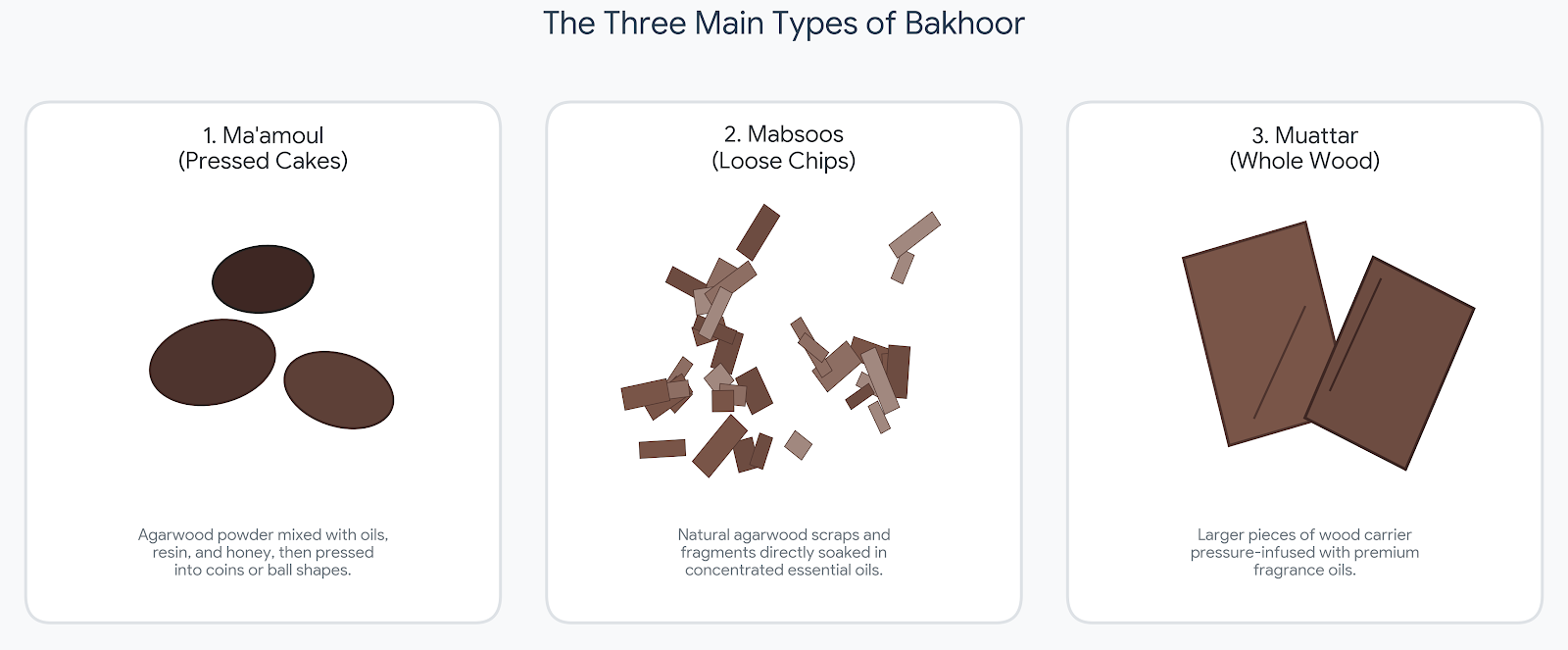
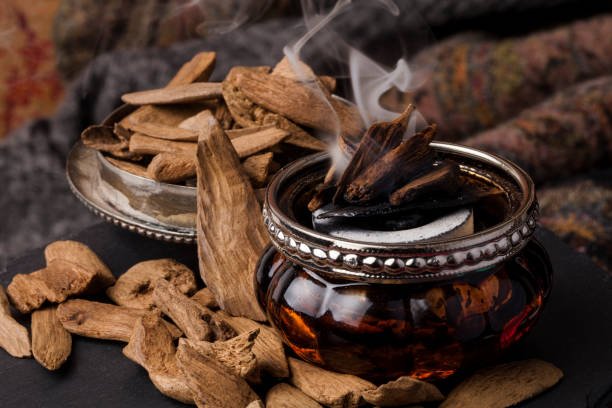
Mabsoos (مبسوس) is the form serious GCC buyers actually want — whole or coarsely broken agarwood chip fragments, soaked in concentrated oud oil with rose water, musk, or a proprietary blend layered on top. No binder. No pressing. The natural chip structure releases fragrance progressively on the charcoal at a rate no compressed form replicates, which is also why Mabsoos is where chip grade matters most: the fragrance you smell directly tracks the resin density of the underlying wood. Premium Mabsoos requires Grade A minimum. The gift-tier product retailing at USD 250 to 500 per fifty grams uses Grade AAA scraps, what the trade calls 勾丝 (gou si), the high-oil-density carving offcuts pulled from log processing, soaked in Hindi or Cambodian oud oil at fifteen to twenty percent. Saudi buyers in particular favour heavy Mabsoos with deep base; UAE buyers tend to pull toward floral-forward versions. Either way the underlying chip is what carries the burn.
Ma'amoul (معمول) is the refined-presentation form. Agarwood powder, typically milled to 80–200 mesh from Grade A chip stock, gets mixed with rose or jasmine essential oil, frankincense resin, and natural binders — honey, date syrup, makko bark. The mixture is pressed into coin or ball shapes that burn slowly, evolve cleanly on the charcoal, and present well in retail packaging. The luxury tier of Ma'amoul uses kynam-grade powder layered with real pure oud oil in the middle notes; the mass-market tier shares Mabsoos's Grade B base but compensates with stronger binder masking. Ma'amoul is also the form most often used in luxury gifting and corporate hospitality programs because it ships, stores, and presents better than loose chips.
Muattar (معطّر) is the volume tier of the global bakhoor trade, and the easiest category to fake. Larger pieces of low-grade agarwood (sometimes legitimate, sometimes not) are pressure-infused with fragrance oils. Premium Muattar built on real low-grade agarwood with real oud oil is a credible mid-market product. Budget Muattar is plain Cinnamomum or other neutral wood soaked in DPG-diluted synthetic oud, visually convincing in the package, structurally fraudulent on the charcoal, and the single product form most likely to land your retail SKU in front of a complaint queue. The break-and-inspect protocol in Section 7 catches it in five seconds; we recommend running that test on every new Muattar sample regardless of how presentable the supplier is.
Ma'amoul vs Mabsoos vs Muattar — At a Glance
| Form | Structure | Minimum grade | Where it sells | Fraud risk |
|---|---|---|---|---|
| Mabsoos (مبسوس) | Whole or coarsely broken chips soaked in oud oil. No binder, no pressing. | Grade A | Serious GCC buyers; Saudi favours heavy base, UAE floral-forward | Low — chip structure is hard to fake |
| Ma'amoul (معمول) | Powder 80–200 mesh pressed with binder into coins or balls | Grade A stock | Luxury gifting and corporate hospitality — ships and presents best | Medium — binder can mask a weak base |
| Muattar (معطّر) | Larger low-grade pieces pressure-infused with fragrance oil | Low grade (legitimately) | Volume tier of the global trade | High — budget tier is often neutral wood in synthetic oud |
Grades are our internal plantation scale. Retail prices are indicative GCC gift-tier figures, not our wholesale quotes.
Watch: Bakhoor Burn Test & Mabsoos vs Muattar Comparison
Two short videos from the AgarwoodTown sourcing floor walk through what the three product forms actually look like on the charcoal. The first video demonstrates a Grade A Mabsoos burn cycle, note the progressive fragrance release described in Section 2. The second video runs the break-and-inspect protocol on a Muattar sample so you can see exactly what an adulterated chip looks like vs a verified plantation chip — the same protocol every wholesale buyer should run on a sample box before placing the first order.
The 7 Standards Luxury Bakhoor Houses Should Demand from a Source Supplier
What follows is the framework serious GCC fragrance houses now use to evaluate a new source supplier. We have tried to write it the way an experienced procurement lead would explain it over coffee, not as a checklist. The seven standards group naturally into three areas: where the chip comes from, what should arrive with it, and whether the supply will still be there twelve months later.
Source verification: where the chip actually comes from
The single most useful question to ask a new supplier is the simplest one: is this chip from a plantation you own or work directly with, and can you walk me through the harvest cycle? A trader will hedge — they bought it from someone who bought it from someone, and the answer changes from batch to batch. A source supplier names the cultivar, the harvest year, and usually the specific plantation block. The hedge itself is the answer.
A genuine plantation source can also give you an order-of-magnitude annual volume figure. This protects you from a failure mode buyers don't usually notice until the second year of working together: you find a small operator with great chips and steadily place larger orders, and one season their harvest comes in light and they have nothing for you. Annual production scale matters. AgarwoodTown's Guangdong network produces tens of thousands of kilograms of CITES-documented plantation agarwood per year across the cultivar mix, that is roughly the volume floor below which a serious bakhoor program will keep getting blindsided. Operators producing under one or two thousand kilograms annually are usually one off-season away from being out of stock during your next ordering window.
Documentation: what should arrive with every shipment
The CITES Appendix II export permit is non-negotiable. Every Aquilaria species is listed; the permit is government-issued and takes fifteen to thirty business days to process. A source supplier treats it, the species certificate, and the plantation origin certificate as default documentation in every shipment, not as an upgrade or "we can arrange that." We have seen retail brands lose entire Ramadan windows to customs holds at Jeddah and Jebel Ali because their supplier — a trader, not a source, could not produce CITES documentation that matched the shipped goods. The cost of that lost window dwarfs the entire annual procurement budget.
The oud oil, when present in the blend, should arrive with a GC-MS report on the specific batch. This is not a gesture. The oud oil category is the most adulterated raw material in the global fragrance trade. DPG (dipropylene glycol), DEP (diethyl phthalate), and mineral oil are the three most common dilutents, and they all show up cleanly on GC-MS chromatography. The presence of those markers in a "pure" oud oil chromatogram is a complete dealbreaker; the absence of GC-MS documentation altogether is the same dealbreaker, framed more politely. Suppliers skip GC-MS not because the test is hard — it costs USD 80 to USD 200 per batch, but because they know what would show up.
Resin grade documentation, per shipment, should be a written assessment naming the chip lot and the resin coverage band. Verbal claims do not count. Grade misclaiming. Grade B chips quietly relabelled as Grade A, Grade A pushed into AAA, is the single most common fraud above the white-wood-DPG tier, and a supplier who refuses to issue per-lot written grade documentation is simply hedging against being held to it.
Continuity: the supply you can build a brand around
Bakhoor brands die when their supply pivots underneath them. Your supplier should be able to ship the same cultivar, the same resin grade, the same density spec twelve months from now and twenty-four. The conversation that surfaces this is direct: what was your dominant cultivar mix in the last two years, and what will it be in the next two? Newer plantation operators run inconsistent cultivar mixes year-on-year because they are still figuring out what works on their land. Established operators have hardened off the same cultivar inventory, the 西瓜叶 / 金沙叶 / 虎斑二号 mix discussed earlier — across multiple harvest cycles and can give you specific projections. The question itself is the test: the answer reveals whether you can build a product line around the supplier or whether they are a one-season spot purchase.
The last piece is the sample-then-bulk protocol. A serious source supplier insists on a calibration sample at full sample price, credited against your first commercial order, before any meaningful bulk shipment. This protects both sides, the buyer verifies the actual material, the supplier confirms the buyer is committed enough to sample at full price. Suppliers offering free large samples on first contact are almost always selling the sample as the product itself; what arrives in the bulk container is downgraded to a different spec, and you discover that after you have paid. If the front end feels too easy, the back end will be expensive.
Source Supplier vs Trader — The Distinction That Matters
The difference between a source supplier and a trader sounds abstract until your second order arrives looking nothing like your first.
A trader sells whatever is in front of them this month. Last batch from one upstream source, next batch from another. The chip you sample in March may not be the chip you receive in November. Their margin model rewards sourcing flexibility, pivot upstream based on whose offer beats whose this quarter, take the spread. None of this is malicious; it is just the structural incentive of being a trader. It is also incompatible with running a stable retail SKU through Ramadan, Eid Al-Fitr, Eid Al-Adha, and the December gifting window using a single consistent product.
A source supplier produces a stable annual volume across a known cultivar mix on a published harvest schedule. They maintain direct access to the plantation block, the inoculation calendar, and the cultivar inventory. They can shift harvest timing modestly to align with a major buyer's window. They can hold back specific high-grade lots for a long-term partner. If a buyer's program is moving up-tier and needs more 虎斑二号 grafted material, they can graft additional trees — that decision starts paying off four to six years out, on the partnership timeline rather than the transaction timeline. A trader cannot make any of these moves; they place orders against what has already been harvested, with whoever currently holds it.
This is why the bakhoor brands with stable retail programs in 2026 have all made the same kind of decision in some form. They moved their base material relationship out of the trader layer and built a direct line to a plantation source. The brands still cycling through new "best-price" suppliers every two seasons tend to be the same brands at the trade fairs every year wondering why their margin compression is accelerating. Usually the answer is that they are competing on price against their own supplier's next better customer.
Spotting Counterfeits in the Premium Tier
Three checks. We run them on every sample that comes in, whether it is from a new supplier, from a competitor we are evaluating, or from our own outgoing batches at QC. They are not theoretical. They catch the majority of counterfeit product in the category, and end-to-end they take about ninety seconds plus one thirty-minute burn cycle. The dominant fraud in bakhoor — DPG-soaked white wood with synthetic fragrance, fails all three.
Burn a 1 g sample and time the fragrance curve
Real agarwood-base bakhoor releases fragrance in layers over 20–45 minutes on charcoal. Rose / floral top notes open in the first 2–3 minutes; mid-notes build at 8–15 minutes; the deep woody base persists through 30+ minutes. If the fragrance peaks then vanishes within 10 minutes, or if there is any plasticky / alcohol / chemical edge on the smoke — reject. That is DPG-soaked white wood with synthetic fragrance.
Break open a Muattar piece; inspect the interior
Genuine Muattar shows oil-stained, darkened wood fibres all the way through the cross-section. Fake Muattar shows completely white interior with only a thin surface coating of oil — the cheapest possible construction. Five seconds, and it catches the majority of fraud in this product form.
Demand per-component documentation
Legitimate suppliers disclose, per shipment: chip origin certificate (plantation or wild, named species), resin grade with documented assessment, oud oil GC-MS report (no DPG / DEP / mineral oil markers), binder type (natural makko, not synthetic polymer), and CITES Appendix II permit for the Aquilaria components. No disclosed chip grade equals no deal — regardless of how favourable the sample, you cannot scale a retail line off an untraceable supply chain.
The Inquiry Process — What to Send for an Evaluation Sample
If your team is evaluating a new bakhoor source supplier for the 2026 or 2027 program, the calibration we typically run with new partners begins with a short conversation rather than a quote request. We need to know your target retail tier per fifty grams and which product form your line leans toward, Mabsoos heavy, Ma'amoul heavy, or a balanced mix — because that decides which cultivar lots we draw the calibration sample from. Your annual volume estimate, even directionally, helps the same way. Destination port matters too: the CITES processing pattern is slightly different for UAE, KSA, Kuwait, and Oman, and we adjust documentation accordingly. If you already have a baseline you are trying to match or improve, sending a five to ten gram reference sample from your current supplier lets our sourcing lead calibrate against it directly.
From there: a 200 to 500 gram grade-calibration sample ships DHL at full sample price, credited against any subsequent commercial order. A GC-MS report on the oud oil component arrives with it for your in-house chemist or perfumer to verify. A thirty-minute call with our sourcing lead walks through the cultivar inventory and the harvest schedule. The bakhoor houses we work with treat their source supplier as a five-year decision, and we treat onboarding accordingly, there is real time investment on both sides before any commercial shipment, which is also why we are deliberate about who we take on.
Browse the cultivar inventory: bakhoor raw materials · Grade A–AAA chips for premium Mabsoos · plantation and Hindi pure oud oil
Schedule a calibration call: contact our sourcing lead, typical reply within one business day. For Ramadan-window programs delivering into GCC retail in March or April, the calibration process needs to begin by mid-November the previous year to allow CITES processing time and a proper sample-then-bulk sequence.
For external reference, see Wikipedia: Bakhoor for the underlying species and historical context.
For trade-policy reference, see CITES Appendix II — Aquilaria spp..
Frequently Asked Questions
The serious GCC luxury bakhoor houses treat their agarwood base supplier as a 5-year partnership decision, not a procurement transaction. The plantation production cycles in Guangdong run on 6–8 year tree maturation timelines, which means a partnership that begins this year is already shaping output that arrives in 2032. AgarwoodTown's longest-running B2B partners have been on continuous annual programs since the 2018 plantation harvest cycle — that is the relationship horizon this category rewards.
For commercial bakhoor production, yes — at every retail tier from mass-market through luxury gift. Gas chromatography studies confirm that plantation Aquilaria sinensis contains the same sesquiterpene and 2-(2-phenylethyl)chromone profile as wild material of equivalent resin grade. What buyers historically paid wild-tier prices for was scarcity premium and provenance romance, not measurable chemistry. Wild material remains relevant for collector-tier ceremonial use, but plantation material is the only viable supply chain for any house shipping consistent SKUs.
"Oud" (عود) refers to agarwood — the resinous wood itself. "Bakhoor" (بخور) refers to the incense preparation made from agarwood chips blended with additional fragrance materials (oud oil, rose water, frankincense, makko binder), designed for burning over charcoal. All bakhoor contains oud as its base; plain "oud burning" — burning raw agarwood chips without additional fragrance — is also common and technically distinct from a formulated bakhoor blend.
The quality of finished bakhoor is determined almost entirely by the agarwood base. Use genuine agarwood scraps (高油脂勾丝/碎料) with high resin density — these naturally absorb and fix the fragrance oil additions. Never use plain white wood (白木), regardless of how premium the fragrance oil you apply on top. AgarwoodTown supplies Grade A and AAA plantation agarwood scraps specifically for bakhoor production with CITES documentation included.
For premium luxury bakhoor (gift-box product retailing at USD 100+/50g), use Grade AAA chips or premium scraps (勾丝). MOQ from AgarwoodTown: Grade A chips from 1 kg; Grade AAA from 500 g. For commercial-volume bakhoor blending, Grade B or A chips (MOQ 1 kg) provide the best economics. We recommend ordering a 200–500 g sample of each grade before committing to bulk production runs.
Yes — all Aquilaria species, including plantation A. sinensis chips used as bakhoor base, are listed under CITES Appendix II. AgarwoodTown provides government-issued CITES export permits with every commercial chip order. For UAE, Saudi Arabia, Kuwait and other GCC destinations, we include phytosanitary certificates, plantation origin certificates and CITES permits as a standard package. CITES processing time: 15–30 business days, run in parallel with production.
Standard payment: 30% deposit, 70% on B/L copy. T/T wire transfer preferred; PayPal accepted for orders under USD 2,000. Lead time: 7–14 days for in-stock grades B and A; 14–21 days for Grade AAA (limited availability). CITES permit adds 15–30 business days — we initiate it simultaneously with production. DHL Express to GCC destinations: 3–5 business days from Guangdong. Sea freight available for orders above 50 kg.
AgarwoodTown supplies both. Raw agarwood chips, powder and oud oil for buyers manufacturing their own bakhoor; and finished bakhoor products (Mabsoos, Ma'amoul pressed cakes) for buyers who want ready-to-retail product. Custom finished bakhoor under your private label: MOQ 1 kg per blend, 3–4 weeks production lead time. Raw chip orders (Grade B through AAA): from 500 g, 7–14 day dispatch.
GCC bakhoor sell-through spikes 30–60% in the 6 weeks before Ramadan and again at Eid. Retail shelves need stock 8–10 weeks ahead of Ramadan, which means factories need chip and oud oil raw materials 12–14 weeks ahead. CITES permits add another 15–30 business days. Practical rule: place wholesale chip orders for the Ramadan window by mid-to-late December — earlier if you need Grade AAA or custom blended bakhoor production.
Place 1–2 chips of bakhoor (about 3–5 grams) on the heating surface of a charcoal mabkhara or directly into the bowl of an electric bakhoor burner. With charcoal, light the charcoal disc until it glows red-grey, set the chip on top, and let the smoke perfume the room for 8–15 minutes. With an electric burner, switch on, wait 60 seconds for the plate to warm, then drop the chip in — most units run a 7–10 minute cycle and shut off automatically. Walk the burner around the room and through hanging clothes to layer the fragrance.
Charcoal method: hold a quick-light charcoal disc with metal tongs over an open flame for 30–60 seconds until sparks travel across the surface, place it in a heatproof mabkhara on a layer of sand or ash, wait two minutes for the disc to glow evenly, then place the bakhoor chip on top. The chip should smoulder, not flame; if it catches fire, the charcoal is too hot and you should move the chip to the edge of the disc. Electric method: skip the charcoal entirely. Plug in or switch on the electric bakhoor burner, allow the plate to reach 180–220°C (about one minute), then place a 3–5 g chip in the bowl. Electric is safer indoors, more consistent in scent release, and the preferred choice for hotels, retail demos and apartment living.
References
- 1Barden A., Anak N.A., Mulliken T., Song M.. Heart of the Matter: Agarwood Use and Trade and CITES Implementation for Aquilaria malaccensis. TRAFFIC, Cambridge, UK, 2000.View source
- 15Liu Y., Chen H., Yang Y., Zhang Z., Wei J., et al.. Whole-tree Agarwood-Inducing Technique: An Efficient Novel Technique for Producing High-Quality Agarwood in Cultivated Aquilaria sinensis Trees. Molecules, 2013.doi:10.3390/molecules18033086
- 58Tan C.S., Isa N., Ismail I., Zainal Z.. Agarwood Induction: Current Developments and Future Perspectives. Front. Plant Sci., 2019.doi:10.3389/fpls.2019.00122
- 59CITES Secretariat. Aquilaria spp. and Gyrinops spp. — Appendix II Listing. Convention on International Trade in Endangered Species, 2004.View source
- 60
- 61Yeatts K.B., et al.. Indoor air pollutants and health in the United Arab Emirates. Environmental Health Perspectives, 2012.View source
All scientific references are provided for transparency. AgarwoodTown summarises peer-reviewed findings for educational purposes and does not claim to provide medical or regulatory advice.
Wholesale Catalog
Buy the products discussed in this article


Related Articles
Source Direct from Origin
Discuss Your Requirements with Our Team
We respond within 24 hours. Share your target grade, quantity and destination — we'll send current pricing, a sample pack option, and CITES documentation details.