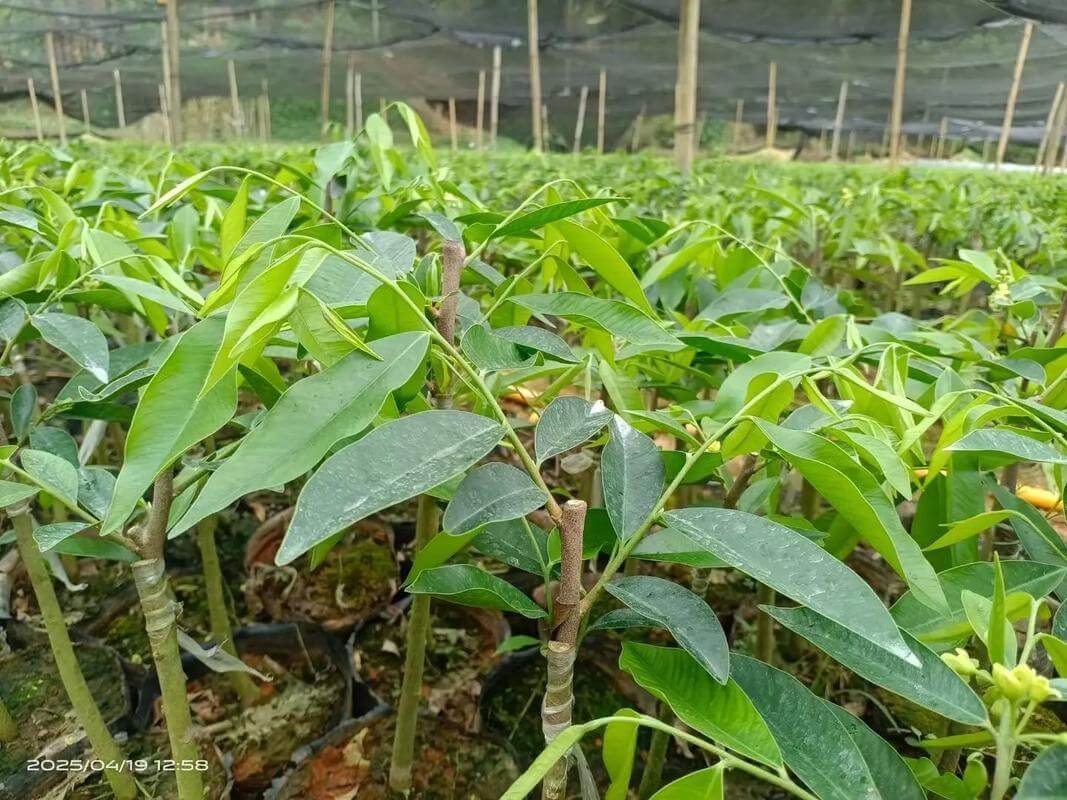
Agarwood Plant Seedlings Wholesale 2026: 6 Proven Aquilaria sinensis Cultivars, Planting Guide
Choosing agarwood seedlings wholesale determines 8-year plantation ROI. The cultivar you pick at Year 0 will decide more about your agarwood plantation profitability than anything you do over the next eight years. A Grade B Aquilaria sinensis log wholesales at USD 80–150/kg in Guangdong. Grade AAA sinking material from the same plantation, same harvest year, just a different cultivar, runs USD 1,200–4,000/kg. That 25× spread is mostly the cultivar choice. Inoculation method, fertiliser regime, and harvest timing each move the dial, but none of them get close to that gap. Six cultivars dominate the 2026 commercial agarwood seedlings wholesale market in Guangdong. Pick well and you land in the premium kynam-grafted tier; pick poorly and you land in the volume cash-flow tier with thinner margins. Growers in Dianbai and Maoming who have run multiple eight-year cycles know the trade-offs; most first-time investors find them out after the fact. This guide is meant to spare you that. We cover the six cultivars, climate suitability, the eight-step grow protocol, the mortality-control playbook, and the realistic per-hectare ROI envelope, so you can lock in the right Aquilaria sinensis seedling order before your first season starts. Premium plantation seedlings remain scarce in 2026 due to limited Aquilaria sinensis cultivars and aged grafting stock. Connoisseur growers source heritage cultivars — premium artisan grafting on rare wild rootstock makes aged kynam scarcity-priced for limited B2B allocation.

Written by
Wang Jianyu
Founder & Chief Sourcing Officer, AgarwoodTown
15+ years hands-on experience grading plantation agarwood, sourcing directly from Dianbai and Maoming districts in Guangdong — the world's largest Aquilaria sinensis cultivation region. Wang has personally inspected thousands of CITES export shipments and holds plantation certification from China's National Forestry and Grassland Administration. He advises GCC, European and East Asian wholesale buyers on grade selection, CITES compliance and supply chain due diligence.
CITES Certified
In this article
Aquilaria sinensis Seedling Varieties: Which Cultivar Should You Plant?
The choice of Aquilaria sinensis cultivar is the most consequential decision in any agarwood plantation investment.[5] Time-to-first-harvest, resin density at maturity, target export grade, the per-hectare ROI envelope; all of them get set on the day the seedlings go in the ground. The two videos below walk through visual identification of the six cultivars AgarwoodTown supplies, plus a live nursery tour of grafted Kynam-line stock.[15] The cultivar comparison table that follows is the planning reference B2B buyers use when locking in seedling MOQs and delivery schedules.
For premium B2B partners, AgarwoodTown offers heritage artisan kynam grafting from rare wild aged Aquilaria sinensis — limited connoisseur-grade allocation each season.
| Cultivar | Leaf & Growth | Time to Resin* | Resin Yield | Fragrance | Best For | Price (USD/plant) |
|---|---|---|---|---|---|---|
| 🍉 Watermelon Leaf 西瓜叶 Xīguā Yè | Broad patterned veins; upright dense canopy | 3–5 yrs | ★★★★☆ | Sweet-woody, persistent | Volume commercial plantations, Grade A–AAA chips. Standard first-investor choice. | $15–25 |
| ✨ Golden Sand 金沙叶 Jīnshā Yè | Narrow willow-like drooping branches; needs staking yr 1–2 | 1.5–3 yrs (fastest) | ★★★★★ | Honey-floral, oil-rich | Premium oil distillation, AAA bakhoor. Higher management, higher reward. | $20–35 |
| 🌾 Xiangmai 香麦 Xiāng Mài | Elongated upright; suited to tight spacing & elevation | 3–5 yrs | ★★★☆☆ | Clean green-woody, subtly spiced | Reliable volume at higher altitude (up to 600m); Fujian / Zhejiang border regions. | $15–20 |
| 🐯 Tiger Stripe No.2 虎斑2号 Hǔbān Èrhào (grafted) | Medium; dark amber resin striping visible on cut | 3–4 yrs | ★★★★★ | Complex multi-layered Qinan character | Boutique plantations; Japan kōdō, Gulf luxury & Chinese collector markets. | $35–80 |
| ♟️ Luomen Heiqi 罗门黑棋 Luómén Hēiqí (grafted) | Leathery deep-green; compact slow-growing canopy | 4–6 yrs | ★★★★★ | Deep cool Qinan, strong base; 2–3× price premium | High-value boutique supply. Best combined with a volume cultivar for balanced cash-flow. | $50–120 |
| 🫒 Oil Leaf 油叶子 Yóuyè Zi | Waxy dark-green; medium height, moderate branching | 2–3 yrs | ★★★★☆ | Fruity-floral, high scent penetration | Fastest ROI timeline. Ideal feedstock for oud oil distillation. | $18–28 |
Data based on Guangdong plantation industry averages and AgarwoodTown nursery observations. Ratings are indicative — actual results vary with inoculation method, soil quality, and management. * Time to resin measured from first drilling/inoculation on trees aged 3–5 years.
Where Can You Plant Aquilaria sinensis? Climate & Geographic Requirements
Aquilaria sinensis is a tropical-to-subtropical tree that thrives within specific temperature, rainfall, and soil parameters. Understanding these requirements before purchasing seedlings prevents costly establishment failures.
Temperature
- Optimal annual average: 20–25°C
- Minimum tolerated (brief cold events): 2–3°C. Short-duration frosts can be survived by established trees, but seedlings in the first growing season are vulnerable to temperatures below 5°C.
- Upper limit: Up to 37°C with adequate moisture. Shade netting is recommended for seedlings when temperatures exceed 33°C.
Rainfall & Irrigation
- Minimum annual rainfall: 1,200mm (or equivalent drip irrigation)
- Optimal: 1,500–2,500mm distributed through the growing season
- Drainage: Well-drained soil is essential, waterlogged roots cause crown die-off and root rot within weeks
Viable Planting Regions
| Region | Countries / Areas | Climate Fit | Notes |
|---|---|---|---|
| South China | Guangdong, Guangxi, Hainan, Yunnan, Fujian | ★★★★★ | Core production region. All cultivars suitable. |
| Southeast Asia | Vietnam, Thailand, Cambodia, Malaysia, Indonesia | ★★★★★ | Tropical conditions ideal. Lower land cost than China. |
| South Asia | India (Assam, Kerala, Karnataka), Bangladesh | ★★★★☆ | High rainfall in NE India suits A. sinensis well. |
| Middle East | UAE, Oman (coastal), Yemen | ★★☆☆☆ | Feasible with drip irrigation. High capex for water. |
| East Africa | Kenya (coastal), Tanzania, Madagascar | ★★★☆☆ | Experimental plantings underway. Promising coastal zones. |
| Not suitable | Europe (excluding Canary Islands), most of North America, arid Middle East interior | ✗ | Temperatures too cold or rainfall too low without major infrastructure. |
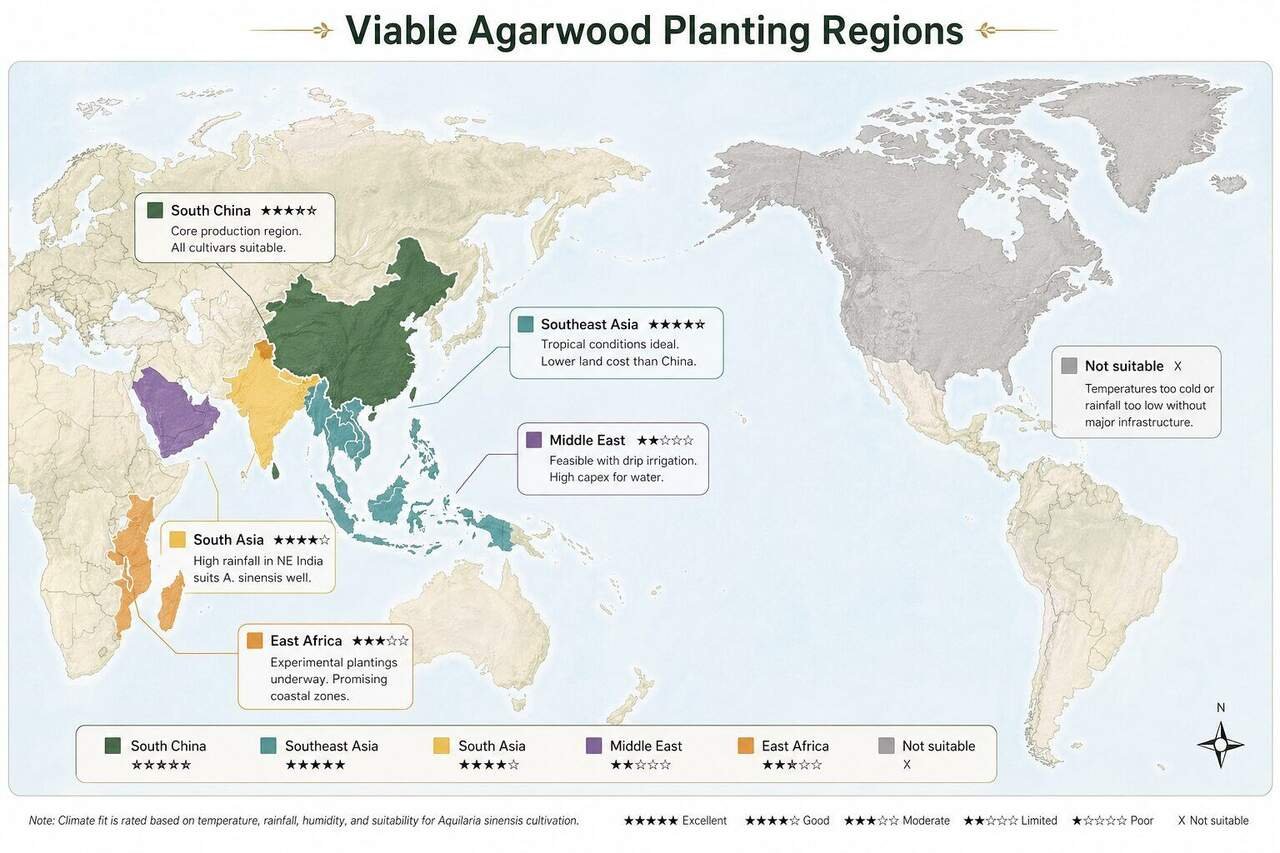
Rule of thumb: if your location experiences more than 10 consecutive days per year below 3°C, outdoor commercial planting is not viable without frost protection infrastructure.
From Seedling to Harvest: The Complete Aquilaria Cultivation Process
From the moment a grafted seedling enters the field to the first harvestable resin yield, an Aquilaria sinensis commercial plantation runs through a 5-stop drilling-method wound-induction procedure refined over two decades of Guangdong production. Each stage has measurable inputs and observable outputs, the step-by-step breakdown below is the planning reference AgarwoodTown uses when scoping a new plantation block. For the full science behind resin induction and scion grafting, see our What Is Cultivated Agarwood guide.
Site Preparation & Soil Testing (Month 1–2)
Clear vegetation, test soil pH (target 4.5–6.5 slightly acidic), assess drainage by digging 50cm test holes after rain. Prepare raised planting mounds (20–30cm) if drainage is borderline. Apply base organic fertiliser (decomposed manure or compost at 2–3kg per planting hole). Mark planting positions at 3×3m spacing (800 plants/ha) or 3×3.5m (750/ha).
Seedling Selection & Transplanting (Month 2–3)
Source healthy 6–12 month old seedlings (30–50cm height, hardened off). Avoid tissue-culture plantlets — they have poor transplant survival rates. Plant in the early morning; avoid transplanting in peak heat. Apply 30–50% shade netting immediately. Water thoroughly at planting and for the first 30 days. Survival target in Month 1–3: >90%.
Early Growth Management (Year 1–2)
Apply slow-release NPK fertiliser every 3 months. Remove shade netting progressively from Year 2 as trees reach 1.5m height — mature trees prefer full sun for optimal resin development. Monitor for Zeuzera moth borer (main pest) — install pheromone traps from Year 1. Apply foliar micronutrients (zinc, boron) in Year 2 to support branch development. Target height at end of Year 2: 1.5–2.5m.
Pre-Inoculation Preparation (Year 3)
Confirm tree health and minimum trunk diameter (at least 8–10cm DBH). Thin the weakest 10–15% of trees (sell as decorative specimens or landscape trees). Choose inoculation method: drilling (most common, cost-effective for commercial scale), WTTI (whole-tree technique for higher yield), or biological (fungal inoculation for organic positioning). Engage experienced inoculation contractor.
Inoculation (Year 3–4)
Drilling inoculation: create holes 2–3cm diameter at 30–40cm intervals spiralling up the trunk. Apply inoculant (Phaeoacremonium or Botryodiplodia fungal culture). Seal holes with organic wax (Pojanagaroon & Kaewrak, 2005 [13]). WTTI technique: flush entire vascular system with stimulant solution via pressurised injection at root collar — larger resin zone, higher yield, requires specialist equipment (Liu et al., 2013 [15]). Monitor all trees at 6 months with core sampling to confirm resin formation.
Resin Development Phase (Year 4–6)
Maintain regular fertilisation and pest monitoring. Do NOT apply nitrogen-heavy fertilisers during resin development — this promotes wood growth at the expense of resin density. Reduce irrigation slightly (controlled water stress helps concentrate resin). Watch for crown dieback or Zeuzera damage — treat immediately. Conduct annual core sampling to track resin density progress. Target resin colour at Year 5 core sample: amber-brown Grade B or better.
Partial Early Harvest (Year 5–6)
Harvest the 10–15% of trees with the highest resin response first — this provides early cash flow and data on final grade. Process: fell selected trees, separate resin-bearing heartwood from sapwood by hand-carving or machine processing, grade chips by density and fragrance, dry to <12% moisture content. Export with CITES permit and phytosanitary certificate.
Main Harvest & Replanting (Year 6–8)
Harvest remaining 60–70% of trees at peak resin density. Grade, process, and sell chips by grade category. Reserve 10–15% of highest-quality sinking-grade material for collector or premium market pricing (significantly higher per-kg value). After harvest: replant with new seedlings in the same holes (soil is already well-structured), beginning the next 6–8 year cycle. Stumps can be left for several years as secondary resin source.
Maintenance, Disease Management & Improving Survival Rate
Seedling mortality is the single biggest risk factor in commercial agarwood cultivation. Under poor management, mortality rates in Year 1–2 can reach 25–40%, destroying the economic viability of the investment. AgarwoodTown's plantation team has developed the following protocols, all of which are provided as a free growing guide with every seedling order.
🐛 Pest Management: Zeuzera Moth Borer
The Zeuzera (leopard moth) caterpillar is the primary pest of young Aquilaria sinensis. Larvae bore into the central stem, causing rapid crown death. Early detection is critical:
- Install pheromone traps (1 per 500m²) from Year 1 to monitor adult moth activity
- Inspect stems monthly — entry holes show frass (sawdust-like frass visible at base of stem)
- Treatment: inject 40% trichlorfon solution into entry holes; seal with clay
- Preventive: neem oil foliar spray every 30 days during the wet season
🦠 Bacterial & Fungal Disease
High humidity combined with poor drainage is the leading cause of root rot and bacterial leaf blight in the first growing season. Research by Chhipa & Kaushik (2017)[5] demonstrates that while specific fungi induce beneficial agarwood resin formation, a different set of opportunistic bacteria and pathogens can colonise stressed or wounded trees with destructive results, making proper wound management critical during inoculation:
- Root rot (Phytophthora spp.): Caused by waterlogged soil. Prevention: raised mounds, well-drained substrate, avoid over-irrigation. Treatment: soil drench with metalaxyl fungicide.
- Bacterial leaf blight: Presents as water-soaked brown lesions on young leaves after heavy rain. Treat promptly with copper bactericide spray (copper oxychloride 0.3%).
- Post-inoculation infection: After drilling, unsealed holes can become infected with competing organisms. Always seal holes within 24 hours with beeswax or latex sealant. Cui et al. (2013)[35] confirmed that correct fungal inoculation protocols in A. sinensis significantly outperform unmanaged wound responses.
🌡️ Temperature Stress Management
- Cold events (below 5°C): Young seedlings (Year 1) need frost cloth or temporary greenhouse protection when temperatures drop below 5°C. Established trees (3+ years) can tolerate brief dips to 2–3°C.
- Heat stress (above 35°C): Maintain irrigation and keep 20–30% shade for trees in their first growing season during peak summer.
📋 Survival Rate Targets by Management Level
| Management Level | Year 1 Survival | Year 3 Survival |
|---|---|---|
| Basic (watering + occasional fertiliser) | 65–75% | 55–65% |
| Standard (pest trapping + regular fertiliser + soil monitoring) | 80–88% | 72–80% |
| Professional (full protocol per AgarwoodTown guide) | 90–95% | 85–92% |
→ AgarwoodTown provides a full plantation management manual covering monthly care schedules, fertiliser formulations, and pest identification charts with every wholesale seedling order of 100+ plants.
Aquilaria Leaves: Tea, Mosquito Repellent and Agarwood By-Products
Pruned Aquilaria sinensis foliage is a real revenue stream during Year 2–7, before main heartwood harvest. Dried agarwood leaves brew into a mildly sweet herbal tea sold across Guangdong, Hainan and Vietnamese markets at USD 8–25/kg, with documented studies on antioxidant flavonoid content. The same leaves, smouldered or distilled, yield a natural mosquito repellent used in rural southern China. For plantation operators, structured pruning during years 2–7 turns what would be green waste into a $400–1,200/ha annual side margin while keeping the canopy open for inoculation work later.
Plantation Establishment Costs: Per-Hectare Budget (2026)
| Cost Category | Year 0 (Establishment) | Year 1–2 (Growth) | Year 3–4 (Inoculation) | Year 5–8 (Harvest Cycle) |
|---|---|---|---|---|
| Land (lease/ha/year) | USD 200–800 | USD 200–800 | USD 200–800 | USD 200–800 |
| Seedlings — Standard (800/ha) | USD 6,000–12,000 | — | — | — |
| Seedlings — Grafted / Tiger Stripe No.2 | USD 28,000–64,000 | — | — | — |
| Soil prep, shade netting & planting labour | USD 800–1,800 | — | — | — |
| Irrigation system (drip) | USD 1,200–3,000 (one-time) | — | — | — |
| Fertiliser, pest management & labour | — | USD 600–1,000 / yr | USD 400–700 / yr | USD 300–500 / yr |
| Inoculation (drilling + fungal treatment) | — | — | USD 1,500–3,500 / ha | — |
| Harvest, processing, grading & drying | — | — | — | USD 1,500–3,000 / ha |
| CITES export permit + phytosanitary | — | — | — | USD 300–600 / shipment |
| Total per hectare (Year 0–8) | USD 10,000–20,000 (standard) USD 35,000–75,000 (grafted) |
Based on Guangdong, China conditions with professional management. Costs in Southeast Asia (Vietnam, Thailand) are typically 20–40% lower for labour and land. Middle East irrigation adds USD 3,000–8,000/ha.
ROI Timeline: Year-by-Year Cash Flow (Standard Seedlings, 1 Hectare)
| Year | Activity | Cash Out (USD) | Cash In (USD) | Cumulative Net |
|---|---|---|---|---|
| Year 0 | Land prep, seedlings (800 standard), shade net, irrigation, planting | −12,500 | 0 | −12,500 |
| Year 1 | Fertiliser, pest management, Zeuzera monitoring | −1,200 | 0 | −13,700 |
| Year 2 | Maintenance + thin weakest 10% (sell landscape specimens) | −1,000 | +600 | −14,100 |
| Year 3 | Drilling inoculation (full plantation) + maintenance | −3,200 | 0 | −17,300 |
| Year 4 | Re-inoculation of low-response trees + maintenance | −1,400 | 0 | −18,700 |
| Year 5 | Partial harvest — top 15% resin-response trees | −900 | +5,500 | −14,100 |
| Year 6 | Main harvest — 60% of plantation; Grade B/A/AAA mix | −2,200 | +30,000 | +13,700 |
| Year 7–8 | Final harvest, stump processing, replanting | −1,800 | +13,000 | +24,900 |
Assumes: 800 standard A. sinensis seedlings/ha; Year 3 drilling inoculation; 82% survival to Year 6 (professional management); grade mix 40% B / 50% A / 10% AAA at main harvest; 2026 FOB Guangzhou prices. Grafted/Tiger Stripe plantations shift grade distribution toward AAA and increase Year 6 revenue by 40–80%.
Source Aquilaria Seedlings from AgarwoodTown — Wholesale Pricing & What's Included
AgarwoodTown supplies Aquilaria sinensis seedlings from our certified Dianbai, Guangdong nursery network. Browse our full Aquilaria seedlings wholesale catalogue, 6 cultivar varieties available with CITES documentation. Available cultivars include standard commercial stock and grafted Qinan-lineage plants including Tiger Stripe No.2.
- Standard cultivars (Watermelon Leaf / Xiangmai / Oil Leaf): USD 15/plant — 6–12 month old, 30–50cm height, hardened off. MOQ: 100 plants.
- Golden Sand Leaf (金沙叶): USD 20–28/plant. Requires staking guidance (provided in care manual). MOQ: 100 plants.
- Tiger Stripe No.2 grafted (虎斑2号): USD 50–80/plant, 6–8 months post-graft, verified Qinan-line rootstock. MOQ: 50 plants.
- Phytosanitary certificate & CITES export permit: Included with every export order.
- Free plantation management manual: Included with all orders of 100+ plants, covers monthly care schedule, fertiliser programme, Zeuzera control protocol, inoculation timing guide, and harvest grading reference.
- Shipping windows: March–May and September–November (optimal temperature transit). Air freight for small orders; sea freight in temperature-controlled plant containers for 500+ plants.
Browse our Agarwood Seedlings product page for current stock and pricing, or request a wholesale quote with growing guide →
For external reference, see Wikipedia: Aquilaria for the underlying species and historical context.
For trade-policy reference, see FAO Forestry — Agarwood Cultivation.
Frequently Asked Questions
For resin quality (grade AAA, Qinan-character), Tiger Stripe No.2 (grafted) consistently outperforms standard cultivars, followed by Golden Sand Leaf for oil distillation. For reliable commercial volume production with lower upfront seedling cost, Watermelon Leaf (西瓜叶) is the most widely used and well-documented cultivar in Guangdong's commercial industry. Many experienced growers plant a mixed block — 70% standard Watermelon Leaf for volume, 20% Golden Sand for premium oil, and 10% Tiger Stripe No.2 for collector-grade output.
Established Aquilaria sinensis trees can survive brief cold events down to approximately 2–3°C. However, seedlings in their first growing season are vulnerable below 5°C and require frost cloth or temporary greenhouse protection during cold snaps. For reliable commercial cultivation, a location with an annual average temperature above 18°C and no more than 5–10 consecutive days per year below 5°C is strongly recommended. Regions in southern China (Guangdong, Guangxi, Hainan), Vietnam, Thailand, and tropical Southeast Asia are within the viable range.
Standard plantation density is 800–1,000 plants per hectare at 3×3m or 3×3.5m spacing. This supports full canopy development while allowing equipment access for inoculation at Year 3–4. In high-rainfall tropical environments (>2,000mm/year), wider spacing of 3×4m (625 plants/ha) reduces disease pressure. For small plots or home cultivation, 2×2m spacing (2,500 plants/ha) is used but requires active canopy management to prevent competition.
The three main causes of first-year mortality are: (1) transplant shock from poorly hardened seedlings — always source 6–12 month old hardened plants, not tissue culture; (2) Zeuzera moth borer — install pheromone traps from planting day; (3) root rot from poor drainage — plant on raised mounds 20–30cm above surrounding ground level. Following AgarwoodTown's plantation management protocol, survival rates of 90–95% in Year 1 are achievable. The manual is included free with wholesale orders of 100+ plants.
Yes. Live Aquilaria plants (including seedlings) are listed under CITES Appendix II. Export requires a CITES export permit from the country of origin and an import permit from the destination country. AgarwoodTown provides both the CITES export permit and phytosanitary certificate with every seedling export order. Buyers are responsible for obtaining the import permit from their country's CITES Management Authority — we provide all supporting documentation needed for the import permit application.
Timeline depends on cultivar and inoculation method: Oil Leaf and Golden Sand Leaf cultivars can show meaningful resin formation 2–3 years post-drilling, with a partial early harvest possible at Year 4–5. Standard cultivars (Watermelon Leaf, Xiangmai) typically require 3–5 years post-inoculation for Grade A commercial material, placing the main harvest at Year 6–7 from planting. Grafted Qinan-line cultivars (Tiger Stripe No.2) have a similar growing timeline to standard cultivars but produce higher-grade resin at the same harvest point. There is no legitimate shortcut to less than 4–5 years for Grade A material — be cautious of suppliers claiming 2-year full harvests.
Based on AgarwoodTown plantation data and 2026 FOB Guangzhou wholesale prices: a professionally managed 800-plant/ha standard-seedling plantation will generate approximately USD 25,000–33,000 gross revenue at the main Year 6 harvest (120–150kg of Grade B/A/AAA chips). Against a total cost of USD 15,000–20,000 over 8 years, this represents a net return of +USD 8,000–18,000, or approximately 8–11% IRR annualised. Grafted Qinan-line plantations have higher upfront costs but produce 40–80% more revenue at harvest due to the grade premium, achieving comparable or slightly better IRR at 9–12%.
References
- 5Chhipa H., Kaushik N.. Fungal and Bacterial Diversity Isolated from Aquilaria malaccensis Tree and Soil, Induces Agarospirol Formation within 3 Months after Artificial Infection. Frontiers in Microbiology, 2017.doi:10.3389/fmicb.2017.01286
- 13Pojanagaroon S., Kaewrak C.. Mechanical Methods to Stimulate Aloes Wood Formation in Aquilaria crassna Pierre Ex Hlec. (Kritsana) Trees. Acta Horticulturae, 2005.doi:10.17660/ActaHortic.2005.676.20
- 15Liu Y., Chen H., Yang Y., Zhang Z., Wei J., et al.. Whole-tree Agarwood-Inducing Technique: An Efficient Novel Technique for Producing High-Quality Agarwood in Cultivated Aquilaria sinensis Trees. Molecules, 2013.doi:10.3390/molecules18033086
- 26Azren P.D., Lee S.Y., Emang D., Mohamed R.. History and perspectives of induction technology for agarwood production from cultivated Aquilaria in Asia: A review. Journal of Forestry Research, 2018.doi:10.1007/s11676-018-0627-4
- 35Cui J., Guo S., Fu S., Xiao P., Wang M.. Effects of inoculating fungi on agilawood formation in Aquilaria sinensis. Chinese Science Bulletin, 2013.doi:10.1007/s11434-013-5856-5
- 58Tan C.S., Isa N., Ismail I., Zainal Z.. Agarwood Induction: Current Developments and Future Perspectives. Frontiers in Plant Science, 2019.doi:10.3389/fpls.2019.00122
- 59
- 60
- 61
All scientific references are provided for transparency. AgarwoodTown summarises peer-reviewed findings for educational purposes and does not claim to provide medical or regulatory advice.
Wholesale Catalog
Buy the products discussed in this article


Related Articles
Source Direct from Origin
Discuss Your Requirements with Our Team
We respond within 24 hours. Share your target grade, quantity and destination — we'll send current pricing, a sample pack option, and CITES documentation details.