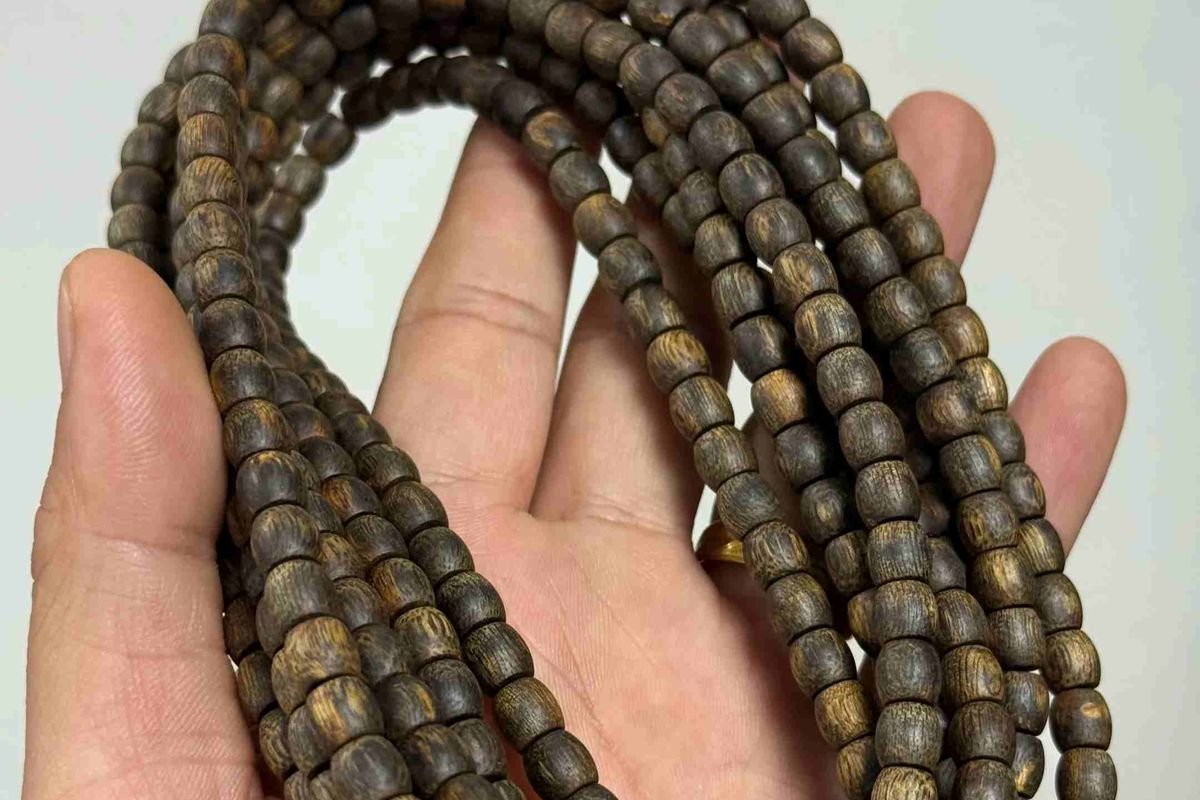
Agarwood Bracelet Care: A Guide Retailers Can Pass On to Customers
A bracelet leaves the shop counter, and from that day its condition depends on the customer. Good agarwood bracelet care is simple, but very few buyers are told the rules. Water, perfume, strong sun and careless storage cause most of the problems retailers later hear about, while honest wear produces the patina collectors actually want. This guide sets out what we explain to bracelet buyers from our Dian Bai plantation: what harms resin beads, why their colour changes, how to store them and when to restring. Use it as the basis for your own customer care card.

Written by
Founder & Chief Sourcing Officer, AgarwoodTown
15+ years hands-on experience grading plantation agarwood, sourcing directly from Dianbai and Maoming districts in Guangdong — the world's largest Aquilaria sinensis cultivation region. Wang has personally inspected thousands of CITES export shipments and holds plantation certification from China's National Forestry and Grassland Administration. He advises GCC, European and East Asian wholesale buyers on grade selection, CITES compliance and supply chain due diligence.
CITES Certified
In this article
- What Does Agarwood Bracelet Care Involve?
- Why Care Advice Belongs at the Counter
- Why Do Agarwood Beads Change Colour?
- How Grade Affects Colour Change
- Water, Sweat, Perfume and Sun: What Harms the Beads?
- Water and the Cord: The Underestimated Risk
- Why Perfume and Added Oil Are the Biggest Mistakes
- If a Customer Has Already Oiled the Bracelet
- How Should an Agarwood Bracelet Be Stored?
- Cleaning Without Damage
- What Is Patina, and Is It Good or Bad?
- How Real Patina Builds
- When and How to Restring an Agarwood Bracelet
- Restringing as a Retail Service
- A Care Card Retailers Can Copy
- One Care Message for a Whole Jewelry Line
- Frequently Asked Questions
1. What Does Agarwood Bracelet Care Involve?
Agarwood bracelet care comes down to four habits: keep the beads dry, keep perfume and lotions off them, keep them out of strong sun and heat, and store them in a breathable pouch. Everything else is detail.
Why is resinous agarwood scarce? According to Liu et al. (2013), only about 10% of Aquilaria trees form agarwood naturally; the rest stay pale, almost scentless wood unless they are wounded and infected.[5]
We always start with one fact: agarwood is not a stone or a metal. It is wood from Aquilaria trees that has filled with dark aromatic resin after the tree was wounded and infected.[1] Therefore a bead behaves like a small piece of resinous timber. It can swell, dry out, crack, absorb smells and darken with handling.
The resin itself is a complex mix of sesquiterpenes and 2-(2-phenylethyl)chromones, plus many minor volatile compounds.[2] Those compounds give the bead its scent when it warms on the wrist. Moreover, they make the bead sensitive to solvents such as the alcohol in perfume.
None of this makes agarwood fragile in normal wear, and we would not want customers to treat it as fragile. A bracelet worn daily and treated sensibly will last for many years. In practice, most damage comes from a few avoidable situations, and customers simply need to know what they are.
Why Care Advice Belongs at the Counter
Retailers carry the after-sales conversation, not the wholesaler. When a bead cracks after a sauna, or a bracelet smells of cologne instead of wood, the customer comes back to your shop.
A short care briefing at the point of sale prevents most of those visits. It also sets the right expectation about colour change, which some first-time buyers mistake for a defect.
For background on what the bracelet means to different buyers and how we grade bracelet wood, see our agarwood bracelet wholesale guide. This article stays with what happens after the sale.
2. Why Do Agarwood Beads Change Colour?
Agarwood beads change colour because their surface collects skin oils, gets polished by friction and slowly reacts with air and light. Most beads gradually turn darker and glossier with wear. This is normal, and in Chinese collecting circles it is the whole point of wearing the bracelet. We would tell any first-time buyer to expect it.
In our view, three processes work together. First, every touch leaves a thin film of natural skin oil on the bead. Second, friction against skin and clothing burnishes the surface, closing fine tool marks from turning. Third, exposed wood gradually darkens with air and light, like most timber does.
Agarwood adds a fourth factor of its own. The resin is oily, and it sits in the wood structure rather than as a coating. As the bead warms on the wrist, the surface often looks richer and slightly more lustrous. Collectors read this as the resin "coming out", although the visible change is mostly at the surface.
The result is a gradual shift, usually over months rather than days. For example, a bracelet that left the shop matte and brown may look deep brown with a soft sheen after a season of regular wear.
How Grade Affects Colour Change
From what we see on our grading table, how much a bead changes depends heavily on its resin content. On our grading table we sort bracelet wood by visual inspection, aroma, resin content and the sink test, using our internal D, C, B, A and AAA scale. That scale is our own, not an ISO or CITES standard.
Lower-grade beads contain more pale wood between the resin lines. That pale wood absorbs skin oil readily, so it darkens visibly, and the contrast between the light and dark zones softens over time. Customers with a Grade C or B bracelet usually notice the biggest change.
High-resin beads start dark, so the change is less about colour and more about gloss. A dense Grade A or AAA bead tends to develop a smooth, almost waxy shine. Published grading reviews also treat colour, oiliness and density as linked quality markers for agarwood.[3]

3. Water, Sweat, Perfume and Sun: What Harms the Beads?
| Exposure | What can happen | What to tell customers |
|---|---|---|
| Showering, swimming, washing up | Wood swells, then shrinks as it dries; repeated cycles can open fine cracks and dull the surface. Pool and sea water add chlorine or salt. | Take the bracelet off before any contact with water. If it gets wet, pat it dry and let it dry slowly at room temperature. |
| Heavy sweat (gym, sauna, hot weather) | Light sweat is part of normal wear. Heavy sweat combined with heat can leave a sticky film and marks, and a sauna exposes the wood to steam and high temperature together. | Remove it for workouts and saunas. After a hot day, wipe it with a dry soft cloth. |
| Perfume, cologne, hand sanitiser | Alcohol and fragrance materials can dull the surface and cover the bead's own scent. | Apply fragrance first and put the bracelet on once the skin is dry. Never spray the bracelet directly. |
| Lotions, sunscreen, cosmetics | Creams leave a film that traps dust and makes the surface look patchy. | Let creams absorb before wearing; wipe off any residue promptly. |
| Direct sun, car dashboards, heaters | Heat and dry air can draw moisture from the wood and lead to fine cracks; strong light may change surface colour unevenly. | Do not leave the bracelet in a hot car or on a sunny windowsill. |
| Knocks against hard surfaces | Agarwood is softer than stone; beads can dent or chip, and some lighter beads scratch easily. | Remove it for heavy manual work and store it apart from metal jewellery. |
| Strong household smells | Wood absorbs odours such as smoke, cooking fumes and cleaning products. | Keep it away from kitchens and chemical cupboards when not worn. |
General care guidance based on how resinous wood behaves. Effects vary with grade, bead size, cord type and climate.
Water and the Cord: The Underestimated Risk
Water is the exposure customers underestimate most. Many people treat a wooden bracelet like a silicone band and keep it on in the shower. However, resinous wood still responds to moisture, and the drying phase does more harm than the wetting phase.
A bracelet that has been soaked should never go near a hair dryer or a radiator. Fast drying is exactly the condition that opens cracks. Instead, the customer should blot it with a soft towel and leave it flat in a shaded room for 24–48 hours, until it is fully dry.
Cord deserves a separate mention from us. Elastic cord loses strength faster when it is repeatedly wet, and a weakened cord is the usual cause of a bracelet suddenly breaking. Therefore water damage often shows up first as a snapped string, not as a damaged bead.
4. Why Perfume and Added Oil Are the Biggest Mistakes
The single most common care mistake is trying to make a bracelet smell stronger. Customers spray perfume on it, rub oud oil into it, or soak it in fragrance oil. All three spoil a genuine bracelet.
- It masks the real scent. A genuine bead releases its own aroma gently when warmed by the skin. Added fragrance sits on top and hides it.
- It changes the surface. Alcohol-based perfume can dull the finish, while added oil leaves a sticky, uneven film that attracts dust.
- It confuses authenticity checks. Oil-soaked low-grade wood is a classic counterfeit. If a customer later asks a dealer to check the bracelet, an oiled surface looks exactly like that fake.
- It cannot be fully undone. Wood absorbs oil, so wiping removes the surface layer but not what has soaked in.
The scent of a real bead naturally seems quieter at room temperature and stronger when worn. That is normal behaviour, not a sign the bracelet has "run out". Our guide to spotting fake agarwood explains why a bracelet that smells strongly when cold deserves a closer look.
If a Customer Has Already Oiled the Bracelet
Our advice is to stop adding anything at once. Wipe each bead with a dry, lint-free cloth once a day for the next 1–2 weeks, and keep wearing the bracelet so skin contact and friction work on the surface.
Do not try to strip the oil with alcohol, soap or a solvent. That adds a second problem to the first. A light coating usually fades from view over a few months of wear, although oil that has soaked deep into the wood stays.
5. How Should an Agarwood Bracelet Be Stored?
Store an agarwood bracelet flat, in a soft breathable pouch or a lined box, at room temperature, away from sun, heat and strong smells. That covers almost every situation.
Laying the bracelet flat matters more than people think, and we would put it first on any care card. Hanging it on a hook keeps the elastic cord under constant tension, so it stretches sooner. A flat bracelet also avoids pressure marks on the beads.
We also suggest keeping it apart from other jewellery. Metal chains, rings and gemstone beads are harder than agarwood and can scratch or dent it in a shared tray. A separate pouch solves this cheaply, and in our view it is the best low-cost add-on a shop can give with each bracelet.
Smell is the other storage risk we would flag. Wood picks up odours, so a bracelet stored in a drawer with scented soap or in a smoky room will slowly take on that smell. A clean cloth pouch inside a closed drawer is usually enough protection.
Some collectors keep high-grade pieces in a closed glass jar or wooden box to hold the aroma between wearings. That works well for short periods, provided the bracelet goes in completely dry. However, sealing a damp bracelet in an airtight container invites mould, so drying always comes first.
Finally, wearing is part of storage. Collectors of 手串 (hand-held bead strings) in China generally prefer to wear or handle a bracelet regularly, because long untouched storage leaves the surface dry and matte. A bracelet that is worn a few times a week tends to stay in the best condition.
Cleaning Without Damage
Routine cleaning needs only a dry, soft, lint-free cloth. We recommend nothing more. After wearing, the customer can wipe each bead gently to remove sweat and dust before putting it away.
Several common cleaning methods do more harm than good, and we would steer customers away from all of them. Ultrasonic jewellery cleaners, soap and water, alcohol wipes, household polish and silver-cleaning cloths with chemical impregnation should all stay away from agarwood. A soft, dry toothbrush can lift dust from carved surfaces, but nothing wet is needed.
If the surface has become sticky after contact with lotion or sunscreen, the customer should wipe it repeatedly with a dry cloth rather than reach for a solvent. In practice, regular wear and wiping restore most surfaces over a few weeks.


6. What Is Patina, and Is It Good or Bad?
| Feature | Healthy patina (desirable) | Grime or damage (needs attention) |
|---|---|---|
| Appearance | Even, soft sheen across the bead; colour deepens gradually | Patchy dull spots, sticky film or visible dirt in holes and carving |
| Feel | Smooth and dry to the touch | Tacky, greasy or rough |
| Cause | Regular wear, clean hands and gentle handling | Lotion, perfume, added oil, sweat left to dry or water exposure |
| Scent | The bead's own woody, resinous aroma when warmed | Perfume, cosmetics, smoke or a stale smell |
| Timeframe | Builds over months and years | Can appear after a single mistake |
| What to do | Keep wearing and wiping with a dry cloth | Stop the cause, wipe dry, and let wear rebuild the surface |
How Real Patina Builds
Patina is the soft, glossy surface layer that agarwood beads develop through long wear. In the Chinese bead trade it is called 包浆 (bāojiāng), and the habit of handling beads to build it is called 盘 (pán). For many buyers in China, a well-developed patina is a sign of a bracelet that has been worn and cared for.
Good patina cannot be rushed, whatever some sellers claim, and we would say so plainly. Some sellers suggest rubbing beads hard, coating them or oiling them to "speed up" the shine. However, those shortcuts produce a coated surface, not patina, and they bring back all the problems described in the perfume section above.
Clean hands are the main requirement, and it is the one habit we would stress above all others. Customers who handle their beads after washing their hands and before applying creams usually get the most even result.
Step-by-Step Process
7. When and How to Restring an Agarwood Bracelet
Check for the warning signs
Restring when the cord shows between beads, the bracelet hangs looser than it did, the cord looks frayed or discoloured at the holes, or the knot has started to slip. How often this happens varies with wear, water exposure and cord quality, so we suggest a quick look every 2–3 months rather than a fixed replacement date.
Photograph and lay out the beads
Before cutting the old cord, photograph the bracelet and lay the beads out in order on a soft cloth. Beads on one bracelet are usually turned from related material, but each has its own grain, so keeping the original order preserves the look the customer bought. Count them too: an 8 mm round-bead bracelet for an average wrist usually carries around 20–23 beads.
Choose a cord to match the bead holes
Elastic cord is the usual choice for slip-on bracelets; knotted silk or nylon thread is common for malas with tassels. Pick the thickest cord that passes comfortably through the holes, because a thin cord wears faster and lets beads rock and rub. For most 6–10 mm beads, 0.8–1.0 mm elastic cord is a common fit; very small beads, such as the 3 mm beads in our range, need finer cord.
Restring without forcing the holes
Use a threading needle or wire guide and pass the cord through gently. Forcing a thick cord can split a bead at the hole, which is the most common restringing damage. Pre-stretching elastic cord before threading helps it keep its length later.
Size, knot and hide the knot
Size the bracelet to sit comfortably without pulling tight, tie a firm knot, and draw it into a bead hole or under the guru bead. Leave it to rest for 24 hours before regular wear so the knot settles.
Hand it back with the care advice
Restringing is a natural moment to remind the customer about water, perfume and storage. A fresh cord on a bracelet that keeps going into the shower will not last long.
Restringing as a Retail Service
For a retailer, restringing is also a service opportunity. A customer who comes back for a new cord is a customer who still wears the piece, and that visit is a chance to show them newer stock.
One practical point from our side concerns the materials. Agarwood beads are sold by weight, and every bead lost or damaged is value lost. At our starting price of $18/g, a bracelet weighing around 15 g represents about $270 of material at the entry point, and higher grades cost considerably more. Careful restringing protects that value.
8. A Care Card Retailers Can Copy
| Topic | Customer-facing line |
|---|---|
| Water | Remove before showering, swimming, washing up and saunas. If it gets wet, pat dry and let it dry slowly at room temperature. |
| Fragrance and creams | Put perfume and lotion on first; wear the bracelet once your skin is dry. Never spray or oil the beads. |
| Sun and heat | Keep out of direct sun, hot cars and away from heaters. |
| Storage | Store flat in the pouch provided, away from other jewellery and strong smells. |
| Cleaning | Wipe with a dry soft cloth after wearing. No water, soap, alcohol or jewellery cleaners. |
| Colour change | Your beads will slowly darken and gain a soft shine with wear. This natural patina is expected and adds character. |
| Scent | Real agarwood smells strongest when warm on the wrist and quieter at room temperature. |
| Cord | Check the cord every 2–3 months. If it loosens or frays, bring it in for restringing before it breaks. |
Adapt the wording to your own brand and language. Keep it to one side of a small card so customers actually read it.
One Care Message for a Whole Jewelry Line
A care card works best when staff say the same thing out loud. Two sentences at the till — no water, no perfume — prevent most complaints. The card then covers the rest.
Buyers who stock bracelets alongside other agarwood pieces can use our card with small changes. Pendants, earrings and carved pieces follow the same rules on water, fragrance and heat, so one care message fits a whole agarwood jewelry line. Our jewelry wholesale guide covers how those pieces are made and matched to grade.
In our experience as exporters, paperwork also belongs in the after-sales picture. All Aquilaria species have been listed in CITES Appendix II since 2004, and loose beads and bracelets can fall under permit requirements.[4] Annotation #14 exempts some finished retail-packaged products, so check the current annotation text before you plan imports. Every wholesale shipment from us travels with a grading note or certificate and a CITES export permit where required.
Stocking agarwood bracelets for your shop?
Browse our wholesale agarwood bracelet range, from the Hainan black chess-bead bracelet to the round-bead multi-wrap bracelet. Bracelets are priced by weight from $18/g, with grades from D to AAA.
Tell us your market and target grade, and we will reply within 4 business hours, Monday to Saturday, 9:00–18:00 China time. Ask for a bracelet quote →
Frequently Asked Questions
It is better not to. Agarwood is resinous wood, so repeated wetting and drying makes it swell and shrink, which can open fine cracks and dull the surface. Water also weakens elastic cord. If the bracelet does get wet, pat it dry and let it dry slowly at room temperature, never with a hair dryer.
Darkening is normal. Skin oils, gentle friction and exposure to air and light all deepen the surface colour over months of wear, and the resin gives the bead a soft sheen. Lower-grade beads with more pale wood usually change the most. This patina is something many collectors actively want rather than a defect.
No. Perfume and added oil mask the bead's own scent, leave a sticky or dull surface and soak into the wood, so they cannot be fully removed. An oiled bracelet also looks like a common counterfeit if anyone checks it later. Apply fragrance to skin first and put the bracelet on afterwards.
Usually not. Genuine agarwood releases most of its scent when warmed on the wrist and smells quieter at room temperature. A bracelet stored for a long time may also seem faint until it is worn again. Avoid adding oil to boost it. If it smelled very strong when cold at purchase, that may deserve a closer look.
Wipe them with a dry, soft, lint-free cloth after wearing. For carved surfaces, a soft dry toothbrush lifts dust. Do not use water, soap, alcohol, polish or ultrasonic cleaners, because these can damage the surface or the cord. If the beads feel sticky after lotion, keep wiping with a dry cloth rather than using solvents.
There is no fixed interval, because it depends on how often the bracelet is worn, whether it gets wet and the quality of the cord. Check it every 2–3 months. When the cord shows between beads, the bracelet feels looser, or the cord looks frayed at the holes, restring it before it breaks.
Store it flat in a soft breathable pouch or lined box, at room temperature, away from sunlight, heaters and strong smells. Keep it apart from metal and gemstone jewellery that could scratch it. A closed jar is fine for a completely dry bracelet, but never seal one away while it is still damp.
Yes, beads can develop fine cracks, mostly from fast drying after water exposure, strong heat or being forced onto a thick cord. A hairline surface crack is often cosmetic and stable if the conditions that caused it stop. A bead split through the hole usually needs replacing, which is why careful restringing matters.
Occasional sun during normal wear is fine. The risk comes from long, concentrated exposure, such as a bracelet left on a car dashboard or a sunny windowsill. Heat and dry air can draw moisture from the wood and lead to cracking, while strong light may change the surface colour unevenly.
A short card covering water, perfume and creams, sun and heat, storage, cleaning, expected colour change, scent behaviour and cord checks is enough. Staff should also say the two key rules out loud at the till: no water and no perfume. That conversation prevents most of the after-sales complaints shops receive.
References
- 1
- 2Naef R.. The volatile and semi-volatile constituents of agarwood, the infected heartwood of Aquilaria species: a review. Flavour and Fragrance Journal, 2011.View source
- 3Liu Y.Y., Wei J.H., Gao Z.H., et al.. A Review of Quality Assessment and Grading for Agarwood. Chinese Herbal Medicines, 2017.View source
- 4
- 5Liu Y., Chen H., Yang Y., et al.. Whole-tree agarwood-inducing technique: an efficient novel technique for producing high-quality agarwood in cultivated Aquilaria sinensis trees. Molecules, 2013.View source
All scientific references are provided for transparency. AgarwoodTown summarises peer-reviewed findings for educational purposes and does not claim to provide medical or regulatory advice.
Wholesale Catalog
Buy the products discussed in this article


Related Articles
Source Direct from Origin
Discuss Your Requirements with Our Team
We respond within 24 hours. Share your target grade, quantity and destination — we'll send current pricing, a sample pack option, and CITES documentation details.