Agarwood Resin: What It Is, How It Forms and How Buyers Measure It
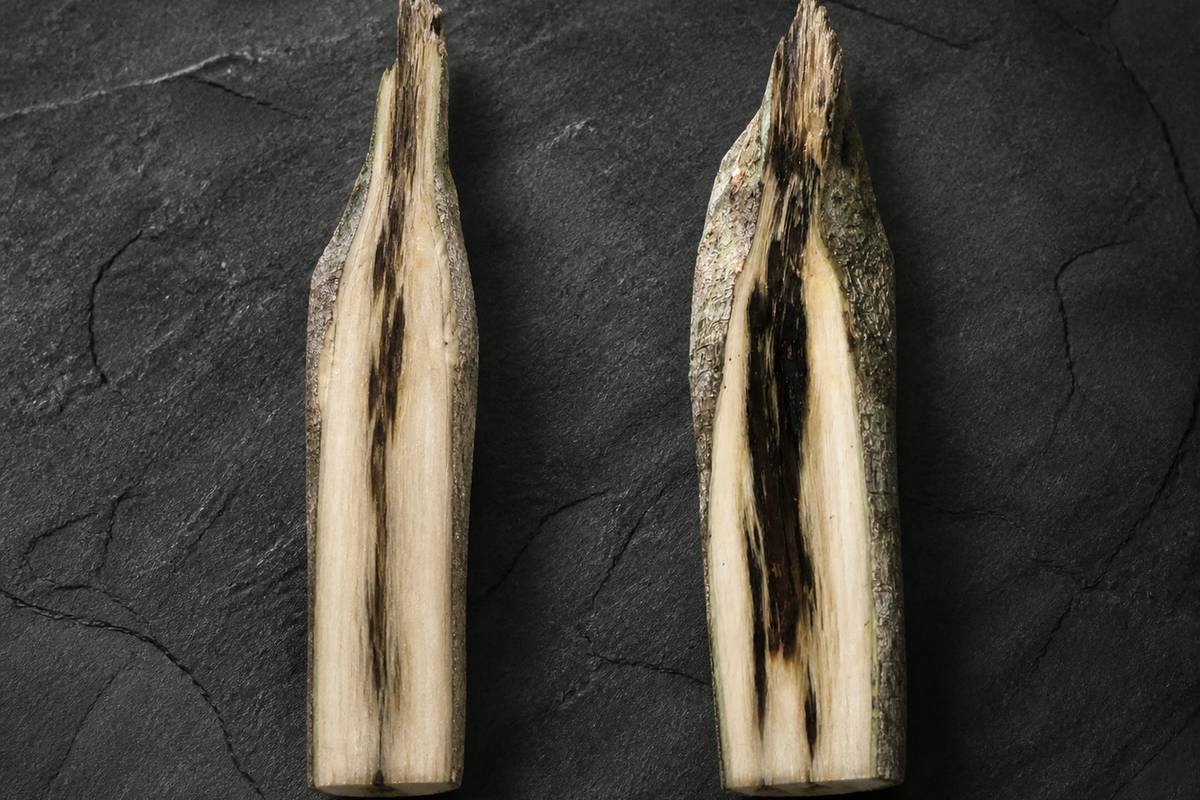
Everything a buyer pays for in agarwood comes down to one thing. Agarwood resin is the dark, fragrant material an Aquilaria tree builds into its wood after injury, and without it the wood is pale and almost scentless. More resin usually means more scent, more weight and a higher price. This guide explains what the resin is, how it forms on our plantation in Dian Bai, what it is made of, and how buyers measure it, including the famous sink test and its limits.

Written by
Founder & Chief Sourcing Officer, AgarwoodTown
15+ years hands-on experience grading plantation agarwood, sourcing directly from Dianbai and Maoming districts in Guangdong — the world's largest Aquilaria sinensis cultivation region. Wang has personally inspected thousands of CITES export shipments and holds plantation certification from China's National Forestry and Grassland Administration. He advises GCC, European and East Asian wholesale buyers on grade selection, CITES compliance and supply chain due diligence.
CITES Certified
In this article
- What Is Agarwood Resin?
- Agarwood Resin vs Agarwood Oil
- How Does Agarwood Resin Form?
- Resin on a Plantation Tree
- Resin From Gyrinops
- What Is Agarwood Resin Made Of?
- How Do Buyers Measure Agarwood Resin Content?
- The Alcohol-Soluble Extract Test
- Sinking Agarwood: The Chinese Density Classes
- Chén Xiāng Does Not Mean It Sinks
- How to Run an Agarwood Sink Test Properly
- What the Sink Test Proves, and What It Does Not
- Fakes and False Results
- How Much Resin Can Plantation Agarwood Hold?
- Resin by Grade on Our Scale
- Agarwood Price per Kg in 2025: Why Resin Sets It
- Frequently Asked Questions
1. What Is Agarwood Resin?
Agarwood resin is the aromatic material an Aquilaria tree deposits into its own wood after it is wounded and infected. It darkens the wood, makes it heavier and gives it the scent the trade calls oud.
One measurable benchmark does exist. According to Liu et al. (2013), the Chinese Pharmacopoeia requires no less than 10% alcohol-soluble extractive in agarwood; induced samples in the study reached 11.60–18.08%, while two wild samples scored 10.56% and 19.30%.[3]
Healthy Aquilaria wood holds none of it. It is pale, soft and light, and it smells of little more than sawdust. So when we talk about agarwood, chips, beads or oil, we are really talking about how much resin a piece holds and how good that resin smells.
The resin is not a separate lump inside the trunk. It soaks into the wood fibres around a wound, in streaks and patches that follow the grain. That is why one chip can show black, oily veins next to pale wood that never reacted.
According to the CITES Secretariat, both resin-forming genera, Aquilaria and Gyrinops, have been listed in Appendix II since 2004, which is why resin-rich wood travels with export permits.
Agarwood Resin vs Agarwood Oil
Resin and oil are related but not the same. Resin is what sits in the wood. Oil is the aromatic fraction that distillation or extraction pulls out of that resinated wood.
We make both. Our resinated oud wood chips start from $0.24/g with a 100 g MOQ, and our hydro-distilled oil starts from $7.00/g with a 10 g MOQ. Resin-rich wood earns most as chips, beads or carvings; thinner material earns most in the still.
2. How Does Agarwood Resin Form?
Agarwood resin forms as a defence. When a tree is wounded and microbes, mainly fungi, enter the wood, the tree fills the tissue around the wound with aromatic compounds.[1] Over months and years, that zone darkens and grows heavier.
In the wild, the wound comes by chance: a storm, a broken branch, an insect boring into the trunk. Many trees never get a wound deep enough to form useful resin. That is why collectors once cut many trees to find a few that held oud.
Time matters. A study that sampled induced Aquilaria sinensis wood over one year tracked how the chemical profile changed month by month as the resin developed.[2] In plain terms, young resin and mature resin are not the same material.
Resin on a Plantation Tree
On a plantation, growers start the process on purpose. We drill or cut our trees and add an inducer, so the defence response begins on a known schedule. Whole-tree techniques can spread resin further through a trunk than single wounds can.[3]
Even then, resin builds unevenly. Two trees treated on the same day can give very different wood, and so can two ends of one log. For the methods themselves, see our guide to agarwood inoculation.
Resin From Gyrinops
Agarwood resin does not come only from Aquilaria. Trees of the related genus Gyrinops, such as G. walla in Sri Lanka and G. versteegii in eastern Indonesia, form the same kind of fragrant resin after wounding and infection.
Both genera have been listed in CITES Appendix II since 2004, so Gyrinops wood needs the same export paperwork. For a buyer, the practical point is that the permit names the genus and species, and that name should match the offer.


3. What Is Agarwood Resin Made Of?
| Compound family | What it contributes | Why buyers care |
|---|---|---|
| Sesquiterpenes | Much of the woody, warm and sweet character | Their balance shifts with species, region and age of the resin |
| 2-(2-phenylethyl)chromones | Typical agarwood markers, many released on heating | Used in research and lab reports to confirm genuine agarwood |
| Aromatic and minor volatiles | Top notes and fine detail | Explain why two dense pieces can smell very different |
| Wood tissue (non-resin) | Structure only; little scent | Pale wood dilutes resin and lowers density and price |
A simplified summary of published reviews. Agarwood contains well over a hundred reported volatile compounds, and the mix varies widely between samples.
Chemically, agarwood resin is a complex mix dominated by sesquiterpenes and 2-(2-phenylethyl)chromones, and published reviews list a long catalogue of further compounds.[4] No single molecule makes the smell of oud.
Heat changes the picture again. Many of the chromones break down and release their scent only when the wood is warmed, which is why a cold chip can smell faint while the same chip fills a room on a burner. It is also why we judge resin on gentle heat, not by sniffing cold wood, and why oil and smoke from one lot never smell quite the same.
That complexity has a practical side. Two pieces with the same weight and colour can smell deep and layered or thin and sharp. Therefore we never grade on density alone, and we provide GC-MS reports on request for our oils, so buyers can see the compound families behind the scent.
4. How Do Buyers Measure Agarwood Resin Content?
| Feature | What the method tells you | Its main limitation |
|---|---|---|
| Visual inspection | Colour, streak pattern and how far resin runs into the piece | Surface can be dyed or coated; cut faces tell more |
| Weight in the hand | A quick sense of density compared with similar pieces | Rough; shape and moisture change the feel |
| Sink test | Whether the whole piece is denser than water | Says nothing about scent; can be faked |
| Aroma when warmed | How good the resin smells, not only how much there is | Needs a trained nose and the same heat for every sample |
| Alcohol-soluble extract | A lab measure of extractable resin, used in Chinese pharmacopoeia work | A floor for medicinal material, not an incense grade |
| GC-MS profile | Which compound families are present | Shows composition, not total resin or market value |
The Alcohol-Soluble Extract Test
The one lab number traders mention most is the alcohol-soluble extract. A ground sample is soaked in ethanol, and the share of material that dissolves is weighed. Dark, resin-rich wood gives far more extract than pale wood, so the figure works as a rough screen for resin content.
It has limits. The test cannot tell a deep, sweet resin from a thin one, and it says nothing about grade for incense. We treat it as a floor, not a ladder.
Researchers reviewing agarwood quality in China make the same point: traditional checks such as look, aroma, burning and sinking are still widely used, but they are partly subjective, so chemical markers help.[5] The Chinese Pharmacopoeia sets an alcohol-soluble extract minimum for medicinal chen xiang; check the current edition for the figure.
On our own grading table, founder Wang Jianyu combines four tests on every lot: visual inspection, aroma, resin content and the sink test. The result is a letter on our internal D–AAA scale, with Kynam on allocation. That scale is ours, not an ISO or CITES standard, and our agarwood grades guide explains each letter.
5. Sinking Agarwood: The Chinese Density Classes
| Class | Chinese term | What you see in water | What it usually suggests |
|---|---|---|---|
| Sinking | 沉水 chén shuǐ | The dry piece drops and rests on the bottom | Heavy resin through most of the piece |
| Half-sinking | 半沉 bàn chén | Hangs at mid-depth or rests at an angle | Plenty of resin, spread unevenly |
| Floating | 浮水 fú shuǐ | Floats, often partly above the surface | Lighter resin or more unreacted wood |
| Floating, pale | Often sold simply as 沉香 material | Floats high, like ordinary wood | Little resin; offcuts or early-harvest wood |
Trade terms vary between regions and dealers. These classes describe water behaviour only; they are not a quality grade and not an ISO or CITES standard.
Chén Xiāng Does Not Mean It Sinks
Sinking agarwood is wood so loaded with resin that the whole piece is denser than water. The Chinese name for agarwood itself, chén xiāng (沉香), means "sinking fragrance", so the test is old enough to have named the material.
That history causes confusion. The word chén xiāng on a label simply means agarwood; it does not promise the piece sinks. Only a class such as chén shuǐ, or a test you watch yourself, tells you that. Floating wood is not poor wood either: many floating pieces burn beautifully and suit incense, bakhoor and powder.
Step-by-Step Process
6. How to Run an Agarwood Sink Test Properly
Start with dry, clean pieces
Test wood that has been stored dry, not chips that were just washed. Wood that has already soaked up water reads heavier than it really is, so a fair test starts with dry material.
Use plain water at room temperature
Use clean water in a clear glass, deep enough for the piece to fall freely. Do not add salt or sugar: dissolved solids make water denser and sinking harder.
Lower each piece in gently
Lay the piece flat on the surface and let go. A chip dropped from height can plunge on momentum and look as if it sinks.
Release trapped air
Bubbles cling to cracks and can hold a dense chip up. Tap the glass or touch the piece briefly with a thin stick, then watch again.
Read the result in a fixed time
Judge within a minute or two. Wood left in water for hours slowly absorbs it and may sink even if it began afloat.
Test a handful, not one piece
Draw pieces from different parts of the bag and count how many sink, hang or float. The spread tells you more than the best piece a seller chooses to show.
Dry the wood, then smell it
Pat the pieces dry and let them air-dry before storage, since damp agarwood can mould. Then warm a sliver and judge the scent. The water raises the question; the aroma answers most of it.
7. What the Sink Test Proves, and What It Does Not
| Feature | What a sinking result shows | What it does not show |
|---|---|---|
| Density | The piece, as tested, is denser than water | How the density is spread inside the piece |
| Resin load | In genuine agarwood, usually heavy resin | That the weight comes from resin, not added material |
| Aroma | Nothing directly | Whether it smells deep, sweet, thin, sour or smoky |
| Origin and age | Nothing reliable | Species, region or how long the resin took to form |
| Authenticity | It rules out plain light wood | That the piece is agarwood at all; other dense woods sink |
| Value | A reason to keep testing | A price; two sinking pieces can differ greatly in worth |
Fakes and False Results
Because buyers trust the water test, sellers have learned to beat it. Waterlogged wood can sink after a long soak. Low-grade wood can be loaded with heavy resins, glues or waxes. Mineral powder can be pressed into cracks. Several tropical hardwoods sink naturally, and darkened and scented, they pass a casual test.
Oil soaking is a separate problem. Most perfume oils are lighter than water, so soaked chips gain scent more than weight. Even so, they are the most common fake on the scent side. Our guide to spotting fake agarwood covers every trick in turn.
The safe rule is easy to remember. A sinking result is a reason to keep testing, never a reason to stop.
8. How Much Resin Can Plantation Agarwood Hold?
Plantation agarwood can hold a lot of resin, and some pieces sink, but sinking wood is a small share of any harvest. Most cultivated material falls in the floating and half-sinking range, and a supplier who promises otherwise deserves hard questions.
On our 100+ mu of Aquilaria sinensis in Guan Zhu Town, every tree is inoculated, and we also buy from more than 100 contracted plantation farmers. All of it is plantation material. On our grading table, sinking pieces appear, but as the exception rather than the rule, and we grade each lot on what it actually does in water and on the burner.
Resin by Grade on Our Scale
In qualitative terms, D and C material floats, B usually floats lower, A often half-sinks, and AAA half-sinks or sinks. Sinking alone never lifts a piece into AAA, though: a dense chip with a thin scent stays where its aroma puts it. Our solid, resin-rich sections are sold as plantation agarwood logs from $88 per piece.
For buyers, the practical advice is simple. Ask for the class (sinking, half-sinking or floating) and the grade in writing, then test a handful of pieces from the bag yourself. If the seller will not let you test, or only shows one perfect piece, treat the claim with caution.
Wild sinking wood is still traded, mainly to collectors. Wild Aquilaria has declined across Asia, which is one reason all species sit in CITES Appendix II.[6] Our wild vs cultivated agarwood price guide covers that side of the market.
Agarwood Price per Kg in 2025: Why Resin Sets It
Resin content is the main reason agarwood price per kg spreads so widely. In October 2025, Khaleej Times reported top-grade wild chips at an oud exhibition in Sharjah priced at roughly AED 70,000–105,000 per kg.[7] Those are asking prices for rare, heavily resinated wild wood.
Plantation wood with modest resin trades far lower. Our own entry-grade chips start at $0.24/g, about $240/kg. In our view the gap between those two numbers is almost entirely a resin story: density, age of the resin and how much of each piece is dark wood.
Want to test our resin yourself?
Order a paid sample from 100 g of chips across two or three grades, and run the sink test and the aroma test side by side. Samples are non-refundable, and any genuine problem is fixed by replacement or credit. Every wholesale shipment carries a grading note and, where required, a CITES export permit.
Ask for a graded chip sample set → We reply within 4 business hours, Monday to Saturday, 9:00–18:00 China time. For oil made from this resin, see our hydro-distilled oud oil.
Frequently Asked Questions
Agarwood resin is the aromatic material an Aquilaria tree deposits into its wood after it is wounded and infected. It darkens the wood, makes it heavier and gives it the scent known as oud. Healthy Aquilaria wood holds no resin, so the amount and quality of resin set the value of agarwood.
It forms as a defence response. When a tree is wounded and fungi or other microbes enter the wood, the tree fills the surrounding tissue with aromatic compounds. In the wild this happens by chance; on plantations, growers wound and inoculate trees on purpose. Either way, the resin builds slowly and unevenly over months and years.
No. Resin is the material inside the wood. Oil is the aromatic fraction that hydro distillation or CO₂ extraction pulls out of resinated wood. Resin-rich pieces usually earn most as chips, beads or carvings, while thinner material and offcuts earn most when distilled into oil.
Only some of it. Agarwood sinks when resin makes the whole piece denser than water, a class the Chinese trade calls chén shuǐ. Many genuine pieces float or hang at mid-depth and still smell excellent. A piece that sinks may also be a fake, so the sink test is a starting point, not proof.
Combine several checks: look at cut faces for resin streaks, feel the weight, run a sink test, and warm a sliver to judge the scent. Labs can add an alcohol-soluble extract test, used in Chinese pharmacopoeia work, and GC-MS to show which compounds are present. No single test answers everything.
Yes. Waterlogged wood, wood injected with heavy resins or glues, wood with mineral powder pressed into cracks, and naturally dense hardwoods can all sink. Watch the test yourself with dry pieces, read it within a minute or two, check cut faces, and always follow with an aroma test on gentle heat.
Usually more resin means more scent and weight, but not always better scent. Resin composition varies, so a dense piece can smell thin or sour while a lighter one smells deep and sweet. That is why we grade on visual inspection, aroma, resin content and the sink test together, never on density alone.
Yes, but only as a small share of a harvest. Most plantation agarwood floats or half-sinks, because inoculated trees are harvested on a working timetable. On our scale, sinking pieces usually sit in A or AAA, but sinking alone never makes a piece AAA if its aroma does not match.
Because resin forms slowly and unevenly, only after injury and infection, and most of any trunk stays pale. Resin-rich pieces are a small share of each harvest, grading them takes skilled hands, and trade needs CITES paperwork. Our chips start at $0.24/g at grade D and rise steeply with resin content.
References
- 1Tan C.S., Isa N., Ismail I., Zainal Z.. Agarwood Induction: Current Developments and Future Perspectives. Frontiers in Plant Science, 2019.View source
- 2Liao G., Dong W.-H., Yang J.-L., Li W., Wang J., Mei W.-L., Dai H.-F.. Monitoring the Chemical Profile in Agarwood Formation within One Year and Speculating on the Biosynthesis of 2-(2-Phenylethyl)Chromones. Molecules, 2018.View source
- 3Liu Y., Chen H., Yang Y., et al.. Whole-tree Agarwood-Inducing Technique: An Efficient Novel Technique for Producing High-Quality Agarwood in Cultivated Aquilaria sinensis Trees. Molecules, 2013.View source
- 4Naef R.. The volatile and semi-volatile constituents of agarwood, the infected heartwood of Aquilaria species: a review. Flavour and Fragrance Journal, 2011.View source
- 5Liu Y.Y., Wei J.H., Gao Z.H., et al.. A Review of Quality Assessment and Grading for Agarwood. Chinese Herbal Medicines, 2017.View source
- 6
- 7Zakir S.M.A.. Dh100,000 for 1kg wood in Sharjah: What's so special about oud?. Khaleej Times, 2025.View source
All scientific references are provided for transparency. AgarwoodTown summarises peer-reviewed findings for educational purposes and does not claim to provide medical or regulatory advice.
Wholesale Catalog
Buy the products discussed in this article


Related Articles
Sourcing Reference
Oud Wood Price by Grade: How Agarwood Is Graded from D to AAA and Kynam
15 min read
Sourcing Reference
Fake Agarwood: How to Spot Treated Chips, Beads and Carvings Before You Buy
15 min read
Plantation
Agarwood Inoculation Methods: How Plantation Trees Are Induced and What It Means for Grade
14 min read
Source Direct from Origin
Discuss Your Requirements with Our Team
We respond within 24 hours. Share your target grade, quantity and destination — we'll send current pricing, a sample pack option, and CITES documentation details.