Agarwood Inoculation Methods: How Plantation Trees Are Induced and What It Means for Grade
A healthy Aquilaria tree holds almost no oud, so every plantation depends on one step. Agarwood inoculation is how growers deliberately start the tree's resin response instead of waiting decades for chance damage. The method chosen — simple wounding, drilling, a chemical inducer, a fungal culture or whole-tree infusion — shapes where resin forms, how fast it builds and what grade the wood reaches. This guide explains each method as the published research describes it, how long each takes to pay off, and what a wholesale buyer should ask a supplier about it.

Written by
Founder & Chief Sourcing Officer, AgarwoodTown
15+ years hands-on experience grading plantation agarwood, sourcing directly from Dianbai and Maoming districts in Guangdong — the world's largest Aquilaria sinensis cultivation region. Wang has personally inspected thousands of CITES export shipments and holds plantation certification from China's National Forestry and Grassland Administration. He advises GCC, European and East Asian wholesale buyers on grade selection, CITES compliance and supply chain due diligence.
CITES Certified
In this article
- What Is Agarwood Inoculation?
- Why Cultivated Trees Need Induction
- From Chance Damage to Planned Methods
- When Is a Tree Ready to Inoculate?
- Agarwood Inoculation Methods at a Glance
- How Do Wounding and Drilling Work?
- Traditional Wounding
- Drilling, Holing and Nailing
- Chemical vs Fungal Agarwood Inoculation
- What Is in an Agarwood Inoculation Kit?
- Chemical Inducers
- Fungal and Microbial Inoculants
- What Is Whole-Tree Infusion?
- How Long From Inoculation to Harvest?
- How Does the Inoculation Method Affect Grade?
- Why Time Often Matters More Than Method
- What Buyers Should Ask About Agarwood Inoculation
- Frequently Asked Questions
1. What Is Agarwood Inoculation?
Agarwood inoculation is the deliberate wounding of an Aquilaria tree, often combined with an inducing agent, so that the tree forms aromatic resin in its wood. Researchers use the broader term "induction" for the same family of techniques.[1]
Is there an official quality bar? According to the Chinese Pharmacopoeia, as cited by Liu et al. (2013), medicinal agarwood must contain at least 10% alcohol-soluble extractive. In that study, induced plantation samples measured 11.60–18.08%, against 10.56% and 19.30% for two wild samples.[5]
The resin is a defence response. When the tree is injured and microbes or chemical stress reach the living wood, it seals the damaged zone with dark, fragrant compounds. That resin-loaded wood is what the trade calls agarwood or oud.
Inoculation research has moved quickly. Chinese groups, for example Liu et al. (2013) in the journal Molecules, have published whole-tree inducing methods that aim to spread resin through much more of the trunk than a single wound can.
Why Cultivated Trees Need Induction
Plantation trees grow in clean rows, with little lightning, storm damage or insect boring. Therefore a well-kept Aquilaria tree can reach full size and still contain almost no resin. Our guide on how to recognise an agarwood tree explains why a healthy trunk is pale and nearly scentless.
Without induction, a plantation would only be a timber stand. Inoculation turns it into an agarwood source. In practice, every commercial grower of cultivated agarwood uses some form of it.
From Chance Damage to Planned Methods
For centuries, agarwood came from wild trees that happened to form resin. Collectors often felled many trees to find the few that held it, which put heavy pressure on wild Aquilaria across Asia.[2]
Growers then copied nature. Early farmers cut, chopped and burned trunks to imitate natural injury. Later, research groups across Asia added drilled holes, chemical inducers and fungal cultures, which made planned production possible on cultivated trees.[3]
Our own supply follows this plantation model. We run 100+ mu of Aquilaria sinensis under artificial inoculation in Guan Zhu Town, Dian Bai, and we also work with 100+ contracted plantation farmers. We sell plantation material only.
All of our own trees are inoculated plantation Aquilaria sinensis, on 100+ mu in Guan Zhu Town, and we also buy from more than 100 contracted plantation farmers. So this guide comes from the grower's side: what each method means for the wood we later grade from D to AAA.
When Is a Tree Ready to Inoculate?
Inoculating too early wastes the tree. Many growers wait until trees are around five to six years old and the trunk is thick enough to drill without weakening it, although programmes differ by species and site.
Trials judge results by the discoloured zone that spreads from each hole, then by resin content and aroma at harvest. Researchers also use DNA testing to confirm which fungi took hold. Ask any inoculation provider how they measure success, not only what they inject.
2. Agarwood Inoculation Methods at a Glance
| Method | How it works | Where resin forms | Main trade-offs |
|---|---|---|---|
| Traditional wounding | Chopping, cutting, bark stripping or burning the trunk | Along the wound edges, often shallow | Cheap and simple, but slow, patchy and hard to repeat |
| Drilling / holing | Rows of holes bored into the trunk, sometimes left open or plugged | Rings and columns around each hole | Easy to scale and record; lots of pale wood between holes |
| Nailing | Metal nails or pegs driven into the trunk | Small zones around each nail | Low cost; limited resin per wound |
| Chemical inducers | Stress chemicals introduced into wounds | Around and beyond the wound, depending on the agent | Can speed formation; dose and residue questions need answers |
| Fungal / microbial | Cultures of fungi isolated from agarwood placed into wounds | Around inoculated holes, spreading slowly | Closer to the natural route; results vary by strain and tree |
| Whole-tree infusion | An inducer fed into the conducting tissue so the sap carries it upward | Across a much larger part of the trunk | More resin-bearing wood per tree; needs skill and correct dosing |
A qualitative summary drawn from published induction reviews and general trade experience. Speed, spread and results vary widely with tree age, health, climate and the exact protocol, so treat this as a map rather than a specification.
3. How Do Wounding and Drilling Work?
Physical methods injure the wood and let the tree, and the microbes around it, do the rest. They are the oldest family of agarwood inoculation and still the most widely understood.[1]
Traditional Wounding
The traditional approach simply damages the trunk. Farmers chop into it with a knife or axe, strip bark, or char a section with fire. In southern China, growers historically cut deep notches into the trunk and returned years later to collect the darkened wood around them.
These methods cost almost nothing. However, they are slow and unpredictable. Resin tends to form as a thin layer on the wound surface, and much of the tree never reacts at all.
Heavy wounding also weakens the tree. A trunk cut too deeply can break in a storm or die back before resin has built up. Consequently, most commercial plantations moved towards smaller, more controlled wounds.
Drilling, Holing and Nailing
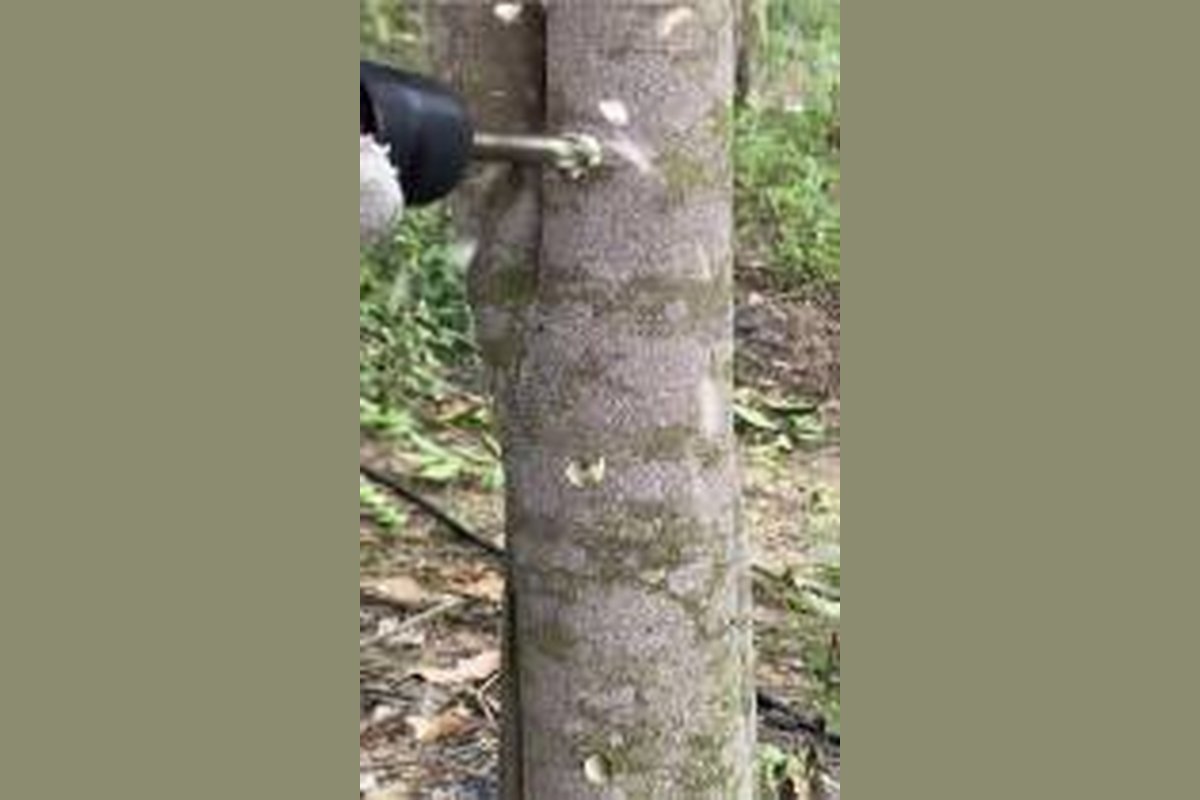
Drilling replaced the axe on many plantations. Workers bore rows of holes into the trunk at set spacing, from the base upward. Each hole becomes a small wound, and the tree builds resin in a ring or column around it.
The advantage is control. A grower can record the number of holes, their depth, their height and the date. Moreover, the work scales well with a power drill, which is why drilled trunks are the image most buyers associate with plantation agarwood.
The drawback shows up after harvest. Drilled wood typically carries dark zones around each hole, with pale, unresinated wood between them. That pale wood has to be carved away by hand, and it lowers the share of the log that reaches higher grades.
Nailing is a lighter version of the same idea. Metal nails or pegs keep the wound open and add a little extra stress. In practice, it produces small resin patches and suits farmers with very limited budgets more than commercial lots.
On our own plantation, artificial inoculation is the reason the wood exists at all. Every tree we harvest was wounded on purpose, and every lot we sell is graded afterwards, so the method we choose shows up directly on our grading table and in our price list.

4. Chemical vs Fungal Agarwood Inoculation
Both approaches start with a wound, usually a drilled hole. The difference is what goes into it: a chemical that triggers stress, or a living culture that infects the wood.[1]
Chemical Inducers
Chemical agarwood inoculation uses substances that push the tree into a stronger defence response. Published work covers a broad range of agents, including salts, acids, and plant signalling compounds such as methyl jasmonate and ethylene-releasing products.[1]
The appeal is speed and reach. A well-chosen inducer can trigger resin over a wider zone than a bare hole. Several Asian programmes also packaged inducers into ready-to-use kits for smallholders.[3]
There are, however, real cautions. The wrong agent or dose can kill wood tissue without forming useful resin, or kill the tree outright. Buyers in perfumery and in traditional-medicine markets also ask what was used, so a supplier should be able to answer plainly.
Fungal and Microbial Inoculants
Fungal agarwood inoculation imitates the natural route more closely. Researchers have isolated many fungi from agarwood, with genera such as Fusarium, Lasiodiplodia and Aspergillus among those commonly studied.[1] Growers culture selected strains and place them into drilled holes.
The tree reacts to the infection much as it would in the wild. Nevertheless, results are uneven. The same strain can perform well in one stand and poorly in another, because tree age, health, season and local microbes all play a part.
Many current protocols therefore combine approaches. A drilled wound, a chemical stress agent and a microbial culture may all be used together, and the reviews treat these combinations as an active research area rather than a settled recipe.[1]
What Is in an Agarwood Inoculation Kit?
Searches for an "agarwood inoculation kit" or "how to make agarwood inoculant" are common, and kits are sold online. They usually contain a liquid or paste inducer, sometimes with a fungal culture, plus instructions for drilling and dosing. Published trials show that the same idea can work, with fungi such as Fusarium or Lasiodiplodia and with chemical solutions.[4]
We do not sell inoculants, and we would not mix one from an online recipe. Dose, timing and tree size all change the result, and an overdose can kill a tree before useful resin forms. If you are planning a plantation, start with documented seedlings and talk to growers in your climate before you buy any kit.
What Is Whole-Tree Infusion?
Whole-tree infusion is a more systematic form of agarwood inoculation. It delivers an inducer into the tree's water-conducting tissue, so the sap carries it up through the trunk. Instead of resin rings around separate holes, the aim is resin across a large part of the tree.
The best-known published version is the whole-tree agarwood-inducing technique developed in China for Aquilaria sinensis. Its authors fed an inducer into the xylem through a transfusion set and reported resin forming well beyond the infusion point, with more agarwood per tree than conventional wounding methods.[5]
For a grower, the attraction is clear. More of the trunk becomes saleable wood, and less pale wood ends up as waste. Moreover, the work happens at a few points on the tree rather than in dozens of drilled holes.
The method still needs care. Dose, timing and tree condition all matter, and a poorly managed infusion can stress a tree without the expected result. In addition, wood that has spread resin widely may not be as dense as wood that built resin slowly around one wound, so the grade still depends on how long it was left to form.
For buyers, whole-tree material usually shows up as logs and larger sections with resin spread through more of the cross-section. Our plantation agarwood logs, from $88 per piece, let buyers judge resin spread directly rather than from a description.

Step-by-Step Process
5. How Long From Inoculation to Harvest?
Grow the tree to working size
Agarwood inoculation only makes sense once the trunk is thick enough to hold resin. Growers usually judge each block by trunk diameter and tree health rather than by a fixed age, because soil, spacing and climate change growth rates. Young, thin trees give little wood however well the inoculation works.
Choose the method and record it
The grower picks a method — drilling, an inducer, a culture, infusion or a combination — and should record the date, method and position for each tree or block. That record is what later lets a buyer separate a recently treated tree from one that has been forming resin for years.
Let the resin build
Resin starts forming around the treated zone and then darkens and spreads slowly. Published plantation studies describe harvests anywhere from within the first year to several years after induction, and the right point varies with method, species and the grade the grower is aiming for.
Check before felling
Growers often take test cuts or fell a sample tree from a block to see how far resin has moved. External signs such as bark colour or sap flow help, but they do not show density, so a cut section remains the most reliable evidence.
Harvest, clean and grade
After felling, workers cut the trunk into sections and carve away pale wood by hand. The remaining resinated wood is graded by eye, aroma, resin content and sink test, then routed to chips, beads, carvings, logs or distillation depending on what it can support.
Buyers often ask how soon a tree can be harvested after agarwood inoculation. The honest answer is that a tree can be cut early, but early wood is rarely high-grade wood.
Short formation periods tend to give lighter, thinner resin that suits distillation, powder and entry-grade chips. Longer periods generally give darker and denser material. Consequently, growers who need cash flow harvest early, while growers aiming at higher grades accept a longer wait and more risk.
That timing also drives tree value. Our article on what sets an agarwood tree price covers how induction date and method change a standing-tree offer, so we do not repeat the price side here.
6. How Does the Inoculation Method Affect Grade?
| Feature | Point methods (wounding, drilling, inoculated holes) | Whole-tree infusion |
|---|---|---|
| Resin pattern | Dark rings or columns around each wound, pale wood between | Resin spread through a larger share of the cross-section |
| Saleable wood per tree | Lower; much of the trunk is carved away | Higher, according to the published whole-tree work |
| Density near the wound | Can become dense where resin has had years to build | Depends strongly on formation time; early harvests can be light |
| Typical routing | Best zones to chips and beads, the rest to distillation and powder | More material for logs, chips and distillation from one tree |
| Record keeping | Simple: count holes, note depth and date | Needs dosing records as well as dates |
| What decides the top grade | Mostly formation time and tree health | Mostly formation time and tree health |
The method of agarwood inoculation shapes where resin forms and how much of the tree carries it. Grade, however, depends on what the resin looks like, smells like and weighs once the wood is on the table.
We grade on four criteria: visual inspection, aroma when heated, resin content and the sink test. Founder Wang Jianyu still grades the wood himself, and the scale runs D, C, B, A and AAA, with Kynam handled separately on allocation. That scale is ours, not an ISO or CITES standard. Grading reviews from China describe a similar mix of appearance, aroma and resin-related measures.[6]
On the grading table, induced plantation wood shows its history clearly. Wood harvested soon after treatment tends to sit in D and C, with resin in thin lines. Wood left to form for longer reaches B and A more often, and the occasional AAA piece is dense enough to sink.
Why Time Often Matters More Than Method
Buyers sometimes assume a newer agarwood inoculation method means a higher grade. In practice, no inoculation method replaces formation time. A drilled tree left for years can yield denser wood than an infused tree harvested early.
Method mainly changes yield and distribution. Time, tree health and the grader's eye decide the grade. For a full breakdown of how chips move through the scale, see our agarwood grading guide for buyers.
Kynam is a separate case. It is a distinct, rare material, and choosing an inoculation method on ordinary stock does not reliably produce it. That is why we never list Kynam as a stock grade.
Where Induced Wood Usually Ends Up
| Material after harvest | Usual use | Related product · starting price |
|---|---|---|
| Dense, dark pieces near long-formed wounds | Graded chips, beads, small carvings | Oud wood chips from $0.24/g · MOQ 100 g · D–AAA |
| Larger sections with wide resin spread | Logs and display pieces | Agarwood logs from $88/piece |
| Thin resin lines and offcuts | Distillation feedstock | Hydro-distilled oud oil from $7.00/g · MOQ 10 g |
| Small fragments and cleaning waste with resin | Powder for incense and blends | Agarwood powder from $10.30 per 50 g |
| Untreated young trees | New plantations, buyer inoculates later | Seedlings $15/plant · MOQ 10 |
Typical routing in the trade for plantation wood. Starting prices are our current wholesale list prices in USD and rise with grade.
That routing explains why agarwood inoculation matters even to buyers who never see a tree. A plantation that drills and harvests early produces a lot of distillation feedstock. A plantation that waits longer produces more chip-grade wood.
For example, a buyer of graded plantation oud chips is buying the best zones of each harvest. A buyer of hydro-distilled oud oil is often buying the value locked in thinner wood that would never sell whole. We distil in-house by steam and hydro distillation and also produce supercritical CO₂ oil.
7. What Buyers Should Ask About Agarwood Inoculation
You cannot see an inoculation method in a bag of chips, so ask for it in writing. These questions separate a documented plantation supply from guesswork.
- Species and source: which Aquilaria species, and is the material plantation-grown? Our stock is plantation Aquilaria sinensis.
- Method: was the wood induced by wounding, drilling, a chemical inducer, a fungal culture or infusion? A supplier should be able to say this plainly.
- Dates: when was the block induced, and when was it harvested? Formation time tells you more about likely grade than the method name.
- Grade evidence: ask for the grading note that will travel with the goods and a paid sample before volume. Our samples start from 100 g of chips or 1 g of oil.
- Lab data for oil: GC-MS reports are available on request for our oils. A GC-MS profile shows the aromatic composition; it does not, on its own, prove how the tree was induced.
- Permits: all Aquilaria species have been in CITES Appendix II since 2004, and plantation material is covered too.[7] We ship with a CITES export permit where required. Check the current annotation #14 text, and your own import rules, before you plan a shipment.
- Live plants: seedlings travel with a phytosanitary certificate as well as any CITES paperwork.
Planting your own stand or buying induced wood?
If you plan to grow and inoculate trees yourself, start with our Aquilaria sinensis seedlings for new plantations and read our seedling and cultivar guide first. If you would rather buy finished wood, tell us your market and target grade and we will suggest a sample set.
We reply within 4 business hours, Monday to Saturday, 9:00–18:00 China time. Ask for a sample and wholesale quote →
Frequently Asked Questions
Agarwood inoculation means wounding a cultivated Aquilaria tree on purpose, often with an added chemical or fungal agent, so that it produces aromatic resin. The tree forms that resin as a defence response. Without some form of induction, most plantation trees would grow to full size with little or no agarwood inside.
No method guarantees a top grade on its own. Method mainly decides where resin forms and how much of the tree carries it, while formation time and tree health decide density and aroma. A drilled tree left for years can grade higher than an infused tree harvested early, so ask about dates as well as method.
It varies with species, method, tree health and the grade the grower wants. Published plantation work describes harvests from within the first year to several years after induction. Early harvests usually give lighter wood suited to distillation and entry grades, while longer formation generally gives darker, denser wood that reaches higher grades.
Neither is better in every case. Fungal inoculation follows the natural infection route more closely but gives uneven results between trees and sites. Chemical inducers can act faster and over a wider zone, but dose and residue questions need clear answers. Many current protocols combine a wound, a chemical agent and a microbial culture.
It is a method developed in China for Aquilaria sinensis in which an inducer is fed into the tree's water-conducting tissue through a transfusion set. The sap carries it upward, so resin can form across much of the trunk rather than only around separate holes. Its authors reported more agarwood per tree than conventional wounding.
Sometimes the pattern gives clues. Drilled logs often show resin rings around holes with pale wood between them, while infused trees can show wider resin spread. However, chips and oil rarely reveal the method reliably, and a GC-MS report shows composition rather than induction history. Ask the supplier for the method in writing.
Usually yes for international trade. All Aquilaria species have been listed in CITES Appendix II since 2004, and plantation-grown material is covered by that listing. Some finished retail-packaged products fall under an exemption in annotation #14, so check the current annotation text and your own import rules before you ship.
Yes. We run more than 100 mu of Aquilaria sinensis under artificial inoculation in Guan Zhu Town, Dian Bai District, Maoming, Guangdong, and we also buy from more than 100 contracted plantation farmers. All the wood we sell is plantation material, graded on our D to AAA scale before it ships.
Growing your own trees means years of waiting before inoculation, then more years of resin formation and a real risk of uneven results. Buying graded wood lets you check the material before you commit. Seedlings suit long-term plantation projects; chips, logs and oil suit buyers who need saleable stock now.
References
- 1Tan C.S., Isa N., Ismail I., Zainal Z.. Agarwood Induction: Current Developments and Future Perspectives. Frontiers in Plant Science, 2019.View source
- 2FAO Forestry. Agarwood (Non-Wood Forest Products). Food and Agriculture Organization, 2004.View source
- 3Azren P.D., Lee S.Y., Emang D., Mohamed R.. History and perspectives of induction technology for agarwood production from cultivated Aquilaria in Asia. Journal of Forestry Research, 2018.View source
- 4Chhipa H., Chowdhary K., Kaushik N.. Artificial production of agarwood oil in Aquilaria sp. by fungi: a review. Phytochemistry Reviews, 2017.View source
- 5Liu Y., Chen H., Yang Y., et al.. Whole-tree Agarwood-Inducing Technique: An Efficient Novel Technique for Producing High-Quality Agarwood in Cultivated Aquilaria sinensis Trees. Molecules, 2013.View source
- 6Liu Y.Y., Wei J.H., Gao Z.H., et al.. A Review of Quality Assessment and Grading for Agarwood. Chinese Herbal Medicines, 2017.View source
- 7
All scientific references are provided for transparency. AgarwoodTown summarises peer-reviewed findings for educational purposes and does not claim to provide medical or regulatory advice.
Wholesale Catalog
Buy the products discussed in this article


Related Articles
Source Direct from Origin
Discuss Your Requirements with Our Team
We respond within 24 hours. Share your target grade, quantity and destination — we'll send current pricing, a sample pack option, and CITES documentation details.