Oud Candle Making: A Wholesale Guide to Using Real Agarwood Oil in Candles
Candle makers write to us with the same problem again and again. They want an oud candle that smells of real agarwood, but the oil costs far more than a typical fragrance oil and behaves differently in wax. This guide is written for small and mid-sized candle brands, not hobbyists. We cover how much oud oil a candle actually needs, what to check on flash point and safety data, which waxes suit oud, what a candle costs at our wholesale oil prices, and how to label the result honestly.

Written by
Founder & Chief Sourcing Officer, AgarwoodTown
15+ years hands-on experience grading plantation agarwood, sourcing directly from Dianbai and Maoming districts in Guangdong — the world's largest Aquilaria sinensis cultivation region. Wang has personally inspected thousands of CITES export shipments and holds plantation certification from China's National Forestry and Grassland Administration. He advises GCC, European and East Asian wholesale buyers on grade selection, CITES compliance and supply chain due diligence.
CITES Certified
In this article
- What Is an Oud Candle, and Is the Oud Real?
- Why Oud Oil Behaves Differently From Fragrance Oil
- Oud Wood Candle, Oud Scent Candle, Agarwood Candle: Same Idea?
- Buying an Oud Candle: What the Label Should Tell You
- Real Oud Oil vs Synthetic Oud Accord
- How Much Oud Oil Goes Into a Candle?
- Oud as a Fraction of the Fragrance Blend
- Flash Point and Safety Data: What to Check
- Which Wax Works Best for an Oud Candle?
- Soy and Coconut Blends
- Paraffin, Blends and Beeswax
- What Does an Oud Candle Cost to Make?
- CO₂ or Hydro-Distilled Oil for Candles?
- A Testing Routine for Oud Candle Formulas
- Labelling, Claims and Import Documents
- Building an Oud Range Around the Candle
- Frequently Asked Questions
1. What Is an Oud Candle, and Is the Oud Real?
An oud candle is a scented candle whose fragrance is built around the smell of agarwood. In most retail candles, however, that smell comes from a synthetic accord rather than from oil distilled out of real Aquilaria wood.
Supply sets the tone for everything that follows. According to a 2013 study in Molecules (Liu 2013), agarwood forms naturally in only about 10% of Aquilaria trees, so genuine oud oil always starts from a limited raw material.[6]
Oud itself is the dark, resin-loaded heartwood that forms when an Aquilaria tree reacts to injury and infection.[1] Oud oil is the aromatic fraction pulled out of that wood by distillation or extraction. It is one of the more expensive natural materials in perfumery.
So when a buyer asks us whether an oud candle "really contains oud", the honest answer is usually no. That gap is an opportunity. A brand that blends documented agarwood oil into its candle has something genuinely different to sell, as long as the formula and the label hold up.
We grow and distil plantation Aquilaria sinensis in Dian Bai, Guangdong, and we produce around 500 kg of oud oil a year. Therefore this guide looks at candles from the oil supplier's side of the table: what the material can do in wax, and what it cannot.
Why Oud Oil Behaves Differently From Fragrance Oil
Candle fragrance oils are designed for wax. Perfumers build them from materials chosen for throw, stability and price, and wax suppliers publish load guidance for them.
Natural oud oil was never designed for that job. It is a complex mixture dominated by sesquiterpenes and 2-(2-phenylethyl)chromones, with many minor volatiles that vary from batch to batch.[2] Much of that profile is heavy and slow to evaporate.
In practice, this has three consequences. First, oud oil is strong on a blotter but can feel quiet in cold wax. Second, its heavier notes tend to show more in the hot throw than in the cold throw. Finally, every batch smells slightly different, so a formula that worked last season needs re-checking with new oil.
If you are new to the material itself, our guide to how oud smells explains the woody, resinous, animalic and smoky facets you will be working with.
Oud Wood Candle, Oud Scent Candle, Agarwood Candle: Same Idea?
Retail names blur the picture. An "oud wood candle" or "oud scent candle" usually means a woody accord, while "agarwood candle" sometimes signals real oil. None of these names is regulated, so the formula and the ingredient list matter more than the name on the jar.
When candle brands ask us to quote, we ask one question first: do you want the label to say the candle contains agarwood oil? If yes, we size the oil order to the formula. If no, an accord may be the better buy, and we say so.
Buying an Oud Candle: What the Label Should Tell You
Most searches for an oud candle come from shoppers, so it helps to know what a good label says. Look for the wax type, the burn time, the fragrance load and whether the oud note comes from real agarwood oil or an accord. A clear warning label and a wick sized for the jar are signs of a careful maker.
Real agarwood oil is rare in candles because of its cost. That is not a flaw in itself; it simply means the label should not promise natural oud when the candle carries an accord.
2. Real Oud Oil vs Synthetic Oud Accord
| Feature | Natural agarwood oil | Synthetic oud accord (candle fragrance oil) |
|---|---|---|
| What it is | Oil distilled or extracted from resinated Aquilaria wood | A blend of aroma chemicals built to suggest an oud character |
| Designed for wax? | No — performance must be tested in each wax | Usually yes, with a supplier-stated maximum load |
| Scent | Layered and variable; shifts with grade, species and batch | Consistent and often more linear |
| Typical use in a candle | A small fraction of the blend, adding depth and authenticity | The whole fragrance load, or the base of a blend |
| Cost | High; our list prices start at $1.50/g (CO₂) and $7.00/g (hydro) | Low per gram, which is why most oud candles use it |
| Documentation | Ask for SDS, batch data and, where relevant, CITES paperwork | SDS and IFRA certificate from the fragrance house |
| Label claim | Can truthfully state that it contains agarwood oil | Should not imply agarwood content |
Neither option is wrong. An accord suits volume retail; real oil suits premium and niche lines that need a story which holds up to scrutiny.
Many candle brands end up in the middle. They use a well-made oud accord or a woody fragrance oil as the backbone, then add a measured dose of real agarwood oil on top. Moreover, that hybrid approach keeps cost under control while still letting the label mention genuine agarwood.
For oud in fine fragrance, see our agarwood perfume sourcing guide.
3. How Much Oud Oil Goes Into a Candle?
| Wax type | Commonly cited total fragrance load | Notes for an oud blend |
|---|---|---|
| Soy container wax | Often around 6–10% | Soft wax holds oil well; heavy oud notes may need a longer curing time before the cold throw opens |
| Coconut or coconut-apricot blends | Often around 6–12% | Creamy, slow burn; many makers like it for woody and resinous scents |
| Paraffin container wax | Often around 6–10% | Usually strong hot throw; good for testing how much oud the blend really needs |
| Paraffin–soy blends | Often around 6–10% | A middle path between throw and a natural wax story |
| Pillar and votive waxes | Often lower, around 3–6% | Too much oil can sweat or weaken the structure; test carefully |
| Beeswax | Often low, around 3–6% | Beeswax has its own honeyed smell, which competes with oud |
These are general ranges that candle makers and wax suppliers commonly cite for total fragrance load (all fragrance by weight of wax). They are not specifications for our oil. Always follow your wax manufacturer's maximum and test in your own wax, wick and vessel.
The short answer: the total fragrance load sits in the normal range for your wax, but real oud oil is usually only a small part of that load. Very few brands run a candle on 100% oud oil.
The table gives broad ranges because waxes differ widely. A wax manufacturer's data sheet always outranks a general rule. Moreover, a higher load does not automatically give a stronger candle. Past a point, oil can sweat out of the wax, cause sooting or tunnel the burn.
Oud as a Fraction of the Fragrance Blend
Think of the fragrance as a blend first, and the load second. For example, a candle at an 8% total load might carry a blend that is mostly a woody base, plus a small share of real agarwood oil.
How small depends on the oil, the base and the price you need to hit. Some brands use oud as a trace that adds depth; others push it high enough that it leads the scent. There is no standard share. You find yours by testing several levels side by side.
Because oud oil is viscous and concentrated, many makers pre-dilute it before weighing. A common approach is to dissolve the oil into a portion of the fragrance base, or into a candle-compatible diluent, so that tiny amounts can be weighed accurately. Check that any diluent suits candle use and appears on your safety paperwork.
4. Flash Point and Safety Data: What to Check
Flash point is the lowest temperature at which a liquid gives off enough vapour to ignite briefly near a flame. For candle makers it matters for safe handling, storage and transport, and it appears on the safety data sheet (SDS) for every fragrance material.
We do not publish a single flash point for our oud oil, and you should not rely on one from any blog. Natural oils vary by batch and by extraction method. Therefore the right step is to request the SDS and the stated flash point for the specific batch you are buying, and to design your process around that figure.
There is also a common misunderstanding to clear up. Many makers believe a fragrance "burns off" if they add it above its flash point. In general, flash point describes ignition risk near an open flame, not the temperature at which scent disappears. However, adding oil to very hot wax can drive off lighter notes and is harder to handle safely, so wax suppliers usually give a recommended addition temperature.
Those recommendations vary by wax. Many container waxes are commonly mixed with fragrance somewhere around 80–90 °C (roughly 175–195 °F), but some waxes call for higher or lower figures. Follow the data sheet for your wax, then confirm it in your own test pours.
Before you pour: three documents to request
1. Safety data sheet (SDS) for the batch. It should state the flash point, hazard classification and handling advice for the exact oil you receive.
2. Analytical data. We provide GC-MS reports on request, which help you confirm the oil is agarwood and support your own safety assessment.
3. Trade paperwork. For cross-border shipments, ask which CITES documents apply to your order and destination, since Aquilaria species are listed in CITES Appendix II.
Never heat oud oil over an open flame or a hot plate with no temperature control. Weigh it at room temperature and add it to wax at the temperature your wax supplier specifies.
5. Which Wax Works Best for an Oud Candle?
There is no single best wax for an oud candle. Soy and coconut blends suit brands that sell a natural story; paraffin and paraffin blends tend to give a stronger hot throw. The right choice depends on your market, your vessel and how much real oud the price allows.
Soy and Coconut Blends
Soy container wax is soft, holds fragrance well and fits a natural-materials label. On the other hand, many makers find soy needs a longer curing time before heavy woody notes open in the cold throw.
Coconut and coconut-apricot blends are popular for premium woody candles. They burn slowly and evenly, and many makers report a smooth throw with resinous notes. Because they often cost more than soy, they pair well with a premium oud positioning.
Paraffin, Blends and Beeswax
Paraffin usually delivers the strongest hot throw for a given load. That makes it a useful test wax, even for brands that sell in soy: if a blend is weak in paraffin, it will rarely shine elsewhere.
Paraffin–soy blends sit between the two. Meanwhile, beeswax is the hardest match. It carries its own honeyed scent and typically accepts less fragrance, so a costly oud note can disappear behind it. We would only suggest beeswax when the honey note is part of the concept.
Wick choice follows the wax and the load. A heavier, more viscous oil can change how a wick burns, so re-test the wick series whenever you change the amount of oud in a formula. A candle burns by melting wax that the wick draws up and vaporises at the flame, so small formula changes matter.[3]

6. What Does an Oud Candle Cost to Make?
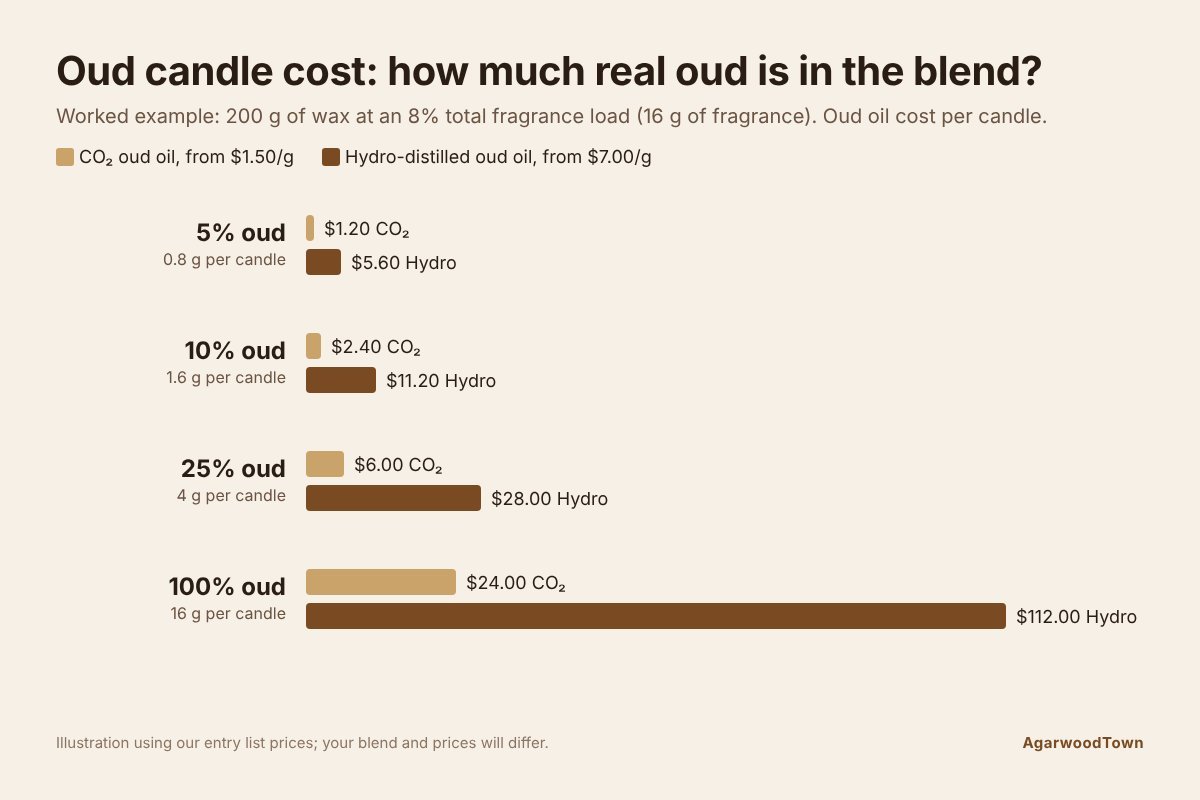
| Real oud share of the 16 g blend | Oud oil per candle | Oud cost with CO₂ oil | Oud cost with hydro oil |
|---|---|---|---|
| 5% | 0.8 g | $1.20 | $5.60 |
| 10% | 1.6 g | $2.40 | $11.20 |
| 25% | 4 g | $6.00 | $28.00 |
| 100% (no base fragrance) | 16 g | $24.00 | $112.00 |
Worked example only: a candle with 200 g of wax at an 8% total fragrance load (16 g of fragrance). Oil costs use our starting list prices — CO₂ agarwood oil from $1.50/g and hydro-distilled oud oil from $7.00/g, MOQ 10 g each. Higher grades cost more. Wax, wick, vessel, base fragrance and labour are not included.
The table makes the economics plain. Real oud is affordable in a candle only when it is a share of the blend, not the whole load. At a 5–10% share with CO₂ oil, the oud cost per candle stays in the low single dollars at our starting prices.
A candle built entirely on hydro-distilled oil, by contrast, would carry over $100 of oil before the jar and wax. That is a collector object, not a product line. Therefore many brands plan a hybrid formula from the start.
Scale changes the arithmetic too. For example, a 10 g order of oil covers about twelve candles at the 5% share above, which is ideal for development but not for a launch.
CO₂ or Hydro-Distilled Oil for Candles?
Both are real agarwood oil, but they behave differently. Our CO₂ agarwood oil for candle blends is extracted at low temperature with supercritical carbon dioxide and often reads brighter and cleaner. It is also the lower-cost route, from $1.50/g.
Our traditional hydro-distilled oud oil follows the water-and-steam route and usually gives the deeper, darker, more animalic profile many customers associate with oud. It starts at $7.00/g, so it suits small premium editions or very low shares in a blend.
Neither is better for every candle. In practice, many makers sample both and test each at the same share in the same wax. The extraction differences are covered in more depth in our oud oil extraction explainer.


Step-by-Step Process
7. A Testing Routine for Oud Candle Formulas
Order paid samples of each oil you are considering
Our oil samples start from 1 g, paid and non-refundable, which is enough for blotter work and small test blends. Ask for the SDS and stated flash point for the batch at the same time, so your safety review can run alongside the scent work.
Evaluate the oil on its own first
Smell each oil on a blotter over several hours and note how it changes. Record which facets you want to carry into the candle: woody, smoky, sweet, leathery or animalic.
Build the blend before you touch wax
Decide the base fragrance, then make small blends with different shares of real oud, for example a low, middle and high level. Weigh every component on a precise scale and label each blend with its exact recipe and the oil batch.
Pour a test matrix
Pour each blend at the same total load in your chosen wax and vessel, ideally with two or three wick sizes. Add fragrance at the temperature your wax supplier specifies. Keep everything else identical so that you are testing one variable at a time.
Rest the candles, then test cold and hot throw
Let the candles rest (cure) for the period your wax supplier recommends; natural waxes often need longer. Then assess cold throw, and burn each candle in a closed room of known size for hot throw. Heavy oud notes often show more clearly when hot.
Run full burn and safety checks
Burn test across several sessions to check melt pool, sooting, flame height and container temperature. Only after a clean burn do you lock the formula, the wick and the load, and file the paperwork your market requires.
Re-check with every new oil batch
Natural oud varies from batch to batch. When you reorder, smell the new oil against a retained sample of the old one and run at least a short test pour before full production, adjusting the oud share if the profile has shifted.
8. Labelling, Claims and Import Documents
Label an oud candle for what is actually in it. If the blend contains documented agarwood oil, you can say so. If the oud character comes from an accord, describe the scent ("oud accord", "oud-inspired") rather than implying natural agarwood content.
Safety labelling is a separate question from marketing claims. Many markets require hazard information on scented candles when the fragrance blend triggers it; for example, the EU and UK apply chemical classification and labelling rules to such products. Your SDS for every component, including the oud oil, feeds that assessment. Moreover, many brands work to IFRA standards, which set limits by product category, so ask your fragrance supplier and your regulatory adviser how candles are treated.
The safe approach is to collect every SDS, keep the batch numbers, and have a qualified person review the finished candle for your target market.
On the trade side, Aquilaria species have been listed in CITES Appendix II since 2004.[4] Bulk oil shipped across borders may need an export permit; annotation #14 exempts certain finished products packaged for retail, but you should check the current annotation text for your exact product. In the EU, CITES is implemented through Council Regulation (EC) No 338/97, so importers there also follow EU rules.[5]
Every wholesale shipment from us goes with a grading note and a CITES Appendix II export permit where required. Our shipping and documentation page covers the logistics side.
Building an Oud Range Around the Candle
A candle is often the entry product in an oud home-fragrance range. Customers who like the scent in wax are natural buyers for the traditional formats that oud comes from.
For example, some brands sit the candle next to wholesale agarwood incense sticks for customers who want a drier, smokier version of the same note. Others add bakhoor chips for burner use, which speak strongly to buyers from Gulf households, where bakhoor is part of everyday hospitality.
Oud candle sourcing at a glance
Oil options: CO₂ agarwood oil from $1.50/g · hydro-distilled oud oil from $7.00/g · MOQ 10 g · paid samples from 1 g.
Documents to ask for: SDS with batch flash point · GC-MS report on request · CITES Appendix II export permit where required.
Formula rule of thumb: keep total fragrance load within your wax supplier's limits and treat real oud as a tested share of the blend.
Contact: we reply within 4 business hours, Mon–Sat 9:00–18:00 China time, through our wholesale enquiry form.
Frequently Asked Questions
Most retail oud candles rely on a synthetic oud accord, because real agarwood oil is expensive and was not designed for wax. Some premium brands add a measured share of genuine oil to a woody base. If a label claims real oud, ask the brand or supplier for documentation showing agarwood oil in the blend.
Use the total load your wax manufacturer recommends; candle makers commonly cite ranges of roughly 6–10% for many container waxes and lower figures for pillars and beeswax. Real oud oil is normally only part of that load. Test several levels in your own wax, wick and vessel before you decide.
We do not quote a general flash point, because natural oils vary by batch and extraction method. Request the safety data sheet and stated flash point for the specific batch you are ordering, and base your handling, storage and shipping decisions on that document rather than on a figure from a blog or forum.
Flash point describes ignition risk near a flame, not the point at which scent vanishes, so the common "burn off" idea is misleading. However, very hot wax can drive off lighter notes and is harder to handle safely. Add fragrance at the temperature your wax supplier specifies and confirm the result in test pours.
Neither is better for every candle. CO₂ agarwood oil, from $1.50/g on our list, often reads brighter and keeps unit cost low. Hydro-distilled oud oil, from $7.00/g, usually gives a darker, more animalic profile. Many makers sample both and test them at the same share in the same wax and vessel.
It depends on the share of oud in the blend. In our worked example of a 200 g candle at an 8% load, a 5% oud share uses 0.8 g of oil: about $1.20 with CO₂ oil or $5.60 with hydro oil at starting prices. Running the whole load on oud would cost far more.
There is no single best wax. Coconut and coconut-apricot blends are popular for premium woody scents, soy fits a natural-materials story, and paraffin usually gives the strongest hot throw. Beeswax competes with oud because of its own honey scent. Test your blend in at least two waxes before committing to one.
Aquilaria species are listed in CITES Appendix II, so bulk oil shipped across borders may need an export permit, and some importing countries add their own rules. Annotation #14 exempts certain retail-packaged finished products, so check the current text. We supply the export permit with wholesale shipments where it is required.
Both our CO₂ agarwood oil and our hydro-distilled oud oil have a minimum order of 10 g. For development, paid samples start from 1 g and are non-refundable. A 10 g lot is enough for a careful round of test pours; production orders are then calculated from grams per candle and planned units.
References
- 1Tan C.S., Isa N., Ismail I., Zainal Z.. Agarwood Induction: Current Developments and Future Perspectives. Frontiers in Plant Science, 2019.View source
- 2Naef R.. The volatile and semi-volatile constituents of agarwood, the infected heartwood of Aquilaria species: a review. Flavour and Fragrance Journal, 2011.View source
- 3
- 4
- 5European Commission. Wildlife trade — implementation of CITES through Council Regulation (EC) No 338/97. European Commission, Environment, 2025.View source
- 6Liu Y., Chen H., Yang Y., et al.. Whole-tree agarwood-inducing technique: an efficient novel technique for producing high-quality agarwood in cultivated Aquilaria sinensis trees. Molecules, 2013.View source
All scientific references are provided for transparency. AgarwoodTown summarises peer-reviewed findings for educational purposes and does not claim to provide medical or regulatory advice.
Wholesale Catalog
Buy the products discussed in this article


Related Articles
Source Direct from Origin
Discuss Your Requirements with Our Team
We respond within 24 hours. Share your target grade, quantity and destination — we'll send current pricing, a sample pack option, and CITES documentation details.