Agarwood Tree Price: What Really Sets the Value of an Aquilaria Tree
Buyers and new growers often send us one short question: what is the agarwood tree price? We understand why they ask, but the honest answer is that a tree has no fixed price. Its value depends on the resin inside it, and nobody can see that resin until the trunk is opened. This guide explains what drives the value of a standing or harvested Aquilaria tree, why per-tree quotes vary so widely, and when buying seedlings, logs or chips makes more sense than buying trees.

Written by
Founder & Chief Sourcing Officer, AgarwoodTown
15+ years hands-on experience grading plantation agarwood, sourcing directly from Dianbai and Maoming districts in Guangdong — the world's largest Aquilaria sinensis cultivation region. Wang has personally inspected thousands of CITES export shipments and holds plantation certification from China's National Forestry and Grassland Administration. He advises GCC, European and East Asian wholesale buyers on grade selection, CITES compliance and supply chain due diligence.
CITES Certified
In this article
- What Sets an Agarwood Tree Price?
- A Tree Is Not Yet Oud
- The Main Value Drivers of a Tree
- How Does Inoculation Change Agarwood Tree Price?
- Time Since Induction
- Why the Induction Method Matters
- Why Do Per-Tree Quotes Vary So Widely?
- Oud Tree Price per Kg: Why the Unit Matters
- What a Tree Quote Actually Includes
- The Costs Between Tree and Saleable Wood
- Standing Tree vs Harvested Material
- Seedlings, Logs or Chips: What Should You Buy?
- How to Evaluate a Tree Offer
- Tree Sales, Investment Pitches and Red Flags
- Wild Trees, Poaching and Planting Rules
- Frequently Asked Questions
1. What Sets an Agarwood Tree Price?
An agarwood tree price is set by the resinated wood a buyer expects to recover from it, minus the cost and risk of getting that wood out. Trunk size, age, induction history and species all matter, but only because they predict resin.
Scarcity starts in the forest. According to a 2013 study in Molecules (Liu 2013), agarwood forms naturally in only about 10% of Aquilaria trees, which is why plantations now induce resin on purpose.[4]
That is the key difference between a tree and almost any other timber. A eucalyptus or pine is valued by volume. An Aquilaria tree, however, is valued by a small fraction of its wood that has turned dark and aromatic, and that fraction can be large, small or close to zero.
So when someone quotes a single number per tree, ask what assumption sits behind it. In practice, every per-tree figure is an estimate of hidden resin, and the estimate is only as good as the evidence offered for it.
A Tree Is Not Yet Oud
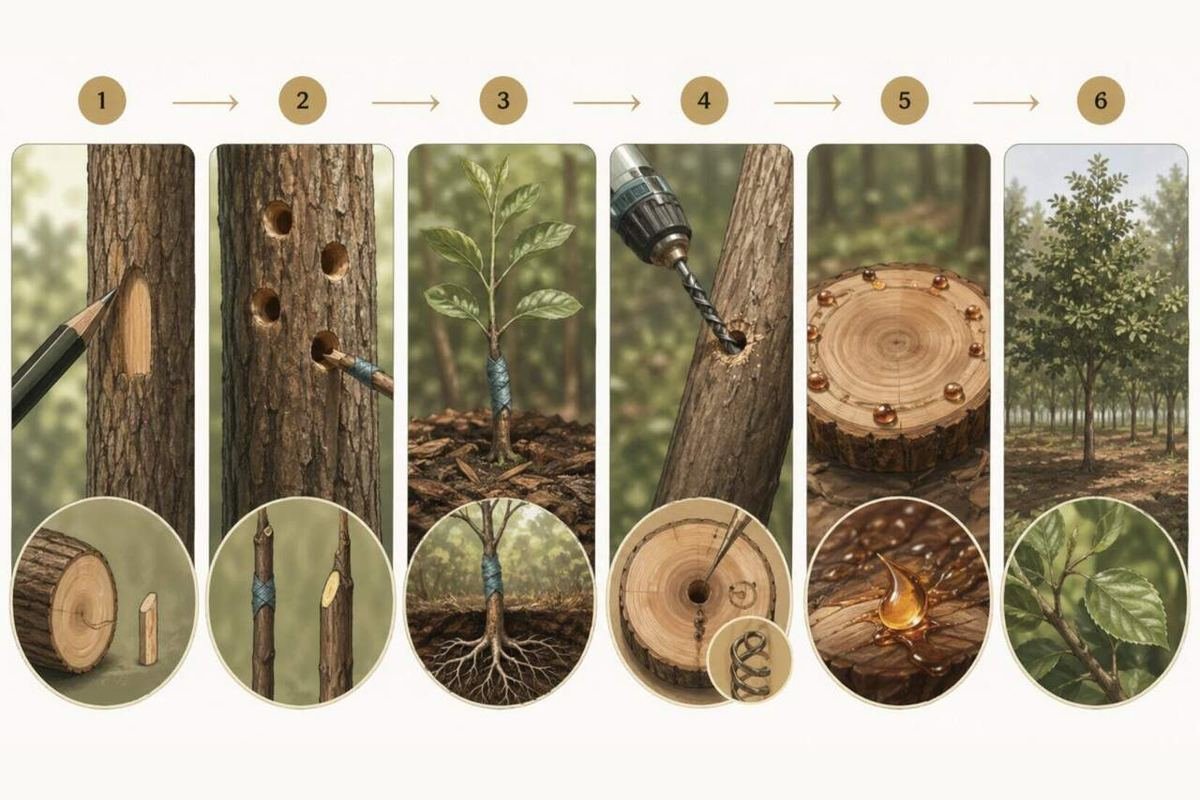
Healthy Aquilaria wood is pale, light and nearly odourless. Oud forms only where the tree has been wounded and infected, and the tree fills that damaged tissue with resin as a defence response.[1]
Therefore an old, tall, handsome tree can hold almost nothing of value. Wild collectors learned this the hard way: historically they felled many trees to find the few that had formed resin naturally.
Plantations changed the odds by wounding trees on purpose. Even so, induction raises the probability of resin rather than guaranteeing a set amount. Our guide to how cultivated agarwood trees mature covers the growing side, so here we stay with value.
2. The Main Value Drivers of a Tree
| Driver | Why it matters | How a buyer can check it | Effect on value |
|---|---|---|---|
| Induction status | An uninduced tree has little or no resin; an induced tree has started forming it | Visible drill holes or wound lines, induction records, dates | The largest single step between low and meaningful value |
| Time since induction | Resin builds gradually around each wound | Written date of inoculation, consistent across the block | Longer formation generally gives darker, denser wood |
| Induction method | Method shapes how far resin spreads through the trunk | Supplier explanation, sample cuts from sister trees | Wider, more even spread raises usable yield |
| Trunk diameter and height | A thicker trunk offers more wood that can hold resin | Tape measure at a fixed height, photos with scale | Raises the ceiling, but only if resin is present |
| Species and origin | Species affects scent profile and market preference | Species named in documents, plant source records | Matters to oil and incense buyers with fixed profiles |
| Tree health | A stressed or rotting tree may form poor resin or decay | Canopy condition, bark, signs of rot or termites | Poor health is a discount, sometimes a large one |
| Access and logistics | Felling, cutting and transport cost money | Site visit, road access, distance to processing | Remote or steep sites cut net value |
| Legal paperwork | Export of Aquilaria products is regulated under CITES | Plantation registration, source documents, permit pathway | Material without a clean paper trail is hard to sell abroad |
Qualitative guide only. No single driver sets a price; buyers weigh them together and discount for what they cannot verify.
3. How Does Inoculation Change Agarwood Tree Price?
Inoculation is the point where a tree starts to become a commodity. Before it, the agarwood tree price reflects timber and potential; after it, the price begins to reflect resin that is actually forming.
Researchers describe a range of induction approaches, from physical wounding to chemical and biological inoculants.[2] Across Asia, the move from chance formation to deliberate induction is what made plantation agarwood possible at scale.[3]
At our plantation in Guan Zhu Town, Dian Bai, we use artificial inoculation on our own 100+ mu of Aquilaria sinensis. However, inoculation is a start, not a result. A buyer still has to judge how long the resin has had to build and how well it has spread.
Time Since Induction
Resin accumulates slowly around each wound. As a general rule, a tree harvested soon after induction yields lighter material, while a longer formation period tends to give darker, heavier wood.
That is why a credible tree offer always states when the tree was inoculated. Without a date, a buyer cannot separate a freshly drilled tree from one that has been forming resin for years. Both may look similar from outside.
Still, longer is not automatically better for every buyer. Lighter, early-harvest wood suits distillation and incense, whereas carvers and collectors want dense pieces. Consequently, the right harvest timing depends on the end product.
Why the Induction Method Matters
Simple drilling creates resin in rings around each hole, with pale wood between them. Methods that spread an inducer through the conducting tissue can produce resin across a larger part of the trunk.
For example, a study on cultivated Aquilaria sinensis described a whole-tree inducing technique that distributed resin formation through much of the stem.[4] Published results like this show what is possible under trial conditions; they are not a promise for any particular tree.
For a buyer, the practical point is simple. Ask which method was used, then ask to see cut sections from trees treated the same way. A cross-section tells you more than any description.

4. Why Do Per-Tree Quotes Vary So Widely?
Agarwood tree price quotes vary because each seller is pricing a different bundle of facts, assumptions and risks. Two trees of the same age can differ several-fold in recoverable resin, and two quotes for the same tree can rest on different harvest plans.
Moreover, the trade has no public reference price for standing trees. Chips, oil and logs are bought and sold often enough that buyers can compare offers. Standing trees, by contrast, are traded privately, one deal at a time.
This is also why we do not publish a per-tree figure. Any number we printed here would mislead more readers than it helped, because the variation between trees is larger than the variation between price lists.
What a Tree Quote Actually Includes
Before you compare two quotes, check that they describe the same thing. In practice, a tree quote may cover any of these arrangements:
- Uninduced trees: plants or young trees sold for the buyer to grow and inoculate later.
- Induced standing trees: trees already inoculated, sold in place, with the buyer responsible for harvest timing.
- Felled trunks: whole trunks or large sections, sold before the pale wood is removed.
- Cleaned logs: sections with most unresinated wood carved away, sold by the piece.
Each step down this list removes some uncertainty and adds some labour. Therefore the price rises along the chain, while the risk to the buyer falls.
The Costs Between Tree and Saleable Wood
A tree only becomes money after a long list of work. Felling, sectioning, hand-carving away the pale wood, drying, sorting and grading all take skilled time, and much of the trunk's weight ends up as low-value offcuts.
Grading then splits the recovered wood into tiers. Published reviews show that agarwood quality assessment combines visual, aroma, density and chemical criteria, and that systems differ between markets.[5] On our own grading table, the same tree usually produces pieces across several of our D, C, B, A and AAA grades.
Finally, export adds paperwork. Every Aquilaria species has been listed in CITES Appendix II since 2004, so wood and many products leaving China need permits.[6] A buyer who purchases trees must plan for that pathway, whereas a buyer of finished material can let the supplier handle it.
Oud Tree Price per Kg: Why the Unit Matters
Many listings quote an oud tree price per kg, but per kg of what? Whole trunk, cleaned resinated wood and graded chips can differ by many times in value. On our side, we never sell standing trees by weight. We sell what the grading table shows: logs from $88 per piece and D–AAA chips from $0.24/g, with a 100 g MOQ.
So when you compare a quote, ask what the kilogram contains. If the answer is "the whole tree", most of it is pale wood worth little more than timber.
5. Standing Tree vs Harvested Material
| Feature | Buying a standing tree | Buying harvested, graded material |
|---|---|---|
| What you can see | Bark, canopy, drill wounds; the resin itself stays hidden | The actual wood or oil, which you can smell, weigh and burn |
| Price basis | An estimate of future recoverable resin | Grade, weight or piece, on a published price list |
| Main risk | Resin yield lower than expected, or poor spread | Grade mismatch, which a paid sample largely removes |
| Labour after purchase | Felling, cleaning, drying, grading and processing | None, beyond your own manufacturing |
| Time to sale | Months or years, depending on harvest timing | Shipped once paperwork and payment clear |
| Export documents | Buyer must arrange the CITES pathway for each product | Supplier ships with grading note and CITES permit where required |
| Who it suits | Growers and processors with land, staff and distillation capacity | Perfumers, incense makers, retailers and traders |


6. Seedlings, Logs or Chips: What Should You Buy?
| Option | What you get | Who it suits | Our starting price · MOQ |
|---|---|---|---|
| Seedlings | Young Aquilaria plants for a new or expanding plantation | Growers with land and a long time horizon | $15/plant · MOQ 10 · phytosanitary certificate |
| Logs | Harvested, resinated sections sold by the piece | Carvers, collectors, processors and display buyers | From $88/piece |
| Oud wood chips | Graded pieces of resinated wood, grades D to AAA | Bakhoor retailers, incense makers, distillers | From $0.24/g · MOQ 100 g |
| Standing trees | Resin potential in place, value unknown until harvest | Experienced growers and processors only | Not price-listed; depends on the drivers above |
Starting prices are current wholesale list prices in USD and rise with size, grade and resin content. We do not quote per-tree prices for standing trees.
For most buyers, the question is not really "what does a tree cost?" but "which stage of the chain should I buy at?" The answer depends on your capacity to handle risk and labour.
If you want to grow, start with plants. Our Aquilaria sinensis seedlings are listed at $15 per plant with a minimum of 10, and they travel with a phytosanitary certificate. However, a seedling is a long-term project, so budget for land, care, induction and years of waiting.
If you want wood you can inspect, logs are the closest thing to buying part of a tree without the guesswork. Our resinated agarwood log pieces start from $88 per piece, and price rises with size, density and resin coverage.
If you make or sell finished goods, buy graded material. Our graded oud wood chips start from $0.24/g at entry grade, with a 100 g minimum. For how those prices compare across wild and cultivated stock, see our per-kilogram price breakdown for wild vs cultivated agarwood.
Regional demand shapes these choices too. Gulf bakhoor retailers usually want chips, whereas carvers and collectors in Greater China tend to look at logs. Meanwhile Japanese incense makers and perfumers mostly care about grade and scent profile, not about trees at all.
Step-by-Step Process
7. How to Evaluate a Tree Offer
Pin down exactly what is for sale
Ask whether the offer covers uninduced trees, induced standing trees, felled trunks or cleaned logs. Also ask who pays for felling, cleaning and transport. Two offers are only comparable when they describe the same stage and the same responsibilities.
Get the induction record in writing
Request the species, planting date, inoculation date and induction method for the block. A seller who cannot give dates is asking you to price resin blind, and you should discount the offer heavily or walk away.
Ask for cut evidence from sister trees
Request photos or physical sections from trees of the same age and treatment that have already been felled. Look at how far the dark zones spread from each wound and how much pale wood remains between them.
Grade a sample of the harvested wood
Have recovered wood graded by visual inspection, aroma, resin content and sink test. If possible, burn or distil a small amount. Your own sample result is a far better guide to value than any claimed yield.
Check the legal and export pathway
Confirm plantation source documents and how CITES export permits will be obtained for the products you plan to make. Material that cannot be exported legally is worth far less than its grade suggests.
Compare against buying finished material
Finally, price the same end product as chips, logs or oil bought graded and documented. If the tree route only wins on optimistic assumptions, buying further down the chain is usually the safer decision.
8. Tree Sales, Investment Pitches and Red Flags
Agarwood trees are sometimes marketed as investments, with fixed returns per tree after a set number of years. Treat those pitches with real caution, because nobody can see the resin before harvest.
- Guaranteed yields: resin formation varies with tree health, method, climate and time. A promised kilogram figure per tree is an assumption, not a fact.
- Prices based on top grades: some projections value all recovered wood at high-grade or Kynam-level prices. Real harvests split across several grades, and much of the trunk becomes offcuts.
- No exit plan: ask who will fell, clean, grade and sell the wood, and at what cost. A tree you cannot process or export is hard to turn into money.
- Missing paperwork: without plantation source records, the CITES pathway becomes difficult. Check the current annotation text and your own country's import rules before you commit.
We are growers and processors, not an investment scheme. We sell seedlings, logs, chips, oil and incense at listed prices, and we make no promises about future tree values or returns.
Wild Trees, Poaching and Planting Rules
Wild agarwood trees are under heavy pressure. Poachers often fell or wound trees in search of resin, and several Aquilaria species are now assessed as threatened. That is the main reason every species is listed in CITES Appendix II.
Rules on planting and harvesting differ by country, and they decide what a standing tree is legally worth. In the Philippines, for example, the environment department allowed commercial propagation of agarwood in 2021.[7] The same logic applies to an aquilaria tree price anywhere: check that you can legally harvest and sell the wood before you pay for the tree.
Not sure which stage to buy at?
Tell us your end product, target grade and volume, and we will suggest whether plants, logs or graded wood fits. Paid samples start from 100 g of chips, and we reply within 4 business hours, Monday to Saturday, 9:00–18:00 China time.
Ask for a sample and a wholesale quote → For grade definitions, read our agarwood grading guide; for export paperwork, see our CITES permit walkthrough.
Frequently Asked Questions
There is no fixed agarwood tree price. A tree is worth the resinated wood that can be recovered from it, minus the cost of harvesting, cleaning, grading and exporting that wood. Because resin is hidden inside the trunk, two trees of the same age can differ greatly in value, so any single per-tree number is an estimate.
Age alone does not create oud. Healthy Aquilaria wood is pale and almost scentless, and resin forms only after the tree is wounded and infected. An old tree that was never injured may contain little or no resin. Age matters mainly because a larger trunk can hold more resin once induction has taken place.
Generally yes, because an inoculated tree has started forming resin while an uninduced tree usually has not. However, value depends on how long ago the tree was induced, which method was used, and how well the resin spread. Ask for the inoculation date and method in writing, and for cut sections from similar trees.
Mostly by evidence from comparable trees. A careful buyer checks the induction record, then looks at felled sister trees of the same age and treatment to see how far resin has spread. Grading a sample of harvested wood gives the best guide. External signs such as wounds and bark condition only hint at what lies inside.
For most wholesale buyers, logs are the safer choice. A log has already been felled and cleaned, so you can see the resin and judge density before paying. Buying standing trees suits experienced growers and processors who can manage harvest, cleaning, grading and export paperwork themselves. Our logs start from $88 per piece.
Our Aquilaria sinensis seedlings are listed at $15 per plant, with a minimum order of 10 plants, and they ship with a phytosanitary certificate. Keep in mind that a seedling is the start of a long project: it needs land, care, induction and years of resin formation before any wood can be harvested and graded.
We do not offer trees as investments and we make no promises about future values or returns. Be cautious with any scheme that guarantees a yield or price per tree, because resin formation varies and harvests split across several grades. Ask who will harvest, grade and sell the wood, and how it will be exported legally.
All Aquilaria species have been listed in CITES Appendix II since 2004, so international trade in wood, logs and many products needs export permits. Live plants also need a phytosanitary certificate. Some finished retail products may be exempt under the annotation, so check the current annotation text and your own national import rules before shipping.
Because they are often pricing different things. One quote may cover uninduced trees, another induced standing trees, and a third felled trunks with cleaning included. Sellers also assume different resin yields and grade mixes. Compare quotes only after confirming the stage, the induction record and who pays for harvest, processing and permits.
There is no fixed price for a 10-year-old tree, because age does not create resin. A tree of that age is worth what its resin turns out to be at harvest, which depends on when and how it was inoculated. Treat any fixed "10-year" price as a sales claim and ask to see test cuts or harvested wood.
It depends entirely on what the kilogram contains. Whole-trunk prices mix a little resin with a lot of pale wood, while graded chips are priced by resin content. Our own reference points are logs from $88 per piece and chips from $0.24/g at grade D, rising with grade.
References
- 1FAO Forestry. Agarwood (Non-Wood Forest Products). Food and Agriculture Organization, 2004.View source
- 2Tan C.S., Isa N., Ismail I., Zainal Z.. Agarwood Induction: Current Developments and Future Perspectives. Frontiers in Plant Science, 2019.View source
- 3Azren P.D., Lee S.Y., Emang D., Mohamed R.. History and perspectives of induction technology for agarwood production from cultivated Aquilaria in Asia. Journal of Forestry Research, 2018.View source
- 4Liu Y., Chen H., Yang Y., et al.. Whole-tree Agarwood-Inducing Technique: An Efficient Novel Technique for Producing High-Quality Agarwood in Cultivated Aquilaria sinensis Trees. Molecules, 2013.View source
- 5Liu Y.Y., Wei J.H., Gao Z.H., et al.. A Review of Quality Assessment and Grading for Agarwood. Chinese Herbal Medicines, 2017.View source
- 6
- 7
All scientific references are provided for transparency. AgarwoodTown summarises peer-reviewed findings for educational purposes and does not claim to provide medical or regulatory advice.
Wholesale Catalog
Buy the products discussed in this article


Related Articles
Source Direct from Origin
Discuss Your Requirements with Our Team
We respond within 24 hours. Share your target grade, quantity and destination — we'll send current pricing, a sample pack option, and CITES documentation details.