Kodo Incense: The Japanese Art of Listening to Agarwood, Explained by a Supplier
Most agarwood in the trade ends up as smoke, oil or beads. A small, demanding share goes to Japan for kodo incense, the classical art of "listening" to fragrant wood. Kōdō uses tiny slivers heated on a mica plate, never set alight, so every flaw in the wood shows. This guide explains what happens in a kōdō session, the tools, the old "six countries and five tastes" system, and which grades suit it. It ends with what kōdō schools and koh makers ask of a plantation supplier like us.

Written by
Founder & Chief Sourcing Officer, AgarwoodTown
15+ years hands-on experience grading plantation agarwood, sourcing directly from Dianbai and Maoming districts in Guangdong — the world's largest Aquilaria sinensis cultivation region. Wang has personally inspected thousands of CITES export shipments and holds plantation certification from China's National Forestry and Grassland Administration. He advises GCC, European and East Asian wholesale buyers on grade selection, CITES compliance and supply chain due diligence.
CITES Certified
In this article
- What Is Kodo Incense?
- Why "Listening" and Not Smelling
- Kōdō Among the Classical Arts
- How Did Kōdō Develop in Japan?
- From Temple Offering to Court Pastime
- The Two Main Schools
- Kumikō and Genjikō: The Incense Games
- Kodo Incense Tools and What Each One Does
- How Does a Kōdō Session Work?
- The Six Countries and Five Tastes
- How a Supplier Reads the System Today
- What Grade of Agarwood Does Kodo Incense Use?
- Jinkō vs Kyara on the Grading Table
- Supplying Kōdō Schools and Koh Makers
- What Japanese Buyers Ask For
- How We Prepare Material for Japan
- Paperwork for Shipping Agarwood to Japan
- Frequently Asked Questions
1. What Is Kodo Incense?
Kodo incense is not a product but a practice. Kōdō (香道), "the way of fragrance", is the Japanese art of appreciating aromatic wood, mostly agarwood, within a set of codified steps and manners.[1]
The numbers explain the price. According to Liu et al. (2013), only about 10% of Aquilaria trees produce agarwood without human help, so most supply today comes from induced, cultivated trees.[6]
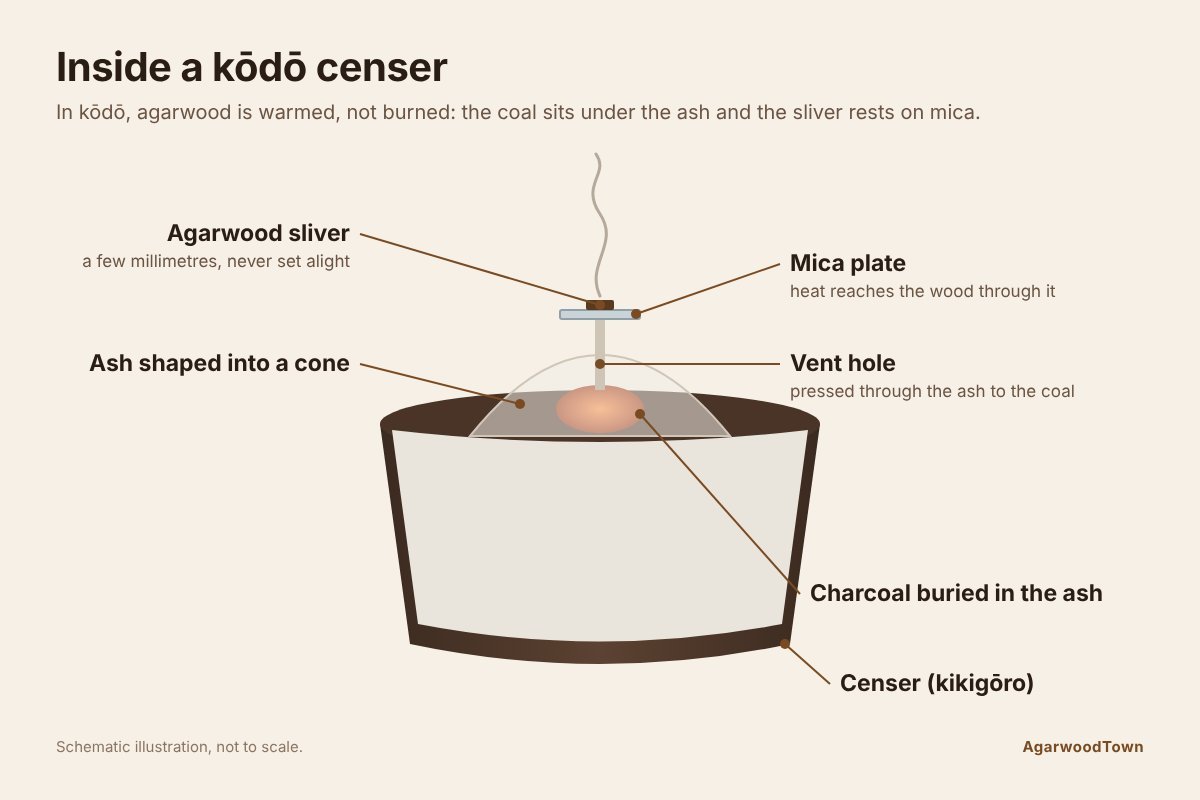
Participants pass a small censer from hand to hand. Inside, a sliver of wood sits on a thin mica plate above buried charcoal. The wood warms and releases its scent slowly, without smoke or flame.
When buyers outside Japan search for kodo incense, they usually mean one of two things. Either they want the wood used in the ceremony, or they want Japanese-style pressed incense, called koh, that carries the same aesthetic. We supply both, so this guide covers both sides.
Why "Listening" and Not Smelling
Kōdō practitioners do not say they smell incense. Instead, they "listen" to it, a practice called monkō (聞香). The word choice signals attention: the guest is meant to receive the fragrance quietly and reflect on it.
In practice, this changes how a guest holds the censer. One hand cups it, the other shields the top, and the guest draws in the scent with short, calm breaths. The aim is to follow how the aroma changes, not to judge it in one sniff.
For a supplier, that matters a great deal. A piece that smells fine on charcoal for three seconds may flatten after a minute of gentle heat. Kōdō exposes exactly that weakness.
Kōdō Among the Classical Arts
Kōdō is often listed alongside chadō (the tea ceremony) and kadō (flower arrangement) as one of Japan's classical arts of refinement.[1] However, it remains far smaller than the other two.
That small size has a practical consequence. Demand for true ceremonial wood is narrow but steady, and the buyers are knowledgeable. Meanwhile, the much larger market for everyday Japanese incense draws on the kōdō vocabulary and aesthetic.
2. How Did Kōdō Develop in Japan?
Kōdō grew out of Buddhist incense offerings and later became a refined pastime of the aristocracy and warrior class. It took its formal shape in the Muromachi period, roughly the fifteenth and early sixteenth centuries.[1]
From Temple Offering to Court Pastime
Incense reached Japan with Buddhism. Japan's early chronicle, the Nihon Shoki, records a piece of fragrant wood washing ashore on Awaji Island in 595, and it is usually read as agarwood.[1]
Agarwood never grew in Japan. Therefore every piece arrived by sea, through trade routes that ran from Southeast Asia and southern China. One famous log, known as Ranjatai, is still kept in the Shōsōin treasure house in Nara.
During the Heian period, court nobles blended kneaded incense and competed over their mixtures. Later, warrior-class patrons turned their attention to single pieces of fine wood. They compared pieces, named them and kept them as treasures.
By the Muromachi period, under shogun Ashikaga Yoshimasa and the Higashiyama cultural circle, these games and comparisons settled into a structured art. Rules for handling the censer, sequences of guests and scoring for incense games all date from this time.[1]
The Two Main Schools
Two schools trace their roots to that period. The Oie school, associated with the court noble Sanjōnishi Sanetaka, stresses literary appreciation and poetry. The Shino school, founded by Shino Sōshin, places more weight on formal etiquette and procedure.
Both schools still teach today, and both use the same core material: agarwood. Their differences lie in manners, game formats and atmosphere, not in the kind of wood they want. For a supplier, the specification is shared.
Kumikō and Genjikō: The Incense Games
Kōdō is not only quiet appreciation. In kumikō, guests pass a censer around, comment on the scent and try to identify it. Such games took shape in the fifteenth and sixteenth centuries; some test memory, while others follow sequences that hint at classic poems.
The best known is Genjikō. Five censers are prepared, and players decide which hold the same wood and which differ. Answers are recorded as geometric diagrams, the Genjikō-no-zu, which later became crests on kimono, lacquerware and pottery. A late-sixteenth-century text, the Ten Virtues of Kō, sums up why the practice was prized.
3. Kodo Incense Tools and What Each One Does
| Tool | Japanese name | What it does | Why it matters to the wood |
|---|---|---|---|
| Censer | Kōro (香炉) | Small cup that holds ash and a buried piece of charcoal | Sets the scale: only a tiny sliver fits on top |
| Fine ash | Hai (灰) | Packed and shaped into a cone over the charcoal | Ash depth controls how hot the plate becomes |
| Charcoal | Tadon or sumi (炭) | Small glowing charcoal buried inside the ash | Provides gentle, steady heat rather than flame |
| Mica plate | Ginyō (銀葉) | Thin square of mica, often edged in metal, set on the ash cone | Separates wood from heat so it warms and never burns |
| Tweezers and chopsticks | Ginyō-basami, kyōji | Place the mica plate and lift the wood sliver | Keep oils from fingers off the wood and the plate |
| Ash tools | Hai-oshi and feather brush | Press, pattern and tidy the ash cone | A clean, even cone gives even heating |
| Incense packets | Kōtsutsumi (香包) | Folded paper envelopes holding numbered slivers | Used in games where guests identify pieces blind |
Names and exact tool sets vary between schools; this table describes the common functions rather than one school's formal list.
The key tool is the mica plate. Because the wood never touches the charcoal, it releases its aroma by warming rather than burning. As a result, there is no smoke and no harsh, charred edge to hide behind.
That is why kōdō is such a strict test of agarwood. On open charcoal, as in Gulf bakhoor, even a modest chip can produce a satisfying cloud. On a mica plate, only resin with real depth keeps giving scent over several minutes.
Step-by-Step Process
4. How Does a Kōdō Session Work?
Prepare the censer
The host lights a small piece of charcoal and buries it in fine ash inside the kōro. The ash is then pressed into a neat cone, often marked with a simple pattern, and a vent is opened down to the charcoal so heat can rise.
Set the mica plate
With tweezers, the host places a thin mica plate on top of the cone. The plate sits over the vent and becomes a gentle hotplate. Its height above the charcoal decides how warm the wood will get, so hosts adjust the ash carefully.
Place the agarwood sliver
A sliver of agarwood, only a few millimetres across, goes onto the plate with chopsticks. Pieces are cut thin so they warm through evenly. In incense games the slivers come from numbered paper packets, and guests do not know which wood they are receiving.
Pass the censer and listen
Each guest receives the censer in turn, cups it in the left hand, shields it with the right and inhales quietly, usually three times. The guest then passes the censer on and reflects on the scent before speaking or writing.
Identify, compare or compose
In simple sessions guests just appreciate the wood. In incense games, called kumikō, they match pieces they heard earlier or link them to poetry. Genjikō, for example, uses patterns named after chapters of The Tale of Genji to record which samples matched.
Record the result
A recorder writes the answers on a formal sheet, sometimes in fine calligraphy. Scoring is gentle and the sheet may be given to the best listener. The record, rather than a winner, is what the session is remembered by.
5. The Six Countries and Five Tastes
| Category (rikkoku) | Name origin as usually explained | Character as traditionally described |
|---|---|---|
| Kyara (伽羅) | Not tied to one place; the highest tier of agarwood | Elegant and refined, with sweetness that shifts as it warms |
| Rakoku (羅国) | Usually linked to Siam (Thailand) | Sharp, clear and somewhat sweet |
| Manaka (真那賀) | Usually linked to Malacca | Light and fleeting, delicate |
| Manaban (真南蛮) | Named after "southern" foreign trade; sometimes linked to India's Malabar coast | Sweet but heavy, sometimes described as coarse |
| Sumotara (寸門多羅) | Usually linked to Sumatra | Sour at the start, with a lighter finish |
| Sasora (佐曽羅) | Origin uncertain | Cool and light, sometimes with a spicy edge |
The six names are traditional kōdō categories. Their links to real places are historical and partly uncertain; today the categories describe scent character rather than verified origin.
Kōdō sorts agarwood into six "countries" (rikkoku) and describes each piece by five "tastes" (gomi): sweet, sour, hot, salty and bitter.[1] Together the two lists are called rikkoku gomi, and they give practitioners a shared language.
The five tastes are borrowed from the palate, not the nose. Therefore they work as metaphors: a "salty" note might be mineral or marine, while a "bitter" note may suggest smoke or medicinal depth. Practitioners learn them by comparing pieces side by side over years.
How a Supplier Reads the System Today
We treat rikkoku gomi as a description system, not a sourcing system. A Japanese buyer may tell us they want something "close to manaka" or "with rakoku sharpness". That request tells us about aroma, not about the country the wood should come from.
In fact, modern agarwood chemistry supports that caution. Agarwood aroma comes from a large mix of sesquiterpenes and chromones, and the balance shifts with species, resin formation and age.[2] Two pieces from one plantation can fall into different kōdō categories.
So a sensible approach is to describe candidate pieces in plain aroma language first, then let the buyer, who knows their school's references, place them in the six-country system. We do not label our plantation Aquilaria sinensis as Rakoku or Manaka on any invoice.


6. What Grade of Agarwood Does Kodo Incense Use?
| Feature | Wood for kōdō ceremony | Agarwood for koh incense |
|---|---|---|
| Form | Solid wood cut into thin slivers | Powder or fine chips blended into pressed incense |
| Heating | Warmed on a mica plate, no flame | Lit and burned, or warmed in some formats |
| Typical grade (our scale) | A, AAA and kynam pieces with dense, even resin | D to B material, chosen for consistent aroma |
| What the buyer checks | Aroma development over minutes, cleanness, no off-notes | Batch consistency, particle size, burn behaviour |
| Order size | Small lots, selected piece by piece | Kilogram lots for production runs |
| Our starting price | Kynam wood from $0.89/g; AAA chips quoted by grade | Japanese koh incense from $6/g · MOQ 100 g |
Kōdō wants the top of the grading table. Because the wood is warmed, not burned, only pieces with dense, well-distributed resin give a full and changing aroma on the mica plate.[3] Lower grades tend to fade quickly or show a thin, woody note.
On our internal scale, ceremony buyers usually look at A, AAA and kynam. That scale is ours, not an ISO or CITES standard, and we explain it in our agarwood grading guide. A Japanese buyer will also apply their own judgement, piece by piece.
Jinkō vs Kyara on the Grading Table
In Japan, ordinary agarwood is jinkō (沈香), "sinking incense", while the finest tier is kyara. Kyara matches what Chinese buyers call kynam (奇楠). It is softer and waxier than ordinary resinated wood and gives a cool, sweet note even at low heat.[4]
On our grading table, kynam behaves differently from the start. A thin sliver often feels slightly tacky when cut, and it begins to release scent at a lower temperature than AAA jinkō. We sell plantation kynam wood as allocation only, quoted per enquiry, with list prices starting from $0.89/g.
AAA jinkō is the workhorse of most kōdō lots. It is dense, heavy and often sinks in water, and it holds aroma well on the plate. Our graded oud wood chips run from grade D to AAA, starting from $0.24/g with a 100 g MOQ, and ceremony buyers pick from the upper end.
7. Supplying Kōdō Schools and Koh Makers
Supplying kodo incense buyers is a different job from supplying bakhoor or oil buyers. Japanese customers want small, carefully selected lots, honest descriptions and the same character from one order to the next.
In the Japanese trade, much ceremony wood does not go to teachers directly. Instead, it passes through incense makers and wood dealers who cut slivers, assemble kōdō sets and produce koh incense. Those companies then serve schools, temples and retail shops. Our Japan market page outlines the main buyer types.
What Japanese Buyers Ask For
The first request is almost always a sample, heated by the buyer's own method. A Japanese buyer will place a sample sliver on their own mica plate at their own temperature. Therefore we expect our description to be tested, not trusted.
Next comes consistency. A koh maker building a product line needs the second and third shipments to match the first. For that reason they ask about the plantation block, the inoculation age and how the supplier sorts lots, not only about grade.
Finally, buyers ask about cleanliness. Ceremony wood should carry no added oil, no dye and no soaking. Moreover, it should be free of dust, bark and pale, unresinated wood that would add a raw, sappy note on the plate.
- Species and origin: plantation Aquilaria sinensis from Dian Bai, Guangdong, stated on the CITES export permit.
- Grade and selection: our D–AAA scale plus kynam; ask for photos of the actual lot.
- Treatment: ask for natural wood only, with no oil enhancement, for ceremony lots.
- Cut: agree the form in advance; many buyers prefer chips they slice themselves.
- Documents: grading note, CITES export permit where required and a GC-MS report on request.
How We Prepare Material for Japan
Founder Wang Jianyu grades wood for Japanese lots himself, using visual inspection, aroma, resin content and the sink test. For kōdō, a careful supplier adds one step: warming a thin sliver from each lot on a low-temperature plate and following the aroma over several minutes.
In the trade, pieces that open well and stay clean suit ceremony use, while pieces that start strong but turn flat or sharp are better suited to koh incense. That way, lower lots still have a home.
For koh makers we also supply milled agarwood powder from $10.30 per 50 g, and finished Japanese-style koh incense from $6/g with a 100 g MOQ. Buyers who want the top tier in pressed form can ask about our kyara-grade incense.
If you are comparing stick formats instead, our guide to agarwood incense sticks covers cored and coreless sticks, koh and kyara sticks in more depth. This post stays with the ceremony itself.
8. Paperwork for Shipping Agarwood to Japan
Kōdō wood is regulated like any other agarwood. All Aquilaria species have been listed in CITES Appendix II since 2004, so international trade in wood, chips and slivers usually needs export documents.[5]
- Export permit: we ship every wholesale order with a CITES Appendix II export permit wherever one is required.
- Small lots still count: a 100 g lot of ceremony slivers is still wood, so do not assume a small parcel is exempt.
- Annotation #14: the listing exempts some finished, retail-packaged products. Check the current annotation text before you plan, because annotations can change at CITES meetings.
- Japan side: confirm import requirements with the Japanese authorities or your customs broker before the first shipment.
- Grading note: each shipment carries our grading note or certificate, stating the grade.
Sourcing wood for kōdō or koh production?
Tell us whether you need ceremony slivers, chips to cut yourself, powder or finished koh, and we will propose a sample set. Paid, non-refundable samples start from 100 g of chips, and we reply within 4 business hours, Monday to Saturday, 9:00–18:00 China time.
Request a kōdō sample set → or read our replacement and credit policy first.
Frequently Asked Questions
Kodo incense refers to kōdō, the Japanese art of appreciating fragrant wood, mainly agarwood. A thin sliver is warmed on a mica plate above buried charcoal, and guests pass the censer and "listen" to the scent. The term is also used loosely for Japanese-style koh incense made in the same aesthetic tradition.
The verb used in kōdō, kiku, is the one for listening, and the practice is called monkō. It signals quiet, attentive reception rather than casual smelling. Guests follow how the aroma develops over time and reflect on it, much as a listener follows a piece of music.
No. The agarwood sliver sits on a thin mica plate that rests on a cone of ash, with glowing charcoal buried underneath. The wood warms gradually and releases its aroma without flame or smoke. That gentle heat is why kōdō exposes weak or oil-treated wood so clearly.
The six countries, or rikkoku, are kyara, rakoku, manaka, manaban, sumotara and sasora, traditional categories of agarwood. The five tastes, or gomi, are sweet, sour, hot, salty and bitter, used as metaphors for aroma. Together they give practitioners a shared vocabulary for describing each piece.
Kōdō uses the upper end of the grading table, because a warmed sliver only performs well when resin is dense and even. On our internal scale that usually means A, AAA and kynam. Lower grades suit pressed koh incense, where blending and burning compensate for lighter resin.
Broadly, yes. Kyara is the Japanese name for the top tier of agarwood, and kynam (奇楠) is the Chinese name for the same class of soft, waxy, highly aromatic wood. Grading conventions differ between markets, so always judge a sample yourself rather than relying on the label alone.
Yes, provided the piece is well resinated and clean. Plantation wood forms resin through the same defence response as wild wood, although its character can differ from old wild material. Ceremony lots are best selected by warming slivers on a plate, and Japanese buyers test samples by their own method.
Kōdō wood is solid agarwood cut into slivers and warmed on a mica plate. Koh incense is a pressed product made from agarwood powder and other ingredients, then shaped into sticks, cones or other forms. Koh is for everyday use and needs batch consistency; kōdō wood is selected piece by piece.
Usually, yes. Aquilaria is listed in CITES Appendix II, so wood, chips and slivers generally travel with an export permit, which we provide wherever required. Annotation #14 exempts some finished retail-packaged products, so check the current annotation text and confirm Japanese import rules before shipping.
Paid, non-refundable samples start from 100 g of chips, which is enough to test many slivers on your own plate. Oud wood chips have a 100 g MOQ, Japanese koh incense also starts at 100 g, and kynam is allocated per enquiry. We fix any problem by replacement or credit rather than returns.
No. Kōdō uses small slivers of agarwood warmed on a mica plate over hidden charcoal, never burned. Japanese incense sticks, or koh, are a separate everyday tradition. Both use agarwood, and we supply both: Japanese-style koh incense from $6/g with a 100 g MOQ, and graded chips for slicing.
References
- 1
- 2Naef R.. The volatile and semi-volatile constituents of agarwood, the infected heartwood of Aquilaria species: a review. Flavour and Fragrance Journal, 2011.View source
- 3Liu Y.Y., Wei J.H., Gao Z.H., et al.. A Review of Quality Assessment and Grading for Agarwood. Chinese Herbal Medicines, 2017.View source
- 4Yang D.-L., Wang H., Guo Z.-K., Li W., Mei W.-L., Dai H.-F.. Fragrant agarofuran and eremophilane sesquiterpenes in agarwood ‘Qi-Nan’ from Aquilaria sinensis. Phytochemistry Letters, 2014.View source
- 5
- 6Liu Y., Chen H., Yang Y., et al.. Whole-tree agarwood-inducing technique: an efficient novel technique for producing high-quality agarwood in cultivated Aquilaria sinensis trees. Molecules, 2013.View source
All scientific references are provided for transparency. AgarwoodTown summarises peer-reviewed findings for educational purposes and does not claim to provide medical or regulatory advice.
Wholesale Catalog
Buy the products discussed in this article


Related Articles
Source Direct from Origin
Discuss Your Requirements with Our Team
We respond within 24 hours. Share your target grade, quantity and destination — we'll send current pricing, a sample pack option, and CITES documentation details.