Aquilaria Species Guide: Sinensis, Malaccensis, Crassna, Subintegra and Gyrinops Compared
Buyers often treat agarwood as one material, yet the trade runs on several different trees. The Aquilaria species behind a lot of oud shapes its scent, its price logic and the name printed on its CITES permit. Five sources matter most in wholesale: A. sinensis, A. malaccensis, A. crassna, A. subintegra and the related genus Gyrinops. This guide maps where each grows, how its wood and oil tend to smell, which are planted at scale and how CITES covers all of them. We write as growers of plantation A. sinensis in Dian Bai, Guangdong.

Written by
Founder & Chief Sourcing Officer, AgarwoodTown
15+ years hands-on experience grading plantation agarwood, sourcing directly from Dianbai and Maoming districts in Guangdong — the world's largest Aquilaria sinensis cultivation region. Wang has personally inspected thousands of CITES export shipments and holds plantation certification from China's National Forestry and Grassland Administration. He advises GCC, European and East Asian wholesale buyers on grade selection, CITES compliance and supply chain due diligence.
CITES Certified
In this article
- What Are Aquilaria Species? The Short Answer
- Aquilaria and Gyrinops: Two Genera, One Product
- Identifying Species: From Leaves to DNA
- Which Aquilaria Species Matter in the Agarwood Trade?
- Where Does Each Aquilaria Species Grow?
- Aquilaria sinensis — Southern China
- Aquilaria malaccensis — India to the Malay World
- Aquilaria crassna — Mainland Southeast Asia
- Aquilaria subintegra — Thailand
- Gyrinops Species — Eastern Indonesia, New Guinea and Sri Lanka
- How Do Aquilaria Species Differ in Scent?
- Species vs Processing: Which Matters More?
- Species Name vs Origin Label: What Should an Invoice Say?
- Which Aquilaria Species Are Cultivated?
- Plantation Countries by Species
- Why Plantations Changed the Supply
- How Does CITES Cover Aquilaria Species?
- How to Specify Aquilaria Species When You Order
- Frequently Asked Questions
1. What Are Aquilaria Species? The Short Answer
Aquilaria species are the trees that produce most of the world's agarwood. The genus belongs to the family Thymelaeaceae and holds around twenty accepted species, native from northeast India across Southeast Asia to southern China and New Guinea.[1]
The numbers explain the price. According to Liu et al. (2013), only about 10% of Aquilaria trees produce agarwood without human help, so most supply today comes from induced, cultivated trees.[7]
Not every species matters to the trade. A handful form resin readily, grow where agarwood has a long tradition, or have been planted in large numbers. Therefore, most commercial oud you will meet traces back to five names.
However, species is only half the story. A healthy Aquilaria tree holds almost no scent. Oud forms only where the tree has been wounded and has filled the damaged wood with resin.
So species sets the starting chemistry, while wounding, time and processing decide what reaches your warehouse. Keep both in mind when you read a supplier's description.
Aquilaria and Gyrinops: Two Genera, One Product
Gyrinops is a smaller, closely related genus in the same family. Its species grow mainly in eastern Indonesia, New Guinea and Sri Lanka, and they also form resinous wood that the trade sells as agarwood or gaharu.[2]
Commercially, the two genera travel together. CITES lists both, Indonesian traders sell both, and a lab report on the resin shows the same broad compound families. In practice, the genus matters most when a permit or invoice has to name the source correctly.
One naming trap is worth knowing early. Older texts call the tree of northeast India Aquilaria agallocha. Botanists now treat that name as a synonym of A. malaccensis, so documents using either name usually describe the same species.[3]
Identifying Species: From Leaves to DNA
Botanists separate Aquilaria species by leaves, flowers and fruit, but the differences can be small. That is why research groups increasingly use DNA barcodes, such as the matK gene region, to confirm a species.
For a buyer, the practical step is simpler: the CITES permit must name the species, and a reputable supplier should be able to say how that was confirmed. Our guide on how to identify an agarwood tree covers the field checks.
2. Which Aquilaria Species Matter in the Agarwood Trade?
| Species | Native range | Common trade names | Planted at scale? |
|---|---|---|---|
| Aquilaria sinensis | Southern China: Guangdong, Hainan, Guangxi, Fujian | Chén xiāng (沉香), bái mù xiāng (白木香), Chinese or Hainan agarwood | Yes — widely planted in southern China, including our Dian Bai plantation |
| Aquilaria malaccensis | Northeast India and Bangladesh through Myanmar, Thailand, Malaysia, Sumatra, Borneo and the Philippines | Hindi or Assam oud, gaharu, aloeswood in older texts | Yes — plantations in northeast India, Bangladesh, Malaysia and Indonesia |
| Aquilaria crassna | Cambodia, Laos, Thailand and Vietnam | Cambodian, Lao or Vietnamese oud; trầm hương in Vietnam | Yes — a major plantation species across mainland Southeast Asia |
| Aquilaria subintegra | Thailand | Thai oud, often sold simply as "subintegra" oil | Yes — planted in Thailand and Malaysia |
| Gyrinops (e.g. G. versteegii, G. walla) | Eastern Indonesia, New Guinea, Sri Lanka | Gaharu, Indonesian or Papua agarwood | Partly — planting programmes in eastern Indonesia |
| Other Aquilaria (e.g. A. microcarpa, A. beccariana, A. hirta, A. filaria) | Borneo, Sumatra, the Malay Peninsula, New Guinea | Usually sold under regional names without species separation | Mostly wild-harvested; smaller planted areas |
Ranges are simplified, and plantation areas change quickly. Legally, the species and source named on the CITES permit count — not the trade name on the label.
3. Where Does Each Aquilaria Species Grow?
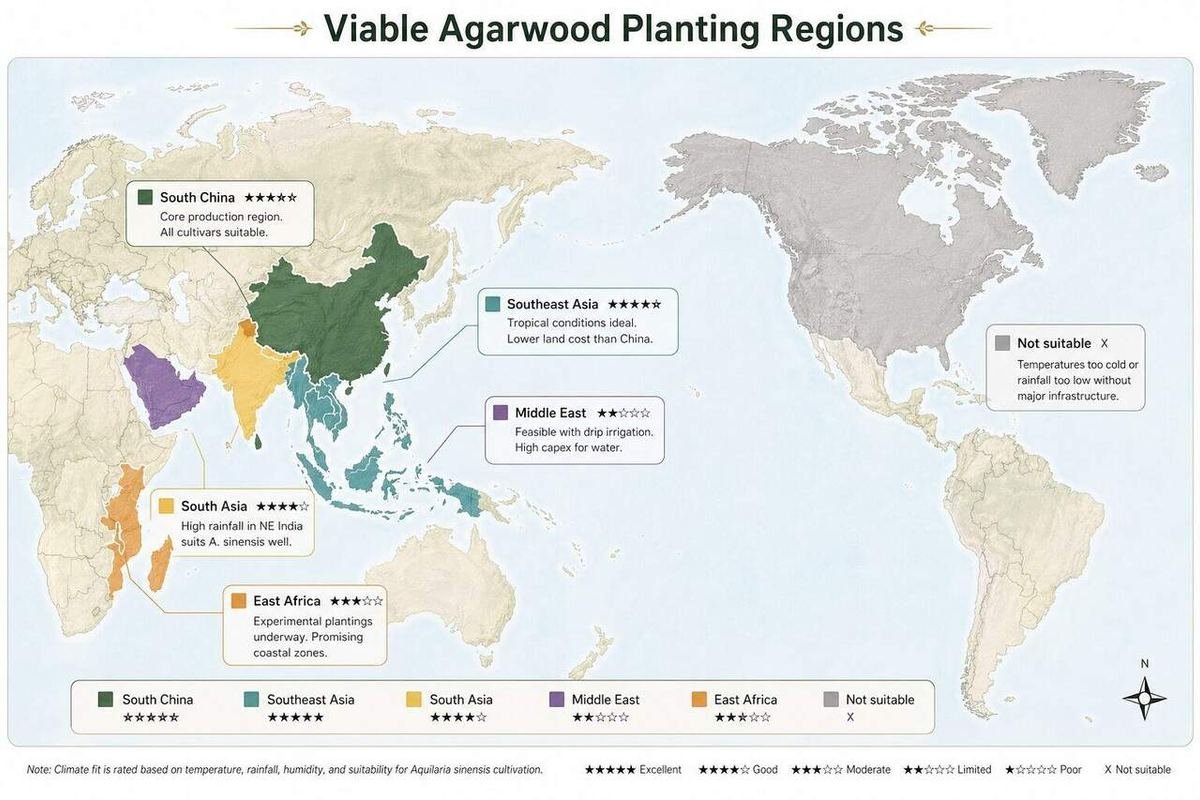
Each commercial species has a home range, and most of the trade's regional names follow those ranges. However, plantations now carry several species well beyond their native areas, so geography alone no longer proves species.
Aquilaria sinensis — Southern China
Aquilaria sinensis is the main agarwood species native to China. It grows in the hills and lowlands of Guangdong, Hainan, Guangxi and Fujian, and Chinese buyers know its resinous wood as chén xiāng.[1]
It is also our species. Our 100+ mu plantation in Guan Zhu Town, Dian Bai District, Maoming, sits inside its native range, and we inoculate our own trees artificially. In addition, we work with more than 100 contracted plantation farmers.
Hainan agarwood is the same tree. Its reputation comes from place, history and old wild stock, not from a separate species. Therefore a buyer who wants "Hainan" quality is really asking about origin and resin age.
Aquilaria malaccensis — India to the Malay World
Aquilaria malaccensis has the widest range of the commercial species. It runs from Assam and Bangladesh through Myanmar and Thailand to Peninsular Malaysia, Sumatra, Borneo and the Philippines.[3]
This is the species behind the "Hindi" oud that Gulf buyers prize, and behind much of the Malaysian and Indonesian gaharu trade. It was also the first Aquilaria species to be listed by CITES, after decades of heavy wild harvesting.
For the Malay and Indonesian side of this story, see our gaharu guide for the Malay and Indonesian trade. We do not repeat its grade names here.
Aquilaria crassna — Mainland Southeast Asia
Aquilaria crassna grows in Cambodia, Laos, Thailand and Vietnam.[1] It supplies most of the oil sold as Cambodian, Lao or Vietnamese oud, and much of Vietnam's carving and kynam trade.
Moreover, crassna is now one of the most widely planted species in the region. If you are weighing it against our stock, our article on how Cambodian crassna oil compares with Chinese sinensis covers the oil side in detail.
Aquilaria subintegra — Thailand
Aquilaria subintegra is native to Thailand. It is less famous than crassna, yet it has become a familiar plantation species in Thailand and Malaysia, and some distillers sell its oil under the species name itself.
Published documentation on subintegra is thinner than on the three big species. Consequently, buyers should lean on samples and supplier records rather than on general descriptions.
Gyrinops Species — Eastern Indonesia, New Guinea and Sri Lanka
The Gyrinops genus covers a small group of species. G. versteegii is the best known in Indonesian trade, while G. walla grows in Sri Lanka.[2]
Gyrinops wood usually reaches buyers as gaharu from the eastern Indonesian islands and Papua. Although it forms resin by the same defence response, lots vary widely between islands, so a sample matters even more here.
4. How Do Aquilaria Species Differ in Scent?
Species gives each oud a recognisable family resemblance, but it never acts alone. Broadly, the trade describes sinensis as sweet and cool, crassna as fruity, Indian malaccensis as deep and animalic, and Gyrinops as lighter.
Chemistry explains part of the pattern. Analyses of agarwood from different Aquilaria species report the same main compound families — sesquiterpenes and 2-(2-phenylethyl)chromones — in different proportions and with different minor constituents.[4]
The table below uses common trade language, not lab standards. For a fuller vocabulary of oud notes, our guide to describing what oud smells like goes deeper.
| Source | Oil, as the trade describes it | Heated chips | Main caveat |
|---|---|---|---|
| A. sinensis (China) | Sweet, cool, lightly honeyed and resinous; usually cleaner than Indian styles | Sweet, cool smoke; high grades turn dense and long-lasting | Profile shifts with inoculation method and resin age |
| A. malaccensis (India, Bangladesh) | Deep, leathery, often animalic or "barnyard" | Rich and dark, sometimes sharp | Much of the animalic note comes from long soaking before distillation |
| A. malaccensis (Malaysia, Indonesia) | Woody, earthy, sometimes smoky | Warm and woody, varies by region | Lots from Borneo and Sumatra may mix several species |
| A. crassna (Cambodia, Vietnam, Laos) | Fruity, sweet, jammy and bright | Sweet, fruity, rounded | Country labels cover a very wide quality range |
| A. subintegra (Thailand, Malaysia) | Sweet and fruity, often compared with crassna | Sweet, light to medium body | Less published data; judge by sample |
| Gyrinops (eastern Indonesia, New Guinea) | Lighter, sweet-woody, sometimes green | Softer than heavy Aquilaria wood | Quality varies widely by island and supplier |
Common trade descriptions only. Two oils from the same species can differ more than two oils from different species, because grade, resin age and distillation change the result.
Species vs Processing: Which Matters More?
In most purchases, processing and grade outweigh species. On our own grading table, sinensis from different blocks and resin ages already spans a wide range, from light D-grade wood to dense AAA pieces.
Four factors usually move the scent more than the tree does:
- Resin content. Our internal scale runs D, C, B, A and AAA, with Kynam above it on allocation only. A grade jump changes depth and length far more than a species swap.
- Resin age. Older resin zones smell rounder; young induced resin tends to read brighter and thinner.
- Extraction route. Hydro-distillation and supercritical CO₂ pull different fractions from the same wood. Our hydro-distilled oud oil starts at $7.00/g, while our CO₂ agarwood oil starts at $1.50/g, both with a 10 g MOQ.
- Soaking and fermentation. Long pre-distillation soaking, common in Indian practice, adds much of the animal character buyers link to "Hindi" oud.
Therefore, if you need "a crassna-style oil", describe the target profile to your supplier first. Species alone will not tell you whether a given lot fits your formula.


5. Species Name vs Origin Label: What Should an Invoice Say?
| Feature | Species name (e.g. Aquilaria sinensis) | Origin or style label (e.g. "Cambodian", "Hindi") |
|---|---|---|
| What it describes | The botanical tree that formed the resin | A country, region or scent style |
| Legal weight | Required on CITES permits and customs paperwork | None on its own; a marketing description |
| How you verify it | Export permit, plantation records, supplier declaration | Supplier statement, sometimes harvest paperwork |
| What it predicts | A broad scent family and chemistry | A style that may be made from more than one species or origin |
| Risk of misuse | Low when the permit matches the goods | High; "Cambodian" or "Hindi" is sometimes used as a style name for oil made elsewhere |
| Best use | Contracts, permits and compliance files | Product naming for end customers, when it is true |
6. Which Aquilaria Species Are Cultivated?
Four Aquilaria species and at least one Gyrinops species are now planted at commercial scale. The main ones are sinensis in China, crassna in mainland Southeast Asia, malaccensis from northeast India to Indonesia, and subintegra in Thailand and Malaysia.
Cultivation grew because wild supply could not keep up. Collectors had felled many wild trees to find the few that held resin, and wild Aquilaria populations declined across their range. Growers then learned to induce resin in planted trees on purpose.[5]
Plantation Countries by Species
- China: A. sinensis, mainly in Guangdong, Hainan and Guangxi. Dian Bai and the wider Maoming area form one of the long-established growing districts.
- Vietnam, Cambodia, Laos, Thailand: mainly A. crassna, with A. subintegra also common in Thailand.
- Northeast India and Bangladesh: A. malaccensis, often grown around homesteads and small holdings as well as in larger blocks.
- Malaysia and Indonesia: A. malaccensis and A. subintegra, plus Gyrinops versteegii in eastern Indonesia.
Plantation areas also exist outside Asia's native ranges. However, the volumes that reach wholesale buyers still come overwhelmingly from these countries.
Why Plantations Changed the Supply
Cultivated trees made agarwood plannable. A grower knows the species, the planting year and the induction date of each block, which a wild collector never could.[5]
The induction method then decides much of the outcome. Drilling, chemical inducers, fungal inoculants and whole-tree infusion all produce resin, but at different speeds and patterns. Our separate guide to agarwood inoculation methods explains those trade-offs.
For growers choosing what to plant, species choice usually follows climate and local market. Our article on Aquilaria cultivars and seedling selection covers that decision. We sell Aquilaria sinensis seedlings for new plantations at $15 per plant, MOQ 10, shipped with a phytosanitary certificate.

7. How Does CITES Cover Aquilaria Species?
CITES covers every Aquilaria species and every Gyrinops species. Both genera are listed in Appendix II, so international trade in their wood, oil and many products needs permits showing legal and sustainable origin.[6]
- History: A. malaccensis was listed first. The listing was extended to all Aquilaria and Gyrinops species in 2004, partly because traders and customs officers could not reliably tell the species apart.
- Plantation wood is still covered: cultivated origin does not take material out of Appendix II. Instead, the permit records the source, so plantation stock is documented differently from wild stock.
- The species must match: the permit names the species. If your invoice says crassna and the permit says sinensis, expect questions at import.
- Annotation #14: the listing exempts some finished, retail-packaged products. Check the current annotation text before you plan a shipment.
- Our shipments: every wholesale order ships with a grading note and a CITES Appendix II export permit where required. Plants also travel with a phytosanitary certificate.
Importing countries may add their own layer; the EU, for instance, applies CITES through its own wildlife trade regulation. For the full paperwork sequence, read our step-by-step CITES agarwood permit walkthrough.
Step-by-Step Process
8. How to Specify Aquilaria Species When You Order
Decide whether species matters to your customer
Some buyers sell by scent and grade only. Others, especially perfumers and collectors, sell by species or origin. Settle this first, because it decides how much documentation you need from the supplier and what you can honestly print on your own labels.
Write the species into the enquiry
Name the species in Latin, not only the trade name. "Aquilaria sinensis, plantation origin, Grade B chips" leaves far less room for confusion than "Chinese oud". Ask the supplier to repeat the same wording on the quotation and the proforma invoice.
Ask where and how the wood was grown
Ask for the country and region, whether the material is plantation or wild, and how the resin was induced. A plantation supplier should answer all three plainly. Vague answers on origin are a reason to slow down, not to negotiate harder on price.
Test a paid sample against your reference
Order a sample before volume. Our samples start from 100 g of chips or 1 g of oil; they are paid and non-refundable. Compare the sample with a reference you already trust, ideally side by side, heated or on a blotter, and note how it changes over a few hours.
Request a GC-MS report for oils
A GC-MS report will not prove species on its own, but it shows whether the oil carries typical agarwood marker compounds. We provide GC-MS reports on request. Keep the report with the lot number so you can compare future orders.
Check the permit against the goods
When the shipment documents arrive, confirm that the species, quantity and product type on the CITES permit match the invoice and the packing list. Mismatches are far easier to correct before the goods leave than after they reach your customs.
Comparing species for your next order?
Tell us which species or style you currently buy, your market and your target grade. We will suggest a sinensis sample set to test against it, and we reply within 4 business hours, Monday to Saturday, 9:00–18:00 China time.
Ask for a species comparison sample → or start with our graded oud wood chips, from $0.24/g with a 100 g MOQ across grades D–AAA.
Frequently Asked Questions
Botanists currently accept around twenty Aquilaria species, native from northeast India across Southeast Asia to southern China and New Guinea. Only a few of them dominate the agarwood trade: A. sinensis, A. malaccensis, A. crassna and A. subintegra, together with the related genus Gyrinops. Species counts shift a little as taxonomists revise names and synonyms.
No species is best in every use. Gulf buyers often prize Indian malaccensis oils for depth, perfumers like crassna for its fruity sweetness, and Chinese and Japanese buyers value sinensis for its sweet, cool character. Within any species, resin content, resin age and processing make a bigger difference than the tree itself.
No. Hainan agarwood comes from Aquilaria sinensis, the same species that grows in Guangdong, Guangxi and Fujian. Its reputation rests on the island's history, climate and old wild stock rather than on a separate tree. When a seller quotes Hainan origin, ask for documents that support the location claim.
They are two closely related genera in the family Thymelaeaceae. Botanists separate them by flower structure. Both form aromatic resin after wounding, and both are sold as agarwood or gaharu. Gyrinops grows mainly in eastern Indonesia, New Guinea and Sri Lanka, and CITES lists it in Appendix II alongside Aquilaria.
Usually not. Aquilaria agallocha is an older name for the agarwood tree of northeast India, and botanists now treat it as a synonym of Aquilaria malaccensis. You will still see it in older literature, traditional texts and some product descriptions. On a CITES permit, expect the accepted name, A. malaccensis.
Yes. All Aquilaria and Gyrinops species are listed in CITES Appendix II, and this has applied genus-wide since 2004. Appendix II does not ban trade; it requires permits showing legal and sustainable origin. Plantation material is covered too. Annotation #14 exempts some finished retail-packaged products, so check the current annotation text.
Experienced noses can often guess the style, but smell alone cannot prove species. Soaking time, distillation method, resin grade and blending all shift the profile, and some oils are styled to imitate another origin. Treat smell as a first check, then rely on the supplier's documents, the CITES permit and a GC-MS report.
We grow Aquilaria sinensis on our own 100+ mu plantation in Guan Zhu Town, Dian Bai District, Maoming, Guangdong, and we induce resin by artificial inoculation. The species is named on the CITES export permit for each shipment, so you always know what you are buying. We do not sell wild agarwood.
Usually the species native to your region, because it is adapted to the climate and buyers nearby already know its scent. In southern China that is sinensis; in mainland Southeast Asia it is mostly crassna. Check local rules on planting material and CITES registration of plantations before you buy seedlings in volume.
References
- 1
- 2Nasution A.A., Siregar U.J., Miftahudin, Turjaman M.. Identification of chemical compounds in agarwood-producing species Aquilaria malaccensis and Gyrinops versteegii. Journal of Forestry Research, 2019.View source
- 3Barden A., Anak N.A., Mulliken T., Song M.. Heart of the Matter: Agarwood Use and Trade and CITES Implementation for Aquilaria malaccensis. TRAFFIC International, 2000.View source
- 4Naef R.. The volatile and semi-volatile constituents of agarwood, the infected heartwood of Aquilaria species: a review. Flavour and Fragrance Journal, 2011.View source
- 5Azren P.D., Lee S.Y., Emang D., Mohamed R.. History and perspectives of induction technology for agarwood production from cultivated Aquilaria in Asia. Journal of Forestry Research, 2018.View source
- 6
- 7Liu Y., Chen H., Yang Y., et al.. Whole-tree agarwood-inducing technique: an efficient novel technique for producing high-quality agarwood in cultivated Aquilaria sinensis trees. Molecules, 2013.View source
All scientific references are provided for transparency. AgarwoodTown summarises peer-reviewed findings for educational purposes and does not claim to provide medical or regulatory advice.
Wholesale Catalog
Buy the products discussed in this article


Related Articles
Essential Oil
Cambodian Oud Explained: Aquilaria crassna vs Chinese Sinensis Oil for Wholesale Buyers
13 min read
Education
Gaharu Explained: A Plantation Grower's Guide to Agarwood in the Malay Trade
13 min read
Plantation
Agarwood Plant Seedlings Wholesale 2026: 6 Proven Aquilaria sinensis Cultivars, Planting Guide
17 min read
Source Direct from Origin
Discuss Your Requirements with Our Team
We respond within 24 hours. Share your target grade, quantity and destination — we'll send current pricing, a sample pack option, and CITES documentation details.