How to Identify Agarwood Tree Species: A Grower's Step-by-Step Field Guide
Buyers who visit an agarwood plantation usually ask two questions before they reach the first row. Which trees are agarwood, and which of them hold oud? This guide answers the first question step by step, because knowing how to identify agarwood tree species starts with five things you can check by eye. Then it answers the second, harder question. A healthy Aquilaria tree holds no resin at all, so we also show how growers like us look for it.

Written by
Founder & Chief Sourcing Officer, AgarwoodTown
15+ years hands-on experience grading plantation agarwood, sourcing directly from Dianbai and Maoming districts in Guangdong — the world's largest Aquilaria sinensis cultivation region. Wang has personally inspected thousands of CITES export shipments and holds plantation certification from China's National Forestry and Grassland Administration. He advises GCC, European and East Asian wholesale buyers on grade selection, CITES compliance and supply chain due diligence.
CITES Certified
In this article
- How to Identify Agarwood Tree Species: The Short Answer
- Before You Start
- Step 1 — Check the Agarwood Leaf
- Agarwood Tree Leaves: Shape, Size and Veins
- Leaves That Fool Beginners
- Step 2 — Read the Bark and the Inner Fibre
- Step 3 — Confirm With Agarwood Leaves and Fruits
- Step 4 — Narrow Down the Species
- Step 5 — Check Whether the Tree Holds Resin
- Healthy Tree vs Resin-Forming Tree
- Common Mistakes When You Identify an Agarwood Tree
- How We Use This on Our Plantation
- When a Field Check Is Not Enough
- Frequently Asked Questions
1. How to Identify Agarwood Tree Species: The Short Answer
Here is how to identify agarwood tree stock in one line: check the leaf, the bark, the flowers and fruit, then the source papers. When four clues agree, you are almost certainly looking at Aquilaria, the genus behind nearly all traded agarwood.
Scarcity starts in the forest. According to a 2013 study in Molecules (Liu 2013), agarwood forms naturally in only about 10% of Aquilaria trees, which is why plantations now induce resin on purpose.[6]
We suggest the same order to every buyer. First the agarwood leaf, because it is there all year. Then the bark and its tough inner fibre. Then flowers and fruit, if the season allows. Finally, we check what the grower or nursery says about species and origin.
None of this tells you whether a tree holds oud. Resin forms only after a wound and an infection, so a perfectly identified tree can still be worth only its timber. Step 5 covers that second question.
Before You Start
You need very little: a hand lens, a phone camera and permission from the owner. Take photos of the whole tree, the trunk, both sides of a leaf and anything on the ground below.
Please do not peel bark or cut wood on a tree that is not yours. Every wound lets microbes in, and on a plantation we make such wounds on purpose. On someone else's tree, it is simply damage.
2. Step 1 — Check the Agarwood Leaf
The agarwood leaf is the best first clue. It is simple, smooth-edged, leathery and glossy, and it sits alternately along the twig rather than in pairs.
Agarwood Tree Leaves: Shape, Size and Veins
On our own species, Aquilaria sinensis, the leaves run from obovate to elliptic. They are typically 5 to 11 cm long and 2 to 4 cm wide.[1] The tip comes to a short point, and the upper side shines in sunlight.
Now turn the leaf over and hold it to the sky. You should see 15 to 20 pairs of fine side veins leaving the midrib almost in parallel.[1] They are faint, so a hand lens helps. In our experience, this vein pattern is the single most useful leaf clue.
Agarwood tree leaves also tell you little about value. A tree with a full, glossy crown may hold no resin at all, while a tree with thin foliage may be reacting to a deep wound.
Leaves That Fool Beginners
Many tropical trees have a glossy, pointed, smooth-edged leaf. Therefore leaf shape alone is never enough, especially in a mixed hedge or garden.
If the side veins are few and widely spaced, or the leaves sit in opposite pairs, look again. In that case, move on to the bark and fruit before you decide.

3. Step 2 — Read the Bark and the Inner Fibre
Aquilaria bark is smooth and pale, grey to light brown, on young and middle-aged trunks. Its inner bark is the real giveaway: tough, stringy fibre that peels in long strips.
That fibre is a family trait. Aquilaria belongs to the Thymelaeaceae, a family known for strong bast fibre. So when a fallen twig refuses to snap cleanly and leaves long threads instead, it supports your identification.
Colour, however, is a weak clue on its own. Older trees in damp sites carry moss and lichen, and the same trunk can look quite different after a wet season. Use bark to confirm the leaf, not to replace it.
The wood under the bark is pale yellowish-white, light and almost scentless. On a healthy tree, it stays that way right through the trunk. That plain wood makes up most of any trunk, even one that has formed resin.
Use a fallen twig, not a living trunk
To check the fibre without harming a tree, pick up a fallen twig or a dead branch from the ground and bend it. If it shreds into long, tough threads, that fits Aquilaria. We recommend this to anyone checking a tree, instead of peeling bark.
4. Step 3 — Confirm With Agarwood Leaves and Fruits
Agarwood leaves and fruits together give the strongest field identification. The flowers are small, fragrant and yellowish-green, in clusters at the tips of shoots or in the leaf axils.[1] They are easy to miss outside the season.
The fruit lasts longer as a clue. In A. sinensis it is a woody, egg-shaped capsule about 2.5 to 3 cm long, covered in short grey hairs. When ripe, it splits into two flat valves. Usually one seed, sometimes two, hangs from a silky thread inside.[1]
So check the ground under the crown. A split two-valved capsule there can confirm a tree long after the flowers have gone. Collect seed promptly if you need it, because Aquilaria seed loses viability quickly.
That short viability is also why most plantations, ours included, raise nursery seedlings instead of sowing seed straight into the field. Our agarwood seed guide explains germination in detail.
| Clue | What to look for on Aquilaria | Common trap |
|---|---|---|
| Growth habit | Evergreen tree, about 6–20 m when mature, with a straight trunk | Young plantation trees look like many tropical saplings |
| Agarwood leaf | Alternate, leathery, glossy, smooth-edged; 5–11 cm long | Many evergreens share this basic shape |
| Leaf veins | 15–20 pairs of fine, near-parallel side veins | Faint; hold the leaf to the light |
| Bark | Smooth, pale grey to light brown | Moss, lichen and age change the colour |
| Inner fibre | Tough, stringy strips from twigs and bark | Do not peel bark on trees you do not own |
| Flowers | Small, fragrant, yellowish-green, clustered | Seasonal, so most visits see none |
| Fruit | Hairy capsule, 2.5–3 cm, splitting into two valves | Falls fast; check the ground |
| Wood | Pale, light and almost scentless when healthy | Says nothing about resin elsewhere in the trunk |
Measurements are for Aquilaria sinensis, the species we grow. Other Aquilaria species are broadly similar but differ in detail, so treat this as a field checklist, not a botanical key.
5. Step 4 — Narrow Down the Species
| Species | Native range | Field notes | Where buyers meet it |
|---|---|---|---|
| Aquilaria sinensis | Southeast China, including Hainan | 6–20 m tree; hairy two-valved capsule; leaves 5–11 cm | Chinese plantations, chén xiāng (沉香) trade, our own stock |
| Aquilaria malaccensis | Northeast India to Malaysia and Indonesia | Can grow into a large forest tree; similar leaf form | Indian, Malaysian and Indonesian oud and gaharu |
| Aquilaria crassna | Cambodia, Laos, Thailand, Vietnam | Similar leaves; separated mainly by flower and fruit detail | Cambodian and Vietnamese oud |
| Aquilaria microcarpa | Borneo and Sumatra | Often confused with malaccensis in the field | Indonesian gaharu lots |
| Gyrinops spp. | Eastern Indonesia, Papua New Guinea, Sri Lanka | Related genus in the same family; also forms agarwood | Smaller share of trade, often sold as gaharu |
Broad, well-documented differences only. In the field, Aquilaria species overlap heavily, and even researchers find that leaf-and-bark sorting does not always match DNA results.
Species is where field identification gets honestly hard. Leaf shape, bark and habit overlap, so botanists separate species mainly by flowers and fruit.
A 2022 study in North Aceh, Indonesia, shows how hard. Researchers sorted 66 trees by leaf and bark into A. beccariana, A. malaccensis and A. microcarpa. Yet one DNA marker placed all of them in A. malaccensis.[2] If trained researchers disagree with their own DNA results, a buyer with a phone camera should be careful.
For trade, therefore, species comes from the source and its documents. We name A. sinensis on every invoice and CITES permit. Chemical work on A. malaccensis and Gyrinops also shows that the wood from different genera is not identical, which is one more reason to know what you are buying.[3] Our guide to Aquilaria species compares the main ones in more depth.
Step-by-Step Process
6. Step 5 — Check Whether the Tree Holds Resin
Confirm the tree first
Run steps 1 to 4 before you look for resin. Dark, damaged wood on the wrong species means nothing, and many trees darken around wounds in ways that look similar from a distance.
Walk around the trunk and look up
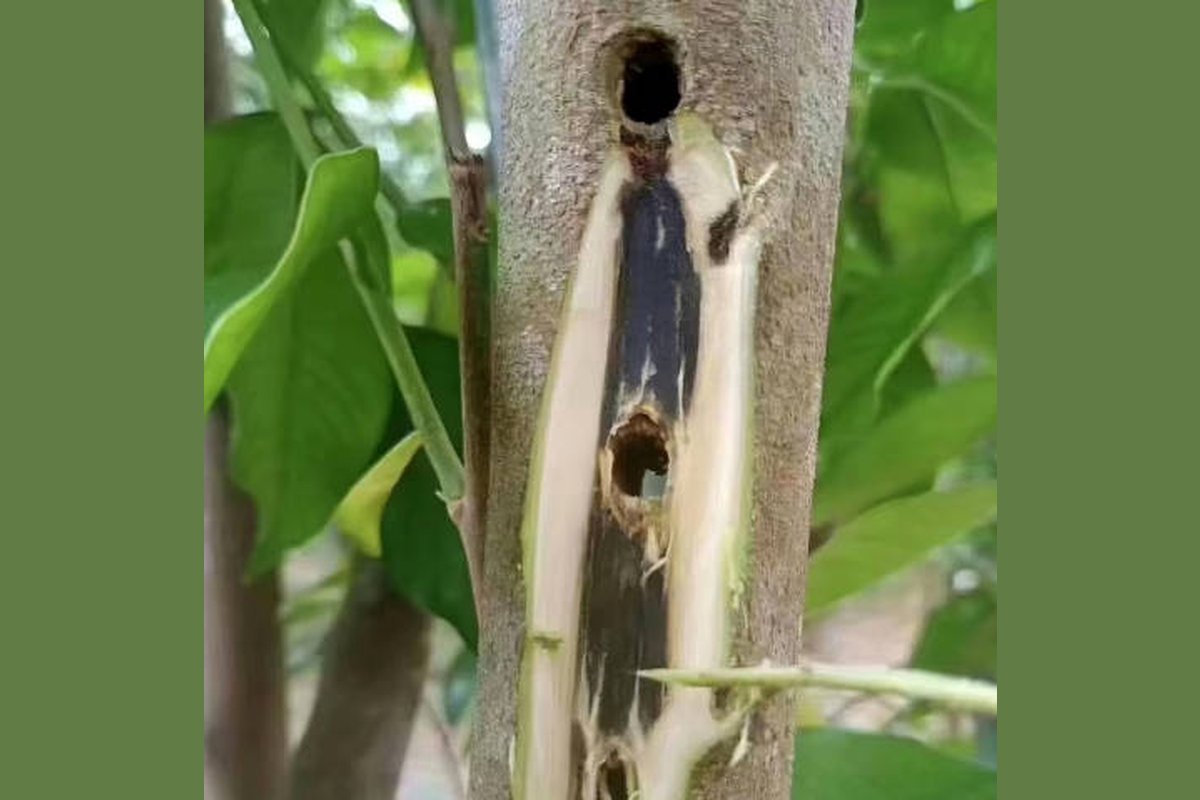
Look for old wounds: broken limbs, scars, insect holes and drill holes. Resin forms where the tree has been injured and infected, so these are the only places worth a closer look.
Read the wound edges
At a resin-forming wound, the exposed wood turns brown to black instead of staying pale. On inoculated plantation trees, growers check the rims of each drill point for this colour change.
Make one small test cut, on your own tree
A shallow cut or a thin core beside a wound shows whether the wood beneath has darkened. Keep it small and clean, because each cut is another wound the tree must deal with.
Warm a sliver and smell it
Heat a thin sliver of the dark wood gently. Resinated wood gives a sweet, woody, resinous scent; plain Aquilaria wood smells only of warm sawdust. Aroma is also one of the four tests on our grading table.
Accept that only harvest shows the volume
Surface signs prove resin is present, not how much. The true amount and grade appear only when the trunk is opened and the pale wood is carved away. That is why we never price a standing tree as if it were graded wood.
Plantations exist because natural resin is so unreliable. Growers wound trees on purpose, by drilling, by inserting an inoculant or by infusing the whole tree, so the defence response starts on a known schedule.[4] Even so, resin builds slowly and unevenly around each wound.
Dieback deserves a warning. A branch dying back near a wound can mean a strong defence response. However, drought, root rot and poor soil look exactly the same, with no oud inside. We treat dieback as a reason to inspect, never as proof.


7. Healthy Tree vs Resin-Forming Tree
| Feature | Healthy Aquilaria tree | Resin-forming Aquilaria tree |
|---|---|---|
| Leaves and crown | Full, glossy foliage | Often normal; sometimes thinning near a wound |
| Trunk surface | Smooth, intact bark | Old wounds, scars, insect holes or drill points |
| Wood at a wound | Pale yellowish-white | Brown to black streaks spreading from the wound |
| Weight of the wood | Light and soft | Heavier where resin fills the fibres |
| Warmed sliver | Faint warm-sawdust smell | Sweet, woody, resinous scent |
| Value | Timber and planting value only | Set by resin extent and grade, known at harvest |
| Export papers | Still Aquilaria, so still CITES Appendix II | CITES Appendix II plus a grading note when sold as oud |
8. Common Mistakes When You Identify an Agarwood Tree
Most mistakes we see come from mixing up two questions: "is this Aquilaria?" and "does it hold oud?". Here are the ones that cost buyers money.
- Trusting one clue. A glossy leaf or pale bark proves nothing alone. Use at least three clues from the checklist above.
- Grading a tree by its outside. Healthy Aquilaria bark and leaves have little scent. Resin inside a living trunk does not perfume the air in any reliable way.
- Buying standing trees on promises. Nobody can guarantee the resin in an uncut trunk. Treat any promised yield or return with great caution.
- Ignoring paperwork. All Aquilaria species sit in CITES Appendix II, which covers wood, oil and live plants in international trade.[5] Seedlings also need a phytosanitary certificate.
- Accepting vague species names. "Agarwood tree" is not a species. Ask the seller to name it, and to say where and how the tree was raised.
How We Use This on Our Plantation
On our 100+ mu plantation in Guan Zhu Town, identification is mostly record-keeping. Every tree is A. sinensis, and we know which ones we inoculated and when. We also buy from more than 100 contracted plantation farmers, under the same rules: documented species, documented inoculation, inspection at harvest.
The resin decision always happens on the grading table, not in the field. Founder Wang Jianyu grades harvested wood by look, aroma, resin content and the sink test, into our own D, C, B, A and AAA scale, with Kynam on allocation only. That scale is ours, not an ISO or CITES standard; our agarwood grades guide explains it.
The grade then sets the product. Solid sections become resinated agarwood logs from $88 per piece. Smaller pieces become D–AAA oud wood chips from $0.24/g with a 100 g MOQ. If you want to grow your own, our Aquilaria sinensis seedlings cost $15 per plant, MOQ 10, with a phytosanitary certificate.
When a Field Check Is Not Enough
A field check narrows the answer; it rarely proves it. For species-level certainty, botanists compare a pressed specimen with leaves, flowers and fruit against herbarium references, and research groups increasingly add DNA barcodes, such as the matK gene region.
Resin needs its own proof. A lab test such as GC-MS shows whether the dark wood contains agarwood compounds. Before you buy a plantation or a large lot of trees, we suggest asking a forestry office or botanist to confirm the species in writing.
Want to see a real agarwood leaf and resin side by side?
Order a paid sample of graded chips from 100 g, or a starter lot of 10 seedlings, and compare them with your own field photos. Samples are non-refundable, and any genuine problem is fixed by replacement or credit. We reply within 4 business hours, Monday to Saturday, 9:00–18:00 China time.
Ask for seedlings or a chip sample → For how plantation trees mature, see our cultivated agarwood tree guide.
Frequently Asked Questions
Check several clues together. Aquilaria has alternate, leathery, glossy, smooth-edged leaves with 15 to 20 pairs of fine, near-parallel side veins, pale smooth bark with tough inner fibre, small fragrant yellowish-green flowers, and a hairy capsule that splits into two valves. Then confirm the species with the grower's documents.
On Aquilaria sinensis, the leaf is obovate to elliptic, about 5 to 11 cm long and 2 to 4 cm wide, leathery and glossy, with a smooth edge and a short pointed tip. The clearest clue is underneath: many fine side veins leave the midrib close together and run almost in parallel.
Use photos from a named source: a botanical garden, a herbarium record or a grower who states the species. Generic stock photos are often mislabelled. When we send seedlings, buyers can photograph the leaves on arrival and compare them with the species named on our invoice and phytosanitary certificate.
The fruit of Aquilaria sinensis is a woody, egg-shaped capsule about 2.5 to 3 cm long, covered in short grey hairs. When ripe it splits into two flat valves, and usually one seed hangs from a silky thread. Fallen capsules under the crown can confirm the tree long after flowering.
Only with difficulty. Species share very similar leaves and bark, and botanists separate them mainly by flowers and fruit. A 2022 study even found that leaf-and-bark groupings did not match one DNA marker. For trade, rely on a documented source that names the species, the location and how the trees were raised.
No. Oud is resin the tree produces as a defence after it is wounded and infected, so a healthy Aquilaria tree holds only pale, almost scentless wood. Wild trees form resin by chance, and many never do. Plantations wound and inoculate trees on purpose, but even then resin forms slowly and unevenly.
Look for old wounds, insect holes or drill points, then check whether the wood at the wound edge has turned brown to black. On your own tree, a small test cut and a gently warmed sliver confirm resin is present. Only harvest shows how much the trunk really holds.
Not necessarily. Dieback near a wound can come with a strong resin response, which is why collectors notice it. However, drought, root disease and poor soil cause the same symptoms in trees with no oud at all. We treat dieback as a reason to inspect the wood, never as proof of grade.
We grow Aquilaria sinensis, the species native to southeast China, on our own 100+ mu plantation in Guan Zhu Town, Dian Bai District, Maoming, Guangdong. Our trees are artificially inoculated, and we also buy from more than 100 contracted plantation farmers. All our stock is plantation-grown, never wild.
For most B2B buyers, harvested wood is safer, because you can inspect its resin and grade. A standing tree is a bet on resin nobody can see. If you want to grow your own, start with documented seedlings; if you want oud, buy graded logs or chips that come with a grading note.
References
- 1
- 2Lukman, Dinarti D., Siregar U.J., Turjaman M., Sudarsono. Characterization and identification of agarwood-producing plants (Aquilaria spp.) from North Aceh, Indonesia, based on morphological and molecular markers. Biodiversitas Journal of Biological Diversity, 2022.View source
- 3Nasution A.A., Siregar U.J., Miftahudin, Turjaman M.. Identification of chemical compounds in agarwood-producing species Aquilaria malaccensis and Gyrinops versteegii. Journal of Forestry Research, 2019.View source
- 4Tan C.S., Isa N., Ismail I., Zainal Z.. Agarwood Induction: Current Developments and Future Perspectives. Frontiers in Plant Science, 2019.View source
- 5
- 6Liu Y., Chen H., Yang Y., et al.. Whole-tree agarwood-inducing technique: an efficient novel technique for producing high-quality agarwood in cultivated Aquilaria sinensis trees. Molecules, 2013.View source
All scientific references are provided for transparency. AgarwoodTown summarises peer-reviewed findings for educational purposes and does not claim to provide medical or regulatory advice.
Wholesale Catalog
Buy the products discussed in this article


Related Articles
Education
Agarwood Tree 2026: 7 Proven Cultivated Kynam & Plantation Oud Insights
12 min read
Plantation
Agarwood Plant Seedlings Wholesale 2026: 6 Proven Aquilaria sinensis Cultivars, Planting Guide
17 min read
Sourcing Reference
Oud Wood Price by Grade: How Agarwood Is Graded from D to AAA and Kynam
15 min read
Source Direct from Origin
Discuss Your Requirements with Our Team
We respond within 24 hours. Share your target grade, quantity and destination — we'll send current pricing, a sample pack option, and CITES documentation details.