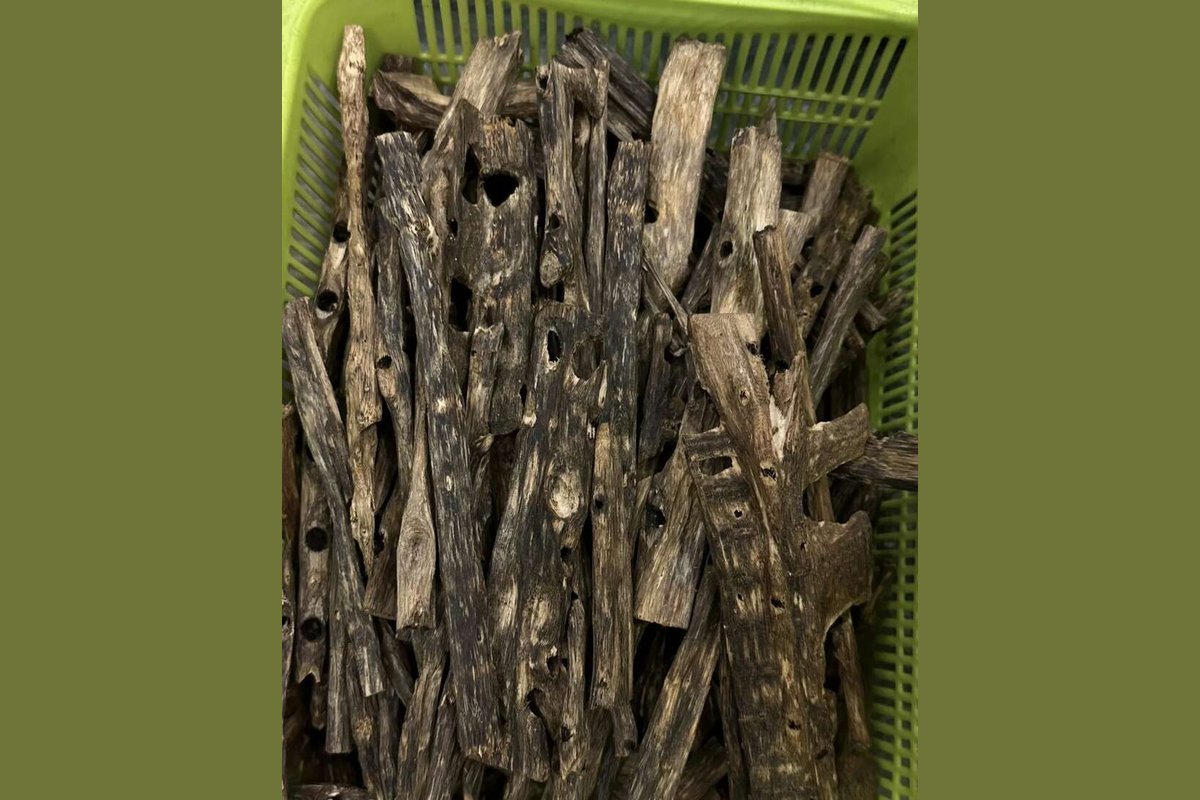
Agarwood and Oud: One Material, Many Names — A Trade Naming Map for Buyers
Buyers often ask us to quote "agarwood" and, in the same email, "oud" — as if they were two products. Agarwood and oud are the same material: resin-loaded wood from Aquilaria trees, sold under a different name in almost every market. The confusion is harmless in conversation, but it causes real trouble on invoices, customs declarations and CITES permits. This naming map shows which word each market uses and where the words really differ. It also shows how we describe our plantation stock on export papers from Dian Bai.

Written by
Founder & Chief Sourcing Officer, AgarwoodTown
15+ years hands-on experience grading plantation agarwood, sourcing directly from Dianbai and Maoming districts in Guangdong — the world's largest Aquilaria sinensis cultivation region. Wang has personally inspected thousands of CITES export shipments and holds plantation certification from China's National Forestry and Grassland Administration. He advises GCC, European and East Asian wholesale buyers on grade selection, CITES compliance and supply chain due diligence.
CITES Certified
In this article
- Are Agarwood and Oud the Same Thing?
- Why One Material Carries So Many Names
- How the Material Behind Both Names Forms
- The Agarwood and Oud Naming Map
- Where the Words Agarwood and Oud Do Differ
- When Oud Means the Oil
- When Oud Means a Perfume Note
- Which Name Does Each Market Use?
- Gulf and Middle East: Oud, Oudh, Dehn al Oud
- Japan: Jinkō and Kyara
- Greater China: Chén Xiāng and Qí Nán
- Southeast Asia and India: Gaharu and Agar
- Western Markets: Agarwood, Aloeswood, Eaglewood
- Quality Words That Travel With the Names
- What Should an Invoice and CITES Permit Say?
- Naming Traps That Delay Shipments
- Frequently Asked Questions
1. Are Agarwood and Oud the Same Thing?
Yes. Agarwood and oud name the same thing: the dark, aromatic wood that forms when an Aquilaria tree fills an injury with resin. "Agarwood" is the botanical and trade term in English, while "oud" is the Arabic word that most fragrance buyers now use.[1]
Why is resinous agarwood scarce? According to Liu et al. (2013), only about 10% of Aquilaria trees form agarwood naturally; the rest stay pale, almost scentless wood unless they are wounded and infected.[7]
There is no separate oud tree and no separate agarwood product. A chip we grade on our table in Guan Zhu Town is agarwood to a European importer and oud to a retailer in Riyadh. Nothing about the wood changes between the two conversations.
We have covered how the resin forms and what forms it is sold in elsewhere, in our beginner explainer on oud. This article has a narrower job. It maps the names, shows where each word is used, and explains which words belong on commercial documents.
According to TRAFFIC's 2000 review of the trade, the same material also travels as eaglewood, aloeswood and gaharu, which is why one shipment can carry several names on its paperwork.
Why One Material Carries So Many Names
Agarwood has been traded across Asia and the Middle East for well over a thousand years. Each culture that bought it gave it a name in its own language, and those names stuck.
Moreover, the trees themselves grow across a wide range. The genus Aquilaria occurs from northeast India through Southeast Asia to southern China, and the related genus Gyrinops also yields resinous wood.[2] Producing countries named the wood one way; consuming countries named it another.
The result is a trade where a single shipment can pass through three vocabularies. In practice, the grower writes Chinese, the exporter writes English, and the end buyer sells it in Arabic or Japanese.
How the Material Behind Both Names Forms
Both names describe the same thing: heartwood of Aquilaria trees, and of the related genus Gyrinops, that darkens with aromatic resin after the tree is wounded and infected by fungi. Healthy wood is pale and nearly scentless. The resin, rich in sesquiterpenes and 2-(2-phenylethyl)chromones, is what gives agarwood, or oud, its value.
That is also why grade words travel with both names. The more resin a piece holds, the darker, heavier and more fragrant it is. Our guide to agarwood resin explains how it forms, step by step.
2. The Agarwood and Oud Naming Map
| Name | Language / region | What it usually refers to | Where you will see it |
|---|---|---|---|
| Agarwood | English (trade and botany) | Resinated Aquilaria or Gyrinops wood in any form | CITES documents, scientific papers, Western catalogues |
| Oud / oudh / oodh / ud | Arabic, then global fragrance trade | The wood, and very often the oil distilled from it | GCC retail, perfume labels, attar houses |
| Dehn al oud | Arabic (Gulf) | Oud oil specifically | Gulf oil shops, tola-sized bottles |
| Aloeswood / aloes / lignum aloes | English, older European usage | Agarwood — unrelated to aloe vera | Historical texts, incense catalogues |
| Eaglewood | English, older trade name | Agarwood, especially Aquilaria malaccensis | Older botanical and forestry literature |
| Gaharu | Malay / Indonesian | Agarwood in all forms | Malaysian and Indonesian trade and forestry |
| Agar / agaru | Hindi, Assamese, Sanskrit roots | Agarwood; "agar oil" for the oil | Indian trade, especially Assam |
| Jinkō (沈香) | Japanese | Agarwood used for incense | Kōdō schools, Japanese incense makers |
| Chén xiāng (沉香) | Chinese | Agarwood; literally "sinking fragrance" | Chinese trade, pharmacopoeia, collectors |
| Trầm hương | Vietnamese | Agarwood | Vietnamese trade |
| Kyara (伽羅) | Japanese | Top tier of agarwood, not ordinary stock | Kōdō, high-end koh incense |
| Kynam / qí nán (奇楠) | Chinese / Vietnamese | Top tier of agarwood, soft and waxy | Collectors, carvings, bracelets |
Spellings vary by transliteration. Grade and tier terms (kyara, kynam, sinking) are not synonyms for agarwood in general; they describe a quality level, as explained in section 5.
Read the table as one material seen through twelve windows. The first ten names all describe agarwood in general. Only the last two are quality tiers, and confusing a tier with a general name is a common and costly mistake.
For example, a buyer who asks for "kyara chips at grade C prices" is asking for two incompatible things. Kyara and kynam describe the rarest resin type; ordinary graded chips are simply agarwood, or oud, at a given grade.
The "aloes" family of names also deserves a note. It comes from old Greek and Latin usage and has nothing to do with the succulent aloe plant. Nevertheless, customs brokers still sometimes confuse the two when a description says only "aloes wood".
3. Where the Words Agarwood and Oud Do Differ
The material is identical, but the words carry different habits. "Agarwood" tends to mean the raw wood and the botanical source. "Oud", by contrast, has drifted toward meaning the scent, and often the oil rather than the wood.
That drift matters for B2B buyers because a quote request using one word can be read in two ways. Therefore a careful supplier confirms the physical form before pricing anything.
When Oud Means the Oil
In Gulf retail and in perfumery, "oud" on its own frequently means oud oil. A shop selling "oud" by the tola is selling oil, while a shop selling "oud" by the gram on a scale is probably selling chips.
Our price list separates the two clearly. Plantation oud wood chips start from $0.24/g with an MOQ of 100 g across grades D–AAA. Oil is a different line: hydro-distilled oud oil starts from $7.00/g and CO₂ agarwood oil from $1.50/g, both with a 10 g MOQ.
If you write "please quote 1 kg of oud", expect a careful supplier to ask whether you mean wood or oil. The difference is a factor of many times in price, so the question is not pedantic.
When Oud Means a Perfume Note
On finished perfume, "oud" often describes a scent direction rather than an ingredient. Many fragrances labelled oud are built on an accord of aroma chemicals designed to suggest agarwood, with little or no real Aquilaria oil inside.
"Agarwood" on an ingredient list, however, implies the real thing. So careful brands that use real oil write "agarwood oil" or "Aquilaria oil" in the ingredient list. They keep "oud" in the product name.
For a buyer, the practical rule is simple. Use "oud" for marketing if you like, but use "agarwood" plus the species on anything a regulator, customs officer or lab will read.
Agarwood vs Oud: How Each Word Is Used in Trade
| Feature | Agarwood | Oud |
|---|---|---|
| Origin of the word | English trade and botanical term | Arabic ʿūd, meaning wood |
| Default meaning | The resinated wood and its source tree | The scent, and often the oil |
| Typical users | Scientists, regulators, importers, Western catalogues | Gulf retailers, attar houses, perfumers, consumers |
| On a CITES permit | Expected, together with the species name | Not a substitute for the species name |
| On a perfume label | Signals real Aquilaria content | May describe an accord with no agarwood inside |
| Risk of misreading | Low; it is a specific material | High; wood, oil or note depending on context |
| Where it belongs | On invoices, permits and grading notes | In product names where the market expects it |


4. Which Name Does Each Market Use?
Each region has a preferred word, and using it signals that you understand the market. The products also differ, so the name usually arrives with a format attached.
We supply 500+ B2B buyers in 10+ countries. The words in a first email usually tell us which market it comes from. Below is a general guide to reading it.
Gulf and Middle East: Oud, Oudh, Dehn al Oud
In Saudi Arabia, the UAE and neighbouring markets, the wood is oud and the oil is dehn al oud. Buyers there burn chips in a mabkhara for hospitality and wear oil as perfume, so both forms sell side by side.
The spellings oud, oudh and oodh are just different ways to write one word. None of them indicates a grade or origin. Our notes on supplying Saudi buyers cover the formats that market prefers.
Japan: Jinkō and Kyara
Japanese buyers say jinkō (沈香) for agarwood and reserve kyara (伽羅) for the very top tier. In kōdō, the incense ceremony, practitioners classify woods into named groups and appreciate small slivers heated on mica rather than burned directly.[3]
Consequently, in the general trade a Japanese enquiry that says "jinkō" is more often about wood than oil — typically small, precisely graded wood or pressed incense, such as our Japanese-style koh incense, which starts from $6/g with a 100 g MOQ.
Greater China: Chén Xiāng and Qí Nán
At home in Guangdong we say chén xiāng (沉香), "sinking fragrance". The name reflects the old test of dropping wood in water: heavily resinated pieces sink. The top tier is qí nán (奇楠), usually written kynam in English trade.
Chinese domestic buyers focus on bracelets, carvings and collector pieces, so the vocabulary there is full of tier words. Moreover, chén xiāng is also a pharmacopoeia term in China, which adds a regulatory meaning that the English word agarwood does not carry.
Southeast Asia and India: Gaharu and Agar
In Malaysia and Indonesia, the word is gaharu, used for wood and oil alike. Much of the region's trade historically centred on Aquilaria malaccensis and related species, and the FAO's forestry work on non-wood forest products describes how collection pressure shaped that trade.[4]
In India, especially Assam, the words agar and agaru appear, and "agar oil" means oud oil. Vietnam uses trầm hương for agarwood and has its own strong collector culture around kynam.
Western Markets: Agarwood, Aloeswood, Eaglewood
In Assam you will also hear "agar agarwood" in search queries and price lists, which simply doubles the Hindi and English names. It is the same material, and on our side it would be quoted as agarwood with the species stated.
European and American buyers mostly write agarwood. Incense specialists and some religious suppliers still say aloeswood. It is an older English name from Greek and Latin, not from the aloe plant.
Eaglewood appears mainly in older forestry and botanical writing. Meanwhile, Western perfumers increasingly use "oud" in product names, so a single Western catalogue may use all three words on one page.

5. Quality Words That Travel With the Names
| Term | Where it comes from | What it actually tells you | How it maps to our scale |
|---|---|---|---|
| Sinking / chén shuǐ (沉水) | Chinese trade | The piece is dense enough to sink in water | Common among AAA pieces; density alone does not set a grade |
| Floating / semi-sinking | Chinese and Southeast Asian trade | Lighter wood with less resin | Typically D to B, depending on aroma and resin spread |
| Kyara (伽羅) | Japanese kōdō | Rarest resin type, soft and waxy | Kynam tier, allocation only |
| Kynam / qí nán (奇楠) | Chinese and Vietnamese | Same top tier, often with a cool, sweet note | Kynam tier, quoted per enquiry |
| Super / double super / king | Retail marketing in several markets | Seller's own label; no shared definition | Ask for the supplier's own grading criteria |
| Wild / old-growth | General trade | A claim about origin, not quality | Not used by us; we sell plantation material only |
| Cultivated / plantation | General trade | Trees grown and usually inoculated by growers | All our stock, grades D–AAA plus Kynam |
The D–AAA and Kynam scale is AgarwoodTown's internal grading scale. It is not an ISO or CITES standard, and other suppliers use different letters, numbers or local terms.
Quality words cause more disputes than the base names do. "Agarwood" and "oud" are neutral; "super", "king" and "double super" are not. They are sales labels, and their meaning changes from one seller to the next.
Academic reviews of agarwood grading show how varied national and commercial systems are, mixing colour, resin content, density, aroma and form.[5] In practice, no two suppliers' letters line up exactly.
That is why we grade with four tests: looks, aroma, resin content and the sink test. Then we put the result on a grading note. Founder Wang Jianyu still grades the wood himself. The note travels with every wholesale shipment, so the word on the invoice matches what was on the table.
Kynam deserves its own caution. Because the word sells, it gets attached to wood that is merely dark or oily. We allocate genuine kynam wood from our allocation list per enquiry, from $0.89/g, and we do not apply the name to ordinary high-grade chips.
Step-by-Step Process
6. What Should an Invoice and CITES Permit Say?
Name the species, not just the trade word
Write the scientific name first: for our stock that is Aquilaria sinensis. All Aquilaria species are listed in CITES Appendix II, so officers match the permit to the species, not to the word oud or gaharu. A description with only a trade name invites questions at the border.
State the physical form
Say exactly what is in the carton: wood chips, powder, logs, beads, carvings, oil or incense sticks. CITES and many customs systems treat forms differently. "Oud" alone does not tell an officer whether a parcel holds oil or wood.
State the source as plantation
Record that the material is cultivated plantation agarwood. Our trees grow on our own 100+ mu plantation in Guan Zhu Town, Dian Bai District, Maoming, with additional material from 100+ contracted plantation farmers. Origin on the invoice should match origin on the permit.
Give quantity in the unit the permit uses
Use net weight for wood, powder and chips, and weight or volume for oil, consistently across invoice, packing list and permit. Mismatched units are one of the simplest ways to stall a shipment that is otherwise in order.
Keep the marketing name in its place
You can still call the product "Royal Oud Chips" on your shelf. On the commercial invoice, however, put the descriptive line first — for example, "Agarwood (Aquilaria sinensis) wood chips, plantation origin, grade B" — and the brand name second.
Check the annotation and your import rules
Annotation #14 exempts some finished, retail-packaged products from the Appendix II listing, so check the current annotation text for your exact product. Importing countries can add their own requirements on top, so confirm with your national CITES authority before you ship.
The CITES listing is the reason precise naming matters. Aquilaria species have been listed in Appendix II since 2004, and the Appendices are published by the CITES Secretariat under scientific names, not trade names.[6]
Every wholesale shipment we send carries a grading note or certificate and a CITES Appendix II export permit where one is required. Live seedlings also travel with a phytosanitary certificate. Ask any supplier for document copies before dispatch so your broker can check the wording against your import paperwork.
Buyers in the EU face an extra layer of implementation rules, which our guide to importing oud incense into Europe explains in more detail.
7. Naming Traps That Delay Shipments
Most problems with agarwood and oud paperwork come from a handful of naming habits. Each one is easy to avoid once you know it.
- "Oud" with no form: a customs line that says only "oud" can be read as perfume, oil or wood. Always add the form.
- "Aloes wood" without the species: some officers read it as aloe vera. Add Aquilaria and the species name.
- Origin words as grade words: "Cambodian", "Hindi" or "Hainan" describe a place or a scent style, not a grade. Use them only when they are literally true of the material.
- "Wild" on plantation stock: never describe cultivated wood as wild. It misstates origin and can conflict with the permit.
- "Kynam" on ordinary high grades: this inflates value and invites disputes downstream. Reserve tier words for genuine tier material.
- Different names on different documents: if the invoice says gaharu, the packing list says oud and the permit says agarwood, a careful officer may hold the shipment until the three are reconciled.
The fix in every case is consistency. Choose one descriptive line — trade name, species, form, origin, grade — and repeat it word for word across every document.
For oil buyers, the same discipline applies to labels. If your bottle contains our hydro-distilled Aquilaria sinensis oil, you can say agarwood oil with confidence and back it with a GC-MS report, which we provide on request. Our explainer on oud oil extraction covers how hydro and CO₂ oils differ before you choose one.
Finally, remember that the end customer rarely cares which word you use. Regulators and labs do. Write for them on paper, and write for your customer on the shelf.
Need paperwork wording checked before you order?
Send us your target market, the form you need and the description your broker plans to use. We will check it against the wording on our invoice, grading note and CITES permit. Then start with a paid sample: 100 g of chips or 1 g of oil.
We reply within 4 business hours, Monday to Saturday, 9:00–18:00 China time. Ask for a wholesale quote and document check → Buyers starting with a finished format can also look at our plantation agarwood incense sticks, from $2.35–$5.89 per box with a 1 kg MOQ.
Frequently Asked Questions
Yes. Agarwood is the English trade and botanical name for resinated wood from Aquilaria trees, and oud is the Arabic name for the same material. The only real difference is usage. Oud is more often used for the oil and for perfume notes. Agarwood is the term regulators and scientists expect.
There is no difference in material. Oud, oudh, oodh and ud are simply different ways of writing the Arabic word in Latin letters. No spelling tells you the grade, the origin, or whether it is wood or oil. So ask the seller to state the form and the grade separately.
Yes. Aloeswood, aloes and lignum aloes are older English names for agarwood that reached English through Greek and Latin. They have nothing to do with the aloe vera plant. Because that confusion still happens at customs, we recommend adding the Aquilaria species name whenever a document uses the word aloeswood.
Gaharu is the Malay and Indonesian name for agarwood, used for wood, chips and oil alike. It does not refer to a particular grade or species. Traders there use it every day. On export papers, however, the scientific name of the Aquilaria species should always appear next to it.
Not exactly. Kyara in Japanese and kynam or qí nán in Chinese and Vietnamese refer to the rarest tier of agarwood, which is softer, waxier and distinctly scented. Ordinary agarwood is not kyara. In our internal scale, kynam sits above AAA, and we supply it by allocation and quote it per enquiry.
In perfumery, oud has become the name of a scent style as well as a material. Many fragrances use an accord of aroma chemicals that suggests agarwood at a fraction of the cost of real oil. If you want to claim real content, use the words agarwood oil or Aquilaria oil and keep supporting documents.
The permit works from scientific names, so the species, such as Aquilaria sinensis, must appear. Add the form — chips, oil, powder or incense — and keep the same description on the invoice and packing list. Trade names like oud or gaharu can appear as well, but never in place of the species.
Chén xiāng means sinking fragrance, and it comes from the old observation that heavily resinated wood sinks in water. However, the Chinese name is used for all agarwood, not only sinking pieces. Sinking grade is a separate quality term, and on our scale it is common among AAA material.
It is the same kind of material, resinated Aquilaria wood, but often from a different species and region, which changes the scent profile. Origin names describe where the wood grew, not its grade. Use them on documents only when they are literally true; our own stock is plantation Aquilaria sinensis from Guangdong.
No, because they are the same thing. We sell agarwood in different forms: oud wood chips from $0.24/g with a 100 g MOQ, hydro-distilled oud oil from $7.00/g, CO₂ agarwood oil from $1.50/g, incense sticks, bakhoor, powder, beads, carvings and logs. Each form is a separate product line.
References
- 1Barden A., Anak N.A., Mulliken T., Song M.. Heart of the Matter: Agarwood Use and Trade and CITES Implementation for Aquilaria malaccensis. TRAFFIC International, 2000.View source
- 2Nasution A.A., Siregar U.J., Miftahudin, Turjaman M.. Identification of chemical compounds in agarwood-producing species Aquilaria malaccensis and Gyrinops versteegii. Journal of Forestry Research, 2019.View source
- 3
- 4FAO Forestry. Agarwood (Non-Wood Forest Products). Food and Agriculture Organization, 2004.View source
- 5Liu Y.Y., Wei J.H., Gao Z.H., et al.. A Review of Quality Assessment and Grading for Agarwood. Chinese Herbal Medicines, 2017.View source
- 6
- 7Liu Y., Chen H., Yang Y., et al.. Whole-tree agarwood-inducing technique: an efficient novel technique for producing high-quality agarwood in cultivated Aquilaria sinensis trees. Molecules, 2013.View source
All scientific references are provided for transparency. AgarwoodTown summarises peer-reviewed findings for educational purposes and does not claim to provide medical or regulatory advice.
Wholesale Catalog
Buy the products discussed in this article


Related Articles
Source Direct from Origin
Discuss Your Requirements with Our Team
We respond within 24 hours. Share your target grade, quantity and destination — we'll send current pricing, a sample pack option, and CITES documentation details.