What Is Attar? Attar Oils Explained for Wholesale Buyers and Perfume Makers
Buyers from India, the Gulf and Western niche brands ask us for "attar" — and they rarely mean the same thing. Attar is an oil-based, alcohol-free perfume, traditionally made by distilling aromatics into a carrier oil such as sandalwood. However, the word now covers everything from a classic Kannauj distillate to a modern blend of oud oil in a neutral base. This guide sets out what attar is, how it differs from pure oud oil, and how to write an attar specification a supplier can actually meet.

Written by
Founder & Chief Sourcing Officer, AgarwoodTown
15+ years hands-on experience grading plantation agarwood, sourcing directly from Dianbai and Maoming districts in Guangdong — the world's largest Aquilaria sinensis cultivation region. Wang has personally inspected thousands of CITES export shipments and holds plantation certification from China's National Forestry and Grassland Administration. He advises GCC, European and East Asian wholesale buyers on grade selection, CITES compliance and supply chain due diligence.
CITES Certified
In this article
- What Is Attar? The Working Definition
- Where the Word Comes From
- Ruh, Classic Distillates and Modern Blends
- Warm and Cool Attars, Kannauj and Ageing
- How Is It Made? The Deg-and-Bhapka Method
- Oud Attar vs Pure Oud Oil vs Perfume Oil
- Why the Difference Matters on an Invoice
- Which Styles Do Buyers Trade?
- How Do B2B Buyers Specify an Attar?
- Choosing the Base Oil
- Choosing the Oud Component
- Dilution and Cost per Gram
- Labelling, Testing and CITES
- Sourcing Oud for Your Range
- Frequently Asked Questions
1. What Is Attar? The Working Definition
An attar is a concentrated perfume in an oil base, with no alcohol. Traditionally, makers distil flowers, herbs, woods or spices and capture the aromatic vapour in a receiving oil, most often sandalwood.[1]
Real oud oil is scarce for a simple reason. According to Liu et al. (2013), only about 10% of Aquilaria trees form agarwood naturally, and only that resinated wood yields oud oil when it is distilled.[5]
That is the classic definition. In today's trade, though, the word stretches much further. A wholesale price list may use it for a Kannauj distillate, a pure undiluted oil, or a blend built in a lab from oils and aroma chemicals.
For a buyer, three questions settle most of the confusion. What is the base oil? What are the aromatic components, and are they natural? Finally, what share of the finished oil is the aromatic part?
Where the Word Comes From
The word reaches English through Persian and Arabic, where related words mean perfume or fragrance. You will also see it spelled ittar or itr, especially in South Asian and Gulf markets.[1]
The craft is most closely linked with Kannauj in Uttar Pradesh, India. The town has a long tradition of attar distilling and is often called India's perfume capital. Distillers there still work in small copper stills, and many family firms supply the Gulf as well as the Indian market.
Ruh, Classic Distillates and Modern Blends
Traditional makers separate two products. A ruh is the pure distilled oil of one material, with no carrier at all. The classic product, by contrast, carries that aroma in a base oil.
Modern blends add a third category. These combine several essential oils, absolutes or aroma chemicals in a neutral carrier. They are not wrong, but they are a different product, and the label should say so.
We grow and process agarwood, so most of these conversations concern oud. Our role is to supply the oud component — oil or wood — that perfume houses then blend into their own bases.
Warm and Cool Attars, Kannauj and Ageing
Traditional attar makers sort their oils into warm and cool. Cool attars, such as rose, jasmine and vetiver (khus), are worn in hot weather. Warm attars, built on heavier materials such as musk, amber, saffron and oud, are kept for cooler months and evenings.
Kannauj in Uttar Pradesh is the best-known production centre. Its makers still hydro-distil flowers in copper stills and draw the vapour into a receiver holding sandalwood oil. Many attars are also rested before sale, sometimes for years, because the blend rounds out with time. Our oud oil aging guide explains why.
Step-by-Step Process
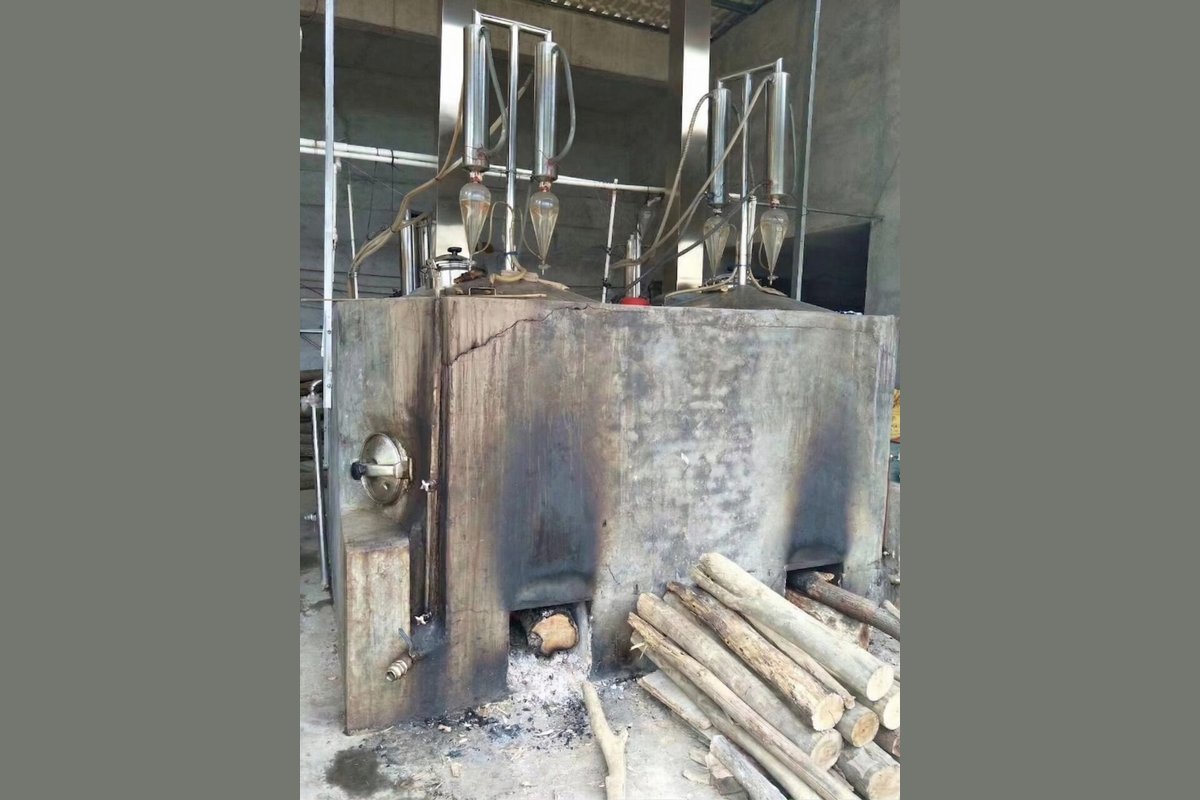
2. How Is It Made? The Deg-and-Bhapka Method
Load the deg with plant material and water
The distiller fills a copper pot, the deg, with fresh petals, herbs, wood or even baked clay, then adds water. The lid is sealed with clay so the vapour has only one way out.
Heat slowly over a wood fire
Heat is kept low and steady for hours. Traditional distillers judge the fire by touch and sound rather than by a thermometer, because overheating scorches the charge and flattens the scent.
Carry the vapour through a bamboo pipe
Steam and aromatic vapour travel through a pipe, often bamboo wrapped in twine, into a receiving vessel called the bhapka. The bhapka sits in a water bath that cools and condenses the vapour.
Capture the aroma in sandalwood oil
The bhapka already holds a measured amount of base oil, classically sandalwood. As the vapour condenses, the aromatic molecules dissolve into that oil. Then the distiller recharges the deg and repeats the cycle many times over.
Separate the water and age the oil
Water settles out below the oil and is drawn off. The finished oil is then stored, traditionally in leather bottles, so that remaining moisture escapes and the scent rounds out before sale.
This method is slow, and every batch differs. Moreover, its strength depends on how many cycles the distiller runs into the same base oil. More cycles give a richer result, while fewer give a lighter one.[1]
Oud fits into this picture in two ways. Some distillers distil agarwood itself, but most houses buy oud oil and blend it in. Agarwood needs long soaking and long distillation, so few small workshops handle the wood themselves.
Our own still room runs the agarwood side of that process. We operate in-house steam and hydro distillation, plus supercritical CO₂ extraction, and we produce around 500 kg of oud oil a year at our plantation in Guan Zhu Town, Dian Bai. For the extraction details, see our guide to how oud oil is extracted.
3. Oud Attar vs Pure Oud Oil vs Perfume Oil
| Feature | Attar (traditional or blended) | Pure oud oil (single material) |
|---|---|---|
| What is in the bottle | Aromatic material carried in a base oil, classically sandalwood | Only the oil distilled or extracted from agarwood, with no carrier |
| Alcohol | None; the base oil is the solvent | None; it is a neat oil |
| Strength | Set by the number of distillation cycles or by the blend ratio | Full strength; a small drop goes a long way |
| Scent profile | Shaped by both the aroma and the base; sandalwood adds creamy warmth | Agarwood alone, varying with species, grade and extraction method |
| Typical use | Worn directly on skin or clothing; sold in small vials | Worn neat by connoisseurs or used as a raw material by blenders and perfumers |
| Price logic | Depends on base cost and on how much oud or other aroma it holds | Depends on grade, species and extraction; ours start from $1.50/g (CO₂) and $7.00/g (hydro) |
| What to ask for | Full composition: base, aromatics, percentage of each | Species, extraction method, grade and a GC-MS report |
In short, every attar is a perfume oil, but not every perfume oil is traditional. Pure oud oil, in turn, is a raw material that may or may not end up inside a blend.
The modern term "perfume oil" adds one more layer. It usually means any alcohol-free fragrance in a carrier such as fractionated coconut oil, jojoba or a synthetic solvent. Many products sold under the name today are perfume oils in this broad sense, and that is fine as long as the label is honest.
Gulf buyers often use the word oud loosely too. In some souks, "oud" on a vial means a pure agarwood oil; in others, it means a blend with an oud character. Our agarwood perfume sourcing guide covers the oil-versus-spray choice for perfume brands, so here we stay with the broader question.
Why the Difference Matters on an Invoice
The distinction is not academic. A buyer who orders an oud blend and receives a 5% blend in a synthetic carrier has paid for something other than what they expected. Meanwhile, a supplier who ships pure oud oil under a blend name may undercharge for it.
Customs and CITES officers also read these words. A vague perfume-oil invoice that actually contains bulk agarwood oil can raise questions at the border, because Aquilaria is a CITES-listed genus. Therefore the oud component should always be described by species and extraction method, whatever the buyer calls the finished product.
4. Which Styles Do Buyers Trade?
| Style | Typical aromatic source | Where it sells | Notes for buyers |
|---|---|---|---|
| Floral | Rose, jasmine, kewra and other flowers distilled into a base | India, the Gulf, South Asian diaspora | Classic Kannauj products; rose versions vary widely in strength and price |
| Earthy (mitti) | Baked clay distilled into sandalwood oil, giving a scent of rain on dry earth | India, niche Western perfumery | A good example of how the base and the distillate together create the scent |
| Herbal and spice | Blends of herbs, spices and resins, often aged | India, Gulf winter markets | Recipes are family secrets; ask for full disclosure of any allergens |
| Oud attar | Agarwood oil blended into, or distilled with, a carrier oil | Saudi Arabia, UAE, Kuwait, Western niche | Ask what percentage is real oud and which species and method it comes from |
| Oud-rose and oud blends | Agarwood oil combined with rose, saffron-style or amber notes | The Gulf, private-label brands | Often partly synthetic; specify which components must be natural |
| Modern blend | Essential oils and aroma chemicals in a neutral carrier | Mass retail, online marketplaces | Not traditional, but legitimate if labelled clearly |
General market categories, not a formal classification. Composition varies by maker, so always ask for a composition statement.
Each type answers a different market. Indian buyers tend to know floral and mitti styles from childhood, while Gulf buyers judge a blend mainly by its oud character and its staying power. Our India market page and Saudi Arabia buyer notes describe how those two markets differ.


5. How Do B2B Buyers Specify an Attar?
| Specification field | What to write | Why it matters |
|---|---|---|
| Product name | The trade name you will use, plus a plain description such as "oud oil in sandalwood base" | Avoids disputes over what the product name means |
| Base oil | Botanical name and grade of the carrier, e.g. sandalwood, or a named neutral carrier | The base sets cost, scent and shelf life |
| Aromatic components | Each component with its source; for oud, the species (e.g. Aquilaria sinensis) and extraction method | Lets you verify natural claims and CITES status |
| Concentration | Percentage of each aromatic component by weight in the finished oil | The single biggest driver of price and strength |
| Oud grade | The supplier grade of the oud oil or wood used, with a reference sample | Grades are supplier-specific, so a sample anchors the meaning |
| Testing | GC-MS report on the oud component; optional allergen statement for your market | Supports authenticity and labelling |
| Packaging | Bulk bottle size, inner and outer packing, or filled retail vials | Retail packaging can change the CITES position |
| Documents | Grading note, CITES export permit where required, commercial invoice wording | Prevents holds at customs |
A checklist we recommend sending to any perfume oil or oud oil supplier, including us. Fields marked as optional depend on your market and claims.
A clear specification protects both sides. It also makes quotes comparable, because two suppliers can only quote fairly when they are pricing the same thing.
Choosing the Base Oil
Sandalwood is the classic attar base. It is soft, creamy and long-lasting, and it blends smoothly with oud. However, sandalwood itself is expensive, and some species face harvest controls in their countries of origin.
Many makers therefore use cheaper or more neutral carriers. Common choices include fractionated coconut oil, jojoba and a range of odourless synthetic carriers. A neutral carrier lets the oud speak on its own, while sandalwood changes the character of the finished oil.
Neither choice is wrong. In practice, a Gulf-style oud blend often uses a neutral carrier so the agarwood dominates. A traditional Indian-style product, by contrast, expects the warmth of sandalwood underneath.
Choosing the Oud Component
For the oud part, the main choice is between hydro-distilled and CO₂-extracted oil. Our hydro-distilled oud oil for blending gives the deep, slightly animalic character that Gulf customers associate with traditional oud.
Our CO₂-extracted agarwood oil, on the other hand, tends to read cleaner and closer to the smell of the raw wood. Some Western brands prefer it for that reason, and it starts at a lower price per gram.
Agarwood oil is chemically complex, with sesquiterpenes and 2-(2-phenylethyl)chromones as the main groups of aroma compounds.[2] That complexity is why two oud oils of the same grade can still smell different in a blend, and why we always suggest testing the oud inside your actual base before you commit.
6. Dilution and Cost per Gram
Dilution decides both the strength and the cost of an oud blend. There is no standard ratio; makers range from a few percent of oud in a carrier to an undiluted oil sold under the same name.
Because the oud is usually the most expensive part, a simple calculation shows what the aroma costs per gram of finished oil. The examples below use our current starting list prices. Higher grades cost more, and the base oil, bottles and labour come on top.
- 5% hydro-distilled oud: 0.05 × $7.00 = about $0.35 of oud in every gram of finished oil.
- 10% hydro-distilled oud: 0.10 × $7.00 = about $0.70 per gram.
- 20% hydro-distilled oud: 0.20 × $7.00 = about $1.40 per gram.
- 10% CO₂ agarwood oil: 0.10 × $1.50 = about $0.15 per gram.
These figures explain the huge price spread at retail. Two vials with the same oud label can differ several times over in real oud content. Consequently, the concentration line in your specification matters more than the product name.
Strength on skin does not scale neatly with percentage, though. A well-made blend at moderate dilution can wear better than a crude blend with more oud, because the carrier and the other aromatics shape how the scent unfolds. For that reason, we suggest testing two or three dilutions side by side on blotters and skin before fixing your ratio.
Run a dilution ladder before you commit
Order a paid 1 g sample of each oud oil you are considering, then make small test blends at three dilutions in your chosen base. Smell them fresh, after an hour and the next day. Finally, pick the lowest dilution that still reads as oud to your customers — that point is where your cost per vial settles.
7. Labelling, Testing and CITES
A perfume oil is a cosmetic or fragrance product in most markets, so local rules on ingredient lists, allergens and safety assessment apply. Those rules differ by country, and we do not give regulatory advice. Instead, confirm them with a regulatory consultant in your market before launch.
- Say what is natural: if you claim real oud, keep the supplier's documents showing species and extraction. If the oud note is an accord, avoid wording that implies agarwood content.
- Ask for lab data: we provide GC-MS reports on request for our oils. Gas chromatography–mass spectrometry separates and identifies the volatile compounds in an oil, which helps confirm an agarwood profile.[3]
- CITES for the oud component: all Aquilaria species have been listed in CITES Appendix II since 2004.[4] Bulk oud oil generally needs an export permit; we supply one with every wholesale shipment where it is required.
- Finished retail vials: annotation #14 exempts some finished, retail-packaged products. Check the current annotation text, because it changes at CITES meetings and the exemption depends on how the goods are packed.
- Your import side: importing countries may add their own requirements. Confirm with your national CITES authority before the first shipment.

Step-by-Step Process
8. Sourcing Oud for Your Range
Define the attar you want to sell
Decide on the style first: Gulf-style oud blend, Indian-style sandalwood product, or a modern formula. That choice sets your base oil, your oud type and the documents your customers will expect.
Order paid oil samples
Samples start from 1 g of oil, paid and non-refundable. We usually suggest one hydro-distilled and one CO₂ sample, so you can compare both inside your base before choosing a direction.
Write the specification
Use the checklist above: base, components, concentration, oud grade, testing and packing. Send it with your target volume, and we will quote against those exact terms rather than a vague product name.
Confirm grade, MOQ and documents
Our oils have an MOQ of 10 g, so a first production run can stay small. We confirm the grade in writing, issue a grading note, and arrange the CITES export permit where required. GC-MS reports are available on request.
Blend, test and reorder
Blend your first batch, test it with real customers, then reorder against the same grade reference. If something arrives wrong, we fix it by replacement or credit; we do not accept returns.
Some makers also want the wood itself, and many Gulf retailers sell perfume oils alongside burning chips. Our graded oud chips from grade D to AAA start from $0.24/g with a 100 g MOQ.
Others want a finished product rather than a raw material. In that case, our ready-made agarwood perfume oil is a faster starting point than building a formula from scratch.
Gulf retailers often pair perfume oils with burning products in one gift set. A small order of bakhoor chips for gift sets, from $6/g with a 250 g MOQ, rounds out the range. If you are new to agarwood as a material, start with our plain guide to what oud is.
Planning an attar range?
Send us your style, your base oil and your target concentration, and we will suggest an oud sample set to match. Founder Wang Jianyu grades the agarwood we distil, and our team replies within 4 business hours, Monday to Saturday, 9:00–18:00 China time.
Ask for an oud sample set and quote → or read our replacement and credit terms before ordering.
Frequently Asked Questions
Attar is a concentrated perfume made with oil instead of alcohol. Traditionally, distillers capture the scent of flowers, herbs or woods in a base oil such as sandalwood. Today the word also covers modern blends of essential oils or aroma chemicals in a neutral carrier, so always ask what a specific product contains.
Not exactly. An essential oil is the pure aromatic oil of one material, such as oud oil from agarwood. A traditional attar carries that kind of aroma in a base oil, so it is diluted by design. Some sellers do label pure oils this way, which is why a written composition matters.
A true attar contains no alcohol; the base oil acts as the solvent and carrier. That is one reason it is popular in markets where buyers prefer alcohol-free fragrance. However, some products sold under the name are actually alcohol-based sprays, so check the ingredient list or ask the supplier for a composition statement.
Pure oud oil is agarwood oil with nothing added. An oud attar is agarwood oil carried in a base oil, or blended with other aromatics, so its oud content is lower. Ask any supplier for the percentage of real oud, the species and the extraction method before comparing prices.
Sandalwood oil is soft, long-lasting and blends easily with other aromatics, so it holds a captured scent well. It also adds a creamy warmth to the finished oil. Because sandalwood is costly and some sources are tightly controlled, many modern makers use neutral carriers instead and keep sandalwood for premium lines.
There is no fixed standard. Makers range from a few percent of oud in a carrier to undiluted oil sold under the same name. Higher oud content raises both strength and cost. We suggest testing several dilutions of our oils in your own base and choosing the lowest one your customers still recognise as oud.
It depends on the materials, the base oil and the concentration. Woody and resinous oils, including oud and sandalwood blends, usually last longer than light floral ones because their aroma molecules evaporate more slowly. Skin type and climate matter too, so test on real wearers rather than relying on a supplier claim.
It depends on the form. Bulk agarwood oil generally needs a CITES export permit, because Aquilaria is listed in Appendix II. Annotation #14 exempts some finished, retail-packaged products, so check the current annotation text and confirm with your national CITES authority. We supply export permits with wholesale shipments where required.
Yes. Our hydro-distilled oud oil starts from $7.00/g and our CO₂ agarwood oil from $1.50/g, both with a 10 g MOQ. Paid, non-refundable samples start from 1 g of oil. That lets a new brand test oud in its own base before committing to a production run.
Smell alone is unreliable, because skilled accords can imitate oud. Ask the supplier for the oud species, the extraction method and a GC-MS report on the oud oil used. Keep the grading note and CITES documents on file. Those records support any natural-oud claim you make on your own label.
References
- 1
- 2Naef R.. The volatile and semi-volatile constituents of agarwood, the infected heartwood of Aquilaria species: a review. Flavour and Fragrance Journal, 2011.View source
- 3Ismail N., Ali N.A.M., Jamil M., Rahiman M.H.F., Tajuddin S.N., Taib M.N.. A Review Study of Agarwood Oil and Its Quality Analysis. Jurnal Teknologi, 2014.View source
- 4
- 5Liu Y., Chen H., Yang Y., et al.. Whole-tree agarwood-inducing technique: an efficient novel technique for producing high-quality agarwood in cultivated Aquilaria sinensis trees. Molecules, 2013.View source
All scientific references are provided for transparency. AgarwoodTown summarises peer-reviewed findings for educational purposes and does not claim to provide medical or regulatory advice.
Wholesale Catalog
Buy the products discussed in this article


Related Articles
Source Direct from Origin
Discuss Your Requirements with Our Team
We respond within 24 hours. Share your target grade, quantity and destination — we'll send current pricing, a sample pack option, and CITES documentation details.