CITES Agarwood Permit Guide: Exporting Oud from China, Step by Step
Many first wholesale orders start with the same worry. Will the goods clear customs, and what does a CITES agarwood permit actually involve? The paperwork is real, but it is not mysterious. Agarwood comes from Aquilaria trees, which are listed in CITES Appendix II, so most international trade in wood, chips, beads and bulk oil needs an export permit from the country of origin. This guide explains how that permit is issued on the China side, what you as the importer must check, and where shipments typically get stuck.

Written by
Founder & Chief Sourcing Officer, AgarwoodTown
15+ years hands-on experience grading plantation agarwood, sourcing directly from Dianbai and Maoming districts in Guangdong — the world's largest Aquilaria sinensis cultivation region. Wang has personally inspected thousands of CITES export shipments and holds plantation certification from China's National Forestry and Grassland Administration. He advises GCC, European and East Asian wholesale buyers on grade selection, CITES compliance and supply chain due diligence.
CITES Certified
In this article
- What Is a CITES Agarwood Permit?
- Why Aquilaria Is Listed in Appendix II
- What Appendix II Means for a Buyer
- Which Agarwood Products Need a CITES Permit?
- Recent Change: India and Plantation Exports
- How to Read Annotation #14
- How Is a CITES Agarwood Permit Issued in China?
- Which Documents Travel With an Agarwood Shipment?
- What Must the Importer Do?
- Why Importing Countries Differ
- Notes for the EU, UK and US
- What Holds Up an Agarwood Shipment?
- How Long Does the Permit Process Take?
- Samples and Small Parcels
- How We Handle the CITES Paperwork on Your Order
- Frequently Asked Questions
1. What Is a CITES Agarwood Permit?
A CITES agarwood permit is an official export document that lets agarwood leave its country of origin legally. It is issued by the exporting country's CITES Management Authority and confirms that the material was obtained legally and that its export will not harm the species in the wild.[1]
Scarcity starts in the forest. According to a 2013 study in Molecules (Liu 2013), agarwood forms naturally in only about 10% of Aquilaria trees, which is why plantations now induce resin on purpose.[8]
CITES is the Convention on International Trade in Endangered Species of Wild Fauna and Flora. More than 180 parties apply it, and each one runs its own permit office. Therefore the permit for our goods comes from China, while the rules at your end come from your own government.
The permit names the exporter, the importer, the species, the type of specimen, the quantity and the source of the material. Customs officers at both ends compare that description with the goods in the carton. In practice, most delays come from a mismatch between the permit and the shipment, not from the permit itself.
Why Aquilaria Is Listed in Appendix II
Agarwood forms only in wounded, infected trees, so collectors historically cut many wild trees to find the few that held resin. That pressure, documented in trade studies from the late 1990s onward, led CITES parties to list Aquilaria malaccensis first and then the whole genus.[2]
Since 2004, all Aquilaria species have been listed in Appendix II, and the related genus Gyrinops is also covered. The species pages on the CITES checklist show the current listing and its annotation for each name.[3]
What Appendix II Means for a Buyer
Appendix II does not ban trade. Instead, it controls trade so that it stays legal and traceable. Commercial shipments are allowed, provided the right document travels with them.
Under the Convention itself, an Appendix II species generally needs an export permit from the exporting country, while a separate import permit is not required. However, CITES sets a minimum, and many countries add stricter national rules. The European Union is the best-known example, and we cover it in detail in our guide to importing oud incense into Europe.


2. Which Agarwood Products Need a CITES Permit?
| Product | Usual position for export from China | What to confirm before ordering |
|---|---|---|
| Oud wood chips (all grades, D–AAA) | Permit normally required, including small lots | Quantity in kg, grade description, species name on the permit |
| Logs and large pieces | Permit normally required | Piece count and total weight; whether your country inspects wood at a designated port |
| Beads, bracelets and carvings | Permit normally required, even when individually boxed | How the permit counts them (pieces or weight) and whether your country adds import rules |
| Bulk oud oil (hydro or CO₂) | Permit normally required for bulk quantities | Unit of measure (kg or litres), species, and whether your buyer wants a GC-MS report as well |
| Bulk incense sticks and bakhoor in cartons | Permit normally required, because bulk goods are not packaged for retail | Whether you will repack in your market; if so, treat them as bulk |
| Finished products packaged and ready for retail | Often exempt under annotation #14, subject to the current text and its exclusions | That the packaging is genuinely retail-ready and that the product type is not excluded |
| Exhausted agarwood powder | May be exempt under the annotation; check the exact current wording | Whether the powder is exhausted (already extracted) or fresh milled wood, which is treated differently |
| Live seedlings | Plant export rules apply, with a phytosanitary certificate | Your country's plant health import rules, which are separate from CITES |
General guidance on how the Aquilaria listing is usually applied. Annotation wording can change at each CITES Conference of the Parties, and national rules can be stricter, so always check the current annotation text and confirm with your national CITES authority before you plan a shipment.
Raw and semi-processed agarwood almost always needs a permit, and size does not create an exemption. A 100 g bag of chips is the same specimen type as a 100 kg carton. For example, buyers who order a starter lot of our plantation oud wood chips receive the same permit process as buyers who order by the carton.
How to Read Annotation #14
Annotation #14 is the note in the CITES Appendices that defines which parts and derivatives of Aquilaria and Gyrinops are covered. It lists a set of exempted items, such as certain seeds, leaves, exhausted powder and finished products packaged for retail. At the same time, it excludes some product types from the retail exemption, and the current text names items such as wood chips, beads, prayer beads and carvings.[1]
We deliberately do not paraphrase the annotation word for word here. The text is amended from time to time, and a blog summary can fall out of date. Therefore read the current wording on the CITES Appendices page whenever you plan a new product line.
Three practical points help. First, "packaged and ready for retail trade" means the unit a shopper would buy, sealed and labelled. Second, a retail box that holds chips or beads is still a box of chips or beads. Third, your own country can treat an exempt item more strictly, so the annotation is a starting point, not the final word.
Step-by-Step Process
3. How Is a CITES Agarwood Permit Issued in China?
Fix the order details first
A permit application describes a specific consignment, so an exporter cannot apply until the order is settled. The application needs the product type, grade, net weight or piece count, the importer's full legal name and address, and the destination country. Changing any of these later usually means a new application.
Document the legal source
China's national CITES Management Authority, the Endangered Species Import and Export Management Office, issues export permits through its offices. The application must show where the material came from. For us that is plantation Aquilaria sinensis from our own 100+ mu plantation in Guan Zhu Town, Dian Bai, and from our 100+ contracted plantation farmers.
Describe the specimen precisely
The application states the species, the specimen type (wood, chips, oil, beads, powder or finished goods), the quantity and the unit. These words should match the packing list exactly.
Review and issue
The authority reviews the application and the source evidence and, if satisfied, issues the export permit. The document records a source code that tells officials whether the material is wild or artificially propagated, and a purpose code for commercial trade. Processing time varies with workload and season, so no exporter can honestly promise a fixed date.
Pack to match the permit
Goods should be packed against the permit, not the other way round. Carton weights, piece counts and product names must agree with the document. Ask for a scan of the permit and the packing list before dispatch so you can check names and quantities.
Export clearance and endorsement
At export, Chinese customs checks the goods against the permit and endorses it. The original permit then travels with the shipment or is couriered to you, depending on the route and what your customs office requires. A copy alone is generally not enough for clearance.
Under CITES rules, an export permit is normally valid for up to six months from issue. In practice, exporters aim to ship well inside that window, because an expired permit cannot be used and has to be replaced.
4. Which Documents Travel With an Agarwood Shipment?
| Document | Issued by | What it does |
|---|---|---|
| CITES export permit | China's CITES Management Authority | Authorises export of the Aquilaria specimens named on it; endorsed by customs at export |
| Import permit (where your country requires one) | Your national CITES authority | Authorises entry into your country; required in the EU and some other markets, not under the Convention alone |
| Commercial invoice | AgarwoodTown | States price, terms and product description; should use the same species and product wording as the permit |
| Packing list | AgarwoodTown | Lists cartons, net and gross weights and piece counts; customs compares it with the permit |
| Grading note or certificate | AgarwoodTown | States the grade on our internal D–AAA and Kynam scale; a commercial document, not a CITES requirement |
| GC-MS report (oils, on request) | Laboratory arranged by AgarwoodTown | Shows the chemical profile of an oil batch; useful for perfumers and regulators |
| Phytosanitary certificate | China's plant health authority | Required for live plants such as seedlings, and sometimes requested for raw wood |
Typical set for a commercial agarwood consignment from AgarwoodTown. Your customs broker or national authority may ask for more, depending on the destination and the product.
Every wholesale shipment from us carries a grading note or certificate, plus a CITES Appendix II export permit wherever one is required. Seedlings also go with a phytosanitary certificate.
If your shipment includes oil, consider asking for a GC-MS report. For example, buyers of our hydro-distilled oud oil can pass the report to their own customers, and the permit and report together give a clear record of what the bottle contains.
Recent Change: India and Plantation Exports
Rules move, so check them every season. In 2024, CITES raised India's annual export quota for Aquilaria malaccensis chips and powder from 25,000 kg to 151,080 kg, and for oil from 1,500 kg to 7,050 kg, after India's non-detriment findings were accepted.[7] The quota for wild-harvested wood stays at zero, so the new volume comes from cultivated trees.
For buyers, the lesson is the same as for our own Chinese stock: plantation origin, a named species and a valid permit are what keep a shipment moving. If a seller in any country cannot show all three, we would not buy from them either.
5. What Must the Importer Do?
The importer's job is to make sure the goods can enter the destination country, which is a separate question from whether they can leave China. Start by contacting your national CITES authority or a customs broker who handles CITES goods, and do this before you pay a deposit.
Ask them four questions. Does my country require an import permit for Aquilaria as well as the export permit? Are there designated ports or inspection points for CITES plants? Does the retail exemption in annotation #14 apply here as written? Finally, which agency inspects the goods on arrival?
Why Importing Countries Differ
CITES sets a floor, not a ceiling. Each party can adopt stricter domestic measures, and several large markets do exactly that for Appendix II plants.
Notes for the EU, UK and US
European Union. The EU applies CITES through Council Regulation (EC) No 338/97 and places Aquilaria in Annex B, which generally requires an import permit in addition to the export permit.[4] Our EU oud incense import walkthrough covers the member-state application and the bulk versus retail packaging decision in depth.
United Kingdom. Since leaving the EU, the UK runs its own CITES permit system. The official guidance explains when you need an import permit and how to apply, so check it for each new product type.[5]
United States. The U.S. Fish and Wildlife Service runs the US CITES permit programme and publishes guidance on import and export requirements. Plant material can also involve other federal agencies at the port of entry, so a broker familiar with CITES plants helps.[6]
For other markets, including the GCC, Japan, India and Southeast Asia, the same principle holds. Confirm with the local authority, then share the requirements with us. Our shipping and export information page lists what we can arrange from our side.
6. What Holds Up an Agarwood Shipment?
| Feature | What causes a hold at customs | What clears smoothly |
|---|---|---|
| Product description | Invoice says "oud" or "incense wood" while the permit says Aquilaria sinensis chips | Invoice, packing list and permit use the same species and product wording |
| Quantity | Shipment weighs more than the permit allows, or uses a different unit | Net weight or piece count matches the permit exactly, in the same unit |
| Consignee | Goods addressed to a forwarder or a different company from the permit | The importer named on the permit is the consignee on the transport document |
| Permit validity | Permit expired before the goods arrived, or only a copy was presented | Shipped well inside the validity window, with the endorsed original available |
| Import permit | Buyer assumed the export permit was enough for an EU or UK entry | Import permit obtained, where required, before dispatch |
| Retail exemption | Bulk cartons or boxed chips declared as exempt retail goods | Exemption claimed only for genuine retail-packaged finished products not excluded by the annotation |
| Re-export | Goods repacked and re-shipped from a third country without a re-export certificate | Re-export certificate obtained in the transit country when goods are re-shipped |
Almost every hold-up on that list is a paperwork mismatch. Genuine disputes about legality are far less common than inconsistent wording and quantities.
Consequently, the cheapest insurance is a five-minute check. Before dispatch, compare the permit scan with the invoice and packing list line by line, and confirm the consignee name your customs office will see.
7. How Long Does the Permit Process Take?
The short answer is several weeks on the export side, plus whatever time your own import authority needs. Exact processing times vary with the season, the authority's workload and how complete the application is, so ask for a current estimate when you confirm the order.
The import side runs on its own clock. In markets that need an import permit, the two applications have to be coordinated, and some authorities ask to see the export permit details first. Therefore European and UK buyers should speak to their authority as soon as quantities are settled.
Samples and Small Parcels
Samples are the most common surprise. Our paid samples start from 100 g of chips or 1 g of oil, and many buyers assume a parcel that small is exempt. Usually it is not, because the specimen type sets the rule, not the weight.
Sample shipments of chips and bulk oil therefore go through the same permit route as larger orders. However, retail-packaged finished goods may fall under the annotation #14 exemption. For example, sealed boxes of retail-boxed agarwood incense sticks can sometimes travel more simply than loose material, subject to the current annotation text and your national rules.
Some express carriers restrict CITES-listed goods on their networks, so ask us which route suits your parcel before you choose a carrier.
Before you place a CITES-regulated order
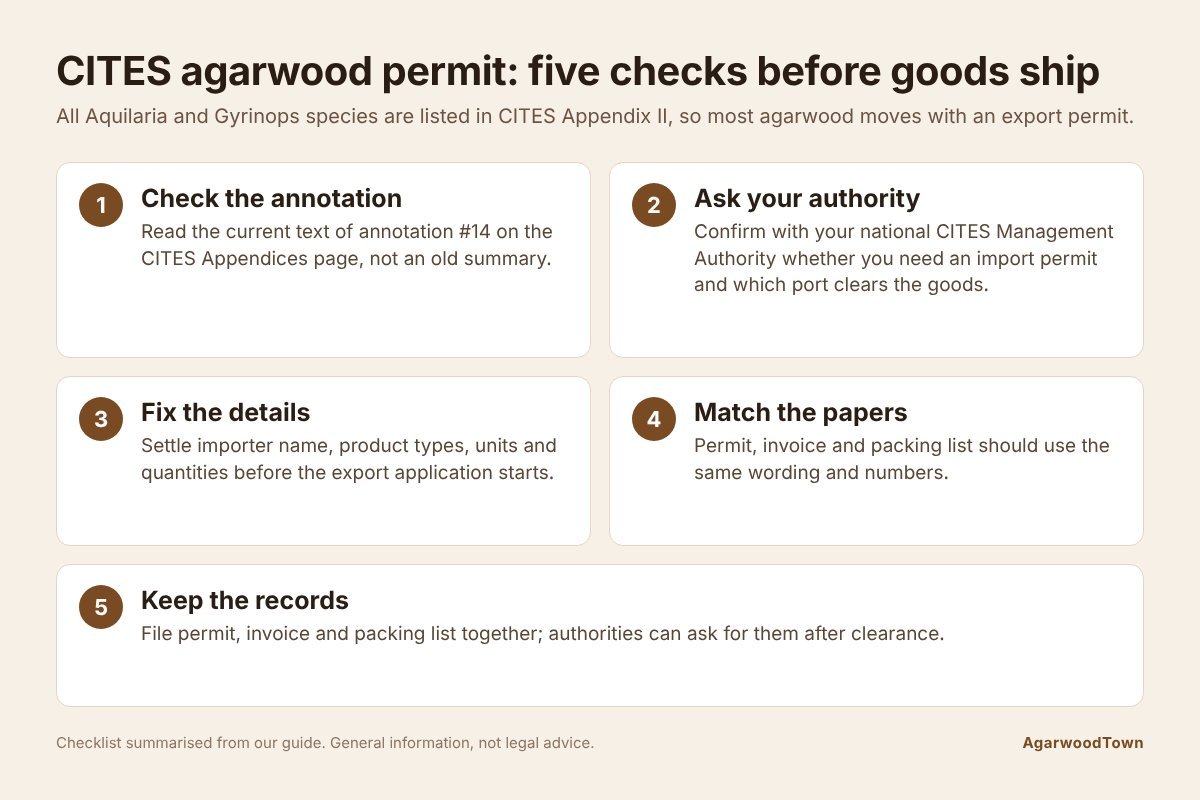
- Check the annotation: read the current text of annotation #14 on the CITES Appendices page; do not rely on an old summary.
- Ask your authority: confirm with your national CITES Management Authority whether you need an import permit and which port can clear the goods.
- Fix the details: settle the importer name, product types, units and quantities before the export application starts.
- Match the papers: make sure the permit, invoice and packing list use the same wording and numbers.
- Keep the records: file the permit, invoice and packing list together, because authorities can ask for them after clearance.
This guide is general information from an exporter's point of view, not legal advice. Rules and annotations change, and your own authority has the final word.

Step-by-Step Process
8. How We Handle the CITES Paperwork on Your Order
You tell us the market and the product mix
Send us the destination country, the products and grades you want, and whether you will resell in retail packaging or repack under your own brand. That choice affects the paperwork as much as the price, so we discuss it before we quote.
Ask for a quote with the documents listed
Ask for a quote that lists the documents the shipment will carry: grading note, CITES export permit where required, phytosanitary certificate for plants and a GC-MS report for oil if you ask for one.
You confirm the importer details
We need the exact legal name and address of the importer as it will appear on your import papers. Founder Wang Jianyu grades the wood, and the grade on the note should match the goods on the permit.
We apply; you check the scans
We arrange the CITES export permit where required. Ask for scans of the permit, invoice and packing list before dispatch, check names, units and quantities, and have any mismatch corrected before the goods move.
Dispatch, clearance and records
The goods leave with the endorsed permit and the full document set. We do not accept returns, but if something is genuinely wrong we resolve it by replacement or credit under our published policy.
We process more than 20 tons of agarwood material a month and ship to more than 500 B2B buyers in over 10 countries. That volume means the permit routine is part of our normal week, not a special project.
Still, no exporter can guarantee clearance at your end. What we can do is give you a consistent, complete document set and answer questions quickly. We reply to enquiries within 4 business hours, Monday to Saturday, 9:00–18:00 China time.
Pricing does not change because of the permit. For reference, our chips start from $0.24/g with a 100 g MOQ, hydro-distilled oil from $7.00/g and CO₂ oil from $1.50/g, both with a 10 g MOQ. Buyers of bakhoor face the same paperwork logic, which our bakhoor sourcing standards guide touches on from the GCC angle.
Planning a first CITES-documented order?
Tell us your country, your product mix and whether you need retail packaging. We will list the documents your shipment will carry and flag anything you should confirm with your own authority.
Ask our export team about permits and a quote → or read our replacement and credit terms before you order.
Frequently Asked Questions
Yes. All Aquilaria species, the main source of agarwood, have been listed in CITES Appendix II since 2004, and the related genus Gyrinops is listed too. Appendix II allows commercial trade but controls it with permits, so most international shipments of agarwood wood, chips, beads and bulk oil need an export permit.
It depends on your country. Under the Convention, Appendix II species generally need only an export permit. However, many countries add stricter rules. The EU, for example, generally requires an import permit for Aquilaria, and the UK runs its own permit system. Confirm your position with your national CITES authority before ordering.
Not automatically. Annotation #14 exempts some finished products packaged and ready for retail trade, but the current text excludes certain product types, such as wood chips, beads and carvings, from that exemption. Read the current annotation on the CITES website, and check whether your country applies stricter domestic rules to the same goods.
Usually yes. The specimen type sets the rule, not the weight, so a 100 g sample of chips is treated like a larger lot. Our paid samples start from 100 g of chips or 1 g of oil, and we follow the same permit route for them. Retail-packaged finished goods may be different under the annotation.
Bulk oud oil from Aquilaria is generally treated as a covered derivative and normally needs an export permit. Finished, retail-packaged perfume products may fall under the annotation #14 exemption, depending on the current wording and your national rules. Tell us your product mix and we will say how we expect to document it.
Under CITES rules, an export permit is normally valid for up to six months from the date of issue, and it covers one specific consignment. If the goods do not ship within that window, the permit cannot be used and a new application is needed. Dispatch should therefore be planned well inside the validity period.
Yes, but the onward shipment normally needs its own document. When CITES goods are re-exported from your country, your national CITES authority usually issues a re-export certificate that refers back to our original export permit. Keep the original paperwork on file, because you will need its details for that application.
Yes, in most cases. The Appendix II listing covers the whole Aquilaria genus, whether the tree was wild or cultivated. Plantation origin affects how the source is recorded on the permit, not whether a permit is needed. Our stock is plantation Aquilaria sinensis from Dian Bai, and the permit records it as such.
Yes, within limits. CITES raised India's annual export quota for Aquilaria malaccensis in 2024, to 151,080 kg of chips and powder and 7,050 kg of oil, while keeping a zero quota for wild-harvested wood. Exports must come from registered cultivated trees and carry Indian CITES documents. Rules can change, so check the current quota before buying.
On our orders, we apply for the Chinese export permit as part of the wholesale service and build the cost into the quote. Your side covers any import permit, customs broker fees and inspection charges in your country. We send document copies before dispatch so your broker can check the wording against your import paperwork.
References
- 1
- 2Barden A., Anak N.A., Mulliken T., Song M.. Heart of the Matter: Agarwood Use and Trade and CITES Implementation for Aquilaria malaccensis. TRAFFIC International, 2000.View source
- 3
- 4European Commission. Wildlife trade — implementation of CITES through Council Regulation (EC) No 338/97. European Commission, Environment, 2025.View source
- 5
- 6
- 7Down To Earth. CITES notified increase in annual export quota for agarwood in India. Down To Earth, 2024.View source
- 8Liu Y., Chen H., Yang Y., et al.. Whole-tree agarwood-inducing technique: an efficient novel technique for producing high-quality agarwood in cultivated Aquilaria sinensis trees. Molecules, 2013.View source
All scientific references are provided for transparency. AgarwoodTown summarises peer-reviewed findings for educational purposes and does not claim to provide medical or regulatory advice.
Wholesale Catalog
Buy the products discussed in this article


Related Articles
Sourcing Reference
Oud Incense Import Europe 2026: The Complete CITES & Wholesale Guide
12 min read
Sourcing Reference
Bakhoor Sourcing 2026: 7 Premium Standards GCC Luxury Brands Use to Evaluate Source Suppliers
14 min read
Education
Agarwood Price Per Kg 2026: Wild vs Cultivated Kynam & Oud Wood Guide
16 min read
Source Direct from Origin
Discuss Your Requirements with Our Team
We respond within 24 hours. Share your target grade, quantity and destination — we'll send current pricing, a sample pack option, and CITES documentation details.