Mabkhara Guide: The Gulf Incense Burner, Its Forms and Its Place in Hospitality
In the Gulf, the object that carries oud to the guest matters almost as much as the oud itself. The mabkhara is the footed incense burner that holds glowing coal and a few chips of agarwood or bakhoor, and it travels from hand to hand at the end of a visit. We do not make or sell mabkharas. We grow and grade the oud and bakhoor that go into them. This guide covers the mabkhara as a cultural object, how it is used in the majlis, and what retailers should pair with it.

Written by
Founder & Chief Sourcing Officer, AgarwoodTown
15+ years hands-on experience grading plantation agarwood, sourcing directly from Dianbai and Maoming districts in Guangdong — the world's largest Aquilaria sinensis cultivation region. Wang has personally inspected thousands of CITES export shipments and holds plantation certification from China's National Forestry and Grassland Administration. He advises GCC, European and East Asian wholesale buyers on grade selection, CITES compliance and supply chain due diligence.
CITES Certified
In this article
- What Is a Mabkhara?
- Mabkhara, Mabkhra, Mibkhara: Names and Spellings
- Why an Oud Grower Writes About Burners
- Regional Forms and the Mabkhara in Architecture
- What Is a Mabkhara Made Of?
- How Is the Mabkhara Used in Majlis Hospitality?
- Where Incense Sits in the Order of Service
- Passing the Burner: Guest Etiquette
- The Mabkhara as a Polite Farewell
- Mabkhara Occasions Beyond the Majlis
- Perfuming Clothes, Hair and Rooms
- What Do You Burn in a Mabkhara?
- Which Grade Suits a Hospitality Session?
- How to Bundle Bakhoor With a Mabkhara
- Sourcing What Goes in the Mabkhara
- Frequently Asked Questions
1. What Is a Mabkhara?
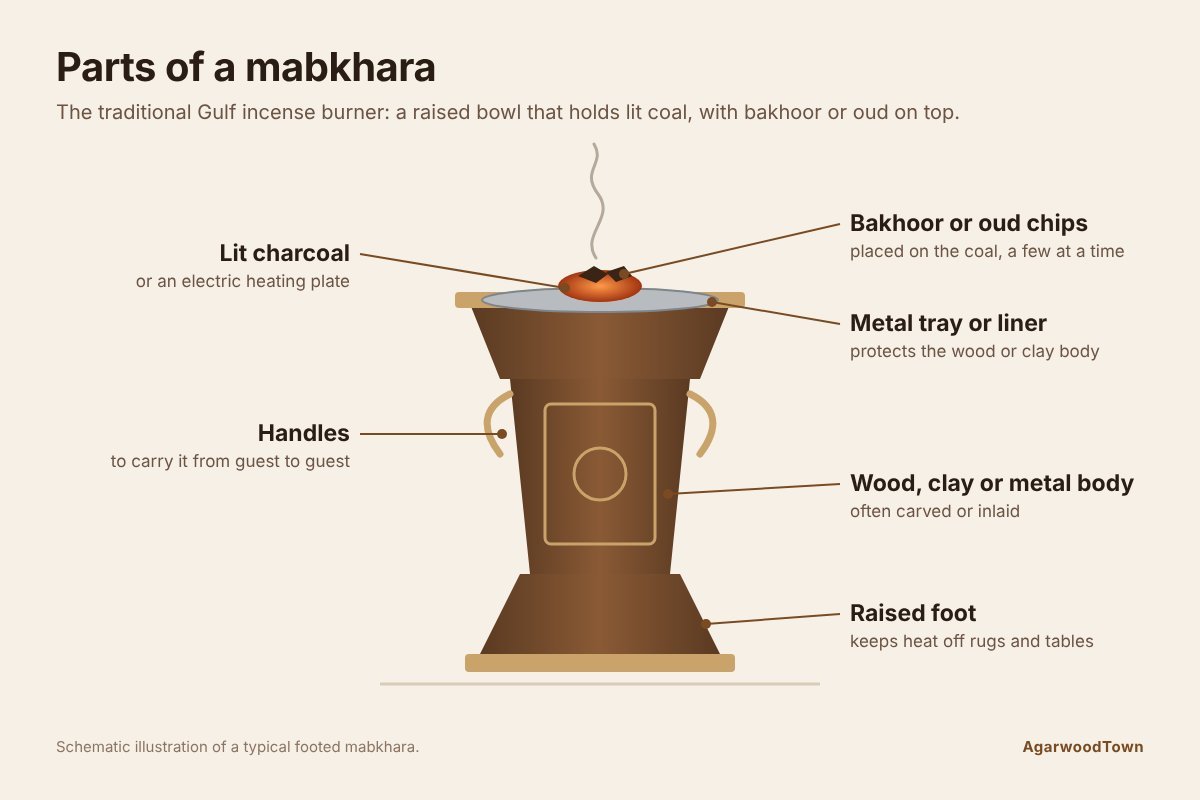
A mabkhara is the traditional incense burner of the Arabian Peninsula. It is usually a small raised bowl on a footed or stepped base, made to hold a piece of lit charcoal with oud chips or bakhoor placed on top.[1]
Incense is an everyday habit in the Gulf, not a special-occasion one. According to a survey of 628 households in the United Arab Emirates (Yeatts 2012), 86% burned incense such as oud and bakhoor at least once a week, and 44% burned it daily.[4]
The design is simple, and that is the point. The bowl contains the heat, the base lifts it off carpets and tables, and the shape lets a host pick it up and carry it to each guest. In many Gulf homes it is as familiar as the coffee pot.
However, the burner is more than hardware. It is a hospitality object, a household ornament and often a gift in its own right. The way a family uses it says something about welcome, respect and the end of a visit.
Mabkhara, Mabkhra, Mibkhara: Names and Spellings
The word comes from the Arabic root linked to incense smoke, the same root that gives bakhoor. In English you will see mabkhra, mibkhara and mubkhar as well as the common spelling, depending on dialect and transliteration. The plural is often written mabakhir.
For retail listings, the spelling matters more than it seems. Shoppers in the UAE, Saudi Arabia and Kuwait search in Arabic first, while diaspora shoppers in Europe and North America often type "Arabic incense burner" or "oud burner". Therefore a product page that uses the Arabic name alongside a plain English description reaches both groups.
Why an Oud Grower Writes About Burners
We are an agarwood plantation and processor in Guan Zhu Town, Dian Bai District, Maoming, Guangdong. We do not manufacture or sell mabkharas, and we will not quote you one.
What we do supply is the material that goes in the bowl: graded oud chips, bakhoor and related incense. In practice, the burner your customer owns decides which of those products performs well for them. A retailer who understands the burner sells better fuel for it.
For the technical side — electric versus charcoal heating, temperature settings and burner safety — read our bakhoor burner guide for retailers. This article stays with the burner as a cultural object and with how people actually use it when guests arrive.
Regional Forms and the Mabkhara in Architecture
The mabkhara takes different shapes around the region. Clay censers are common in Yemen and the Horn of Africa, where the Somali version is called a dabqaad. Gulf households increasingly mix carved wooden burners with modern metal and electric ones.
The shape is famous enough to appear in architecture. Some medieval minarets in Cairo end in a mabkhara-shaped top, and modern monuments in the Gulf, such as the incense-burner landmark in Khorfakkan, use it as a symbol of hospitality.
2. What Is a Mabkhara Made Of?
| Material or form | What it looks like | Where and how it is used | What it means for the fuel you sell |
|---|---|---|---|
| Fired clay or terracotta | Unglazed or painted earthenware, often a square stepped base with a shallow bowl | Long-standing everyday form, widely associated with Yemen, Oman and rural households across the region | Holds charcoal heat well and runs hot; better suited to robust bakhoor and lower-grade chips than to delicate high-grade oud |
| Wood with metal fittings | Carved wooden body, often decorated with brass or white-metal studs, strips and mirror inlay, with a metal-lined bowl | Classic Gulf majlis piece, frequently displayed when not in use | The metal liner takes the coal; customers burn both chips and bakhoor, usually in small amounts per session |
| Brass, copper or silver | Polished metal, sometimes with a lid, chains or a handle for carrying | Formal hospitality, weddings and gift use; silver pieces are often heirlooms | Conducts heat quickly, so the bowl surface gets very hot; small chips and a modest coal work best |
| Stone (including soapstone and marble) | Heavy carved bowl and base, sometimes with brass trim | Decorative and long-lasting; popular in modern interiors | Stable heat and slow to cool; suits longer sessions with bakhoor |
| Modern ceramic, glass or crystal | Contemporary shapes, gold accents, often sold in gift boxes | Gift market, hotels, retail displays and newer homes | Usually paired with charcoal or a small electric insert; buyers expect a matching boxed bakhoor |
| Electric mabkhara | Plug-in or rechargeable unit with a heated plate, often styled like a traditional mabkhara | Apartments, offices, cars and households that avoid open coal | Lower, controllable heat; favours smaller chips and finer bakhoor — see the burner guide for settings |
Regional associations are broad tendencies, not rules. Styles travel across the Gulf, and many households own several mabkharas in different materials.
3. How Is the Mabkhara Used in Majlis Hospitality?
In the majlis, the sitting room where a household receives guests, the incense burner is part of the welcome. The host or a family member carries the lit burner to each guest, who takes a moment to perfume themselves with the smoke before passing it on or handing it back.
Customs differ between countries, tribes, cities and individual families, so treat what follows as a general picture rather than a fixed protocol. Still, a few patterns appear across much of the Gulf, and they shape how your customers use the products you sell them.
Where Incense Sits in the Order of Service
A typical visit opens with Arabic coffee and dates, and often tea, fruit or sweets follow. Incense usually comes later in the visit. In many households the mabkhara is the last gesture of hospitality, offered after refreshments and conversation.
For a supplier, this order matters. Incense is the closing note of the visit, so hosts want a clean, rich smoke that lingers on clothes. They do not want harsh, sharp smoke that guests carry home as a smell of burnt wood.
Passing the Burner: Guest Etiquette
When the burner reaches a guest, the usual gesture is brief. Men often hold the burner near the chest and waft smoke toward the beard, the collar and under the headdress. Women may perfume their hair, scarf or abaya, and sometimes hold the burner under the hem of a garment.
A guest takes a few seconds, not minutes. Holding it too long keeps others waiting, while waving it away abruptly can look like a refusal of the host's welcome. In practice, most guests accept it, perfume themselves briefly and pass it on with a word of thanks.
The host usually tops up the coal or adds a fresh chip between guests if the smoke fades. Therefore the size and resin content of each chip affect how often the host has to refill, which is a practical point retailers can explain at the counter.
The Mabkhara as a Polite Farewell
A widely repeated Gulf saying holds that there is no sitting after the oud. Because incense so often closes a visit, the arrival of the mabkhara can signal, gently and without words, that the gathering is coming to an end.
Visitors from outside the region sometimes miss this cue. Retailers serving mixed or expatriate customers may find it worth a line on a gift card or in-store sign, because it explains why the burner appears when it does. Moreover, it turns a product into a story the customer can retell.

Mabkhara Occasions Beyond the Majlis
The mabkhara is not reserved for formal guests. In many Gulf households it is part of the weekly rhythm, used for family occasions, religious festivals and simple house care.
Common occasions include Friday, when many families perfume the house and their clothes, and Ramadan evenings, when relatives visit after iftar. Eid mornings, weddings and engagement gatherings bring heavier use, and so do visits to a new baby or a new home.
Seasonal demand follows the same calendar. Retailers in the region typically stock up ahead of Ramadan, Eid and the wedding season, because those weeks see more hosting, more gifting and more bakhoor burned per household. Plan your wholesale order with enough lead time for grading, documents and freight.
Perfuming Clothes, Hair and Rooms
Beyond hospitality, people use the burner to scent textiles. A common method places the burner beneath a garment draped over a frame or a basket, so the smoke rises through the fabric. Clothes, scarves and bedding can hold the scent for days.
Many people also layer scent: they perfume clothes with bakhoor or oud smoke, then wear oud oil or attar on the skin. Agarwood has been traded into Arabia for this purpose for centuries, alongside frankincense from the south of the peninsula.[2]
Finally, rooms are perfumed directly. A host may walk through the house with the lit bowl, pausing in corners and doorways, before guests arrive or after cooking. For retailers, this everyday use is the steady, repeat demand behind the festival peaks.

4. What Do You Burn in a Mabkhara?
Two materials fill most mabkharas: plain oud wood chips and bakhoor. Oud chips are pieces of resinated agarwood with nothing added. Bakhoor is a prepared blend, usually wood chips soaked or coated with oils, resins, sugar or other binders.[1]
Pure graded oud wood chips give the scent of the wood itself. The smoke is drier and more complex, and it changes as the chip heats through. Higher grades are the traditional choice for honoured guests and formal occasions.
Bakhoor gives a sweeter, rounder and more perfumed smoke. Each house has its own blend, often with rose, musk, amber or sandalwood notes over an oud base. Our wholesale bakhoor chips start from $6/g with an MOQ of 250 g, and our oudh incense blends sit alongside them for buyers who want a stronger agarwood character.
Some households also burn frankincense resin, either alone or with oud. Frankincense smoke is brighter and more citrus-like, and it remains popular in Oman and Yemen. However, we do not sell frankincense; we stick to agarwood and agarwood-based blends.
A few customers no longer keep a coal burner at all. For them, Arabic-style oud incense sticks are a practical substitute that needs only a stick holder. Sticks start from $2.35 per box at an MOQ of 1 kg, so they make a sensible add-on line.
Oud Chips vs Bakhoor in the Mabkhara
| Feature | Oud wood chips | Bakhoor |
|---|---|---|
| What it is | Resinated agarwood, cut and graded, with nothing added | Prepared blend of wood chips with oils, resins, binders and sometimes sugar or honey |
| Scent in the smoke | Dry, woody, resinous; changes over the session as the chip heats through | Sweeter and more perfumed; the house blend sets the character |
| Typical use | Honoured guests, formal majlis, collectors, personal use | Everyday home scenting, perfuming clothes, weddings and gifting |
| How much per session | One or two small chips; a high-resin chip goes a long way | A pinch to a small spoonful, depending on blend strength and burner size |
| Heat tolerance | Prefers gentle heat; too hot and the chip chars and smells sharp | Usually more forgiving on a hot coal, though sugary blends can scorch |
| How it is judged | Grade, resin content, aroma when heated; our scale runs D to AAA | Blend quality, oil load, burn cleanliness and how long the scent lingers on cloth |
| Our wholesale start price | From $0.24/g · MOQ 100 g · grades D–AAA | From $6/g · MOQ 250 g |
5. Which Grade Suits a Hospitality Session?
For daily home scenting, lower and middle grades work well and keep the cost per session low. For honoured guests, weddings and gifts, Gulf customers traditionally move up the scale. The mabkhara itself is the same; the chip inside changes with the occasion.
We grade every lot by visual inspection, aroma, resin content and sink test, on an internal scale of D, C, B, A and AAA, with Kynam handled by allocation only. This is our own scale, not an ISO or CITES standard, and other suppliers grade differently.
On the grading table, and later on the coal, the differences show up clearly. D-grade chips are mostly pale wood with thin resin lines, so they give a lighter, shorter smoke. AAA chips carry dense resin through much of the piece, so a single small chip can perfume a room and the guests in it for much longer.
At the very top, kynam wood for special occasions sits above AAA. It behaves differently on heat, with a cooler, sweeter note, and many owners warm it gently on a low electric setting or a mica plate rather than directly on a coal. We quote kynam per enquiry, starting from $0.89/g at the lowest end of the range.
Retailers often find it useful to sell by occasion rather than by grade letter. For example, an "everyday" tin, a "guest" tin and a "celebration" tin are easier for a shopper to choose than D, B and AAA. The grade letters still belong on your purchase order and on the grading note that ships with each wholesale lot.
Step-by-Step Process
6. How to Bundle Bakhoor With a Mabkhara
Source the mabkhara from a burner specialist
We do not sell mabkharas, so the burner comes from your own supplier — a local craftsman, a regional importer or a homeware manufacturer. Choose the style for your market first: a clay or wooden piece reads as traditional, while ceramic, crystal or electric units suit gift and modern-interior customers.
Match the fuel to the burner
A hot charcoal mabkhara handles robust bakhoor and lower-grade chips well. An electric unit or a small metal bowl suits finer chips and lighter blends. Therefore pair each burner style with one or two fuels that will actually perform in it, instead of one fuel for every box.
Build tiers around occasions
A starter set might hold a simple burner, a tin of everyday bakhoor and a pack of charcoal. A guest set could add mid-grade oud chips. A wedding or Eid gift set might combine a decorative mabkhara with higher-grade chips and a small bottle of oud oil for layering.
Order samples and test them in the actual burner
Burn each candidate fuel in the exact burner you plan to sell, on the heat source your customers will use. Our paid samples start from 100 g of chips, so you can run several sessions before committing. Note smoke quality, how long the scent lasts and how much ash or residue remains.
Write clear use and safety notes
Print short instructions in Arabic and English: how much fuel per session, where to place the burner, and how to dispose of coal safely. Keep the technical heat guidance consistent with whatever the burner maker states, and add a one-line explanation of how the mabkhara is used for guests.
Plan stock around the hosting calendar
Ramadan, Eid and the wedding season drive the busiest weeks. Place wholesale orders early enough to allow for grading, CITES paperwork where required, and freight. Reorder the fuel more often than the burner, because a good burner lasts for years while bakhoor and chips are used up every week.
7. Sourcing What Goes in the Mabkhara
The burner itself is ordinary homeware, but the agarwood inside it is not. All Aquilaria species have been listed in CITES Appendix II since 2004, so many international shipments of chips and bakhoor need an export permit.[3]
- Documents: every wholesale shipment from us carries a grading note and a CITES Appendix II export permit where one is required.
- Annotation #14: some finished, retail-packaged products are exempt under the listing annotation. Check the current annotation text before assuming your bakhoor tins qualify.
- Burners shipped together: if you import burners and fuel in one consignment, declare them as separate lines so customs can see which goods fall under CITES.
- Import side: your own country may add rules, so confirm with your national CITES authority before the first order.
We grow and inoculate our own Aquilaria sinensis on 100+ mu in Dian Bai, work with 100+ contracted plantation farmers and process 20+ tons of agarwood material a month. That material ends up as the chips, bakhoor and hydro-distilled oud oil for layering that Gulf customers use with their mabkharas. For the wider picture of buying blends, see our bakhoor sourcing guide, and for market detail read our Saudi Arabia market page.
Stocking fuel for your mabkhara range?
Tell us which burners you carry, the occasions you sell for and your target grades, and we will suggest a sample set of chips and bakhoor to test in them. We reply within 4 business hours, Monday to Saturday, 9:00–18:00 China time.
Ask for a mabkhara fuel sample set → or read our replacement and credit terms first. Samples are paid and non-refundable; any problem with an order is fixed by replacement or credit.
Frequently Asked Questions
A mabkhara is used to burn oud chips, bakhoor or other incense, usually on a piece of glowing charcoal. In Gulf homes it perfumes guests at the end of a majlis visit, scents clothes, hair and bedding, and fills rooms before gatherings, on Fridays, during Ramadan and at Eid and weddings.
No. We are an agarwood plantation and processor, so we do not make or sell mabkharas or other burners. We supply what goes into them: graded oud wood chips, bakhoor, oudh incense, incense sticks and oud oil. Retailers who build gift sets source the burner separately and pair it with our fuel.
Light a piece of incense charcoal until it glows evenly and set it in the bowl. Then place one or two small oud chips or a pinch of bakhoor on top and let the smoke build. Our bakhoor burner guide covers heat, charcoal types and safety in more detail for retailers.
When the host brings the burner, a guest briefly wafts the smoke toward the beard, collar, headdress, hair or scarf, then passes it on or hands it back. The gesture takes a few seconds. Customs vary by country and family, but accepting it briefly and with thanks is the usual courtesy.
In many Gulf households incense is the final act of hospitality, offered after coffee, dates and conversation. A widely repeated saying holds that there is no sitting after the oud, so the mabkhara can gently signal that the gathering is closing. Not every family follows this, but the association is strong.
Neither is better in every case. Pure oud chips give the dry, complex scent of resinated agarwood and suit honoured guests and collectors. Bakhoor gives a sweeter, more perfumed smoke and suits daily home scenting and clothes. Many households keep both and choose by occasion, which is why retailers often stock both.
Match the grade to the occasion. Lower grades on our internal D to AAA scale suit everyday scenting at a low cost per session, while higher grades suit guests, weddings and gifts. Our scale is not an industry standard, so test samples in a real mabkhara before choosing your tiers.
Yes. Electric mabkharas heat a metal plate instead of a coal, which gives lower and more controllable heat. That suits smaller chips, finer bakhoor and high-grade or kynam pieces that char on a hot coal. Keep fuel guidance consistent with the burner maker's instructions, and see our burner guide for settings.
Often, yes. Aquilaria species are listed in CITES Appendix II, so many shipments of agarwood chips and bakhoor need an export permit. Annotation #14 exempts some retail-packaged finished goods, so check the current annotation text. The mabkhara itself is ordinary homeware, but declare it separately when it ships with fuel.
A practical gift set holds a burner, a tin of bakhoor, a small pack of oud chips and charcoal or an electric insert, plus a short card in Arabic and English explaining use. Higher tiers can add better-grade chips or a small bottle of oud oil, since many people layer smoke and oil.
References
- 1
- 2Barden A., Anak N.A., Mulliken T., Song M.. Heart of the Matter: Agarwood Use and Trade and CITES Implementation for Aquilaria malaccensis. TRAFFIC International, 2000.View source
- 3
- 4Yeatts K.B., et al.. Indoor air pollutants and health in the United Arab Emirates. Environmental Health Perspectives, 2012.View source
All scientific references are provided for transparency. AgarwoodTown summarises peer-reviewed findings for educational purposes and does not claim to provide medical or regulatory advice.
Wholesale Catalog
Buy the products discussed in this article


Related Articles
Incense
Bakhoor Burner Guide for Retailers: Electric vs Charcoal, Heat and Safety
15 min read
Sourcing Reference
Bakhoor Sourcing 2026: 7 Premium Standards GCC Luxury Brands Use to Evaluate Source Suppliers
14 min read
Incense
How to Burn Bakhoor: A Step-by-Step Guide for Charcoal and Electric Burners
13 min read
Source Direct from Origin
Discuss Your Requirements with Our Team
We respond within 24 hours. Share your target grade, quantity and destination — we'll send current pricing, a sample pack option, and CITES documentation details.