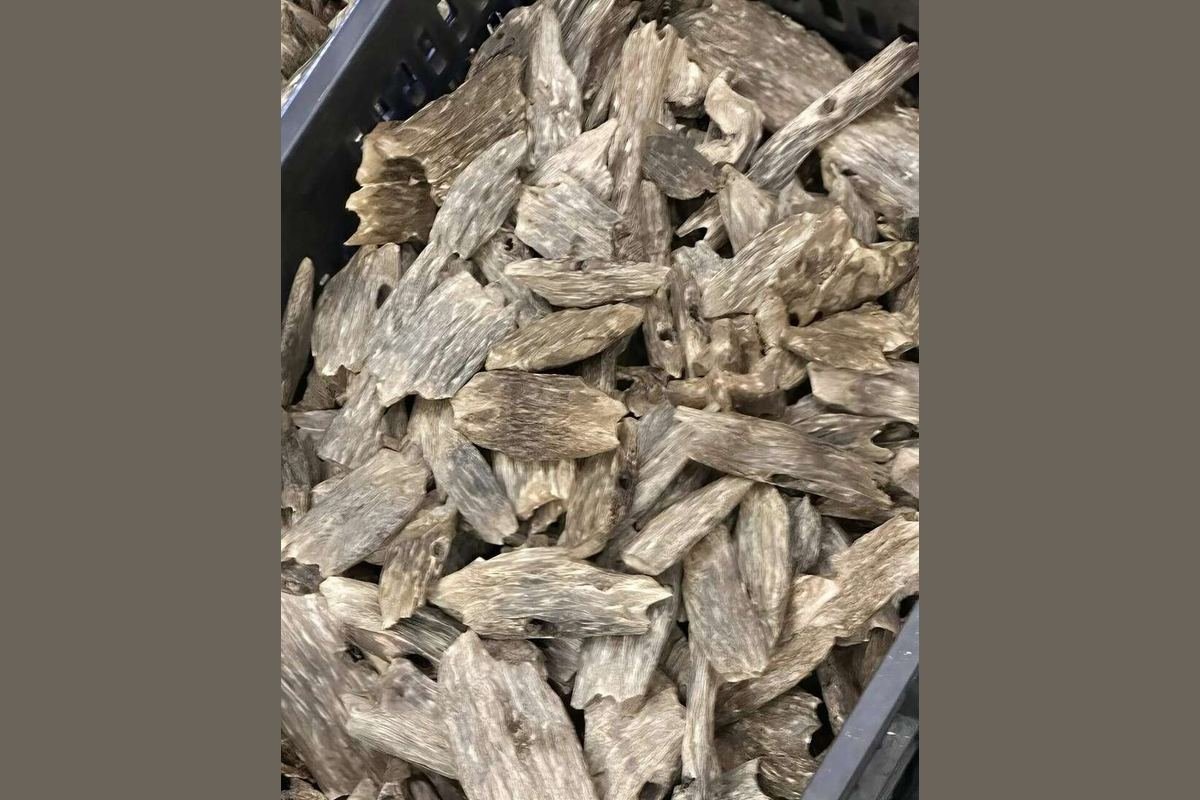
Kyara Agarwood vs Kynam: Names, Traits and the Truth About Grafted Kynam
Buyers from Tokyo and buyers from Guangzhou often ask for the same wood using different words. The kyara agarwood versus kynam question is mostly about language: kyara is the Japanese name, while kynam, qinan and kỳ nam come from Chinese and Vietnamese. Yet the names carry different expectations, and the market now holds two very different materials under them — scarce wild wood and grafted plantation wood. This guide explains the naming, the physical traits graders look for, how grafted kynam differs from wild, and how to check what you are being offered.

Written by
Founder & Chief Sourcing Officer, AgarwoodTown
15+ years hands-on experience grading plantation agarwood, sourcing directly from Dianbai and Maoming districts in Guangdong — the world's largest Aquilaria sinensis cultivation region. Wang has personally inspected thousands of CITES export shipments and holds plantation certification from China's National Forestry and Grassland Administration. He advises GCC, European and East Asian wholesale buyers on grade selection, CITES compliance and supply chain due diligence.
CITES Certified
In this article
- Kyara Agarwood vs Kynam: Same Tier, Different Languages
- Kyara vs Kynam: Where the Names Come From
- Kyara, Kynam, Qinan, Kỳ Nam: A Naming Map
- How Is Kynam Different From Ordinary Agarwood?
- Soft, Waxy and Cool: The Classic Signs
- Does Kynam Always Sink?
- What Does Kyara Mean in Kōdō?
- Kyara as a Grade Word on Incense Labels
- Wild Kynam vs Grafted Plantation Kynam
- How Grafted Kynam Is Produced
- Is Grafted Kynam Real Kynam?
- Kyara vs Kynam: How to Verify Either Before You Buy
- Red Flags in Kyara and Kynam Listings
- Kynam Agarwood Price per Kg
- Buying Kynam Wholesale: Allocation, Price and Paperwork
- Frequently Asked Questions
1. Kyara Agarwood vs Kynam: Same Tier, Different Languages
In the kyara vs kynam question, the short answer is that both words name the same top tier of agarwood. Kyara agarwood and kynam are one material seen through two languages. Kyara (伽羅) is the Japanese term. Kynam is an English trade spelling of the Chinese qínán (奇楠) and the Vietnamese kỳ nam.[1]
One measurable benchmark does exist. According to Liu et al. (2013), the Chinese Pharmacopoeia requires no less than 10% alcohol-soluble extractive in agarwood; induced samples in the study reached 11.60–18.08%, while two wild samples scored 10.56% and 19.30%.[7]
All of them describe agarwood whose resin behaves differently from ordinary oud. It is softer, oilier and sweeter, and it gives off scent even before you heat it. However, each market attaches its own history and its own standards to the word it uses.
That is why the comparison matters to a buyer. A Japanese incense house hearing "kyara" thinks of kōdō reference wood. A Chinese collector hearing "qinan" thinks of colour classes and bead quality. Meanwhile, a Gulf retailer hearing "kinam" may simply expect the most expensive oud on the table.
Kyara vs Kynam: Where the Names Come From
The roots of the word are debated. Most accounts link the Chinese and Vietnamese forms to older Southeast Asian names for fragrant wood, which later moved into Japanese as kyara. In practice, nobody in the trade can trace a single clean line of origin.
Spelling adds to the confusion. You will see kynam, kinam, kanam, qinan, chi-nan and kinam oud on invoices, often for the same thing. Therefore we always ask buyers which word their own customers use, because the label on the final box should match local expectations.
For the wider map of agarwood names — oud, aloeswood, gaharu, jinkō and chén xiāng — see our guide to agarwood and oud naming. Here we stay with the top tier only.
2. Kyara, Kynam, Qinan, Kỳ Nam: A Naming Map
| Term | Script | Where it is used | What buyers usually mean by it |
|---|---|---|---|
| Kyara | 伽羅 | Japan | Top-tier agarwood in kōdō; also a premium grade word on incense labels |
| Qinan / Qi nan | 奇楠 (also 棋楠, 伽南) | Mainland China, Taiwan, Hong Kong | Top-tier agarwood, often sub-divided by colour and texture |
| Kỳ nam | kỳ nam | Vietnam | Top-tier agarwood, historically tied to central Vietnam |
| Kynam / Kinam | Latin spelling | International trade, English listings | Trade transliteration of qinan / kỳ nam; meaning depends on the seller |
| Grafted kynam | 嫁接奇楠 | Guangdong, Hainan and wider plantation trade | Plantation wood from trees grafted with kynam-line scions |
| Sinking grade | 沉水 | China | Dense agarwood that sinks in water — not the same thing as kynam |
Usage varies between traders and over time. This map shows how the words are commonly used in the trade, not a legal or scientific definition.
3. How Is Kynam Different From Ordinary Agarwood?
| Feature | Kynam / kyara | Ordinary high-grade agarwood |
|---|---|---|
| Texture under a knife | Soft and sticky; shavings tend to curl and hold together | Hard and brittle; shavings tend to break into flakes or dust |
| Resin feel | Waxy or oily; resin can soften with the warmth of a hand | Dry and glassy, even when dark and dense |
| Scent unheated | Noticeable sweet scent at room temperature | Usually faint until heated |
| Scent heated | Sweet with a cool, refreshing edge that changes over the session | Warm, woody and resinous; can be deep but less layered |
| Water test | May sink or float — oil content, not density alone, defines it | Top lots often sink; density is a key grade factor |
| Typical use | Kōdō, collector pieces, beads, carvings, top incense | Bakhoor, chips, distillation, beads, incense |
| Availability | Very scarce wild; grafted plantation supply is limited | Regular supply from plantations across grades |
Kynam differs from ordinary agarwood mainly in how its resin feels and releases scent. Graders describe it as soft, waxy and sweet, with a cooling note that ordinary agarwood lacks. Published reviews of agarwood grading show that sensory and physical checks still carry most of the weight, because no single lab number defines quality.[2]
Soft, Waxy and Cool: The Classic Signs
Ordinary dark agarwood is hard. Its resin sits in the wood like glass, so a blade chips it. By contrast, good kynam cuts more like firm wax, and a thin shaving often rolls up instead of snapping.
The scent behaves differently too. Hold a piece of kynam close at room temperature and you will usually smell sweetness straight away. Ordinary agarwood, even at AAA grade, tends to stay quiet until it meets heat.
On a heater the difference becomes clearer. Kynam opens sweet, then shows the cool, slightly sharp edge that Chinese collectors call 凉 (liáng). Moreover, the scent moves through stages over a session, which is one reason kōdō practitioners prize kyara for close listening.
Chinese collectors also sort qinan into informal colour classes, such as green, black, white, purple and yellow. These classes describe resin colour and texture rather than species. They are trade language, not a standard, and two dealers may place the same piece in different classes.
Does Kynam Always Sink?
No, and this surprises many buyers. Ordinary agarwood earns its "sinking grade" label through dense resin. Kynam resin is oilier and softer, so some genuine pieces float or hover in water.
Therefore the sink test, which works well for sorting ordinary chips, says little about kynam on its own. We still record it, but we read it together with texture and scent. Our step-by-step agarwood grading guide explains how the sink test fits into grading the rest of the range.
4. What Does Kyara Mean in Kōdō?
In Japan, kyara is the highest class of aromatic wood in kōdō, the art of appreciating incense. It sits first in the traditional rikkoku system, which sorts agarwood into six "countries" by character rather than by true geographic origin.[3]
The six classes are usually listed as kyara, rakoku, manaka, manaban, sasora and sumotara. Practitioners describe the wood with five tastes — sweet, sour, hot, salty and bitter — and kyara is valued for showing several of them in balance.
Kōdō does not burn wood. Instead, a tiny sliver warms on a mica plate above buried charcoal, and guests "listen" to the scent. This gentle heat suits kyara, because high heat flattens the sweet and cool notes the ceremony is built around.
Kyara as a Grade Word on Incense Labels
Outside the ceremony, kyara also works as a commercial grade word. Japanese incense makers use it on top-line sticks and blends, and the label usually signals that kyara-type wood forms part of the recipe.[3]
The share of kyara in such incense varies widely by maker. For that reason, an importer should ask a supplier what "kyara" means on a specific product, rather than assuming it means pure kyara wood.
Our own kyara incense made with kynam agarwood is a finished stick for buyers who want that tier in pressed form. Buyers serving the wider kōdō and koh market usually start with our Japanese-style koh incense, from $6/g with a 100 g MOQ. The Japan market page covers that buyer profile in more depth.


5. Wild Kynam vs Grafted Plantation Kynam
Wild kynam and grafted plantation kynam share a name but not a history. Wild kynam formed slowly inside old wild trees and is now extremely rare. Grafted kynam comes from plantation trees bred to produce kynam-type resin, and it is the only kind most buyers will realistically see.
We want to be plain about this. True wild kynam is so scarce that it rarely reaches open wholesale channels, and old pieces mostly change hands between collectors. Over-harvesting of wild Aquilaria across Asia is the reason the whole genus now sits in CITES Appendix II.[4]
Wild kynam is historically linked to Aquilaria crassna and related trees in central Vietnam and neighbouring regions. However, kynam is a quality class, not a species, and traders attribute it to several Aquilaria sources.
How Grafted Kynam Is Produced
Grafted kynam starts with a scion. Growers take branches from trees whose resin shows kynam traits and graft them onto ordinary Aquilaria rootstock, commonly Aquilaria sinensis in southern China. The new tree carries the kynam-line crown on a vigorous root system.
Once the trunk reaches working size, growers wound it to start resin formation, as with any plantation agarwood. Published reviews describe the main induction methods used on cultivated Aquilaria, from drilling to inoculants. What differs is the resin: kynam-line trees tend to produce softer, sweeter, oilier resin than standard stock.
At AgarwoodTown, the kynam we allocate is plantation material from grafted kynam-line trees in Guangdong. It is not wild wood, and we do not describe it as wild on any document.
Research from Chinese institutes supports the plantation side of this story. A 2021 study compared agarwood induced from a newly found Chi-Nan (kynam) germplasm of Aquilaria sinensis with ordinary agarwood, and found clearly different chemical profiles.[6] In other words, grafted kynam lines are a real botanical source, not just a marketing label. Even so, we judge every piece on the table, because a kynam line does not guarantee kynam-tier wood.

Is Grafted Kynam Real Kynam?
It depends on who you ask, and buyers should hear both sides. Many plantation growers and Chinese bead buyers accept grafted kynam as kynam, because it shows the key traits: softness, oiliness and the sweet, cool scent. Some collectors, however, reserve the word for wild wood only.
In our grading experience, good grafted kynam clearly separates itself from ordinary agarwood on the table. Even so, it is younger material, and its scent usually feels less layered than the old wild pieces collectors describe. Treat it as a distinct product, not a cheaper copy of wild kynam.
The honest label is therefore the useful one. If you resell grafted kynam, call it plantation or cultivated kynam. Your customers will trust the line more, and you avoid claims you cannot document. For the price gap between wild and plantation material in general, see our wild vs cultivated agarwood price breakdown.
Step-by-Step Process
6. Kyara vs Kynam: How to Verify Either Before You Buy
Ask what the seller means by the word
Start with the label itself. Ask whether the piece is wild or plantation, whether it comes from grafted kynam-line trees, and which species and country it comes from. A clear, written answer is the first test; a vague answer about "old stock" is a warning.
Smell it cold
Hold the piece close at room temperature, ideally in a scent-free room. Kynam usually shows a sweet scent without heat, while ordinary agarwood tends to stay faint. However, surface oil can fake this, so a cold scent alone proves nothing.
Check texture on a sample
On a paid sample you are allowed to cut, take a thin shaving with a sharp blade. Kynam resin tends to feel soft and slightly sticky, and the shaving often curls. Ordinary resinous wood tends to chip, flake or powder instead.
Warm it gently, not on flame
Heat a small sliver on a mica plate or a low-temperature electric heater, as kōdō practice does. Watch for the sweet opening, the cool edge and the way the scent changes over several minutes. High heat burns off these notes and makes any agarwood smell harsher.
Compare against a reference
Grade kynam against something. Warm an AAA chip from the same supplier beside the kynam sample under the same conditions. The difference in sweetness, coolness and development should be obvious; if it is not, the piece may be good agarwood rather than kynam.
Ask for documents and, where useful, lab data
Request the grading note, the CITES export permit where required and a clear origin statement. GC-MS can profile the aromatic compounds, but no single marker proves kynam, so read any lab report alongside the sensory checks rather than instead of them.
Verification is mostly careful comparison. Kynam is defined by how it looks, feels and smells, so the most reliable check is a trained nose testing a sample beside a known reference. Lab work helps, but it does not replace that step.
Agarwood chemistry explains why. Its scent comes from a large mix of sesquiterpenes and 2-(2-phenylethyl)chromones, and the balance shifts with tree, region and resin age.[5] Consequently, a GC-MS report shows a profile, not a yes-or-no verdict on the word kynam.
For wholesale buyers we recommend a paid sample first. Our samples start from 100 g of chips, and they are non-refundable, so plan your tests before you order. Then grade the volume lot against the sample, not against a photograph.
7. Red Flags in Kyara and Kynam Listings
Most problems in this segment come from labels, not from the wood. Watch for these signs before you commit money:
- "Wild kynam" at bulk prices: genuine wild kynam is extremely rare. Kilograms of it offered at plantation-level prices should make you sceptical.
- Kynam with no texture difference: if the wood is as hard and dry as ordinary agarwood, the word is doing the selling.
- Strong scent that fades fast: pieces soaked or rubbed with oil can smell rich at first, then go flat. Re-test a sample after a few days in open air.
- Sinking as the only proof: sinking shows density, and kynam does not always sink. A seller who offers only the sink test has not shown you kynam.
- No origin statement: any honest seller can say whether the piece is wild or plantation, grafted or not.
- No CITES paperwork: Aquilaria has been listed in CITES Appendix II since 2004. Loose wood, beads and carvings usually need an export permit; annotation #14 exempts some finished retail-packaged products, so check the current annotation text.
Kynam Agarwood Price per Kg
Buyers often ask for a kynam agarwood price per kg, and the honest answer has two parts. Our kynam agarwood wood listing starts from $0.89/g, about $890/kg at the entry level, and supply is very limited.
Wild kynam is a different market. The best pieces are sold one by one, never by a standard per-kg list, and we allocate our scarcest pieces per enquiry rather than holding them as stock. Treat any large, cheap, ready-stock "wild kynam" offer with caution, and ask to see the exact pieces before you pay.
8. Buying Kynam Wholesale: Allocation, Price and Paperwork
| Product | What it is | Starting price · terms |
|---|---|---|
| Kynam wood | Plantation kynam pieces from grafted kynam-line trees, graded individually | From $0.89/g · allocation only |
| Kynam carvings and logs | Sculpted pieces and resinated sections in kynam material | Quoted per piece · allocation only |
| Kyara incense | Finished incense sticks made with kynam agarwood | Quoted per enquiry |
| AAA oud wood chips (reference tier) | Our highest standard grade, just below kynam on our scale | Chips from $0.24/g at entry grade, rising with grade · MOQ 100 g |
Kynam is allocation-only at AgarwoodTown and is not held as regular stock. Starting prices are current list prices in USD; individual kynam pieces are quoted per enquiry.
Kynam sits above AAA on our internal grade scale of D, C, B, A, AAA and Kynam. That scale is ours; it is not an ISO or CITES standard, and other suppliers draw the line in different places. Because supply is limited, we allocate kynam to buyers instead of listing open stock.
In practice, a kynam enquiry starts with your use. Bead and bracelet makers, carvers, incense makers and collectors each need different piece sizes and textures. Tell us which you are, and we will tell you what is available at that moment.
Founder Wang Jianyu grades the wood himself, using visual inspection, aroma, resin content and the sink test. Every wholesale shipment carries a grading note or certificate, plus a CITES Appendix II export permit wherever one is required.
For collectors and carvers, our plantation kynam wood pieces are the starting point. We also allocate hand-carved kynam pieces and kynam agarwood log sections for display buyers.
If kynam is beyond your budget, AAA chips remain the honest alternative. Our graded oud wood chips run from D to AAA, so you can build a range and add kynam later. Buyers selling kyara-labelled incense may also find our agarwood incense sticks buying guide useful.
Ask about current kynam allocation
Tell us your market, the form you want and the piece size you need. We reply to enquiries within 4 business hours, Monday to Saturday, 9:00–18:00 China time.
Enquire about kynam allocation → and read our replacement and credit policy before ordering, since samples are paid and non-refundable.
Frequently Asked Questions
Mostly language. Kyara is the Japanese word for the top tier of agarwood, used in kōdō and on premium incense. Kynam is an English trade spelling of the Chinese qinan and Vietnamese kỳ nam for the same tier. The traits buyers expect — soft, waxy resin and a sweet, cool scent — are the same in both markets.
Yes. Qinan is the Chinese pinyin, kỳ nam is Vietnamese, and kynam, kinam or kanam are trade transliterations of those words. All of them point to the same top class of agarwood. However, sellers use the spellings loosely, so always ask whether a specific piece is wild, plantation or grafted material.
Kynam resin is oilier and more wax-like than the glassy resin in ordinary agarwood. As a result, a blade tends to cut it cleanly and shavings often curl rather than snap. Ordinary dark agarwood, even when very dense, is usually hard and brittle. Texture is therefore one of the first things graders check.
Not always. Ordinary agarwood earns a sinking grade because dense resin makes it heavier than water. Kynam resin is oilier and softer, so some genuine pieces float or hover. That is why the sink test helps sort ordinary chips but says little about kynam unless you combine it with texture and scent checks.
Only in very small amounts. True wild kynam is extremely rare, and old pieces mostly trade privately between collectors. Wild Aquilaria populations declined through over-harvesting, which is why the genus is listed in CITES Appendix II. Bulk offers of wild kynam at modest prices deserve strong scepticism and careful documentation checks.
Grafted kynam comes from plantation trees whose crowns were grafted from kynam-line scions onto ordinary Aquilaria rootstock, commonly Aquilaria sinensis in southern China. After wounding, these trees tend to form softer, sweeter resin than standard plantation stock. It is a distinct cultivated product and should be sold as plantation kynam, not as wild.
Plantation. The kynam we allocate is grafted kynam-line material from Guangdong, and we never describe it as wild. It sits above AAA on our internal grade scale, starts from $0.89/g on our list and is quoted per enquiry. Each shipment carries a grading note and a CITES export permit where required.
Gently. Kōdō practice warms a thin sliver on a mica plate above buried charcoal, and a low-temperature electric heater works in a similar way. Direct flame or high heat burns off the sweet and cool notes that define kynam and makes the smoke harsh. Start low and raise the heat slowly.
Not necessarily. In Japan, kyara is also a grade word for top-line incense, and the share of kyara-type wood in a recipe varies by maker. Importers should ask the supplier what the word means on each product. A clear answer, in writing, protects you when your own customers ask the same question.
Usually, yes. All Aquilaria species are in CITES Appendix II, so loose kynam wood, beads, carvings and logs normally travel with an export permit. Annotation #14 exempts some finished retail-packaged products, so check the current annotation text. Your own country may add import rules, so confirm with your national CITES authority.
References
- 1Yang D.-L., Wang H., Guo Z.-K., Li W., Mei W.-L., Dai H.-F.. Fragrant agarofuran and eremophilane sesquiterpenes in agarwood ‘Qi-Nan’ from Aquilaria sinensis. Phytochemistry Letters, 2014.View source
- 2Liu Y.Y., Wei J.H., Gao Z.H., et al.. A Review of Quality Assessment and Grading for Agarwood. Chinese Herbal Medicines, 2017.View source
- 3
- 4
- 5Naef R.. The volatile and semi-volatile constituents of agarwood, the infected heartwood of Aquilaria species: a review. Flavour and Fragrance Journal, 2011.View source
- 6Yu M., Liu Y., Feng J., Chen D., Yang Y., Liu P., Yu Z., Wei J.. Remarkable Phytochemical Characteristics of Chi-Nan Agarwood Induced from New-Found Chi-Nan Germplasm of Aquilaria sinensis Compared with Ordinary Agarwood. International Journal of Analytical Chemistry, 2021.View source
- 7Liu Y., Chen H., Yang Y., et al.. Whole-tree agarwood-inducing technique: an efficient novel technique for producing high-quality agarwood in cultivated Aquilaria sinensis trees. Molecules, 2013.View source
All scientific references are provided for transparency. AgarwoodTown summarises peer-reviewed findings for educational purposes and does not claim to provide medical or regulatory advice.
Wholesale Catalog
Buy the products discussed in this article


Related Articles
Source Direct from Origin
Discuss Your Requirements with Our Team
We respond within 24 hours. Share your target grade, quantity and destination — we'll send current pricing, a sample pack option, and CITES documentation details.