Dehn al Oud: How Gulf Buyers Wear, Measure and Source Neat Oud Oil
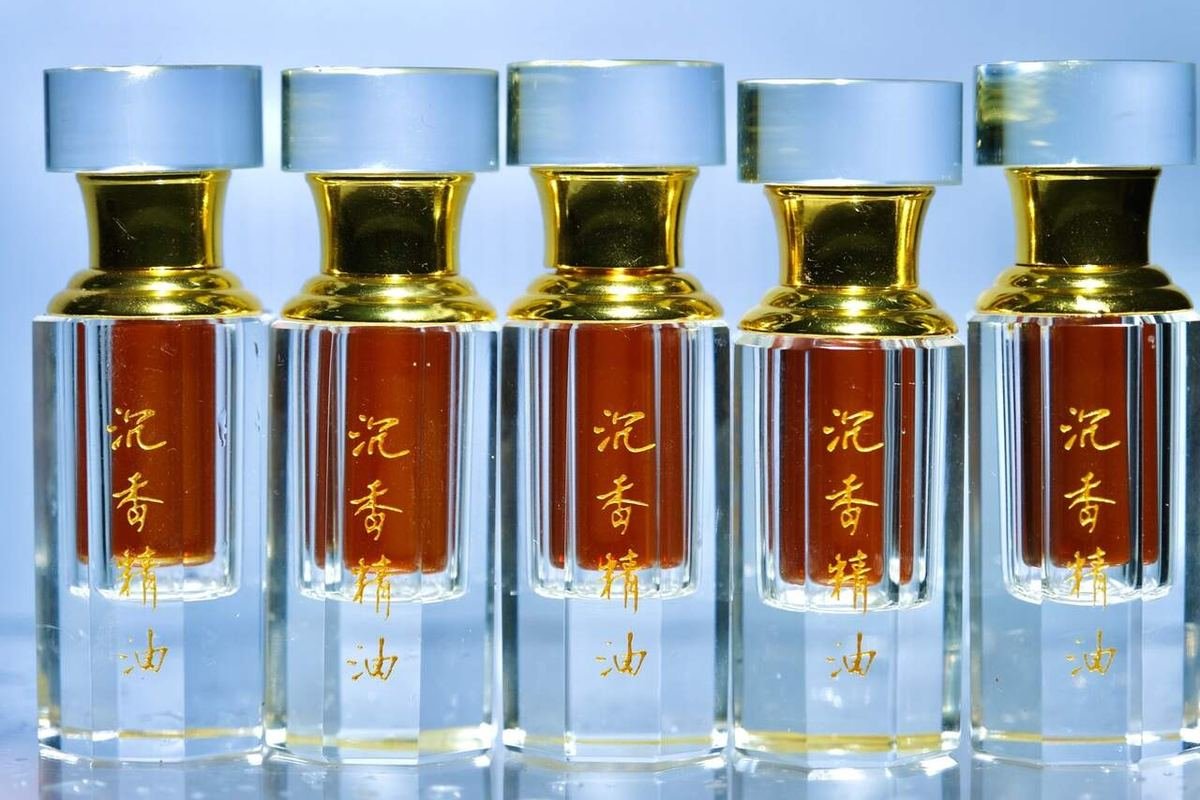
In the Gulf, oud oil has its own name, and the name tells you how buyers think about it. Dehn al oud means "the oil of oud": pure agarwood oil, worn in drops on the skin and traded by the tola rather than by the litre. For a supplier, that phrase sets expectations about purity, measure and character before anyone opens a bottle. This guide covers how dehn al oud is worn, how the tola works in grams and millilitres, what separates one oil from another, and what a GCC buyer should ask a supplier for.

Written by
Founder & Chief Sourcing Officer, AgarwoodTown
15+ years hands-on experience grading plantation agarwood, sourcing directly from Dianbai and Maoming districts in Guangdong — the world's largest Aquilaria sinensis cultivation region. Wang has personally inspected thousands of CITES export shipments and holds plantation certification from China's National Forestry and Grassland Administration. He advises GCC, European and East Asian wholesale buyers on grade selection, CITES compliance and supply chain due diligence.
CITES Certified
In this article
- What Is Dehn al Oud?
- Dehn al Oud vs Attar vs Oud Perfume
- How Is Dehn al Oud Worn in the Gulf?
- Layering With Bakhoor and Perfume
- Occasions and Gifting
- How Much Is a Tola of Dehn al Oud?
- What Sets the Quality of Dehn al Oud?
- Hydro-Distilled vs CO₂ Oil for Dehn Buyers
- How Dehn al Oud Is Made
- Is Your Dehn al Oud Pure?
- What to Ask a Dehn al Oud Supplier For
- Reading a Price per Tola
- Frequently Asked Questions
1. What Is Dehn al Oud?
Dehn al oud is pure oud oil, the aromatic oil taken from resinated agarwood and worn without dilution. In Arabic, dehn (also written duhn) means oil, and oud means wood, so the phrase is plain description rather than a brand.[1]
Incense is an everyday habit in the Gulf, not a special-occasion one. According to a survey of 628 households in the United Arab Emirates (Yeatts 2012), 86% burned incense such as oud and bakhoor at least once a week, and 44% burned it daily.[5]
The oil comes from the dark resin that forms inside Aquilaria trees after wounding and infection. Healthy wood has almost no scent. Therefore every gram of dehn al oud traces back to wood that the tree filled with resin over months or years.
In Gulf usage, the word dehn carries a quality signal. A seller who says dehn al oud implies a single oil, not a blend with sandalwood, rose or a synthetic base. Buyers in Saudi Arabia, the UAE, Kuwait, Qatar, Bahrain and Oman generally hear it that way, and so should any supplier who uses it on a label.
Dehn al Oud vs Attar vs Oud Perfume
Three product types share shelf space in Gulf perfume shops, and they are easy to confuse. Dehn al oud is the neat oil. Attar is a traditional oil-based perfume, often distilled onto a sandalwood base, and it may contain oud as one note among several.[2]
Oud perfume, by contrast, usually means an alcohol-based spray with an oud accord. Some sprays contain real agarwood oil; many rely on aroma chemicals. Our guide to attar and how it differs from pure oud oil covers the attar side in detail, so here we stay with the neat oil.
For a wholesale buyer, the distinction decides the specification. If you sell dehn al oud, your customer expects 100% agarwood oil. If you sell an attar or a perfume oil, you need to state the base and the dilution honestly.
2. How Is Dehn al Oud Worn in the Gulf?
Dehn al oud is worn in very small amounts, applied directly to the skin or to clothing. A single drop, or a touch from the bottle's glass rod, is often enough for a day, because good oud oil is dense and long-lasting.
Common points of application are the wrists, the sides of the neck, behind the ears and sometimes the beard. Many wearers rub a trace between the palms and pass it over the collar or the edge of the ghutra. In practice, each family and region has its own habits, so a retailer should not present one method as the correct one.
Oud oil changes on the skin over several hours. The opening can be sharp, barnyard-like or smoky; later the scent usually settles into a warmer, woody and resinous tone. For that reason, experienced buyers judge an oil after it has rested on the skin or on a paper strip, not in the first minute.
Layering With Bakhoor and Perfume
Layering is central to how oud is worn in the Gulf. A typical sequence starts with smoke from bakhoor or oud chips in a mabkhara, passed over clothes and hair. A few drops of dehn al oud follow, and some wearers finish with an alcohol-based perfume.
Each layer does a different job. The smoke scents the fabric, the oil sits on the skin and lasts, while the spray gives an immediate, brighter projection. Consequently, many Gulf retailers sell dehn al oud next to bakhoor blends for clothing and majlis use and graded oud chips for the burner.
For a supplier, layering has a practical consequence. The oil must not clash with the smoke the customer already uses. A very sharp or fermented oil may sit badly over a sweet bakhoor, while a smooth, woody oil fits most combinations.
Occasions and Gifting
Dehn al oud is part of hospitality and personal grooming across the Gulf. It appears at Friday prayers, Eid, weddings and family gatherings, and a good bottle is a respected gift.
3. How Much Is a Tola of Dehn al Oud?
| Trade term | Weight basis | Common bottle size | Typical use |
|---|---|---|---|
| 1 tola | ≈ 11.66 g | Often a ~12 ml bottle | Standard reference unit for quoting dehn al oud |
| Half tola | ≈ 5.83 g | Often a ~6 ml bottle | Retail sale of better grades |
| Quarter tola | ≈ 2.9 g | Often a ~3 ml bottle | Entry retail, gifting, sampling |
| Smaller fills | Under 1 g up to ~1 g | 0.5–1 ml vials | Testers and high-value single-origin oils |
| Bulk | Grams or kilograms | Glass or aluminium containers | Importer and attar house purchases |
One tola ≈ 11.66 g. Bottle volumes below are common trade sizes, not a fixed standard; fill levels and labelling vary between shops and suppliers. Weight per millilitre depends on the oil, so check by weighing.
A tola is a traditional South Asian unit of weight, about 11.66 g. It reached the Gulf oud trade through long commercial ties with India, and it remains the standard unit for quoting dehn al oud in many souqs.
The bottle sizes are a convention, not a law. A "tola bottle" is commonly around 12 ml, and a "quarter" is commonly around 3 ml. However, millilitres measure volume, while a tola measures weight, and oud oils differ in density. Therefore a 12 ml bottle does not hold exactly one tola of every oil.
This matters as soon as money changes hands in volume. A small difference per bottle becomes a real difference over a few hundred bottles. For that reason, we recommend that every wholesale contract states the quantity in grams, with the bottle size listed separately as packaging.
The same rule helps when you compare quotes. One supplier may quote per tola, another per gram, and a third per 3 ml bottle. Convert everything to price per gram before you compare, and ask each supplier whether the figure is net oil weight or gross weight including the bottle.


4. What Sets the Quality of Dehn al Oud?
The quality of dehn al oud depends on five things: the species and origin of the wood, the resin content of that wood, the extraction method, the way the material was prepared before distillation, and the oil's age. No single factor decides it, and Gulf buyers usually weigh all five.
Chemically, oud oil is a complex mixture dominated by sesquiterpenes and 2-(2-phenylethyl)chromones. Published reviews list a long catalogue of further compounds, and their balance shifts from one oil to the next.[3] That is why two honest, pure oils can smell completely different.
Quality factors Gulf buyers judge
| Factor | What changes | What to look for |
|---|---|---|
| Species and origin | Character of the oil: Indian and Assam oils are often described as deep and animalic, Southeast Asian oils as sweeter or fruitier, Chinese sinensis oils as woody, warm and sometimes slightly cool | A supplier who names the species and region, not just "Hindi" or "Cambodi" as a style |
| Resin content of the feedstock | Depth, density and longevity | Clarity on which grade of wood went into the still |
| Soaking and fermentation | Sharp, barnyard or "funky" opening notes | An honest description of the opening, so you can match it to your market |
| Extraction method | Hydro distillation gives the classic profile; CO₂ gives a brighter, closer-to-wood profile | The method stated on the specification and invoice |
| Age after distillation | Rough edges tend to soften over time | Distillation date or batch date, where the supplier can give it |
| Purity | Everything above is irrelevant if the oil is cut | Willingness to supply a GC-MS report and a sample from the same batch |
Gulf customers also use regional style names, such as Hindi, Cambodi or Malaysian, to describe a scent profile. These names are useful shorthand, but they are not proof of origin. An oil can be sold as "Hindi style" without containing Indian wood.
A good buyer therefore separates two questions: what does the oil smell like, and where did the wood come from. Our guide to describing what oud smells like gives a working vocabulary for the first question. The second needs documents, which we cover in section 8.
On the grading table at our Dian Bai plantation, we see the link between wood and oil every day. Darker, denser wood from the higher end of our D–AAA scale generally gives a fuller oil, while lighter material gives a thinner one. Founder Wang Jianyu grades the wood by visual inspection, aroma, resin content and sink test before it is routed to processing.
Hydro-Distilled vs CO₂ Oil for Dehn Buyers
| Feature | Hydro-distilled oud oil | Supercritical CO₂ agarwood oil |
|---|---|---|
| Process | Wood is soaked, then distilled with water and steam over many hours | Carbon dioxide under pressure extracts the aromatics at low temperature |
| Typical profile | The classic dehn al oud character: deep, woody, sometimes animalic | Brighter and closer to the smell of the raw wood; often smoother |
| Fit for Gulf neat-oil buyers | Closest to what most customers recognise as dehn al oud | Suits buyers who want a cleaner profile or a blending base |
| Fit for perfumery | Strong character; used as a signature note | Easier to blend; common in natural perfumery |
| Our list price | From $7.00/g · MOQ 10 g | From $1.50/g · MOQ 10 g |
| Labelling | Can be sold as dehn al oud if 100% undiluted | Label as agarwood CO₂ extract; say so if sold as dehn |
Most Gulf customers who ask for dehn al oud expect the hydro-distilled profile, because that is what the souqs have sold for generations. Hydro distillation uses water and steam to carry volatile compounds out of the wood, and the long heat exposure helps create the deep character buyers associate with oud.[4]
CO₂ extraction is newer and gives a different oil. It is not a fake or a shortcut; it is a different method with a different result. For example, some perfume houses use CO₂ oil for blends, while selling hydro-distilled oil as the neat product.
We produce both in-house. Our hydro-distilled oud oil for neat-oil retail starts from $7.00/g, and our supercritical CO₂ agarwood extract starts from $1.50/g, both with a 10 g MOQ. Neither is universally better; the right choice depends on what your customers mean when they say dehn.
Step-by-Step Process
5. How Dehn al Oud Is Made

Select and grade the wood
Distillers choose resinated agarwood that is too small, thin or irregular to sell whole as chips or beads. Its resin content sets the ceiling for the oil, so graded feedstock gives a more predictable result than mixed offcuts.
Grind or chip the material
The wood is reduced to small pieces or coarse powder so that water and steam can reach the resin. Finer material exposes more surface, although very fine powder can be harder to handle in the still.
Soak before distillation
In traditional practice the material is soaked in water, sometimes for an extended period. Soaking softens the wood and, depending on its length and conditions, can add the fermented, sharp notes some Gulf customers expect from certain styles.
Distil with water and steam
The soaked material is heated in the still, and the vapour carries volatile aromatic compounds into a condenser. Runs are long, and yield from even good wood is small, which is the basic reason dehn al oud is priced by the gram or tola.
Separate and collect the oil
The condensed liquid separates into water and a thin layer of oil. Distillers collect the oil, remove remaining water and filter it. Some keep the oil from different stages of the run apart, because the early and late fractions can smell different.
Rest, test and bottle
Fresh oil often smells rough and is commonly left to rest before sale. A careful supplier tests each batch, records it, and keeps a retained sample so that later shipments can be compared against the oil the buyer approved.
At our plantation in Guan Zhu Town, Dian Bai District, we run steam and hydro distillation and supercritical CO₂ extraction in-house. Across all product lines, our team of 50+ staff processes more than 20 tons of agarwood material a month and produces around 500 kg of oud oil a year.
The ratio between those two figures tells the story of dehn al oud pricing. A large mass of wood becomes a small mass of oil, and most of the value sits in the resin, not in the wood around it. Consequently, any oil offered far below the market for its claimed origin deserves a closer look.
6. Is Your Dehn al Oud Pure?
Because dehn al oud promises a single, undiluted oil, purity is the first thing a buyer should check. Cut oils are common in the market, and they can be hard to spot by smell alone.
- Carrier oils: cheaper oils added to stretch the volume. They often leave a greasy, lasting ring on paper after the scent has gone.
- Synthetic oud accords: aroma chemicals that imitate oud at a fraction of the cost. They can smell convincing in the first minutes and then flatten.
- Blends sold as neat oil: oud mixed with sandalwood or other oils, then sold as dehn al oud. Honest as an attar, misleading as dehn.
- Lab check: gas chromatography–mass spectrometry (GC-MS) separates and identifies the compounds in an oil, so it can show agarwood marker compounds and flag unexpected ones.[4] We provide GC-MS reports on request.
Our step-by-step guide to testing pure oud oil covers paper, evaporation and viscosity checks you can run before you order lab work.
Step-by-Step Process
7. What to Ask a Dehn al Oud Supplier For
Ask for the species and origin in writing
Request the botanical species and the country or region of the wood, not only a style name. Aquilaria has been listed in CITES Appendix II since 2004, so the species should already appear on the export documents. Our own oil comes from plantation Aquilaria sinensis.
Ask for the extraction method
Hydro-distilled and CO₂ oils smell different and sell differently. Ask the supplier to state the method on the quotation and the invoice, so that the product you retail as dehn al oud matches what you bought.
Ask for a paid sample from the batch you will buy
A sample only helps if the bulk oil matches it. Ask for a batch reference on the sample and the same reference on the shipment. Our samples start from 1 g of oil; they are paid and non-refundable.
Ask for a GC-MS report
A GC-MS report will not tell you whether customers will like the oil, but it supports a purity claim. Ask for a report tied to the batch, and keep it on file in case a retailer or regulator asks.
Ask for quantities in grams, not only bottles
State the order in grams of net oil, then list bottle size and fill separately. This removes the tola-to-millilitre ambiguity and makes price comparisons between suppliers straightforward.
Ask which export documents apply
Bulk agarwood oil can fall under CITES rules, and annotation #14 exempts some finished retail-packaged products. Check the current annotation text with the supplier and your importer. We ship wholesale orders with a grading note or certificate and a CITES export permit where required.
Ask how problems are resolved
Agree in advance what happens if a shipment does not match the approved sample. We do not accept returns; instead, we resolve genuine problems by replacement or credit, as set out in our refund policy.
The checklist gives both sides one written record of what the oil is, so the invoice and the bottle agree. Our market pages for buyers in Saudi Arabia and the UAE trade give country-level context.
Reading a Price per Tola
Souq prices for dehn al oud are usually quoted per tola, while wholesale suppliers often quote per gram. The conversion is simple: multiply the gram price by about 11.66.
At our current list prices, hydro-distilled oud oil starts from $7.00/g, which works out to roughly $82 per tola at the entry price. CO₂ agarwood oil starts from $1.50/g, or roughly $17.50 per tola. Both rise with the grade of the source wood, so treat these figures as the floor, not the average.
Retail prices in the Gulf vary far more widely than that. They depend on origin, age, reputation, packaging and the shop itself, so there is no single "right" price per tola. However, if a retail oil is offered below the wholesale cost of genuine oil, the gap usually has an explanation that a buyer should ask about.
Sourcing dehn al oud for a Gulf market?
Tell us your market, the profile your customers expect and the quantity in grams, and we will suggest hydro-distilled or CO₂ samples to compare. We reply to enquiries within 4 business hours, Monday to Saturday, 9:00–18:00 China time.
Ask for a dehn al oud sample and quote → or review our replacement and credit policy first. Brands building a finished line can also look at our agarwood oil perfume range.
Frequently Asked Questions
Dehn al oud is Arabic for "oil of oud". Dehn, also written duhn, means oil, and oud means wood, referring to agarwood. In Gulf usage the phrase means pure, undiluted agarwood oil worn neat on the skin, as opposed to an attar, a blended perfume oil or an alcohol-based oud perfume.
A tola is about 11.66 g. It is a traditional South Asian weight that the Gulf oud trade still uses for quoting oil. Trade bottles called tola bottles are commonly around 12 ml, but because oils differ in density, a 12 ml bottle does not always hold exactly one tola by weight.
Use very little. A single drop, or a touch from the glass rod in the bottle, is usually applied to the wrists, neck or behind the ears and sometimes the beard. Many wearers apply bakhoor smoke to clothes first, then oil, then perhaps a spray. Let dark oil settle before dressing to avoid marking light fabric.
No. Dehn al oud is the neat oil on its own. An oud attar is a traditional perfume oil in which oud is one component, often on a sandalwood base and sometimes blended with rose or other materials. Both are legitimate products, but they should be labelled as what they are.
If it is 100% agarwood oil, it is a pure oud oil. However, most Gulf customers associate dehn al oud with the hydro-distilled profile, and CO₂ oil smells brighter and closer to raw wood. If you sell CO₂ oil as dehn, say so on the label so customers know which method they are buying.
Start with simple checks: a paper strip test for greasy residue, evaporation over hours and viscosity. Then ask for a GC-MS report tied to the batch, which can show agarwood marker compounds and flag unexpected ones. Finally, compare the bulk shipment with a retained sample from the same batch reference.
Ask for the species and origin in writing, the extraction method, a paid sample from the batch you will buy, a GC-MS report, quantities stated in grams of net oil, the CITES documents that apply to the shipment, and a clear agreement on how problems will be resolved if goods do not match.
Both our hydro-distilled oud oil and our CO₂ agarwood oil have a 10 g MOQ, which is a little under one tola. Paid, non-refundable samples start from 1 g of oil. Hydro-distilled oil starts from $7.00/g and CO₂ oil from $1.50/g, with prices rising by grade of source wood.
References
- 1Barden A., Anak N.A., Mulliken T., Song M.. Heart of the Matter: Agarwood Use and Trade and CITES Implementation for Aquilaria malaccensis. TRAFFIC International, 2000.View source
- 2
- 3Naef R.. The volatile and semi-volatile constituents of agarwood, the infected heartwood of Aquilaria species: a review. Flavour and Fragrance Journal, 2011.View source
- 4Ismail N., Ali N.A.M., Jamil M., Rahiman M.H.F., Tajuddin S.N., Taib M.N.. A Review Study of Agarwood Oil and Its Quality Analysis. Jurnal Teknologi, 2014.View source
- 5Yeatts K.B., et al.. Indoor air pollutants and health in the United Arab Emirates. Environmental Health Perspectives, 2012.View source
All scientific references are provided for transparency. AgarwoodTown summarises peer-reviewed findings for educational purposes and does not claim to provide medical or regulatory advice.
Wholesale Catalog
Buy the products discussed in this article


Related Articles
Source Direct from Origin
Discuss Your Requirements with Our Team
We respond within 24 hours. Share your target grade, quantity and destination — we'll send current pricing, a sample pack option, and CITES documentation details.