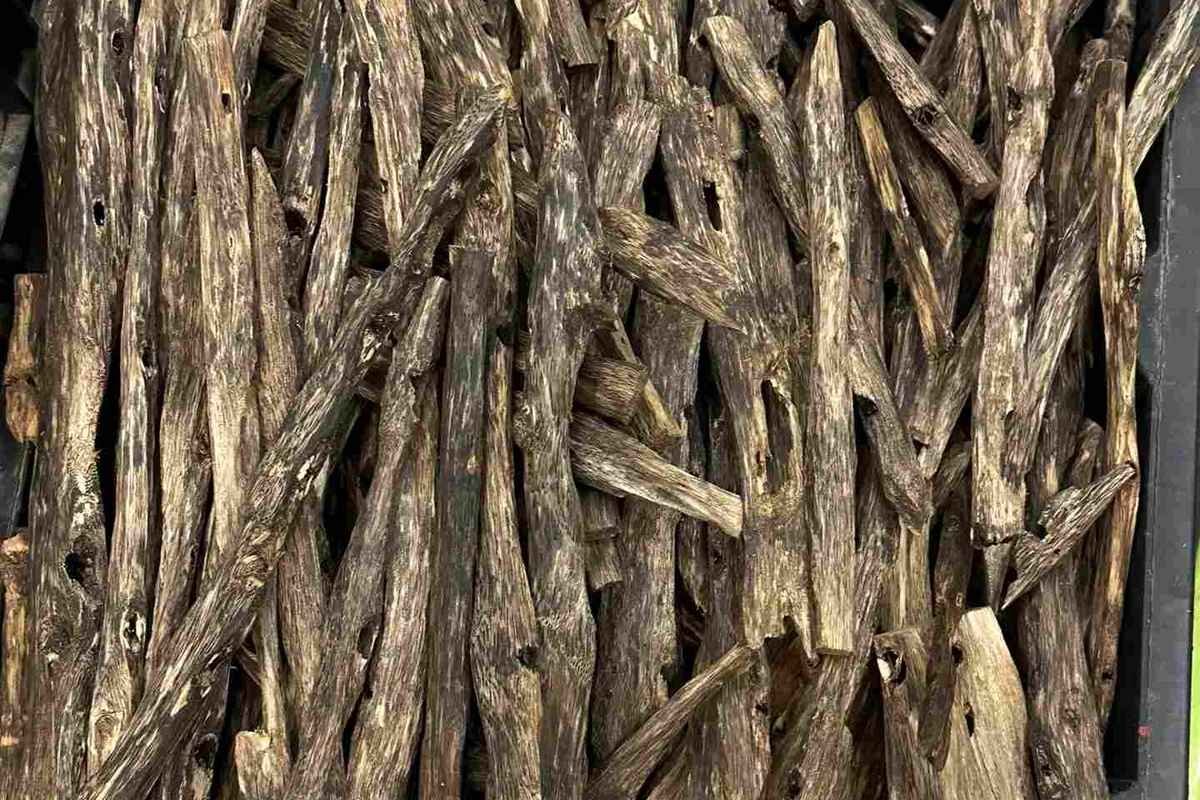
Agarwood India: Assam Hindi Oud, Aquilaria malaccensis and the Export Quota
Gulf perfumers and attar houses often ask us about one origin we do not sell. When buyers ask about agarwood India, they nearly always mean Assam agarwood — the source of the oil the trade calls Hindi oud — comes from Aquilaria malaccensis in northeast India, while our own stock is plantation Aquilaria sinensis from Dian Bai, Guangdong. Buyers still need to understand both. This guide explains where Assam material grows, why Hindi oud smells the way it does, how plantations have changed supply, and how it compares with Chinese sinensis when you plan a wholesale order.

Written by
Founder & Chief Sourcing Officer, AgarwoodTown
15+ years hands-on experience grading plantation agarwood, sourcing directly from Dianbai and Maoming districts in Guangdong — the world's largest Aquilaria sinensis cultivation region. Wang has personally inspected thousands of CITES export shipments and holds plantation certification from China's National Forestry and Grassland Administration. He advises GCC, European and East Asian wholesale buyers on grade selection, CITES compliance and supply chain due diligence.
CITES Certified
In this article
- Agarwood India: What Is Assam Agarwood?
- Agallocha, Malaccensis and Other Names
- Where Does Assam Agarwood Grow?
- Homestead Trees and Village Gardens
- What Does Hindi Oud Smell Like?
- Why Hindi Oud Smells That Way
- How Is Assam Oud Oil Traditionally Made?
- How Plantations Changed Assam Agarwood
- From Wild Stock to Cultivated Trees
- What Plantation Supply Means for Buyers
- India's 2024 Agarwood Export Quota
- Agarwood Tree and Wood Prices in India
- Assam Agarwood vs Chinese Sinensis: How Do They Compare?
- CITES and Origin Claims: What Should Indian Oud Paperwork Show?
- Which Origin Fits Your Product?
- Frequently Asked Questions
1. Agarwood India: What Is Assam Agarwood?
Most of the agarwood India produces is Assam agarwood: resinated wood from Aquilaria malaccensis trees grown in the Indian state of Assam and the neighbouring hill states of northeast India. The oil distilled from it is sold in the Gulf and in India as Hindi oud, Assam oud or simply Indian oud.[1]
Why is resinous agarwood scarce? According to Liu et al. (2013), only about 10% of Aquilaria trees form agarwood naturally; the rest stay pale, almost scentless wood unless they are wounded and infected.[7]
The species is not unique to India. In fact, A. malaccensis has the widest natural range of the commercial agarwood trees, running from northeast India and Bangladesh through Myanmar and Thailand to Malaysia, Sumatra and Borneo.
What makes Assam material distinct, therefore, is not only the tree. It is the combination of species, local growing conditions and a long regional tradition of soaking and distilling the wood.
We should be clear about our own position from the start. AgarwoodTown does not trade Assam or any other Indian material. Our stock is plantation Aquilaria sinensis, grown and inoculated on our 100+ mu plantation in Guan Zhu Town, Dian Bai District, Maoming. We write about Assam agarwood because our buyers compare against it constantly, and a clear picture helps them order the right thing.
Agallocha, Malaccensis and Other Names
Older books and many traditional texts call the agarwood tree of northeast India Aquilaria agallocha. However, botanists now treat that name as a synonym of A. malaccensis, so the two names usually describe the same tree.
In Assam the tree is widely known locally as sanchi or xasi, and the resinated wood is commonly called agar. In the Gulf, meanwhile, the oil keeps its trade label of "Hindi", which simply means Indian.
So if you are looking for the oud tree in India, this is it. Whether the label says agallocha, malaccensis, sanchi or Hindi, the tree behind agarwood in India is the same species.
For a buyer, the practical point is simple. Whatever name appears on a price list, the CITES permit should name the botanical species. Our Aquilaria species guide covers the full genus; here we stay with the Indian story.
2. Where Does Assam Agarwood Grow?
Assam agarwood grows in the humid lowlands and foothills of the Brahmaputra and Barak valleys, and in the neighbouring states of northeast India. The region sits at the western edge of the natural range of A. malaccensis.[1]
The climate suits the tree well. Heavy monsoon rain, warm summers and deep soils allow Aquilaria to grow quickly, much as it does in our own subtropical corner of western Guangdong.
Within Assam, the district of Hojai, around the town of the same name, is widely known in the trade as a centre of agarwood oil distilling. Many family firms there have distilled oud for generations, and the town's name is familiar to Gulf perfume buyers.
Homestead Trees and Village Gardens
Much Assam agarwood does not come from large estates. Instead, many trees grow in homestead gardens, along field edges and in small village plots, often alongside betel nut, tea or fruit trees.
This pattern matters for buyers. A single distiller may buy wood from many small growers, so the age, inoculation history and resin level of each lot can vary widely. Consistency therefore depends heavily on the sorting skill of whoever assembles the batch.
Wild A. malaccensis in the forests of the region has been heavily harvested over the past century. As a result, the material reaching the market today increasingly comes from planted trees rather than old forest stock — a shift we return to in section 5.

3. What Does Hindi Oud Smell Like?
Hindi oud is known for a deep, dark and often animalic character. Traders describe it as leathery, earthy and smoky, with a fermented or "barnyard" edge that some buyers love and others find too heavy.
A good Assam oil usually opens sharp and pungent. However, it settles over hours into a warm, woody and sometimes sweet base that lasts a long time on skin. Experienced attar buyers in the Gulf often judge Indian oil on that drydown rather than on the first impression.
Not every Indian oil smells the same, of course. Lighter, cleaner styles exist, and the profile shifts with wood age, resin content and distiller. In practice, "Hindi" describes a family of styles rather than one fixed scent.
Why Hindi Oud Smells That Way
Two factors shape the profile: the species and the processing. Agarwood from any Aquilaria species carries a mix of sesquiterpenes and 2-(2-phenylethyl)chromones, and the balance between them differs from species to species and lot to lot.[2]
Processing adds the rest. Traditional Indian practice soaks the ground wood in water for an extended period before distillation. During that soak, microbial fermentation develops, and the trade generally credits it with much of the animalic note that defines Hindi oud.
That is why we tell buyers not to treat "Hindi" as a guarantee of species or origin. A Hindi-style oil can be made from wood of another origin if the distiller follows the same soaking practice. Conversely, Assam wood distilled without a long soak will not smell classically Hindi.
For a wider guide to scent vocabulary across origins, see our article on how oud smells by grade and origin.
Step-by-Step Process
4. How Is Assam Oud Oil Traditionally Made?
Sort the wood by resin
Distillers separate the best resinated pieces, which sell as chips, from the lighter wood and offcuts. The lower-resin material usually goes to the still, because whole high-grade pieces earn more as wood than as oil.
Reduce the wood to small pieces or powder
The wood is chipped and ground so that water can reach as much of the resin as possible. Finer material generally gives a more complete extraction, although it also needs careful handling during the soak.
Soak and ferment
The ground wood is soaked in water, traditionally for a long period. Fermentation during this stage changes the aroma and is widely associated with the animalic, leathery tone of Hindi oud. Soak length is a distiller's choice and varies from house to house.
Hydro-distil slowly
The soaked material goes into a still with water and is heated for a long run. Steam carries the volatile aromatics into a condenser, and the oil separates from the water in a receiver. Oil yield is small relative to the weight of wood charged.
Separate, settle and age
The distiller collects the oil from the water surface, removes moisture and lets the oil rest. Many buyers prefer oil that has matured for some time, because a sharp, raw opening often softens with age.
Every step above shapes the final oil. Moreover, the same five steps can produce very different results in different hands, which is why Indian buyers often follow particular distilling houses rather than a region as a whole.
Our own oils are not made in the Hindi style. Our hydro-distilled sinensis oud oil is made in-house by steam and hydro distillation, and we also produce a supercritical CO₂ agarwood oil at lower temperature. Both give a sweeter, cleaner profile than a classic Assam oil.
Neither approach is better in absolute terms. They simply serve different perfumes and different customers, which we discuss in section 8.


5. How Plantations Changed Assam Agarwood
Assam agarwood has moved, over several decades, from a wild-harvested forest product towards a cultivated crop. Smallholders and estates across northeast India now grow A. malaccensis, and planted trees supply a growing share of the wood that reaches distillers.
From Wild Stock to Cultivated Trees
Heavy harvesting of wild A. malaccensis across its range led to international concern well before other agarwood species drew attention. As a result, A. malaccensis was the first agarwood species listed in CITES Appendix II, in the mid-1990s; the listing was extended to all Aquilaria species in 2004.[3]
TRAFFIC's early review of the trade documented how wild stocks in several range countries, including India, had come under pressure from demand for wood and oil. That pressure, in turn, pushed growers towards planting.
Plantation agarwood brings its own challenge, however. A young, healthy tree holds almost no resin, so growers across Asia have developed wounding and inoculation methods to start resin formation in cultivated trees.[4]
Those methods range from traditional nailing and cutting to drilled holes filled with fungal or chemical inducers. The techniques used in India and in China overlap far more than marketing materials often suggest. Our guide to agarwood inoculation methods explains the main approaches in detail.
What Plantation Supply Means for Buyers
For buyers, cultivation has two clear effects. First, it makes legal, documented supply possible at commercial scale, because planted trees can be registered and traced in a way that scattered wild trees cannot.
Second, it changes the material. Plantation wood is generally younger than old wild wood, and its resin forms over a shorter period. Therefore plantation Assam oil does not always match the reference oils that older buyers remember from decades ago.
We see the same pattern with sinensis in China. Young plantation resin smells different from aged wild wood, and honest suppliers should say so. Our article on wild versus cultivated agarwood pricing covers the price side of that gap.
India's 2024 Agarwood Export Quota
Indian export rules sit on top of CITES, and they changed sharply in 2024. As reported by Down To Earth in July 2024, the CITES-notified annual export quota for Indian agarwood chips and powder rose from 25,000 kg to 151,080 kg, and the quota for oil rose from 1,500 kg to 7,050 kg.[5]
Three details matter for buyers. First, the quota covers cultivated trees only; the quota for wild-sourced material stays at zero. Second, the same report puts about 139.89 million planted trees in non-forest areas, mainly in Assam, Manipur, Nagaland and Tripura. Third, exports had been banned until November 2021, so legal, documented Indian supply at this scale is recent.
Quotas and national rules can change again, so anyone sourcing directly from Assam should confirm the current requirements with the Indian authorities before agreeing terms.
Agarwood Tree and Wood Prices in India
We are often asked for the agarwood tree price in India or the agarwood price per kg in Assam. We cannot give a reliable figure. We do not trade Indian material, and local prices move with resin content, grade, tree age and who is buying. Treat any single number you see online with caution.
What we can give is a reference point from our own side. Our plantation Aquilaria sinensis chips start at $0.24/g, about $240/kg at the entry grade, with a 100 g MOQ. Our sinensis seedlings start at $15 each, with an MOQ of 10. Those are Chinese plantation prices, not Indian ones, but they help you sense-check a quote.
6. Assam Agarwood vs Chinese Sinensis: How Do They Compare?
| Feature | Assam agarwood (A. malaccensis, northeast India) | Chinese sinensis (A. sinensis, southern China) |
|---|---|---|
| Botanical species | <em>Aquilaria malaccensis</em> (older name <em>A. agallocha</em>) | <em>Aquilaria sinensis</em>, native to southern China including Guangdong, Hainan and Guangxi |
| Typical oil profile | Deep, leathery, animalic, often with a fermented edge | Sweet, cool, lightly honeyed and resinous; usually cleaner |
| Typical processing | Long soak and fermentation before slow hydro-distillation | Hydro or steam distillation, usually without the long Hindi-style soak; CO₂ extraction also used |
| Burning chips | Rich, dark and sometimes sharp smoke | Sweet, cool smoke; high grades turn dense and long-lasting |
| Main traditional markets | Gulf attar and oud oil buyers, Indian attar trade | Chinese incense, beads and carvings; Japanese incense; growing Gulf and Western demand |
| Supply base today | Smallholder and homestead plantations plus remaining older stock | Plantations with inoculated trees across southern China |
| CITES status | Appendix II; check Indian export rules as well | Appendix II; export permit issued in China where required |
| Available from AgarwoodTown | No — market context only | Yes — plantation material, grades D to AAA plus Kynam allocation |
The comparison shows two complete traditions rather than a better and a worse oud. Assam agarwood built its reputation on depth and animalic power, while Chinese sinensis is valued for sweetness and a cool, clean quality.
A. sinensis is native to southern China, including Guangdong, Hainan and Guangxi, and it has a long history in Chinese incense and traditional practice. In Chinese it is chén xiāng (沉香), and the top tier is kynam (奇楠).
For a perfumer, the choice depends on the brief. A heavy, traditional Gulf-style attar often calls for an Indian-style oil. On the other hand, a modern niche perfume, a cosmetic or a candle often works better with a cleaner sinensis oil that leaves room for other notes.
Many blenders also use both. In that case, sinensis can carry the sweet, woody body of a blend while a smaller dose of an Indian-style oil adds depth. The proportions are a creative decision, so we suggest testing samples side by side.
If you are weighing a third origin as well, our Cambodian oud comparison sets Aquilaria crassna against sinensis and Indian oils.
7. CITES and Origin Claims: What Should Indian Oud Paperwork Show?
Indian oud needs the same core paperwork as any other agarwood in international trade. All Aquilaria species are listed in CITES Appendix II, so commercial shipments of wood, chips and bulk oil generally need an export permit from the country of export.[6]
- Species on the permit: genuine Assam material should appear as Aquilaria malaccensis. A permit naming another species does not support an "Assam" claim.
- Country of export: the permit shows where the goods left from. Oil can be re-exported through trading hubs, so ask how the origin claim is documented.
- Annotation #14: the Aquilaria listing carries an annotation that exempts some finished, retail-packaged products. Check the current annotation text before you plan a shipment.
- National rules: India sets its own export rules on top of CITES, and importing countries, including the EU, may add theirs. Confirm with the relevant national authority.
- Style versus origin: "Hindi" on a label often describes a scent style. If origin matters to your product claims, ask the supplier to put species and country of origin on the invoice.
For our own sinensis, every wholesale shipment travels with a grading note and a CITES Appendix II export permit where required. Our step-by-step CITES permit guide walks through the process from the Chinese side.
8. Which Origin Fits Your Product?
| Your product | Profile that usually fits | Why | Our sinensis option · starting price |
|---|---|---|---|
| Traditional Gulf-style oud attar | Indian / Hindi-style malaccensis oil | Buyers expect depth and an animalic, leathery tone | Hydro-distilled oud oil as a sweeter blending partner · from $7.00/g, MOQ 10 g |
| Modern niche perfume | Cleaner oil, often sinensis | Leaves room for florals, spices and woods | Hydro-distilled oud oil · from $7.00/g, MOQ 10 g |
| Cosmetics, candles, body care | Clean, stable oil with a softer profile | Heavy animalic notes can dominate a base | CO₂ agarwood oil · from $1.50/g, MOQ 10 g |
| Chips for burning (Gulf retail) | Either origin, chosen by grade | Grade and resin content matter more than origin for most shoppers | Oud wood chips, grade D–AAA · from $0.24/g, MOQ 100 g |
| Incense and bakhoor production | Lower-grade wood or powder | Material is blended, so cost per kilogram drives the choice | Bakhoor chips from $6/g (MOQ 250 g) · agarwood powder from $10.30 per 50 g |
| New plantation or nursery | A species suited to your climate | Species choice is a long-term decision | A. sinensis seedlings · $15/plant, MOQ 10, with phytosanitary certificate |
General guidance from the trade, not a rule. Prices in the right-hand column are AgarwoodTown list prices for plantation A. sinensis in USD; we do not sell Assam material.
The table makes one point clear: origin matters most for oil, and much less for blended goods. If a customer specifically wants an Assam or Hindi oil, they should buy from a documented Indian source. We would rather say that plainly than sell sinensis under the wrong name.
However, many buyers who first ask for "Assam" actually need something narrower: a deep oud note, an affordable chip for burning, or a reliable oil for a modern formula. In those cases, plantation sinensis is often a practical fit.
For example, Gulf retailers who sell chips by grade can work with our graded plantation oud wood chips, which run from Grade D up to AAA. Our founder, Wang Jianyu, grades the wood by visual inspection, aroma, resin content and sink test, on our internal D–AAA scale with Kynam above it. That scale is ours, not an ISO or CITES standard.
Growers in warm climates sometimes ask us about planting instead. Our Aquilaria sinensis seedlings ship with a phytosanitary certificate, although any grower should first confirm that the species suits local conditions and import rules.
Buyers based in India itself can read our notes for Indian importers, which cover the market from a sinensis supplier's point of view.
How to test an Assam claim before you buy
- Ask for the botanical species and country of origin in writing, and check them against the CITES permit.
- Request a small paid sample and compare it with a reference oil you trust, smelling both over several hours.
- For bulk oil, ask for a GC-MS report. It will not prove a geographic origin on its own, but it can reveal heavy dilution or synthetic additions.
- Be wary of very low prices for "aged Hindi" oil, because aged wild-wood oils are scarce.
Our oud oil purity testing guide covers the checks in more detail.
Comparing sinensis against your Assam reference?
Send us your product type, target profile and expected volume, and we will suggest sinensis samples to test alongside your Indian reference oil. Samples start from 1 g of oil or 100 g of chips; they are paid and non-refundable. We reply within 4 business hours, Monday to Saturday, 9:00–18:00 China time.
Ask for a sinensis sample set → · Read our replacement and credit terms before ordering.
Frequently Asked Questions
Assam agarwood is resinated wood from Aquilaria malaccensis trees grown in Assam and nearby states of northeast India. The oil distilled from it is sold as Hindi oud, Assam oud or Indian oud. It is known for a deep, leathery and often animalic profile that many Gulf attar buyers value highly.
Often, but not always. Hindi simply means Indian, and much Indian oud oil comes from Assam. However, traders also use Hindi as a style name for any oil with the deep, fermented character of traditional Indian distillation. If the origin matters, ask for species and country of origin on the invoice and CITES permit.
Usually not. Aquilaria agallocha is an older name for the agarwood tree of northeast India, and botanists now treat it as a synonym of Aquilaria malaccensis. You will still see the older name in traditional texts and some product descriptions. On permits and invoices, Aquilaria malaccensis is the name to expect.
Two factors combine. The species and the resin give a deep, woody base, while the traditional Indian practice of soaking ground wood for a long period before distillation adds fermentation notes. The trade generally credits that soak with much of the barnyard or leathery tone that defines the classic Hindi style.
No. We grow and process only plantation Aquilaria sinensis in Dian Bai, Guangdong, and our CITES permits name that species. We write about Assam agarwood as market context, because our buyers compare against it. If you need a genuine Indian oil, buy it from a documented Indian source with the correct paperwork.
Neither is better in every use. Assam oil suits traditional Gulf-style attars that need depth and animalic power. Chinese sinensis is sweeter, cooler and cleaner, so it often suits modern perfumes, cosmetics, incense and beads. Within each origin, resin content, wood age and processing matter as much as species, so always compare samples.
Cultivation has grown substantially in northeast India, with many smallholders and homesteads growing Aquilaria malaccensis, and planted trees supply a growing share of wood for distillation. Wild stocks have been heavily harvested over many decades. Exact proportions vary and are hard to verify, so ask each supplier how its material was sourced.
In most commercial cases, yes. All Aquilaria species are in CITES Appendix II, so bulk oil, chips and wood usually need an export permit. Annotation #14 exempts some finished, retail-packaged products, so check the current annotation text. India and your importing country may also apply their own rules on top of CITES.
Yes, and many blenders do. Sinensis can carry the sweet, woody body of a formula, while a smaller amount of Indian-style oil adds depth and an animalic edge. The right ratio depends on your product, so test small batches. Label the blend honestly and list each species if your claims mention origin.
References
- 1
- 2Naef R.. The volatile and semi-volatile constituents of agarwood, the infected heartwood of Aquilaria species: a review. Flavour and Fragrance Journal, 2011.View source
- 3Barden A., Anak N.A., Mulliken T., Song M.. Heart of the Matter: Agarwood Use and Trade and CITES Implementation for Aquilaria malaccensis. TRAFFIC International, 2000.View source
- 4Azren P.D., Lee S.Y., Emang D., Mohamed R.. History and perspectives of induction technology for agarwood production from cultivated Aquilaria in Asia. Journal of Forestry Research, 2018.View source
- 5Down To Earth. CITES notified increase in annual export quota for agarwood in India. Down To Earth, 2024.View source
- 6
- 7Liu Y., Chen H., Yang Y., et al.. Whole-tree agarwood-inducing technique: an efficient novel technique for producing high-quality agarwood in cultivated Aquilaria sinensis trees. Molecules, 2013.View source
All scientific references are provided for transparency. AgarwoodTown summarises peer-reviewed findings for educational purposes and does not claim to provide medical or regulatory advice.
Wholesale Catalog
Buy the products discussed in this article


Related Articles
Plantation
Aquilaria Species Guide: Sinensis, Malaccensis, Crassna, Subintegra and Gyrinops Compared
13 min read
Essential Oil
Cambodian Oud Explained: Aquilaria crassna vs Chinese Sinensis Oil for Wholesale Buyers
13 min read
Education
Agarwood Price Per Kg 2026: Wild vs Cultivated Kynam & Oud Wood Guide
16 min read
Source Direct from Origin
Discuss Your Requirements with Our Team
We respond within 24 hours. Share your target grade, quantity and destination — we'll send current pricing, a sample pack option, and CITES documentation details.