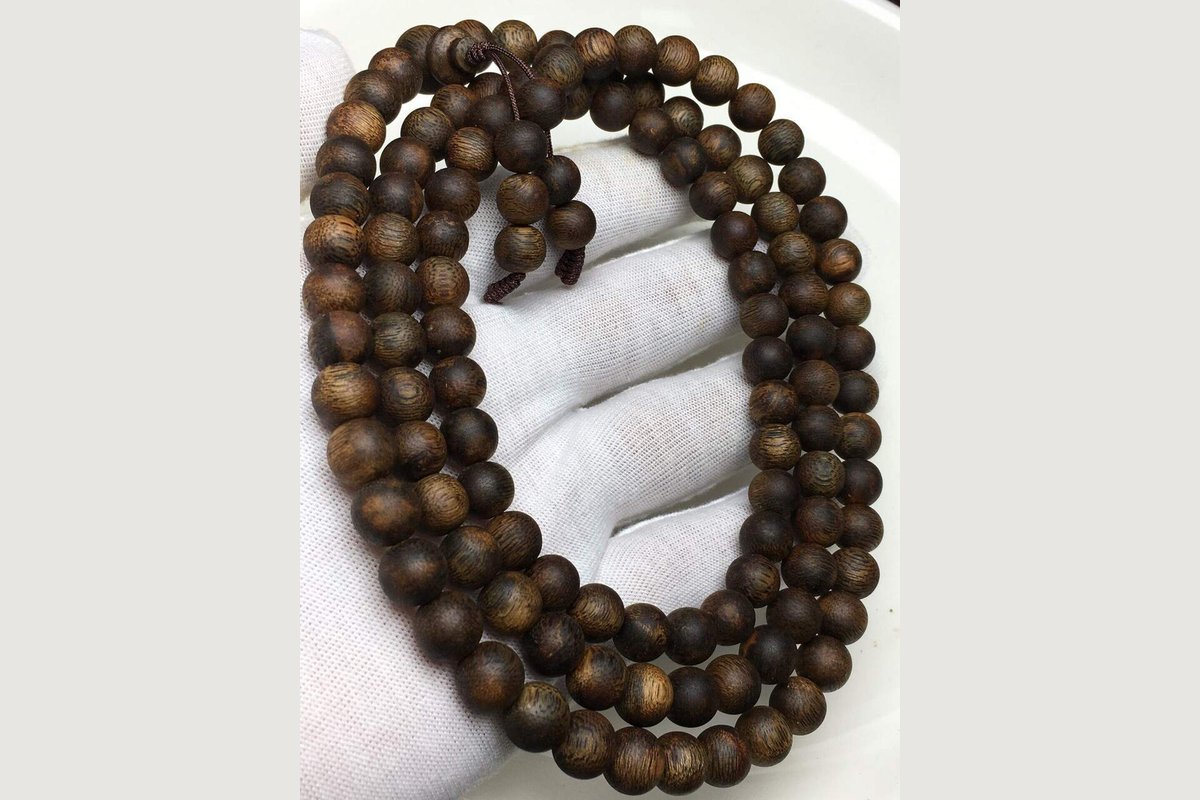
Hainan Agarwood: Reputation, Scent, Collector Beads and How to Check Provenance
Few origin names carry as much weight in Chinese collecting circles as Hainan agarwood. It appears on bead listings, auction lots and incense tins, and it is quoted at prices well above ordinary chén xiāng. Yet the tree behind the name is the same Aquilaria sinensis we grow at our plantation in Dian Bai, Guangdong, across the Qiongzhou Strait. This guide explains where the reputation comes from, how collectors describe the scent, which beads and pieces trade under the name, and how a wholesale buyer can test a Hainan provenance claim before paying for it.

Written by
Founder & Chief Sourcing Officer, AgarwoodTown
15+ years hands-on experience grading plantation agarwood, sourcing directly from Dianbai and Maoming districts in Guangdong — the world's largest Aquilaria sinensis cultivation region. Wang has personally inspected thousands of CITES export shipments and holds plantation certification from China's National Forestry and Grassland Administration. He advises GCC, European and East Asian wholesale buyers on grade selection, CITES compliance and supply chain due diligence.
CITES Certified
In this article
- What Is Hainan Agarwood?
- Why Does Hainan Agarwood Have Such a Reputation?
- Old Hainan Wood vs Plantation Aquilaria sinensis
- Aquilaria sinensis on Hainan Island
- One Species, Many Regions
- Wild Decline and the Shift to Cultivation
- Hainan's Plantation Industry Today
- What Does Hainan Agarwood Smell Like?
- Hainan Agarwood Beads and Collector Pieces
- Our Hainan Black Chess Bracelet Listing
- Carvings, Kynam and the Top of the Market
- Why Hainan Provenance Claims Need Checking
- How to Check a Hainan Agarwood Claim
- Buying Hainan-Style Agarwood Wholesale
- Frequently Asked Questions
1. What Is Hainan Agarwood?
Hainan agarwood is resinous wood from Aquilaria sinensis trees that grew on Hainan Island, China's southernmost province. It is not a separate species. The name describes a place, and in the trade it often describes a scent style and a price tier as well.[1]
Is there an official quality bar? According to the Chinese Pharmacopoeia, as cited by Liu et al. (2013), medicinal agarwood must contain at least 10% alcohol-soluble extractive. In that study, induced plantation samples measured 11.60–18.08%, against 10.56% and 19.30% for two wild samples.[8]
Chinese buyers call it Hainan chén xiāng (海南沉香). Older texts and dealers also use Qióng (琼), the short name for Hainan, so you may see "Qiong" wood on a label. In practice, all of these point to the same idea: agarwood with an island origin.
The material itself forms the same way as any agarwood. A wounded Aquilaria tree fills the damaged tissue with dark aromatic resin, and that resin-loaded wood is what collectors buy.[2] Therefore the questions that matter are age, density, scent and, above all, whether the origin claim is true.
Why Does Hainan Agarwood Have Such a Reputation?
The reputation is historical first. For centuries, Hainan was one of China's best-known domestic sources of incense wood, and classical writers praised island agarwood above much of what arrived by sea. Collectors still quote that literary tradition today.
Scarcity adds to it. Wild Aquilaria on the island was harvested heavily over a long period, so old, naturally formed Hainan pieces are now uncommon. Moreover, wood that sat in the forest for decades has had time to develop a mellow, settled scent that young material cannot copy.
Finally, the name sells. Because "Hainan" commands a premium, it has become a marketing word as much as a geographic one. That is why this guide spends as much time on checking claims as on praising the wood.
2. Old Hainan Wood vs Plantation Aquilaria sinensis
| Feature | Old Hainan agarwood (as traded by collectors) | Plantation A. sinensis (e.g. our Dian Bai stock) |
|---|---|---|
| Species | Aquilaria sinensis | Aquilaria sinensis — the same tree |
| How resin formed | Natural wounds over long periods; formation history usually unknown | Artificial inoculation of cultivated trees; formation period known to the grower |
| Typical scent described | Sweet, cool and clean, with a settled, rounded depth from age | Fresher and brighter; depth rises with resin content and grade |
| Availability | Scarce; mostly private collections, auctions and dealer networks | Steady; graded lots from D to AAA, Kynam by allocation |
| Origin evidence | Often a dealer statement only; hard to prove after the fact | Grower, location and species stated on paperwork |
| Price logic | Origin name, age story and rarity drive a large premium | Grade, weight and form drive the price |
| CITES status | Aquilaria spp. are in Appendix II; export needs permits where required | Same Appendix II rules; we ship with export permits where required |
3. Aquilaria sinensis on Hainan Island
Aquilaria sinensis is native to southern China, and Hainan sits inside its natural range alongside Guangdong, Guangxi and Fujian. The island's tropical climate, long wet season and forested hills suit the tree well.[1]
Chinese trade names reflect this. The species is often called bái mù xiāng (白木香) or tǔ chén xiāng (土沉香), meaning "native agarwood", to separate it from wood imported from Southeast Asia.
One Species, Many Regions
Because Hainan and mainland trees belong to one species, there is no botanical test that marks a chip as "Hainan". Differences in scent come from growing conditions, the age of the resin and how it formed, not from a different tree. Our guide to the main Aquilaria species sets out how sinensis compares with malaccensis, crassna and the other resin producers.
This matters for buyers. A seller who says Hainan wood is "a different, rarer species" is either confused or selling a story. However, a seller who says "this is A. sinensis, and we can show where it grew" is making a claim you can actually check.
Wild Decline and the Shift to Cultivation
Across Asia, wild Aquilaria declined because collectors cut many trees to find the few that held resin. China was no exception, and cultivation of A. sinensis expanded in Guangdong and Hainan as wild supply fell.[3]
Today, much of the Chinese agarwood on the market is plantation wood, induced by drilling, cutting or inoculation. Hainan has its own plantations too, so "grown on Hainan" no longer implies old or wild. In other words, a genuine Hainan origin can describe a young plantation chip just as easily as a century-old collector piece.
Our own position is simple. We grow and inoculate A. sinensis on more than 100 mu in Guan Zhu Town, Dian Bai District, Maoming, Guangdong. We sell plantation material, and we describe it as such.
Hainan's Plantation Industry Today
Hainan is no longer only a name for old wild wood. In June 2025, Xinhua reported that Chengmai County alone had about 30,000 mu (around 2,000 hectares) of agarwood plantations, 18 cooperatives and 42 processing bases, with annual output above 100 million yuan.[4]
We note that the same report described each tree carrying an electronic ID that records its history, and plans to add blockchain tracing. Whole pieces go to carving, fragments to incense, powder to oil. For buyers, that means much "Hainan agarwood" today is plantation wood, and traceability records are worth asking for.
4. What Does Hainan Agarwood Smell Like?
Collectors usually describe Hainan agarwood as sweet, cool and clean, with a honeyed or floral lift and very little harshness. Good pieces are said to stay gentle when heated rather than turning sharp or smoky.
Treat those words as trade vocabulary, not as a specification. They come from tasting sessions, dealer descriptions and collector writing. Moreover, every piece differs, and the same description is applied to fine Guangdong sinensis as well.
The chemistry behind the scent is shared across the genus. Agarwood aroma comes mainly from sesquiterpenes and 2-(2-phenylethyl)chromones, and the balance between those groups shifts with species, resin age and formation history.[5] That variation is why an origin name alone cannot promise a particular smell.
For a wider vocabulary, compare the notes below with what you smell on your own sample. The table reflects how Chinese collectors commonly talk about sinensis wood, including Hainan pieces.
| Descriptor | What collectors mean | How it shows when heated | What can mimic it |
|---|---|---|---|
| Sweet (甜) | A rounded, honey- or candy-like sweetness | Appears early and lingers through the session | Sugared or oil-treated wood; some synthetic oud accords |
| Cool (凉) | A fresh, slightly mentholated or minty edge | Felt at the back of the nose, often in the opening | Kynam-line wood; added cooling aroma chemicals |
| Floral (花香) | A light flowery note over the wood | Rises as the piece warms and fades slowly | Perfumed coatings that fade quickly |
| Clean / clear (清) | Little smoke, mustiness or bitterness | Smooth throughout, without a burnt finish | Low-resin wood heated gently can seem clean but thin |
| Mellow / settled (醇) | Depth associated with aged resin | Steady, layered scent over a long session | Hard to fake convincingly; age stories are easy to fake |
| Woody base (木香) | The plain Aquilaria wood note under the resin | Present in all grades; dominant in low grades | Any agarwood, from any origin |
Descriptors are common collector and trade language, not lab results. Individual pieces vary widely, and none of these notes proves a Hainan origin.

5. Hainan Agarwood Beads and Collector Pieces
Most Hainan agarwood that reaches buyers today is sold as beads, small carvings or loose pieces for heating. Beads dominate because they turn a small amount of dense wood into a high-value, wearable object.
In Chinese collecting culture, a bracelet (手串) or a 108-bead mala is both an ornament and a way to enjoy the scent through skin warmth. Our agarwood bracelet wholesale guide covers bead sizes, cultural meaning and pricing logic in more detail.
Collector beads are judged on density, resin colour, oil sheen and scent at body temperature. Heavy, near-black beads that sink in water fetch the highest prices. Nevertheless, a sinking bead proves density, not geography.
Our Hainan Black Chess Bracelet Listing
Our catalogue includes the Hainan agarwood bracelet in black chess grade. "Black chess" (黑棋, hēi qí) is a collector term for beads so densely resinated that they look as dark as Go stones.
The product page lists 8.8 mm round beads in "Hainan black chess grade", with deep black resin throughout and very limited stock. Its origin line reads "Hainan-grade resin characteristics" — in other words, the listing names a grade and a resin style. Bracelets are priced by weight from $18/g, and the top black chess pieces are quoted on application.
If your customers need a stated geographic origin rather than a grade name, ask us what can be documented for the specific lot before you order. That is the same question you should put to any supplier using the word Hainan.
Carvings, Kynam and the Top of the Market
Above beads sit carvings, sculptural natural pieces and kynam. Kynam (奇楠, qí nán) is a soft, waxy, cool-scented class of agarwood, and Hainan is one of the places Chinese collectors associate with it. Our article on kyara vs kynam naming and characteristics explains how the Japanese and Chinese terms line up.
At this level, provenance stories multiply. A piece may be sold as "old Hainan kynam" with no evidence beyond the dealer's word. Therefore treat every top-tier origin claim as unproven until documents say otherwise.
On our side, the Kynam grade on our internal scale is allocation only. For reference, our kynam wood pieces list from $0.89/g, and kynam carvings sit within a carving range that starts from $98 per piece (MOQ 5).


6. Why Hainan Provenance Claims Need Checking
A Hainan label adds value, and anything that adds value attracts misuse. In our experience on the grading table, the origin name is the easiest part of a listing to change and the hardest part to prove.
- Origin used as a grade: "Hainan grade" or "Hainan style" can describe a scent or quality tier rather than a place. Read the wording closely.
- Mixed lots: a few genuine island pieces can be blended with mainland or imported wood and the whole lot sold under one name.
- Imported wood relabelled: wood from other countries and species sometimes reaches Chinese markets and is resold under domestic origin names.
- Treated wood: low-resin beads can be oiled, dyed or resin-filled to look like dense black chess material. Our guide to spotting fake agarwood covers those tricks.
- No lab shortcut: no routine test reliably proves that a sinensis chip grew on Hainan rather than in Guangdong. Chemistry can support species and quality questions, but origin rests mainly on documents and supplier records.
None of this means Hainan agarwood is a myth. It means the premium should follow evidence, not adjectives.
Step-by-Step Process
7. How to Check a Hainan Agarwood Claim
Ask for the species and the place in writing
Request the botanical name and the growing area on the quotation and the invoice. A genuine Hainan claim should read as Aquilaria sinensis plus a named source on the island. If the seller will only write "Hainan grade" or "Hainan type", treat it as a quality label rather than an origin.
Ask whether the wood is plantation or old stock
Plantation wood from Hainan is legitimate and should be priced as plantation wood. Old or naturally formed pieces carry a higher price, so the seller should explain where they came from and how long they have been held. Vague answers about "family collections" are common and hard to verify.
Check the export documents
Aquilaria species have been listed in CITES Appendix II since 2004, so commercial exports of wood and beads generally need an export permit where required. The permit names the species and the exporting country. It does not prove which province the wood grew in, but missing or inconsistent paperwork is a clear warning sign.
Order a paid sample and test it yourself
Weigh, heat and smell a sample before a bulk order. Check that beads are dense, that the resin pattern runs naturally through the wood and that the scent develops slowly without a perfume-like burst. Academic grading reviews describe the same mix of visual, aroma and density checks used across the trade.
Use GC-MS for treatment and species questions
A GC-MS profile can show whether a sample contains the sesquiterpenes and chromones typical of agarwood and can flag added aroma chemicals. It is useful against fakes. However, it should not be sold to you as proof of Hainan origin on its own.
Price the evidence, not the name
Agree the price on what you can document: species, grade, weight and form. Pay a Hainan premium only for a lot whose origin you can trace and resell honestly. If the evidence is thin, buy the wood on its grade and describe it to your own customers without the origin claim.
8. Buying Hainan-Style Agarwood Wholesale
For most wholesale buyers, the practical choice is not "Hainan or nothing". It is between paying an origin premium on limited evidence and buying well-graded, documented A. sinensis whose scent you have tested yourself.
Start with the grade. Our internal scale runs D, C, B, A and AAA, plus Kynam on allocation. We grade by visual inspection, aroma, resin content and sink test, which matches the criteria described in academic reviews of agarwood grading.[6] This scale is ours, not an ISO or CITES standard, so always confirm it against a sample.
Then match form to customer. Chinese and Southeast Asian bead buyers usually want dense round beads by weight. Collectors of heating wood want loose pieces, while Japanese incense buyers often look for clean, sweet sinensis notes in a different format altogether.
Our graded oud wood chips start from $0.24/g (MOQ 100 g, grades D–AAA). Across the full agarwood bracelet range, beads are priced by weight from $18/g. Sample orders start from 100 g of chips, are paid and non-refundable, and problems with a delivery are fixed by replacement or credit under our refund and replacement policy.
Every wholesale shipment from us carries a grading note or certificate and a CITES Appendix II export permit where one is required.[7] The listing carries annotation #14, which exempts some finished retail-packaged products, so check the current annotation text before planning a shipment. GC-MS reports are available on request.
Finally, be honest downstream. If you resell our plantation sinensis, describe it as plantation Aquilaria sinensis from Guangdong. That description is accurate, defensible and still attractive to collectors who value Chinese agarwood. Send your bead size, grade and quantity through our wholesale enquiry form; we reply within 4 business hours, Monday to Saturday, 9:00–18:00 China time.
Frequently Asked Questions
No. Hainan agarwood comes from Aquilaria sinensis, the same species that grows in Guangdong, Guangxi and Fujian, including on our Dian Bai plantation. The name refers to where the tree grew and to a scent style collectors associate with the island. Any difference in smell comes from growing conditions, resin age and formation history rather than from a separate tree.
The premium comes from history, scarcity and demand. Hainan has long been praised as a domestic source of fine incense wood, and old naturally formed island pieces are now uncommon after centuries of harvesting. Collectors pay for that story and for aged scent. However, the premium only makes sense when the origin can be supported by documents and supplier records.
Collectors usually describe it as sweet, cool and clean, with a honeyed or floral lift and little smoke or bitterness when heated gently. These are trade descriptions rather than lab measurements. Well-formed Guangdong sinensis can show similar notes, and individual pieces vary a great deal, so scent alone cannot confirm that a piece grew on Hainan.
Our product page lists the bracelet as "Hainan black chess grade", 8.8 mm round beads with deep black resin throughout, and its origin line reads "Hainan-grade resin characteristics". The listing names a grade and resin style. If your customers need a stated geographic origin, ask us what can be documented for the specific lot before you place the order.
Not reliably on a routine basis. A GC-MS profile can show whether a sample has the chemical profile typical of agarwood and can flag added aroma chemicals, which helps against fakes. It cannot, on its own, confirm which province a sinensis chip grew in. Origin claims rest mainly on supplier records, invoices and export paperwork.
Black chess (hēi qí, 黑棋) is a Chinese collector term for agarwood so densely resinated that it looks as dark as a Go stone. It describes appearance and resin saturation, and the beads are typically heavy for their size. The term is often paired with Hainan, but it is a grade description, so check origin separately.
Not automatically. Kynam (qí nán) is a distinct class of agarwood with soft, waxy resin and a cool, sweet note, and Hainan is one of several places collectors associate with it. Most Hainan agarwood is ordinary chén xiāng, not kynam. A listing that says "Hainan kynam" makes two claims, and each needs its own evidence.
Usually yes for commercial shipments. All Aquilaria species have been listed in CITES Appendix II since 2004, and wood and bead products generally need an export permit where required. Annotation #14 exempts some finished retail-packaged products, so check the current annotation text and confirm your own country's import rules before shipping.
Describe them accurately: plantation Aquilaria sinensis from Guangdong, with the grade, bead size and weight. Avoid borrowing the Hainan name unless your supplier can document that origin for the specific lot. Honest labelling protects you from complaints and keeps your listings defensible if a customer, marketplace or customs officer asks for evidence.
References
- 1
- 2Li W., Chen H.-Q., Wang H., Mei W.-L., Dai H.-F.. Natural products in agarwood and Aquilaria plants: chemistry, biological activities and biosynthesis. Natural Product Reports, 2021.View source
- 3Azren P.D., Lee S.Y., Emang D., Mohamed R.. History and perspectives of induction technology for agarwood production from cultivated Aquilaria in Asia. Journal of Forestry Research, 2018.View source
- 4
- 5Naef R.. The volatile and semi-volatile constituents of agarwood, the infected heartwood of Aquilaria species: a review. Flavour and Fragrance Journal, 2011.View source
- 6Liu Y.Y., Wei J.H., Gao Z.H., et al.. A Review of Quality Assessment and Grading for Agarwood. Chinese Herbal Medicines, 2017.View source
- 7
- 8Liu Y., Chen H., Yang Y., et al.. Whole-tree agarwood-inducing technique: an efficient novel technique for producing high-quality agarwood in cultivated Aquilaria sinensis trees. Molecules, 2013.View source
All scientific references are provided for transparency. AgarwoodTown summarises peer-reviewed findings for educational purposes and does not claim to provide medical or regulatory advice.
Wholesale Catalog
Buy the products discussed in this article


Related Articles
Plantation
Aquilaria Species Guide: Sinensis, Malaccensis, Crassna, Subintegra and Gyrinops Compared
13 min read
Collectibles
Kyara Agarwood vs Kynam: Names, Traits and the Truth About Grafted Kynam
14 min read
Sourcing Reference
Fake Agarwood: How to Spot Treated Chips, Beads and Carvings Before You Buy
15 min read
Source Direct from Origin
Discuss Your Requirements with Our Team
We respond within 24 hours. Share your target grade, quantity and destination — we'll send current pricing, a sample pack option, and CITES documentation details.