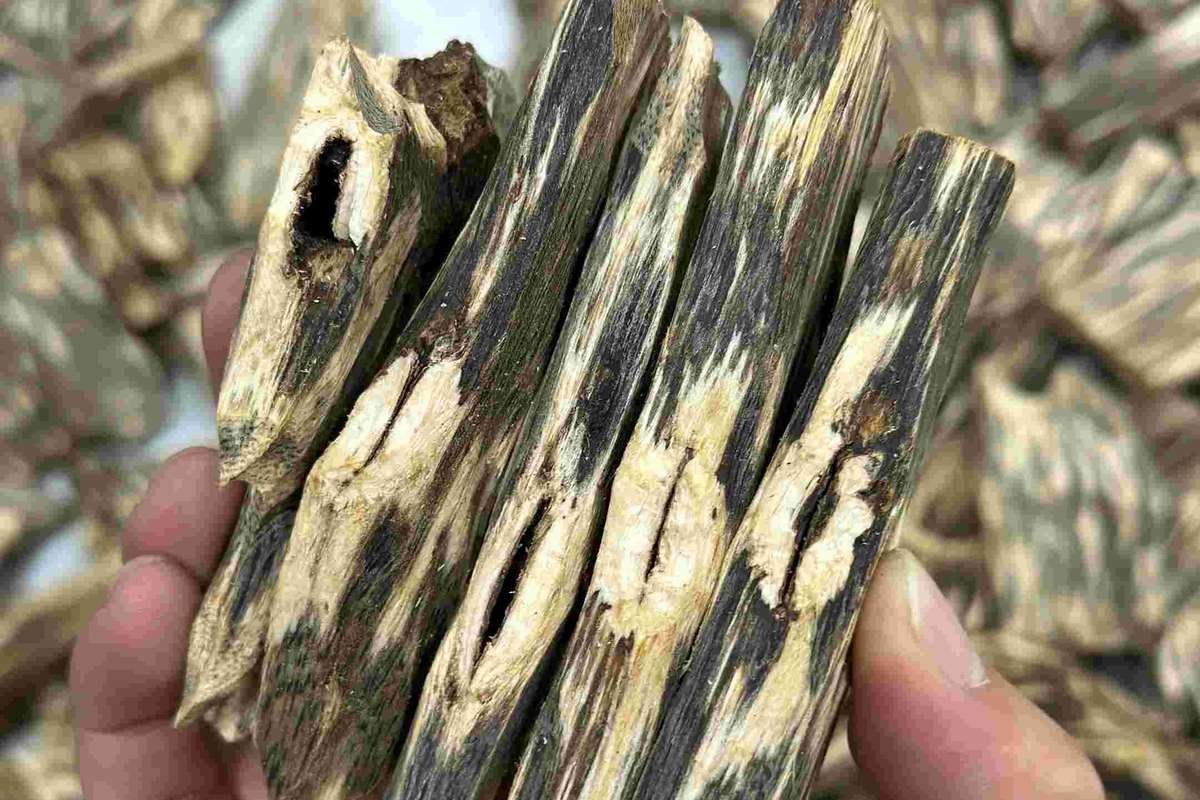
Vietnam Agarwood: Crassna, Khanh Hoa, Kỳ Nam and How It Compares with Chinese Stock
Few origins carry as much weight in the agarwood trade as Vietnam. Buyers mention Vietnam agarwood with the same respect they reserve for kyara, and some of the oldest stories about top-tier wood lead back to its central coast. We are growers in Guangdong, not traders of Vietnamese wood, and we do not sell it. However, wholesale buyers often compare offers from both countries, so this guide sets out the species, the Khanh Hoa trade, kỳ nam, wild versus plantation supply, and how Vietnamese material differs from Chinese stock.

Written by
Founder & Chief Sourcing Officer, AgarwoodTown
15+ years hands-on experience grading plantation agarwood, sourcing directly from Dianbai and Maoming districts in Guangdong — the world's largest Aquilaria sinensis cultivation region. Wang has personally inspected thousands of CITES export shipments and holds plantation certification from China's National Forestry and Grassland Administration. He advises GCC, European and East Asian wholesale buyers on grade selection, CITES compliance and supply chain due diligence.
CITES Certified
In this article
- What Is Vietnam Agarwood?
- Trầm Hương, Dó Bầu and Kỳ Nam: The Vietnamese Vocabulary
- Vietnamese Agarwood Incense: Nhang Trầm and Nụ Trầm
- Where Does Vietnam Agarwood Grow?
- Why Khanh Hoa and Nha Trang Became Trade Names
- The North-Central Planting Belt
- Vietnam Agarwood Labels You Will Meet in the Trade
- Kỳ Nam: Vietnam's Kynam Legacy
- Wild vs Plantation Agarwood in Vietnam
- How Plantation Wood Is Induced in Vietnam
- How Does Vietnam Agarwood Differ from Chinese Stock?
- Scent and Texture: What Buyers Report
- CITES and Origin Paperwork for Vietnamese Material
- How to Evaluate a Vietnam Agarwood Offer
- Frequently Asked Questions
1. What Is Vietnam Agarwood?
Vietnam agarwood is resinated wood from Aquilaria trees grown in Vietnam, most often Aquilaria crassna. The species is native to Vietnam, Cambodia, Laos and Thailand, and it is the tree behind most Vietnamese chips, oil and carvings on the market.[1]
The numbers explain the price. According to Liu et al. (2013), only about 10% of Aquilaria trees produce agarwood without human help, so most supply today comes from induced, cultivated trees.[8]
Like all agarwood, it forms when a tree is wounded and fills the damaged tissue with aromatic resin. The healthy wood around it stays pale and nearly scentless.[2] Therefore the word "Vietnam" on a label tells you where the tree grew, not how much resin the piece holds.
We should be clear about our own position from the start. AgarwoodTown grows and processes plantation Aquilaria sinensis at our 100+ mu plantation in Guan Zhu Town, Dian Bai District, Maoming, Guangdong. We do not buy, blend or resell Vietnamese wood. This article is market context for buyers who weigh both origins.
Trầm Hương, Dó Bầu and Kỳ Nam: The Vietnamese Vocabulary
Vietnamese has its own words for every layer of the trade. Trầm hương, often shortened to trầm, means agarwood in general. Dó bầu is the common name of the crassna tree itself, and growers use it when they talk about plantations.
Kỳ nam names the top tier: soft, waxy, intensely sweet wood that Japanese buyers call kyara and Chinese buyers call qínán (奇楠). Our guide to kyara vs kynam naming traces those terms across languages, so here we focus on what they mean for Vietnamese supply.
In practice, an English invoice may say "Vietnamese oud", a Chinese buyer may say "芽庄沉香" (Nha Trang agarwood), and the CITES permit will simply name the species. All three can describe the same lot.
Vietnamese Agarwood Incense: Nhang Trầm and Nụ Trầm
Much Vietnamese agarwood reaches buyers as incense rather than wood. Vietnamese agarwood incense is sold as nhang trầm (sticks) and nụ trầm (cones), made from agarwood powder bound into a paste, and it is a common sight at temples, family altars and markets across the country.
Quality varies widely. Some products carry a high share of real agarwood powder; others carry very little and rely on added fragrance. We would ask any seller for the agarwood share by weight and a test burn before a volume order, exactly as with Chinese incense.
2. Where Does Vietnam Agarwood Grow?
Vietnam agarwood comes mainly from the forested hills of central and southern-central Vietnam, where crassna grows naturally, and from plantations spread much more widely. Wild trees once grew along the Annamite range, from the north-central provinces down to the south-central coast.
Today the picture is different. Decades of collection thinned the wild population sharply, and crassna is now assessed as Critically Endangered on the IUCN Red List.[1] Most wood moving through Vietnamese trade channels now comes from cultivated dó bầu trees.
Plantation planting spread through many provinces, from the north-central coast to the south and the Central Highlands. Some areas are known locally for smallholder plots, while others host larger estates. Because no single public register covers them all, we do not quote acreage or tree counts.
Why Khanh Hoa and Nha Trang Became Trade Names
Khanh Hoa, the coastal province around Nha Trang, has the strongest agarwood reputation in Vietnam. Its mountains historically yielded some of the most prized wild wood, including kỳ nam, and the region built a trade culture around it.
The link is visible even in public space. A seafront landmark in Nha Trang takes its name from trầm hương, and local shops sell agarwood in many forms. Moreover, the city's name became a brand in the Chinese collector market, where "芽庄" signals the top of the Indochinese range.
However, a place name on a label is a claim, not a certificate. Much of what sells as "Nha Trang" today is a style or grade description rather than proof of a Khanh Hoa tree. Serious buyers therefore treat the name as a starting point for questions, which we cover in section 8.
The North-Central Planting Belt
Khanh Hoa gives Vietnam agarwood its trade name, but much planting now happens further north. Tropenbos has described agarwood agroforestry across the north-central provinces, from Ha Tinh to Thua Thien Hue, mostly on smallholder land.[3]
The same source called for international certification so that oils are classified consistently. Until that exists, Vietnamese oil labels, like Chinese ones, need checking against samples and lab reports.
3. Vietnam Agarwood Labels You Will Meet in the Trade
| Label | Language / market | What it usually signals | What to ask the seller |
|---|---|---|---|
| Trầm hương / trầm | Vietnamese, domestic trade | Agarwood in general, any grade | Grade, wild or plantation, and species |
| Dó bầu | Vietnamese, plantation trade | The crassna tree, usually cultivated | Tree age and induction method |
| Kỳ nam | Vietnamese | Top-tier soft, waxy, sweet agarwood | Wild or grafted line, and any test results |
| Nha Trang / 芽庄 | Chinese collector market | High-grade Indochinese wood with a sweet profile | Actual harvest province and documents |
| Hui'an type / 惠安系 | Chinese collector market | Agarwood from mainland Indochina, including Vietnam, Cambodia and Laos | Which country, which species |
| Xingzhou type / 星洲系 | Chinese collector market | Agarwood from the Malay archipelago, usually a contrast to Hui'an | Species, often malaccensis or related taxa |
| Vietnamese oud | English and Gulf trade | Chips or oil said to be of Vietnamese origin | CITES permit, species and source code |
These are common trade usages, not legal definitions. Meanings drift between dealers and markets, so always ask a seller what a label means for the specific lot.
The Hui'an and Xingzhou split matters because it shapes price expectations in China. Collectors often associate Hui'an wood with sweeter, cleaner notes and Xingzhou wood with heavier, more resinous ones. These are broad tendencies, and good graders judge the piece in hand rather than the family name.
For a wholesale buyer, the table offers one practical lesson. Every label above can be honest, and every one can be stretched. As a result, a label should open a conversation about documents, not close it.
4. Kỳ Nam: Vietnam's Kynam Legacy
Kỳ nam is the reason Vietnam agarwood holds a special place among collectors. Historical accounts tie the finest kyara of the Japanese incense tradition to the central Vietnamese coast, once part of the Champa kingdom.
Kỳ nam differs from ordinary agarwood in texture and behaviour. Ordinary resin sits hard and glassy in the wood, while kỳ nam is softer and can feel sticky when warmed. It also gives off a sweet, cool scent at room temperature, before any heat reaches it.
The Chinese and Vietnamese trades sort kynam further by colour, using terms such as white, green, yellow, purple and black kynam. In practice, these names describe resin colour and character more than separate species. They are useful in conversation, but no two dealers draw the lines in quite the same place.
Wild kỳ nam from old Vietnamese trees is now extremely scarce. When genuine old pieces appear, they mostly change hands between collectors rather than through open wholesale. Therefore any offer of "wild Vietnamese kynam" in bulk deserves careful scrutiny and complete paperwork.
Plantation kynam is a different story. Growers in several countries, including Vietnam and southern China, propagate kynam-line trees by grafting and then induce them. Our own plantation kynam wood from Guangdong starts from $0.89/g. It is Chinese plantation material, not Vietnamese kỳ nam, and that is how it should be described on paper.

5. Wild vs Plantation Agarwood in Vietnam
| Feature | Wild Vietnamese agarwood | Plantation Vietnamese agarwood (dó bầu) |
|---|---|---|
| How resin formed | By chance, after natural injury and infection over many years | Deliberately, after drilling, wounding or inoculation of cultivated trees |
| Availability | Very limited; crassna is assessed as Critically Endangered | The bulk of current Vietnamese supply |
| Typical forms | Old collector pieces, carvings, occasional kỳ nam | Chips, oil, powder, incense, beads and grafted kynam |
| Consistency | Highly variable from piece to piece | More predictable by grade and induction age |
| Price logic | Driven by rarity, age and provenance story | Driven by grade, resin content and processing |
| CITES source code | Usually declared as wild-source material | May qualify as artificially propagated if the exporting authority accepts it |
| Main buyer risk | Provenance and legality of collection | Plantation wood presented as wild |
The comparison shows why the wild versus plantation question matters more than the country name. A plantation chip from Vietnam and a plantation chip from Guangdong share more in their economics than a wild Vietnamese piece shares with either of them.
The same pattern holds across the trade. Wild material trades on story and scarcity, while plantation wood trades on grade. Our comparison of wild and cultivated agarwood prices explains how that gap works for buyers of any origin.
How Plantation Wood Is Induced in Vietnam
Vietnam was among the early places where growers tested deliberate induction on cultivated Aquilaria. Reviews of induction history in Asia describe how methods moved from simple wounding to drilled holes, inserted inoculants and chemical treatments.[4]
The methods themselves are broadly similar to those used in China. Growers drill or cut the trunk, introduce a stimulus, and then wait while resin builds around the wound. The waiting period, the inoculant and the tree's age all change the final grade.
At our plantation we use artificial inoculation on A. sinensis and buy from more than 100 contracted plantation farmers. Although the tools look alike across borders, the species and climate differ. That is why Vietnamese plantation wood and our own wood can feel and smell quite different at the same visual grade.
6. How Does Vietnam Agarwood Differ from Chinese Stock?
| Factor | Vietnam agarwood | Chinese stock (our plantation) |
|---|---|---|
| Main species | Aquilaria crassna (dó bầu) | Aquilaria sinensis (白木香) |
| Native range | Vietnam, Cambodia, Laos, Thailand | Southern China, including Guangdong, Hainan and Guangxi |
| Scent tendency | Often described as sweeter, rounder, with honeyed or fruity facets | Often described as drier, cooler and woodier, with a spicy or herbal edge |
| Collector label in China | Hui'an type; Nha Trang as a premium name | Domestic chén xiāng; Hainan and Guangdong names |
| Wild supply today | Very limited | Very limited; trade relies on plantations |
| Plantation supply | Widespread smallholder and estate planting | Our 100+ mu plantation plus 100+ contracted farmers |
| What we sell | Nothing — market context only | Chips, oils, kynam, logs, incense, beads and carvings |
General tendencies only. Grade, induction method, harvest age and processing can move any single lot a long way from these descriptions.
Species is the first and most durable difference. A. crassna and A. sinensis are distinct trees, and each produces its own balance of aromatic compounds when it forms resin.[2] Our overview of the main Aquilaria species covers how they compare across Asia.
Chemistry explains some of the variation. Published analyses of agarwood list a long catalogue of sesquiterpenes and 2-(2-phenylethyl)chromones, and their proportions vary between species, regions and samples.[5] Consequently, neither origin is simply "better"; they are different materials for different uses.
Scent and Texture: What Buyers Report
Buyers who compare samples side by side often describe Vietnamese wood as sweeter when heated. By contrast, they tend to describe our sinensis chips as cleaner, cooler and more austere, which suits many kōdō and Chinese domestic buyers.
Texture follows grade more than country. A dense, well-resinated sinensis chip and a dense crassna chip can both sink in water, while low-grade wood from either origin floats. For that reason, we grade our own Dian Bai oud wood chips on our internal D to AAA scale, from $0.24/g at entry grade with a 100 g MOQ.
Oil shows the same pattern. Gulf attar houses that like a sweet profile sometimes look to crassna-based oils, while perfumers wanting a dry, woody base often test sinensis. Our hydro-distilled sinensis oud oil starts from $7.00/g, and the CO₂-extracted agarwood oil from $1.50/g, both with a 10 g MOQ. For the neighbouring Cambodian profile, see our Cambodian oud and crassna oil guide.
Within China, the comparison does not stop at the border either. Buyers often weigh Vietnamese pieces against wood from Hainan, which has its own strong collector reputation; our Hainan agarwood guide covers that market. Likewise, Indian buyers compare both with the Assam material described in our Assam agarwood overview.


7. CITES and Origin Paperwork for Vietnamese Material
All Aquilaria species, including crassna, have been listed in CITES Appendix II since 2004. International trade in Vietnam agarwood therefore needs an export permit from Vietnam's CITES authority in most cases.[6]
- Species name: the permit should name the species. A lot sold as Vietnamese crassna should not arrive on paperwork for a different species or country.
- Source code: CITES permits carry a source code, such as wild or artificially propagated. A "wild" sales story on plantation-coded paperwork, or the reverse, is a mismatch to resolve before payment.
- Re-export: Vietnamese wood bought from a third country travels on re-export documents. Ask for the chain back to the original export permit.
- Annotation #14: some finished, retail-packaged products are exempt. Check the current annotation text, because it changes at CITES meetings.
- Your side: importing countries, including EU member states, may add their own rules. Confirm with your national CITES authority.
For our own sinensis stock, every wholesale shipment carries a grading note or certificate plus a CITES Appendix II export permit where required. The CITES agarwood permit walkthrough explains that paperwork step by step.
Step-by-Step Process
8. How to Evaluate a Vietnam Agarwood Offer
Pin down species and origin in writing
Ask the seller to state the species, the country of harvest and whether the wood is wild or plantation. A clear written answer is the baseline; vague phrases such as "Nha Trang style" or "old Vietnamese" are descriptions, not origin statements, and should be clarified before any price talk.
Request the CITES documents up front
Ask for a copy of the export or re-export permit, or a draft of it, before you commit. Check that the species, quantity, product type and source code match the offer. If the seller cannot explain how the paperwork will work, treat that as a red flag regardless of grade.
Buy a paid sample and grade it yourself
Judge the sample by eye, by nose when gently heated, by resin spread and by the sink test. Reviews of agarwood grading describe this mix of sensory and physical checks as the basis of most trade systems. Keep part of the sample sealed so you can compare it with the bulk delivery later.
Compare against a reference of known origin
Origin is hard to read from wood alone. Therefore a side-by-side test against a documented reference, such as a plantation sinensis chip of similar grade, teaches you more than any label. Buyers often keep a small library of documented samples for exactly this purpose.
Ask for lab support on oil
For Vietnamese oud oil, ask whether a GC-MS report is available. A report will not prove the country of origin on its own, but it shows the agarwood marker compounds and can expose obvious dilution or synthetic additions. Make the report part of the purchase terms rather than a favour.
Match the label on your own product
Finally, label your finished product with what your documents can support. If the paperwork says plantation crassna from Vietnam, say that. If you cannot document the origin, describe the material by species and grade only, which keeps your own customers and customs officers satisfied.
These steps apply to any origin, including ours. A good Vietnamese supplier and a good Chinese supplier should both welcome them, because they protect honest sellers as much as buyers.[7]
Some buyers keep both origins in their range, sourcing each from specialists in its home country. For the Chinese side, we offer paid, non-refundable samples from 100 g of chips or 1 g of oil, and we reply to enquiries within 4 business hours, Monday to Saturday, 9:00–18:00 China time.
Buyers who need large sections rather than chips can also review our plantation agarwood logs from Guangdong, from $88 per piece. Whatever the origin, the same rule holds: buy on documents and on the sample in your hand, not on the place name alone.
Frequently Asked Questions
Most Vietnam agarwood comes from Aquilaria crassna, known locally as dó bầu. The species is native to Vietnam, Cambodia, Laos and Thailand. Some other Aquilaria species also occur in the region, so a trustworthy seller should state the species on the invoice and the CITES permit rather than relying on the country name alone.
No. We grow and process plantation Aquilaria sinensis in Dian Bai, Guangdong, and work with more than 100 contracted plantation farmers in China. We do not buy, blend or resell Vietnamese wood or oil. We write about Vietnam because many buyers compare origins, and clear context helps them make better decisions.
Nha Trang is the main city of Khanh Hoa, a province whose mountains historically produced highly prized wild agarwood, including kỳ nam. The name became a premium label, especially in the Chinese collector market. Today it often describes a style or grade rather than a verified Khanh Hoa harvest, so buyers should ask for documents.
Broadly, yes. Kỳ nam is the Vietnamese word for the top tier of agarwood that Japanese buyers call kyara and Chinese buyers call qínán. All three describe soft, waxy, sweet wood. However, dealers draw grade lines differently, and the market now includes both old wild pieces, now scarce, and grafted plantation kynam.
Most of what trades today comes from plantations. Wild crassna has been heavily collected and is assessed as Critically Endangered, so genuine wild wood is scarce. Plantation dó bầu trees, induced by drilling or inoculation, now supply the bulk of Vietnamese chips, oil, powder and incense material for both domestic and export markets.
Buyers often describe Vietnamese crassna as sweeter and rounder, sometimes with honeyed or fruity facets. Chinese sinensis, including our plantation wood, is often described as drier, cooler and woodier. These are tendencies only, because grade, induction method, harvest age and distillation can shift any single lot considerably.
In most cases, yes. Aquilaria crassna is covered by the CITES Appendix II listing for all Aquilaria species, so chips, logs, beads and bulk oil usually need an export permit from Vietnam. Some finished retail-packaged products may be exempt under annotation #14, so check the current text and your national import rules.
Hui'an type (惠安系) is a Chinese collector term for agarwood from mainland Indochina, including Vietnam, Cambodia and Laos. It usually contrasts with Xingzhou type (星洲系), meaning wood from the Malay archipelago. The terms describe broad families of scent and origin, not certified grades, and dealers apply them with varying precision.
Not reliably. Resin colour, density and grain depend heavily on grade and formation, so a dense crassna chip and a dense sinensis chip can look very similar. Scent offers better clues, but documents remain the only solid evidence of origin. Comparing a sample against a documented reference piece helps buyers build experience.
Some buyers prefer the drier, cooler sinensis profile for kōdō, Chinese domestic incense or woody perfume bases. Others want a second origin to balance supply or price. We sell sinensis from $0.24/g for chips and $7.00/g for hydro-distilled oil, with grading notes and CITES permits where required.
References
- 1
- 2Li W., Chen H.-Q., Wang H., Mei W.-L., Dai H.-F.. Natural products in agarwood and Aquilaria plants: chemistry, biological activities and biosynthesis. Natural Product Reports, 2021.View source
- 3Tropenbos International. Promoting agarwood-based agroforestry systems in north central provinces of Viet Nam. Tropenbos International, 2012.View source
- 4Azren P.D., Lee S.Y., Emang D., Mohamed R.. History and perspectives of induction technology for agarwood production from cultivated Aquilaria in Asia. Journal of Forestry Research, 2018.View source
- 5Naef R.. The volatile and semi-volatile constituents of agarwood, the infected heartwood of Aquilaria species: a review. Flavour and Fragrance Journal, 2011.View source
- 6
- 7Liu Y.Y., Wei J.H., Gao Z.H., et al.. A Review of Quality Assessment and Grading for Agarwood. Chinese Herbal Medicines, 2017.View source
- 8Liu Y., Chen H., Yang Y., et al.. Whole-tree agarwood-inducing technique: an efficient novel technique for producing high-quality agarwood in cultivated Aquilaria sinensis trees. Molecules, 2013.View source
All scientific references are provided for transparency. AgarwoodTown summarises peer-reviewed findings for educational purposes and does not claim to provide medical or regulatory advice.
Wholesale Catalog
Buy the products discussed in this article


Related Articles
Essential Oil
Cambodian Oud Explained: Aquilaria crassna vs Chinese Sinensis Oil for Wholesale Buyers
13 min read
Collectibles
Kyara Agarwood vs Kynam: Names, Traits and the Truth About Grafted Kynam
14 min read
Plantation
Aquilaria Species Guide: Sinensis, Malaccensis, Crassna, Subintegra and Gyrinops Compared
13 min read
Source Direct from Origin
Discuss Your Requirements with Our Team
We respond within 24 hours. Share your target grade, quantity and destination — we'll send current pricing, a sample pack option, and CITES documentation details.