Agarwood in Chinese: What Chen Xiang (沉香) Means for Agarwood Buyers
Ask for agarwood in Chinese on an invoice, a price list or a shop sign, and you meet one name. Chen xiang (沉香) is the everyday Chinese word for resinated agarwood, and it is also the title of a monograph in the Chinese Pharmacopoeia. That double life confuses many foreign buyers. This guide explains what the pharmacopoeia term actually covers, which quality markers it sets, how its place in traditional Chinese medicine practice can be described without claims, and what all of this means if you buy agarwood for incense and fragrance, as our customers do.

Written by
Founder & Chief Sourcing Officer, AgarwoodTown
15+ years hands-on experience grading plantation agarwood, sourcing directly from Dianbai and Maoming districts in Guangdong — the world's largest Aquilaria sinensis cultivation region. Wang has personally inspected thousands of CITES export shipments and holds plantation certification from China's National Forestry and Grassland Administration. He advises GCC, European and East Asian wholesale buyers on grade selection, CITES compliance and supply chain due diligence.
CITES Certified
In this article
- Agarwood in Chinese: What Does Chen Xiang Mean?
- Chen Xiang, Chenxiang and 沉香
- Chen Xiang in Chinese Incense Culture
- How Does the Chinese Pharmacopoeia Define Chen Xiang?
- One Species, One Part of the Tree
- Which Quality Markers Does the Monograph Set?
- Chen Xiang in the Pharmacopoeia vs the Incense Trade
- Where Does Chen Xiang Sit in Traditional Chinese Medicine Practice?
- Medicinal-Material Trade vs Incense and Fragrance Trade
- What Does Chen Xiang Mean for Wholesale Buyers?
- Labels, Names and Claims
- Species, Origin and Documents
- How to Buy Chen Xiang for Incense and Fragrance
- Frequently Asked Questions
1. Agarwood in Chinese: What Does Chen Xiang Mean?
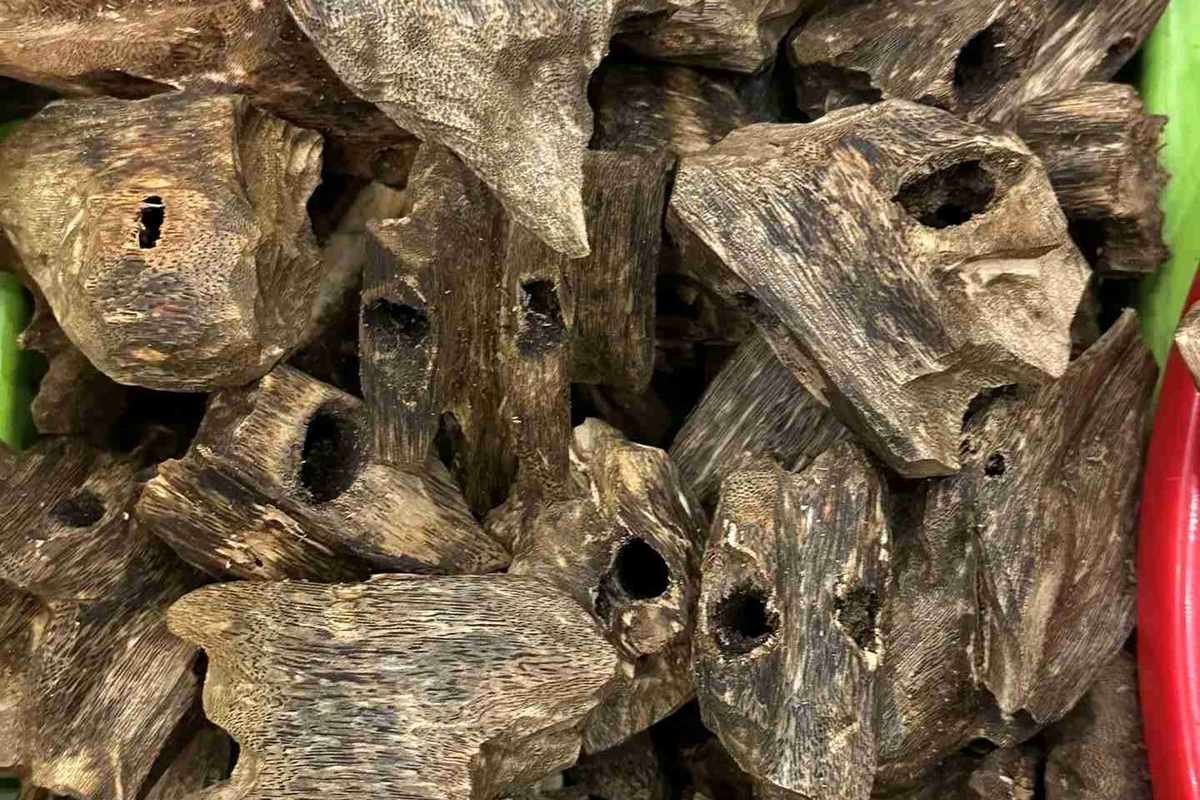
The word for agarwood in Chinese is chen xiang, the name for the dark, resin-loaded wood of Aquilaria trees. The two characters mean "sinking" (沉) and "fragrance" (香), because dense, resin-rich pieces sink in water.[1]
One measurable benchmark does exist. According to Liu et al. (2013), the Chinese Pharmacopoeia requires no less than 10% alcohol-soluble extractive in agarwood; induced samples in the study reached 11.60–18.08%, while two wild samples scored 10.56% and 19.30%.[6]
In daily trade the word is broad. A Guangdong farmer, a Beijing bead retailer and a Shanghai incense maker all say chen xiang. However, each of them may mean a different species, a different grade and a different end use.
The name is old, and so is the trade behind it. Southern China shipped and burned aromatic woods for many centuries, and our history of the agarwood trade traces that route from the early ports to modern plantations.
Chen Xiang, Chenxiang and 沉香
In English you will see chen xiang, chenxiang, chén xiāng and occasionally "chen hsiang" in older texts. They are all the same word. In practice, search engines and customs officers both treat them as one term.
The same material carries other names in other markets. Gulf buyers say oud, Japanese buyers say jinkō, and older Western catalogues say aloeswood. Our explainer on what aloeswood is covers that last name and why it has nothing to do with aloe vera.
Within Chinese, two related words matter on a price list. Chen shui (沉水) describes sinking grade, and qinan or kynam (奇楠) describes a separate, softer and waxier tier. Neither of those is a pharmacopoeia term.
Chen Xiang in Chinese Incense Culture
Long before the pharmacopoeia, chen xiang belonged to incense culture. Song-dynasty scholars counted burning incense among the refined pastimes of daily life, alongside tea, flower arranging and hanging paintings, and Hong Kong's name, "fragrant harbour", is widely linked to the old incense trade through the area.
Today most chen xiang comes from plantations in southern China, especially Guangdong and Hainan. Our own trees grow in Dian Bai, Guangdong, a region with a long history of agarwood cultivation.
2. How Does the Chinese Pharmacopoeia Define Chen Xiang?
The Chinese Pharmacopoeia lists chen xiang as a medicinal material. Its monograph defines it as the resin-containing wood of Aquilaria sinensis, the species native to southern China, including Guangdong and Hainan.[2]
That definition is narrower than everyday usage. Therefore a word that covers almost any agarwood in a shop becomes, in the pharmacopoeia, a precise description of one species and one tissue.
The Chinese Pharmacopoeia is revised in editions, usually every five years. Wording, tests and limits can change between editions, so any buyer who needs the exact text should work from the current edition, not from a summary.
One Species, One Part of the Tree
The monograph names Aquilaria sinensis only. Other resin-producing species, such as A. malaccensis or A. crassna, are traded widely in China as incense and collector material. However, they fall outside that monograph definition.
Our overview of the main Aquilaria species explains where each one grows and how their scent differs. For this topic, the key point is simple: in the pharmacopoeia, species is part of the definition.
The monograph also covers resin-containing wood, not the whole tree. Pale, unresinated Aquilaria wood is light and almost scentless, and it does not meet the definition. Moreover, leaves, bark and seeds are separate materials with no place in that monograph.
Which Quality Markers Does the Monograph Set?
The monograph sets several checks on top of the botanical definition. A published review of agarwood quality assessment in China groups them into appearance, identification tests and content requirements.[2]
- Description: the appearance, colour, texture and aroma of acceptable material, written as a reference for inspectors.
- Identification: tests that confirm the material is what the label says. Check the current edition for the exact methods it specifies.
- Alcohol-soluble extract: a minimum percentage of extractable matter is set. The figure is defined in the monograph itself, so check the current edition rather than relying on a number quoted secondhand.
- Chemical markers: agarwood resin contains characteristic chromones and sesquiterpenes, and pharmacopoeia work in China has used such compounds as reference points.[3]
The extract minimum is the marker most traders mention. It works as a rough screen for resin content, because pale wood yields far less extract than dark, resinated wood. Still, it is a floor for medicinal use, not a grading scale for incense.

3. Chen Xiang in the Pharmacopoeia vs the Incense Trade
| Point | Pharmacopoeia monograph | Incense and fragrance trade |
|---|---|---|
| Species | Aquilaria sinensis only | Any Aquilaria species, plus some Gyrinops; species should be stated on the invoice |
| Material | Resin-containing wood | Chips, powder, logs, beads, carvings, oil, sticks and cones |
| Quality test | Description, identification tests and an alcohol-soluble extract minimum (check the current edition) | Visual inspection, aroma, resin content and sink test; supplier grade scales |
| Grade language | Pass or fail against the monograph | Supplier grades such as our D, C, B, A, AAA plus Kynam (allocation only) |
| Who sets the rules | Chinese drug regulators, through the pharmacopoeia | Buyer and seller contracts, plus CITES and import law |
| Typical buyer | Licensed medicinal-material and decoction-piece businesses in China | Incense makers, perfumers, bakhoor brands, bead and carving workshops |
| Our role | We do not supply material as a medicine | This is the trade we serve, with plantation A. sinensis |
Our D–AAA scale is our own internal grading, not an ISO, CITES or pharmacopoeia standard. Always check the current edition of the Chinese Pharmacopoeia for the monograph text.
4. Where Does Chen Xiang Sit in Traditional Chinese Medicine Practice?
Chen xiang is used in traditional Chinese medicine practice, and it appears in classical materia medica texts as well as the modern pharmacopoeia. That is as far as we, a wood and incense supplier, will go in describing it.
Academic reviews document the traditional uses recorded for agarwood across several Asian medical traditions, alongside laboratory research on its compounds.[4] Those papers exist for researchers. However, a review of traditional use is not evidence that a product does anything for a customer.
We do not repeat traditional indications on this site. In fact, we do not describe any of our products as having a health effect. That choice is deliberate, and we think every incense and fragrance seller should make it too.
Three reasons drive it. First, medicinal claims bring a product under drug or food law in most markets. Second, a claim on your label is your legal problem as well as ours. Finally, our wood is graded for scent and burning, not prepared or tested as a medicinal material.
In China the practical picture is similar. Medicinal materials sold as medicines, and especially processed decoction pieces, move through a separately regulated and licensed channel. The details change over time, so a buyer entering that channel needs local regulatory advice rather than a supplier's blog.
What this article does not say
Nothing on this page is medical advice or a health claim. We do not say that chen xiang, agarwood oil, incense or any of our products prevents, treats or relieves any condition.
Our agarwood is sold for incense, fragrance, craft and cultivation use. If you plan to sell any agarwood product with a health statement, take advice from a regulatory specialist in your market first.
5. Medicinal-Material Trade vs Incense and Fragrance Trade
| Feature | Medicinal-material trade (China) | Incense and fragrance trade |
|---|---|---|
| Reference standard | Chinese Pharmacopoeia monograph for chen xiang | Supplier grade scale, buyer specification and sample approval |
| Species accepted | <em>Aquilaria sinensis</em>, as the monograph defines | Any declared Aquilaria species, if documented correctly |
| Licensing | Drug-sector licences and controls apply; rules vary by activity | General trade rules, CITES permits where required, local product safety law |
| What buyers test | Compliance with monograph tests, done by qualified labs | Aroma, burn behaviour, resin look, sink test; GC-MS for oils on request |
| Label language | Regulated drug or herbal labelling | Descriptive: species, grade, form, weight, origin; no health claims |
| Where we fit | Not our channel | Our channel: plantation chips, powder, incense, oil, logs and seedlings |


6. What Does Chen Xiang Mean for Wholesale Buyers?
For most foreign buyers, the pharmacopoeia definition is background knowledge, not a purchase specification. You are buying chen xiang as an aromatic material, so you should specify it the way the incense and fragrance trade does.
That said, the monograph teaches two useful habits. It names one species precisely, and it separates resinated wood from pale wood. Both habits make a cleaner contract.
Labels, Names and Claims
Writing "chen xiang" on a retail pack is fine as a name. In practice, problems start when the label or listing borrows medicinal language from Chinese sources and translates it into a sales line.
A safe label states what the product is: species, form, grade, net weight and origin. For example, "Plantation Aquilaria sinensis agarwood chips, grade B, 100 g, Guangdong, China" says everything a customer needs without any claim.
Brands that sell into China face an extra point. Because chen xiang is also a pharmacopoeia term, wording that hints at medicinal use can draw attention from regulators. Therefore keep Chinese-language copy as descriptive as the English.
Species, Origin and Documents
Every Aquilaria species has been listed in CITES Appendix II since 2004, and that applies whatever name sits on the invoice.[5] We send every wholesale shipment with a grading note and a CITES Appendix II export permit where one is required.
The listing carries annotation #14, which exempts some finished, retail-packaged products. However, check the current annotation text before you plan a shipment, since annotations can change at CITES meetings.
Inside China, wild Aquilaria sinensis is also protected under national rules for wild plants. That is one reason the domestic trade has shifted toward cultivated trees. We sell plantation material only, grown and inoculated at our 100+ mu plantation in Guan Zhu Town, Dian Bai District, Maoming.
Species matters for scent as much as for paperwork. Chinese A. sinensis has its own character, which Gulf and Japanese buyers often compare against Southeast Asian material. Our guide to how agarwood grading works explains how we sort that material on the table.
Plantation chen xiang by form, for incense and fragrance buyers
| Form | Typical use | Our starting price · MOQ |
|---|---|---|
| Graded chen xiang chips | Heating on a burner, kōdō-style appreciation, bakhoor blending | From $0.24/g · 100 g · grades D–AAA |
| Fine agarwood powder for incense making | Sticks, cones, coils and seal incense | From $10.30 per 50 g |
| Finished agarwood incense sticks | Retail and temple-supply incense | $2.35–$5.89 per box · 1 kg |
| Hydro-distilled oud oil | Perfume oils, attars, fragrance blends | From $7.00/g · 10 g |
| Aquilaria sinensis seedlings | New plantations, with phytosanitary certificate | $15 per plant · 10 plants |
Prices are current list starting points and rise with grade. Kynam is allocation only and not stock-held.
Step-by-Step Process
7. How to Buy Chen Xiang for Incense and Fragrance
Define the end use in writing
State that the material is for incense, fragrance, craft or cultivation. This shapes the grade, form and paperwork, and it keeps both sides clear that no medicinal specification applies. If you need pharmacopoeia-compliant material, you need a licensed medicinal-material channel instead.
Name the species and the source
Ask your supplier to state the Aquilaria species and whether the material is plantation or wild. Our stock is plantation Aquilaria sinensis. A clear species name also makes the CITES permit and your import declaration easier to match.
Order a paid sample
Samples start from 100 g of chips or 1 g of oil. They are paid and non-refundable, and they let you test aroma, burn behaviour and appearance against your own reference before you agree a grade for volume.
Fix the grade and the documents
Agree the grade on our D, C, B, A, AAA scale and the grading note that travels with the goods. For oil, ask for a GC-MS report if your customers expect lab data. Confirm whether your shipment needs a CITES export permit.
Check your own label and import rules
Before goods ship, review your retail label for any medicinal wording and confirm import requirements with your national CITES authority. We do not accept returns, but we resolve genuine problems by replacement or credit under our refund policy.
Sourcing plantation chen xiang for incense or fragrance?
Tell us your market, the form you need and the grade you have in mind, and we will suggest a sample set. We reply to enquiries within 4 business hours, Monday to Saturday, 9:00–18:00 China time.
Ask for a chen xiang sample and quote → or read our replacement and credit terms before you order.
Frequently Asked Questions
Chen xiang (沉香) means "sinking fragrance". It is the Chinese name for agarwood, the resin-loaded wood of Aquilaria trees. The name refers to the way dense, resin-rich pieces sink in water. In English the same material is called agarwood, oud or aloeswood, depending on the market and the catalogue.
Yes. In everyday Chinese trade, chen xiang simply means agarwood of any species and grade. The Chinese Pharmacopoeia uses the same word in a narrower sense, for the resin-containing wood of Aquilaria sinensis. So all pharmacopoeia chen xiang is agarwood, but not all agarwood meets the pharmacopoeia definition.
The monograph defines chen xiang as the resin-containing wood of Aquilaria sinensis, the species native to southern China. Other species such as A. malaccensis and A. crassna are traded in China as incense and collector material, but they fall outside that definition. Check the current edition of the pharmacopoeia for the exact wording.
The monograph sets a minimum percentage of alcohol-soluble extract, which works as a rough screen for resin content. We do not quote the figure here because it is defined in the pharmacopoeia itself and can change between editions. If you need it for a contract, take it from the current edition directly.
No. We sell plantation Aquilaria sinensis for incense, fragrance, craft and cultivation use, and we do not describe any product as having a health effect. In China, medicinal materials sold as medicines move through a separately regulated and licensed channel, and buyers who need that should source through it.
Using chen xiang as a product name is fine in most markets. Problems start when a label adds medicinal language, often translated from Chinese sources. Keep the label descriptive: species, form, grade, net weight and origin. If you want to make any health statement, take regulatory advice in your market first.
All Aquilaria species have been listed in CITES Appendix II since 2004, whatever name appears on the invoice. Bulk wood, chips, powder and oil may need an export permit. Annotation #14 exempts some finished retail-packaged products, so check the current annotation text and your import rules before shipping.
Our chen xiang is plantation material. We grow and inoculate Aquilaria sinensis on our 100+ mu plantation in Guan Zhu Town, Dian Bai District, Maoming, Guangdong, and work with more than 100 contracted plantation farmers. Wild material appears in the wider market, but we do not sell it.
For incense and fragrance, we grade by visual inspection, aroma, resin content and sink test. Our internal scale runs D, C, B, A and AAA, with Kynam offered by allocation only. This scale is our own and is not an ISO, CITES or pharmacopoeia standard, so agree the grade against a paid sample.
Samples start from 100 g of chips or 1 g of oil. They are paid and non-refundable. Wholesale MOQs are 100 g for chips, 10 g for oils and 1 kg for incense sticks. Chips start from $0.24/g at entry grades and rise with grade, so state the grade you want when you ask for a quote.
References
- 1
- 2Liu Y.Y., Wei J.H., Gao Z.H., et al.. A Review of Quality Assessment and Grading for Agarwood. Chinese Herbal Medicines, 2017.View source
- 3Li W., Chen H.-Q., Wang H., et al.. Natural products in agarwood and Aquilaria plants: chemistry, biological activities and biosynthesis. Natural Product Reports, 2021.View source
- 4Hashim Y.Z.H.-Y., Kerr P.G., Abbas P., Mohd Salleh H.. Aquilaria spp. (agarwood) as source of health beneficial compounds: A review of traditional use, phytochemistry and pharmacology. Journal of Ethnopharmacology, 2016.View source
- 5
- 6Liu Y., Chen H., Yang Y., et al.. Whole-tree agarwood-inducing technique: an efficient novel technique for producing high-quality agarwood in cultivated Aquilaria sinensis trees. Molecules, 2013.View source
All scientific references are provided for transparency. AgarwoodTown summarises peer-reviewed findings for educational purposes and does not claim to provide medical or regulatory advice.
Wholesale Catalog
Buy the products discussed in this article


Related Articles
Education
What Is Aloeswood? The Old Name for Agarwood, Explained for Incense Buyers
13 min read
Plantation
Aquilaria Species Guide: Sinensis, Malaccensis, Crassna, Subintegra and Gyrinops Compared
13 min read
Sourcing Reference
Oud Wood Price by Grade: How Agarwood Is Graded from D to AAA and Kynam
15 min read
Source Direct from Origin
Discuss Your Requirements with Our Team
We respond within 24 hours. Share your target grade, quantity and destination — we'll send current pricing, a sample pack option, and CITES documentation details.