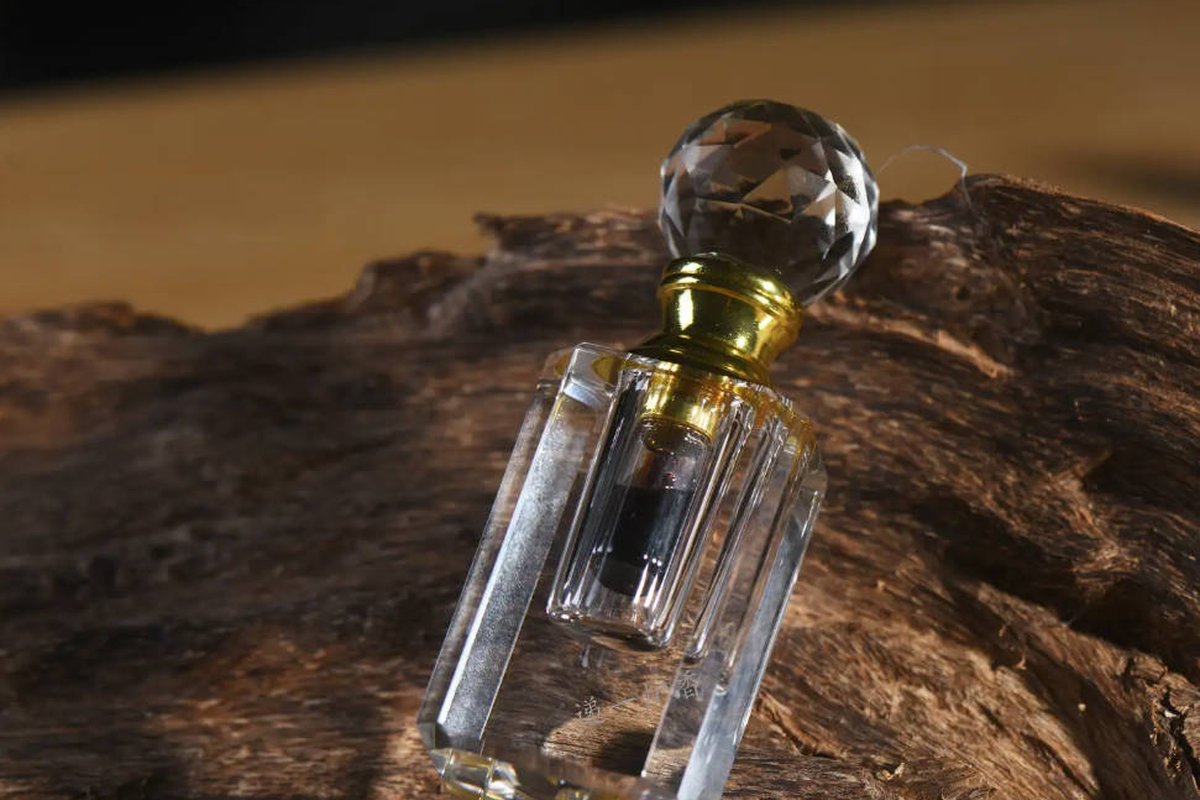
Agarwood GC-MS Test: How to Read a Lab Report for Oud Oil
Sooner or later, every serious oil buyer asks us for a lab report. An agarwood GC-MS report is the most useful document you can hold next to a sample, but only if you know how to read it. This guide walks through what the instrument measures, which compound families real agarwood oil should show, which peaks should worry you. Just as important, it covers what no chromatogram can tell you about grade, scent or origin. We distil oud oil at our Dian Bai plantation and provide GC-MS reports on request, so this is written from the supplier's side of the table.

Written by
Founder & Chief Sourcing Officer, AgarwoodTown
15+ years hands-on experience grading plantation agarwood, sourcing directly from Dianbai and Maoming districts in Guangdong — the world's largest Aquilaria sinensis cultivation region. Wang has personally inspected thousands of CITES export shipments and holds plantation certification from China's National Forestry and Grassland Administration. He advises GCC, European and East Asian wholesale buyers on grade selection, CITES compliance and supply chain due diligence.
CITES Certified
In this article
- What Does an Agarwood GC-MS Test Measure?
- Area Percent Is Not Concentration
- Anatomy of a GC-MS Report: What Each Field Means
- Which Marker Compounds Should an Agarwood GC-MS Report Show?
- 2-(2-Phenylethyl)chromones
- Sesquiterpenes: Agarospirol, Jinkoh-Eremol and Relatives
- Small Aromatics at the Front of the Run
- How to Read an Agarwood GC-MS Report, Step by Step
- Red Flags in an Agarwood GC-MS Report
- Dominant Synthetic Aroma Chemicals
- Carrier Oil and Diluent Signals
- Phthalates and Perfumery Solvents
- Hydro-Distilled vs CO₂ Oil: How Do Agarwood GC-MS Reports Differ?
- What Can a Lab Report Not Tell You?
- How to Request and Use GC-MS Reports in a Wholesale Order
- Frequently Asked Questions
1. What Does an Agarwood GC-MS Test Measure?
An agarwood GC-MS test separates the volatile compounds in an oil and identifies each one by its mass spectrum. In plain terms, it gives you a list of what is in the bottle and roughly how prominent each component is.[1]
Is there an official quality bar? According to the Chinese Pharmacopoeia, as cited by Liu et al. (2013), medicinal agarwood must contain at least 10% alcohol-soluble extractive. In that study, induced plantation samples measured 11.60–18.08%, against 10.56% and 19.30% for two wild samples.[7]
The method has two halves. First, the gas chromatograph pushes a vaporised sample through a long, thin column, and compounds leave the column at different times. Then the mass spectrometer breaks each compound into fragments and records a fingerprint that software compares against a spectral library.
The result is a chromatogram: a line with peaks along a time axis. Each peak is one compound, or sometimes two that overlap. Below the chart, a table lists retention times, peak areas and the library's best guess at each name.
For a wholesale buyer, that table answers two practical questions. Does the oil contain the compound families that define agarwood? And does it contain things that have no business in a pure oil? Our bench tests for pure oud oil cover the quick checks you can run yourself; this guide picks up where those tests stop and the lab takes over.
Area Percent Is Not Concentration
Most essential oil reports express each peak as a percentage of total peak area. That number is useful for comparison, but it is not a weight percentage. Different compounds respond differently in the detector, so two peaks of equal area need not represent equal amounts.
Moreover, area percent only covers what the column could see. Anything too heavy to vaporise, or anything that stayed in the inlet, never makes it into the total. Consequently, an oil diluted with a non-volatile carrier can still produce a tidy-looking report, because the carrier simply does not show up as peaks.

2. Anatomy of a GC-MS Report: What Each Field Means
| Report field | What it tells you | What to check |
|---|---|---|
| Sample ID / batch number | Which physical sample the lab tested | It should match the batch on your invoice and sample label |
| Laboratory name and date | Who ran the test and when | An identifiable lab and a recent date; an undated report proves little |
| Column and method | The column type, oven programme and injection details | Lets another lab repeat the run and compare like with like |
| Chromatogram (TIC) | The total ion current trace showing every detected peak | Look at the overall shape, not only the table underneath |
| Retention time / retention index | When each compound left the column | Retention index supports a library match; time alone is weaker |
| Compound name | The library's best match for each spectrum | Many agarwood compounds are poorly covered by standard libraries |
| Match quality | How closely the spectrum matched the library entry | Low-quality matches should read as tentative, not as facts |
| Area % | Share of total detected peak area | Relative, not absolute; non-volatile material is invisible here |
| Unidentified peaks | Peaks the software could not name | Normal in agarwood oil; a long list is not a red flag on its own |
Field names vary between laboratories. If a report lacks most of the fields in the first four rows, ask the supplier for the full report rather than a summary page.
3. Which Marker Compounds Should an Agarwood GC-MS Report Show?
A genuine agarwood oil should show two compound families clearly: 2-(2-phenylethyl)chromones and sesquiterpenes. Published reviews of agarwood chemistry treat these two groups as the core of the material, with a long tail of minor compounds around them.[2][3]
2-(2-Phenylethyl)chromones
Chromones of this type are among the most characteristic compounds of agarwood. They are rare in other common fragrance materials, which makes them a useful identity marker in a report.[3]
On a chromatogram they usually elute late, because they are larger and less volatile than most terpenes. Typical names include 2-(2-phenylethyl)chromone itself and its methoxy-substituted relatives. Chinese grading research also treats chromone content as one of the chemical indicators that tracks agarwood quality.[4]
There is a catch, however. Some of the more oxygenated chromones are heavy or heat-sensitive, so a standard GC run sees them poorly. For that reason, research groups often add liquid chromatography to study them. The absence of a particular chromone from a GC report is not automatically suspicious.
Sesquiterpenes: Agarospirol, Jinkoh-Eremol and Relatives
Sesquiterpenes are fifteen-carbon compounds that carry much of the woody, resinous character of the oil. Agarwood contains them in unusual variety, across several skeleton types.[2]
Names you may see include agarospirol, jinkoh-eremol, α-agarofuran and its relatives, and a range of guaiane- and eudesmane-type compounds such as guaiene isomers, selinenes and eudesmols. Reviews of the phytochemistry list dozens more, and the exact mix shifts with species, induction method and processing.[5]
In practice, do not expect every named compound in every report. A report showing several sesquiterpene alcohols plus agarofuran-type and eudesmane-type compounds is consistent with agarwood. In contrast, a report with only one or two sesquiterpenes and nothing in the chromone region deserves questions.
Small Aromatics at the Front of the Run
Early in the chromatogram you will often see small aromatic compounds such as benzylacetone and related phenyl ketones and aldehydes. These are reported in agarwood and in agarwood smoke, and they contribute sweet, slightly balsamic top notes.[2]
They are useful supporting evidence, but they are not specific to agarwood. Therefore treat them as part of the pattern, never as proof on their own.
| Compound family | Example names on a report | Where it tends to elute | What it suggests |
|---|---|---|---|
| 2-(2-Phenylethyl)chromones | 2-(2-phenylethyl)chromone; methoxy-substituted analogues | Late in the run | Strong agarwood identity marker |
| Spirovetivane / vetispirane sesquiterpenes | Agarospirol | Middle of the run | Typical agarwood sesquiterpene |
| Eremophilane sesquiterpenes | Jinkoh-eremol | Middle of the run | Typical agarwood sesquiterpene |
| Agarofurans | α-agarofuran, dihydro- and nor-agarofurans | Middle of the run | Characteristic of agarwood oils |
| Guaiane and eudesmane types | Guaiene-related alcohols; selinene and eudesmol isomers | Middle of the run | Woody body of the oil; mix varies by batch |
| Small aromatics | Benzylacetone and related phenyl compounds | Early in the run | Supporting evidence, not specific |
Families and examples only. We deliberately give no percentage ranges: published values vary widely with species, induction method, distillation and the lab's own method, so any fixed range would mislead.
Step-by-Step Process
4. How to Read an Agarwood GC-MS Report, Step by Step
Match the paperwork to the bottle
Before you read a single peak, check the sample ID or batch number on the report. It should match the label on your sample and the line on your quote. A perfect report for a different batch tells you nothing about the oil you are buying.
Look at the whole chromatogram first
Natural agarwood oil usually produces a crowded trace: many medium and small peaks spread across the middle and late part of the run. A trace dominated by one or two towering peaks, with little else, points to a formulated product rather than a resin extract.
Find the sesquiterpene cluster
Scan the middle of the run for sesquiterpenes and sesquiterpene alcohols. Names such as agarospirol, jinkoh-eremol, agarofurans, guaiene isomers and selinene isomers are what you hope to see, alongside several unidentified neighbours.
Check the late-eluting chromone region
Look toward the end of the run for 2-(2-phenylethyl)chromones. Their presence is strong evidence of agarwood. Their weakness or absence calls for a question to the lab, since method settings can affect how well these heavier compounds show.
Hunt for compounds that should not be there
Read the table for isolated aroma chemicals, glycol and ester solvents, phthalates and regular ladders of hydrocarbons. Note the size of each one; a trace may be incidental, while a major peak is a business problem.
Weigh the unknowns sensibly
Agarwood contains many compounds that standard spectral libraries cover poorly, so a list of unidentified peaks is normal. Treat confident names with low match quality as tentative, and ask the lab before you draw conclusions from a single uncertain identification.
5. Red Flags in an Agarwood GC-MS Report
The clearest red flags are peaks that natural agarwood oil does not produce: large isolated aroma chemicals, solvent and carrier signals, and plasticisers. Each one has an innocent explanation at trace level, so size and context matter more than a single name.
Our guide to spotting fake agarwood covers the wood side; here we stay with the oil and the chromatogram.
Dominant Synthetic Aroma Chemicals
Synthetic "oud" bases are built from woody, ambery and leathery aroma chemicals. On a chromatogram they tend to appear as a few large, clean peaks, often with library names that have nothing to do with Aquilaria.
The warning sign is dominance. A pure oil should not owe most of its peak area to one or two compounds that belong to the fragrance industry's catalogue. When such peaks appear together with a thin sesquiterpene cluster and no chromones, the most likely story is a perfume oil labelled as agarwood oil.
Carrier Oil and Diluent Signals
Carriers are harder to see, because many of them barely register. Vegetable oils are mostly heavy triglycerides that do not elute under a normal essential-oil method. As a result, the report can look clean while the bottle is largely carrier.
Still, carriers leave clues. Liquid paraffin and mineral oil tend to show a regular ladder of straight-chain hydrocarbons at even spacing. Ester diluents such as isopropyl myristate show as distinct named peaks, while free fatty acids and their esters can hint at a vegetable carrier.
For example, a report with unusually few peaks, low total signal for the injected amount, and a hydrocarbon ladder deserves a follow-up question. In those cases, the bench checks in our purity guide — blotter behaviour and evaporation residue — become useful companions to the lab data.
Phthalates and Perfumery Solvents
Diethyl phthalate, dipropylene glycol, benzyl benzoate and triethyl citrate are common perfumery solvents. When any of them shows as a major peak in a so-called pure oil, the oil has almost certainly been cut or blended.
At trace level, the picture is less clear. Phthalates can migrate from plastic tubing, caps or droppers, and labs sometimes see them as background contamination. Therefore ask about the size of the peak and how the sample was packed before you reject a lot.
Three report patterns that should stop an order
- One or two giant peaks with fragrance-chemical names, and little else — typical of a formulated perfume oil, not a resin distillate.
- A major solvent or phthalate peak in an oil sold as pure — dilution or blending, whatever the label says.
- No chromones and a thin sesquiterpene cluster, combined with a price far below the market for genuine oil — ask hard questions before you pay.
None of these patterns needs a percentage threshold to recognise. They are about shape and proportion, which is exactly what a chromatogram shows well.


6. Hydro-Distilled vs CO₂ Oil: How Do Agarwood GC-MS Reports Differ?
| Feature | Hydro-distilled oud oil | Supercritical CO₂ agarwood oil |
|---|---|---|
| How it is made | Soaked, ground wood distilled with water and steam over long runs | Wood extracted with carbon dioxide under pressure at low temperature |
| Typical report shape | Strong volatile and sesquiterpene content; heat can reshape some compounds | Often a broader spread, including heavier compounds that distillation leaves behind |
| Chromone region | Present, though the balance depends on wood and run length | Often prominent, because the gentler process carries heavier compounds over |
| Scent character | Deeper, more animalic and fermented notes are common | Closer to the smell of the raw wood, often cleaner and lighter |
| Our starting price | From $7.00/g · MOQ 10 g | From $1.50/g · MOQ 10 g |
| What not to do | Judge it against a CO₂ report and call the difference adulteration | Judge it against a hydro report and call it weak or fake |
7. What Can a Lab Report Not Tell You?
A GC-MS report cannot tell you the grade of the oil, how good it smells, or exactly where it came from. It tells you what compounds are present; quality, value and origin remain judgements that need other evidence.
Grade
Our D, C, B, A, AAA and Kynam scale is a wood grade, set by founder Wang Jianyu and our team through visual inspection, aroma, resin content and sink test. It is our internal scale, not an ISO or CITES standard, and no chromatogram maps onto it directly. Our agarwood grading guide explains how those wood grades work.
Two oils can share the same compound families and still differ sharply in value. Research does link chromone content to quality in Chinese assessment schemes, but those schemes combine chemistry with appearance and other tests.[4] Chemistry alone does not price an oil.
Scent Quality
Smell depends on balance, trace compounds and how notes unfold over hours. Many of the compounds that shape an impression sit near the detection limit or among the unidentified peaks.
Consequently, a report cannot tell a perfumer whether an oil will work in a rose-oud accord or an attar for the GCC market. Only a smelling session can do that. We always recommend testing a paid sample — from 1 g of oil — alongside any report.
Exact Origin
Researchers have compared chemical profiles across Aquilaria species and regions, and some differences are real.[3] However, there is no routine commercial test that pins an oil to a country, let alone a district or a plantation.
Induction method, distillation and storage all move the profile as much as geography does. Therefore an origin claim should rest on traceable paperwork: the supplier's identity, the species named on the CITES documents, and a batch trail from wood to oil. All Aquilaria species sit in CITES Appendix II, so cross-border shipments of bulk oil often need an export permit that names the species.[6] Check the current annotation text for which finished products are exempt.
Age, Wild Status and Legality
A report also cannot show how old an oil is, whether the wood was wild or cultivated, or whether the trade was legal. Our stock is plantation Aquilaria sinensis from our own 100+ mu plantation and our contracted farmers, and our documents say so; the chromatogram cannot.
The same caution applies to traditional pharmacopoeia standards. China's monographs for chén xiāng assess the wood itself with their own methods, which our article on chen xiang in traditional Chinese practice discusses. A perfumery GC-MS report is a different document with a different purpose.
Step-by-Step Process
8. How to Request and Use GC-MS Reports in a Wholesale Order
Ask for the report with the quote
Ask for a GC-MS report at the same time as the price, and specify which oil and which batch. We provide GC-MS reports on request for our hydro-distilled and CO₂ oils, so there is no reason to wait until after payment.
Order a paid sample from the same batch
Our samples start at 1 g of oil. They are paid and non-refundable, which keeps them available to serious buyers. Ask that the sample comes from the batch the report describes, and keep part of it sealed as a retention sample.
Smell first, then read the report
Evaluate the oil on a strip before you open the PDF, so the chart does not bias your nose. Then read the report with the checklist above: batch match, whole trace, sesquiterpenes, chromones, contaminants and unknowns.
Commission your own test for larger orders
For a larger first order, send part of your retained sample to a laboratory you choose. A second report from an independent lab is the strongest way to confirm a supplier's document, and it gives you a reference for future lots.
Write the batch into the contract
Reference the batch and the report on your purchase order, together with the grade, volume and packaging. If a delivery does not match the agreed sample, our policy is to resolve it by replacement or credit rather than returns.
Want a report beside your sample?
We distil roughly 500 kg of oud oil a year at our Dian Bai operation, by steam and hydro distillation and by supercritical CO₂ extraction. Ask for a GC-MS report together with a sample of our hydro-distilled oud oil or our CO₂ agarwood essential oil, and tell us your target market and use.
If you also burn or blend the wood, our graded oud wood chips start at $0.24/g (MOQ 100 g, grades D–AAA), and our bakhoor incense chips start at $6/g. We reply within 4 business hours, Monday to Saturday, 9:00–18:00 China time. Request a quote with a lab report → and see our replacement and credit policy before ordering.
Frequently Asked Questions
It is a laboratory analysis that uses gas chromatography to separate the volatile compounds in agarwood oil and mass spectrometry to identify them. The report lists the detected compounds with retention times and relative peak areas. With that list, a buyer can check for agarwood marker compounds and for signs of dilution or synthetic additions.
No single compound proves it. The convincing evidence is a pattern: a rich cluster of sesquiterpenes such as agarospirol, jinkoh-eremol and agarofurans, together with 2-(2-phenylethyl)chromones later in the run. Those two families together, without dominant synthetic or solvent peaks, are what published agarwood chemistry leads you to expect.
Sometimes, but not always. Mineral oil often shows as a regular ladder of hydrocarbons, and ester diluents show as named peaks. However, many vegetable carrier oils are too heavy to elute under a normal method, so they stay invisible. Combine the report with blotter and evaporation checks to catch heavy carriers.
Not on its own. Phthalates can migrate from plastic caps, droppers or tubing, and labs sometimes record them as background contamination. A major phthalate peak in an oil sold as pure is a different matter and almost always means dilution. Ask about peak size and packaging before you decide.
No. Grades such as our D, C, B, A, AAA and Kynam tiers describe the wood and are set by visual inspection, aroma, resin content and sink test. A report confirms identity and flags contamination, but two oils with similar compound families can still differ widely in scent quality and value.
Not reliably for commercial purposes. Research has found chemical differences between species and regions, yet induction, distillation and storage shift a profile as much as geography does. Origin claims should rest on traceable documents, including the species named on CITES paperwork, rather than on a chromatogram alone.
The processes pull different compounds from the wood. Distillation uses water, steam and long heating, which favours volatile compounds and can alter some of them. Supercritical CO₂ works at low temperature and tends to carry heavier compounds too. Compare each oil with a report of the same type, not with the other process.
Yes, we provide GC-MS reports on request for our oils. Ask for the report together with your quote and name the oil and batch you are considering. Paid samples start at 1 g of oil, so you can smell the same batch the report describes before you commit to a larger order.
For a larger first order, yes, it is good practice. Keep part of your paid sample sealed and send it to a laboratory you choose. A second, independent report confirms the supplier's document, gives you a reference profile for future lots and settles questions quickly if a later delivery smells different.
References
- 1
- 2Naef R.. The volatile and semi-volatile constituents of agarwood, the infected heartwood of Aquilaria species: a review. Flavour and Fragrance Journal, 2011.View source
- 3Li W., Chen H.-Q., Wang H., et al.. Natural products in agarwood and Aquilaria plants: chemistry, biological activities and biosynthesis. Natural Product Reports, 2021.View source
- 4Liu Y.Y., Wei J.H., Gao Z.H., et al.. A Review of Quality Assessment and Grading for Agarwood. Chinese Herbal Medicines, 2017.View source
- 5Hashim Y.Z.H.-Y., Kerr P.G., Abbas P., Mohd Salleh H.. Aquilaria spp. (agarwood) as source of health beneficial compounds: A review of traditional use, phytochemistry and pharmacology. Journal of Ethnopharmacology, 2016.View source
- 6
- 7Liu Y., Chen H., Yang Y., et al.. Whole-tree agarwood-inducing technique: an efficient novel technique for producing high-quality agarwood in cultivated Aquilaria sinensis trees. Molecules, 2013.View source
All scientific references are provided for transparency. AgarwoodTown summarises peer-reviewed findings for educational purposes and does not claim to provide medical or regulatory advice.
Wholesale Catalog
Buy the products discussed in this article


Related Articles
Source Direct from Origin
Discuss Your Requirements with Our Team
We respond within 24 hours. Share your target grade, quantity and destination — we'll send current pricing, a sample pack option, and CITES documentation details.