What Is Bakhoor? Meaning, Ingredients, Types and How It Is Made
Customers in Riyadh grow up with it. Buyers in London or Toronto often meet it for the first time on a shop shelf. So what is bakhoor, exactly? In short, it is scented wood, usually agarwood chips soaked in perfume oils, heated on a burner to fill a room with fragrant smoke. We grow the agarwood that sits at the base of many blends, at our plantation in Dian Bai, Guangdong. This guide defines the word, explains what bakhoor is made of and how it is made, sorts the main types and shows how to tell a good blend from a poor one.

Written by
Founder & Chief Sourcing Officer, AgarwoodTown
15+ years hands-on experience grading plantation agarwood, sourcing directly from Dianbai and Maoming districts in Guangdong — the world's largest Aquilaria sinensis cultivation region. Wang has personally inspected thousands of CITES export shipments and holds plantation certification from China's National Forestry and Grassland Administration. He advises GCC, European and East Asian wholesale buyers on grade selection, CITES compliance and supply chain due diligence.
CITES Certified
In this article
- What Is Bakhoor? A Short Definition
- Bakhoor Meaning: Where the Word Comes From
- Bakhoor vs Oud: Same Thing?
- What Is Bakhoor Made Of?
- The Wood Base
- Oils, Musk and Amber
- Sugar, Honey and Binders
- How Is Bakhoor Made?
- How to Make Bakhoor at Home: The Basic Method
- Types of Bakhoor: Mabsoos, Ma'amoul, Muattar and Natural Chips
- How Is Bakhoor Used?
- Bakhoor vs Incense Sticks
- How to Judge Bakhoor Quality
- Buying Bakhoor: Labels, Musk and CITES
- Frequently Asked Questions
1. What Is Bakhoor? A Short Definition
What is bakhoor? It is a scented material made to be heated, not lit: wood chips or a pressed paste, perfumed with oils and aromatics, placed on charcoal or an electric burner so that it releases fragrant smoke. The best-known blends, often sold as agarwood bakhoor, sit on a base of agarwood, the resin-filled heartwood of Aquilaria trees.[1]
Demand is steady because use is daily. According to a 2012 study in Environmental Health Perspectives (Yeatts 2012), 86% of the 628 UAE households surveyed burned incense at least weekly and 44% burned it every day.[4]
Bakhoor belongs to the home, and that is how we would explain it to a new buyer. Across Saudi Arabia, the UAE, Kuwait, Qatar, Bahrain and Oman, families burn it to scent rooms, the majlis, clothes and hair. It marks Fridays, Ramadan nights, Eid, weddings and the arrival of guests. Similar customs exist in Yemen and the Horn of Africa.
It is not one recipe. Every house, and many families, keep their own mix. Still, nearly every blend combines the same 6 families of material, which we unpack in section 2. In our view, the clearest way to think of bakhoor is as wood plus perfume, with the wood doing the slow work.
Bakhoor Meaning: Where the Word Comes From
The bakhoor meaning is simple. The Arabic word بخور (bakhūr) means incense, and it comes from a root linked to vapour and fumes. The same root gives mabkhara, the burner, and tabkhīr, the act of perfuming with smoke.
English spellings vary: bakhoor, bakhour, bukhoor and bakhur all name the same thing. Retail labels, including ours, also borrow Arabic format names, such as mabsoos and ma'amoul, which describe how the blend is made rather than what it smells like.
Bakhoor vs Oud: Same Thing?
Not quite. Oud (عود) means the wood itself: agarwood. Plain oud chips are natural agarwood with no added oils. Bakhoor is the finished, perfumed product, which may or may not contain agarwood at all.
In practice the words overlap, because the most prized bakhoor is built on oud chips. However, a blend on neutral wood with an oud-style fragrance is still bakhoor. It simply should not be sold as agarwood.
2. What Is Bakhoor Made Of?
| Ingredient family | Typical materials | Job in the blend | What it does on heat |
|---|---|---|---|
| Wood base | Agarwood chips, sandalwood, neutral wood | Carries the oils and keeps burning | Releases a slow, woody note after the oils fade |
| Perfume oils | Oud oil or an oud-style accord, rose, sandalwood oil | Gives the blend its character | Opens fast and fills the room |
| Musk and amber | Synthetic musks, amber accords | Softens and lengthens the scent | Leaves a warm, skin-like finish |
| Resins | Frankincense, myrrh, benzoin | Adds brightness or depth | Melts quickly and leads the opening |
| Sweetener | Sugar, honey | Glazes, sweetens and binds | Caramelises; too much gives dark smoke |
| Binder | Natural gums or resin | Holds pressed cakes together | Burns with the cake; a poor one blackens |
General overview. Proportions vary widely between houses and regions, and most formulas are kept confidential.
The Wood Base
The wood decides how long a blend lasts. Oils give the first strong burst, but the resin in a real agarwood chip carries the second half of the session. The aroma of heated agarwood comes from a large family of sesquiterpenes and 2-(2-phenylethyl)chromones that the tree forms as a defence against wounding and infection.[2] No added oil fully copies that chemistry, which is why we treat the wood as the part of a blend you cannot fake.
Most commercial bakhoor does not need top-grade wood. On our own five-step D to AAA scale, which is an internal scale and not an ISO or CITES standard, D and C chips are the usual base for a heavily perfumed blend. A lightly scented, wood-forward bakhoor shows the wood more, so B or A chips earn their cost there. Our graded oud wood chips start from $0.24/g with a 100 g MOQ.
We would choose the grade from the product promise, not from habit. Cheaper lines often use a neutral wood and rely on the oils for scent. That is a fair product at a lower price. The problem starts only when neutral wood is sold as oud.
Oils, Musk and Amber
Oud, rose and amber are the classic trio in Gulf blends. Natural oud oil makes the agarwood note last, but it is costly: our hydro-distilled oil starts from $7.00/g and our CO₂ agarwood oil from $1.50/g. So many blends use an oud-style accord instead, which is normal as long as the label does not claim natural oil.
Musk in modern bakhoor is almost always synthetic, because deer musk comes from protected species. "Amber" is a perfumery accord, usually built around labdanum, benzoin and vanilla-type notes. It is not fossil amber, and it is not ambergris.
Sugar, Honey and Binders
Sugar and honey sweeten the smoke and help oils cling to the wood, which is why many traditional blends feel sticky and glossy. A moderate amount is part of the style. Yet sugar is also the cheapest way to add weight, and a blend that is mostly sugar burns fast and smokes dark. Pressed formats need a binder as well, usually a natural gum.

Step-by-Step Process
3. How Is Bakhoor Made?
Choose and size the wood
The maker picks the base, such as agarwood chips, a mix of woods or powder for pressed formats, and sieves it to an even size. Pieces of very different size soak up oil unevenly and burn at different rates, so even sizing comes first.
Blend the scent layer
Oils, resins and aromatics are mixed to the house formula. In traditional methods the oils often go into a warm sugar or honey base; other makers soak the chips directly in an oil mix without any sweetener.
Combine wood and scent
The chips are folded into the scented base or left to soak until they have absorbed the oils. For pressed bakhoor, powder, binder and oils are worked into a dough and shaped into cakes, tablets or small balls.
Rest in a sealed container
The blend rests so the oils settle into the wood and the notes merge. Resting time varies by maker and by style, and many houses treat it as part of their private method. Pressed cakes also need drying so they do not crack.
Test burn and pack
A careful maker test-burns each batch on the kind of burner the customer will use, then packs it in sealed jars or tins. Air exposure is the quickest way to flatten a good blend, so the jar matters as much as the recipe.
How to Make Bakhoor at Home: The Basic Method
Many Gulf families still make their own. The basic home method follows the same five steps on a small scale: warm a little sugar until it melts, stir in perfume oils off the heat, fold in a handful of wood chips, then seal the jar and leave it to rest before use. Some recipes skip the sugar and simply soak chips in oil for several days.
We would add two cautions. Melted sugar runs well above 100 °C and sticks to skin, so work slowly and keep children away. And fragrance oils sold for skin or soap are not always tested for burning; a note that smells fine in the bottle can turn sharp on charcoal. Start with a small batch and test-burn it before making more.
For brands rather than home makers, the steps are the same but the questions change: who supplies the wood, which grade, and how batches stay consistent. Our guide to private label bakhoor covers that side, and agarwood powder uses explains the powder that goes into pressed cakes.
4. Types of Bakhoor: Mabsoos, Ma'amoul, Muattar and Natural Chips
| Type | What it is | Look and feel | Best for |
|---|---|---|---|
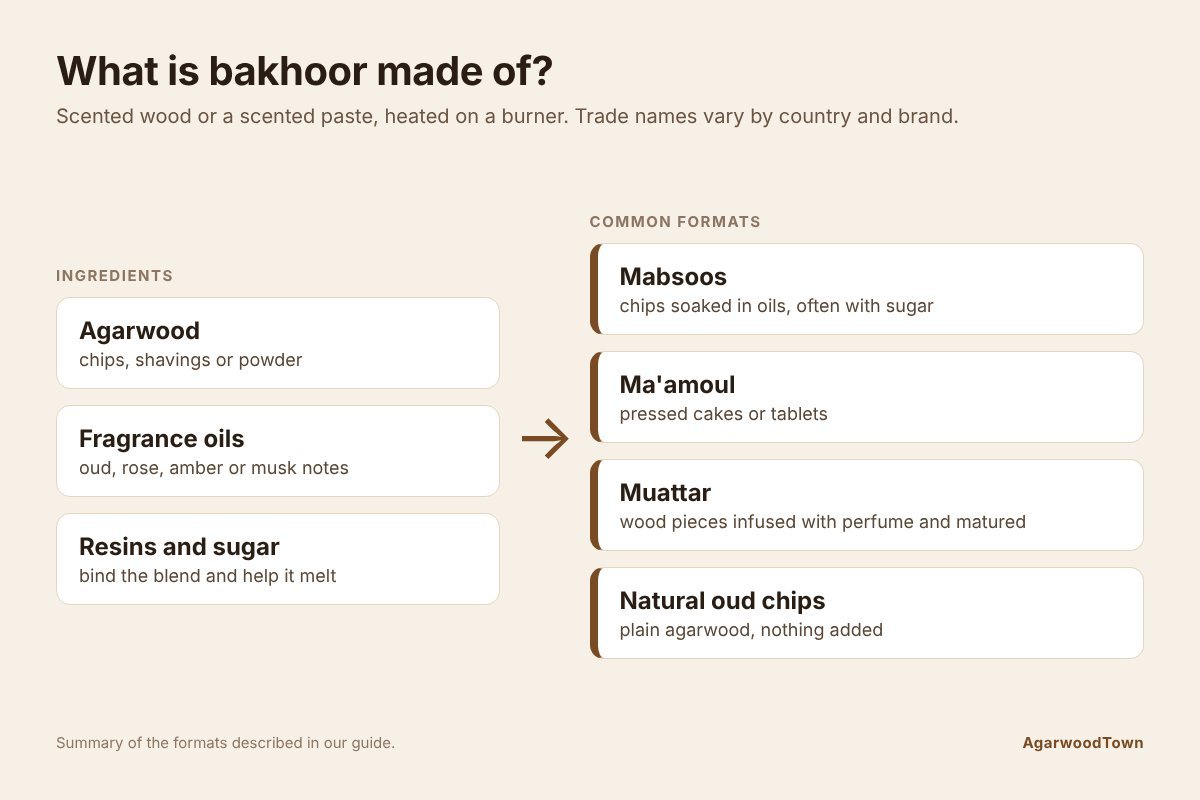
| Mabsoos (soaked chips) | Wood chips soaked in oils, often with sugar | Glossy, slightly sticky chips | Everyday home use and gifting |
| Ma'amoul (pressed) | Powdered wood, oils, resins and binder pressed into cakes or tablets | Uniform pieces, neat in a box | Easy dosing; customers who want tidy pieces |
| Muattar (infused wood) | Wood pieces infused with perfume and left to mature | Dark, oily wood pieces | Rich, long-lasting room scent |
| Natural oud chips | Graded agarwood with nothing added | Dry wood with visible resin lines | Buyers who want the wood alone |
Trade names vary by country and brand; some sellers use mabsoos and muattar for similar products. Ask what is actually in the jar.
In practice, we find the type changes how the product behaves more than the scent does. Sugary mabsoos and pressed ma'amoul melt and smoke sooner, so they want gentle heat. Natural chips open slowly and tolerate a little more. If a customer complains of burnt smoke, the heat is usually wrong for the type.
Format also shapes the pack. Wet, oily chips need a sealed glass jar or lined tin; pressed tablets sit happily in a lighter box. Our bakhoor chips, made on a plantation agarwood base, start from $6/g with a 250 g MOQ. At that price a 10 g trial jar holds $60 of bakhoor, so we suggest testing 2–3 blends in small amounts before you fill shelves.
5. How Is Bakhoor Used?
Bakhoor is placed on gentle heat in a burner called a mabkhara. A small piece is enough: 1 chip or a fragment of a tablet about 1 cm across on a well-lit coal or an electric plate. The goal is a thin, sweet wisp of smoke, not a thick cloud.
The smoke is then put to work. People wave the mabkhara through a room, hold clothes or an abaya over it, let the scent reach their hair, and carry it to guests at the end of a visit. Many households burn it before Friday prayers and throughout Ramadan and Eid. Our mabkhara guide covers the burner itself.
Technique matters more than most first-time buyers expect. We suggest reading our burning guide, linked below, before you judge any sample. Too much heat burns the sugar and oils and hides the wood. Our step-by-step guide on how to burn bakhoor explains charcoal and electric methods, and the bakhoor burner guide compares heat settings.
Bakhoor vs Incense Sticks
Incense sticks burn by themselves once lit. Bakhoor never burns by itself; it needs an outside heat source. That single difference changes the scent: a stick always smells partly of its own combustion, while gently heated bakhoor releases oils and resin with little smoke of its own.
Sticks are easier for customers who own no burner, which is why bakhoor-style sticks sell well outside the Gulf. Our comparison of bakhoor vs incense sticks sets the two side by side.


6. How to Judge Bakhoor Quality
| Feature | Well-made bakhoor | Poorly made bakhoor |
|---|---|---|
| Wood base | Visible agarwood chips with resin lines, even size | Pale, uniform pieces with no resin, or mostly sugar and powder |
| Jar scent | Layered: wood, oil and florals all noticeable | One loud sweet or synthetic note |
| First minutes on heat | Thin, steady scented smoke | Thick dark smoke and a burnt-sugar smell |
| Late burn | Wood note remains after the oils fade | Scent collapses into smoke and char |
| Burner residue | Light, dry spent wood | Sticky black crust that is hard to clean |
| Seller answers | Names the wood species, grade range and oil type | Vague claims such as "royal oud" with no detail |
The quickest test we know is the late burn. Put one small piece on gentle heat and wait 10–15 minutes. If a clean woody note is still there after the perfume has faded, the base is real agarwood. If only smoke and sweetness remain, the blend is carried by oil and sugar.
We would always test on the burner the end customer uses. A blend tuned for charcoal can scorch on a hot electric plate, and one tuned for low heat can smell weak on coal. For a closer look at the wood itself, our agarwood grading guide shows what each grade looks like.
7. Buying Bakhoor: Labels, Musk and CITES
From our side of the trade, buyers who resell or brand bakhoor need three things in order: an honest ingredient list, clear claims and the right paperwork. None of them needs the supplier to reveal its formula, and we would be wary of any seller who refuses to answer them.
- Ingredient list: list the main families roughly by weight, for example agarwood chips, sugar, fragrance, resins. Name natural oud oil only if it is really there. Labelling rules differ by market, so confirm with your importer.
- Musk wording: "musk" or "musk notes" is normal. Avoid wording that suggests an animal source unless you hold documents that prove it.
- No health claims: bakhoor is a fragrance and a custom. Keep words such as treats or therapy off the box and out of listings.
- CITES: all Aquilaria species are listed in CITES Appendix II, so bakhoor containing agarwood may need export and import permits.[3] An annotation exempts some finished, retail-packaged products, but check the current wording before you ship.
- Safety data: ask for safety data sheets for the fragrance oils, which some markets need for classification and labelling.
For choosing and checking suppliers in bulk, read our bakhoor sourcing guide. It covers batch consistency, grading notes and what to ask before a first order.
Want to compare bakhoor blends side by side?
Our plantation agarwood bakhoor chips start from $6/g with a 250 g MOQ, and samples are paid and non-refundable. Tell us your market, format and target price, and we reply to enquiries within 4 business hours, Monday to Saturday, 9:00–18:00 China time.
Ask for a bakhoor sample and quote → Brands that press their own cakes can also source pure agarwood powder, from $10.30 per 50 g.
Frequently Asked Questions
Bakhoor is scented wood made to be heated on a burner. It is usually agarwood or other wood chips soaked in perfume oils, sometimes with sugar, resins, musk and amber. When warmed on charcoal or an electric plate, it releases fragrant smoke used to scent homes, clothes and hair, especially across the Gulf.
Bakhoor comes from the Arabic word bakhūr, meaning incense. It shares a root with mabkhara, the burner, and tabkhīr, the act of perfuming with smoke. In everyday use across the Gulf, bakhoor means the perfumed wood chips or pressed cakes that people burn at home and serve to guests.
Most bakhoor is made of a wood base, usually agarwood chips, plus perfume oils such as oud, rose and sandalwood, and often musk and amber accords. Many traditional blends add sugar or honey to sweeten and bind, and some include resins such as frankincense. Pressed cakes also contain powder and a natural gum binder.
Makers size the wood, blend the oils and aromatics, then combine the two, either by folding chips into a warm sugar and oil base or by soaking them in oil. The blend rests in a sealed jar so the oils settle in. Pressed bakhoor is shaped from powder, oil and binder, dried, test-burned and packed.
A simple home method is to melt a little sugar, stir in perfume oils off the heat, fold in wood chips and seal the jar to rest before use. Some people skip the sugar and just soak chips in oil. Work carefully with hot sugar, and test-burn a small batch first, because not every oil smells good on heat.
No. Oud is the wood itself, agarwood, and plain oud chips have nothing added. Bakhoor is a finished, perfumed product that is often built on oud chips but can also use other woods. A blend on neutral wood with an oud-style fragrance is still bakhoor, but it should not be labelled as agarwood.
The main types are mabsoos, which are chips soaked in oils and often sugar; ma'amoul, which are pressed cakes or tablets; muattar, which are wood pieces infused with perfume and matured; and natural oud chips with nothing added. Trade names overlap between countries, so ask what is actually inside the jar before you buy.
Modern commercial bakhoor almost always uses synthetic musk. Deer musk comes from protected musk deer species listed under CITES, so legal trade in it is tightly controlled and very costly. A low-priced blend that claims real deer musk deserves a hard question, and brands should avoid animal-musk wording without proof.
Heat one small piece gently and wait 10 to 15 minutes. Good bakhoor gives thin, steady smoke and keeps a clean woody note after the perfume fades, and the chips show visible resin lines. Poor bakhoor smokes dark, smells of burnt sugar and leaves a sticky black crust on the burner.
Bakhoor that contains agarwood may need CITES documents, because all Aquilaria species are listed in Appendix II. An annotation exempts some finished, retail-packaged products, but the wording changes from time to time. Check the current annotation and confirm with your national CITES authority before planning an international shipment.
A room usually holds the scent of bakhoor for several hours after one gentle session, and fabrics such as curtains and clothes can hold it much longer. How long depends on the blend, the amount used, the room size and ventilation, so test one small piece before using more.
Bakhoor perfumes the air and fabrics through smoke, while perfume is worn on the skin. In the Gulf they are used together: clothes and hair are scented with bakhoor first, then perfume or oud oil is applied. The two layers are chosen to complement each other.
References
- 1
- 2Naef R.. The volatile and semi-volatile constituents of agarwood, the infected heartwood of Aquilaria species: a review. Flavour and Fragrance Journal, 2011.View source
- 3
- 4Yeatts K.B., et al.. Indoor air pollutants and health in the United Arab Emirates. Environmental Health Perspectives, 2012.View source
All scientific references are provided for transparency. AgarwoodTown summarises peer-reviewed findings for educational purposes and does not claim to provide medical or regulatory advice.
Wholesale Catalog
Buy the products discussed in this article


Related Articles
Incense
How to Burn Bakhoor: A Step-by-Step Guide for Charcoal and Electric Burners
13 min read
Sourcing Reference
Private Label Bakhoor: How to Launch Your Own Bakhoor Line, From Brief to Shelf
15 min read
Sourcing Reference
Bakhoor Sourcing 2026: 7 Premium Standards GCC Luxury Brands Use to Evaluate Source Suppliers
14 min read
Source Direct from Origin
Discuss Your Requirements with Our Team
We respond within 24 hours. Share your target grade, quantity and destination — we'll send current pricing, a sample pack option, and CITES documentation details.