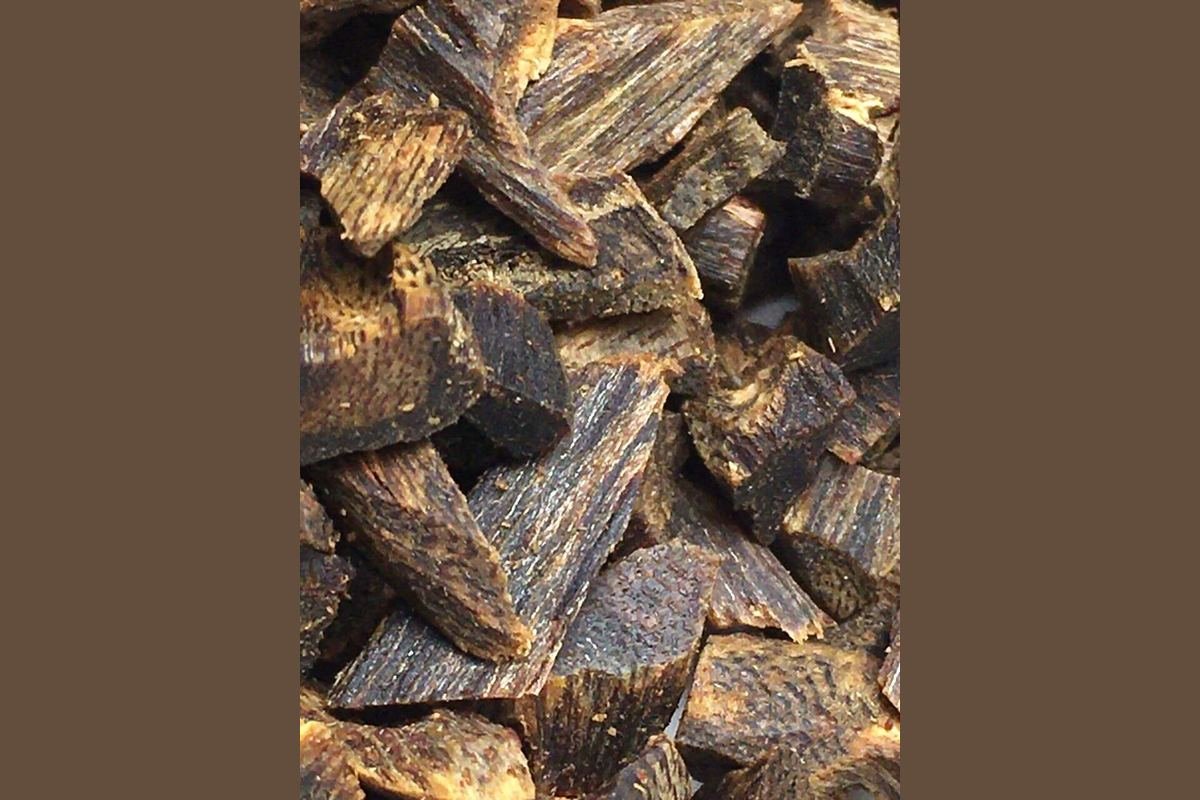
Agarwood vs Sandalwood Incense: Two Trees, Two Fragrances, One Buyer's Guide
Buyers often put both woods in the same sentence, and some assume they are related. Agarwood vs sandalwood incense is really a comparison of two unrelated trees that make fragrance in completely different ways. Agarwood is resin that an injured Aquilaria tree lays down in its wood; sandalwood is the naturally aromatic heartwood of Santalum trees. We grow and process agarwood at our Dian Bai plantation, and we do not sell sandalwood. However, the two meet constantly in incense and attar, so this guide sets out how they differ and why perfumers pair them.

Written by
Founder & Chief Sourcing Officer, AgarwoodTown
15+ years hands-on experience grading plantation agarwood, sourcing directly from Dianbai and Maoming districts in Guangdong — the world's largest Aquilaria sinensis cultivation region. Wang has personally inspected thousands of CITES export shipments and holds plantation certification from China's National Forestry and Grassland Administration. He advises GCC, European and East Asian wholesale buyers on grade selection, CITES compliance and supply chain due diligence.
CITES Certified
In this article
- Agarwood vs Sandalwood Incense: The Short Answer
- Why Buyers Confuse the Two Woods
- How Does Each Wood Make Its Fragrance?
- Agarwood: A Resin Made in Response to Injury
- Sandalwood: Oil Built Into the Heartwood
- Two Different Chemistries
- Agarwood vs Sandalwood Side by Side
- How Do Agarwood and Sandalwood Smell Different?
- Heated Wood vs Oil on Skin
- Where Each Wood Is Used
- Why Do Attars Combine Oud and Sandalwood?
- Practical Notes for Blenders
- CITES and Legal Status Compared
- Why Is Agarwood Priced Differently From Sandalwood?
- Sourcing the Agarwood Side of a Blend
- Frequently Asked Questions
1. Agarwood vs Sandalwood Incense: The Short Answer
In the agarwood vs sandalwood incense question, the key point is simple. They are different trees from different plant families, and their scent comes from different processes. Agarwood is resinated wood from Aquilaria species, while true sandalwood comes from trees in the genus Santalum.[1][2]
Scarcity starts in the forest. According to a 2013 study in Molecules (Liu 2013), agarwood forms naturally in only about 10% of Aquilaria trees, which is why plantations now induce resin on purpose.[6]
A healthy Aquilaria tree has almost no fragrance. In contrast, a mature sandalwood tree carries its aroma in the heartwood as a normal part of growing up. That single difference shapes everything else: supply, grading, scent and price.
A note on our position. AgarwoodTown is an agarwood grower and processor, founded in 2014 in Guan Zhu Town, Dian Bai District, Maoming, Guangdong. We sell agarwood chips, oils, incense and wood products. We do not grow, stock or sell sandalwood, so everything we say about it here is general, published information rather than trade experience.
Why Buyers Confuse the Two Woods
The confusion is understandable. Both are fragrant woods sold as chips, powder, oil and incense. Both appear in temple and household rituals across Asia, and both are associated with long histories of trade.
Moreover, product labels blur the line. A box of incense may list "oud and sandalwood" as one note, and a perfume oil may use both words in its name. Some sellers also use the word "sandalwood" loosely for other aromatic woods. For example, red sandalwood (Pterocarpus santalinus) is a different tree again, valued for colour rather than the classic sandalwood scent.[2]
For a wholesale buyer, the fix is the same as with oud itself. Ask for the botanical name on the invoice. Our agarwood is plantation Aquilaria sinensis, and our documents say so. For the naming side of oud, see our guide on how agarwood and oud names map across markets.
2. How Does Each Wood Make Its Fragrance?
The biology is where agarwood vs sandalwood differ most. Agarwood fragrance is a defence response; sandalwood fragrance is a product of normal ageing. One forms after damage, the other forms as the tree matures. Everything else in the comparison follows from this.
Agarwood: A Resin Made in Response to Injury
Aquilaria wood is pale and light when healthy. When the trunk is wounded and microbes, mainly fungi, enter the damaged tissue, the tree produces dark aromatic resin around the wound.[3] That resin-saturated wood is what the trade calls oud.
In the wild, the trigger is chance: a storm, a broken branch, insect damage. Consequently, many wild trees contain no oud at all. On plantations, growers wound the trees on purpose by drilling or inoculation, so resin forms in a planned way.
At our 100+ mu Aquilaria sinensis plantation we use artificial inoculation, and we also work with more than 100 contracted plantation farmers. Even so, resin never spreads evenly. A single trunk yields wood from pale to nearly black, which is why grading matters so much in agarwood.
Sandalwood: Oil Built Into the Heartwood
Sandalwood works differently. Santalum trees build aromatic oil into their heartwood as they age, and the oil is also concentrated in the roots.[2] No wound or infection is needed.
Sandalwood trees are also hemiparasitic. Their roots attach to the roots of host plants and draw some water and nutrients from them, which affects how the trees are planted.[2] Because heartwood needs time to develop, sandalwood is a slow crop. Published sources describe harvest ages in decades rather than years, although the exact age varies by species, site and management.
Two Different Chemistries
The scent molecules differ as much as the biology. Agarwood resin is dominated by sesquiterpenes and 2-(2-phenylethyl)chromones, and reviews list a long catalogue of further volatile compounds.[4]
Sandalwood oil, by contrast, is defined mainly by the santalols, alcohols that give it its soft, milky woodiness.[2] Therefore a GC-MS trace of real oud oil and one of real sandalwood oil look nothing alike. For our oils, we provide GC-MS reports on request, which is the cleanest way to confirm that an "oud" oil is actually agarwood.

Agarwood vs Sandalwood Side by Side
| Feature | Agarwood (oud) | Sandalwood |
|---|---|---|
| Botanical source | Aquilaria species (also Gyrinops), family Thymelaeaceae | Santalum species, family Santalaceae |
| Where the scent comes from | Resin produced after wounding and infection | Aromatic oil formed in heartwood and roots as the tree matures |
| Healthy tree | Pale, nearly scentless wood with no oud | Fragrant heartwood once the tree is old enough |
| Consistency | Highly variable within one tree; graded piece by piece | More uniform; quality tracks heartwood and oil content |
| Main scent molecules | Sesquiterpenes and 2-(2-phenylethyl)chromones | Santalols (alpha and beta) |
| Typical scent | Deep, resinous, woody, sometimes leathery, sweet or smoky | Soft, creamy, milky, gently sweet wood |
| Role in a blend | Character note that defines the blend | Base and fixative that rounds and extends other notes |
| International trade rules | All Aquilaria spp. in CITES Appendix II since 2004 | Varies by species and country; check current listings |
| Sold by AgarwoodTown | Yes: chips, oils, incense, bakhoor, beads, logs, seedlings | No |
3. How Do Agarwood and Sandalwood Smell Different?
On scent, agarwood vs sandalwood is a contrast of texture. Sandalwood smells smooth and creamy; agarwood smells deeper, darker and far more variable. If sandalwood is a steady background, agarwood is the note people stop and comment on.
Sandalwood has a reputation for consistency. A good oil gives a soft, milky wood note with mild sweetness, and it changes slowly as it dries down. That stability is one reason perfumers have long used it as a base.
Agarwood behaves differently. Depending on grade, species and extraction, one oil may open sharp and fermented, then settle into sweet resin and dry wood. Another may be smoky, leathery or honeyed. On our grading table, two chips from the same trunk can smell noticeably different when warmed.
For a fuller vocabulary of oud notes, our guide to what oud smells like breaks the profile into woody, resinous, animalic, sweet and smoky facets.
Heated Wood vs Oil on Skin
Both woods change character with the way they are used. Warmed gently on a mica plate or electric burner, agarwood releases sweet, layered resin notes; burned hot on charcoal, it turns smokier and loses detail.
Sandalwood chips and powder also release more scent with heat, but the result is usually softer and less complex. As a result, many incense makers use sandalwood as a body and add agarwood for depth.
Oils differ in the same direction. Our hydro-distilled oud oil carries the traditional, darker profile. Meanwhile, our CO₂-extracted agarwood oil is often brighter and closer to the smell of the raw wood. Neither is "better"; they suit different formulas.

4. Where Each Wood Is Used
| Use | Role of agarwood | Role of sandalwood | What buyers should specify |
|---|---|---|---|
| Attar and perfume oil | Signature note, often the expensive heart of the blend | Classic carrier and base oil for traditional attars | Oud content, base oil, dilution and botanical names |
| Fine perfumery | Natural oud oil or a synthetic oud accord | Natural oil or synthetic sandalwood molecules | Whether the material is natural, and in what share |
| Japanese incense | Jinkō, the core of kōdō and premium koh | Byakudan, widely used in sticks and blends | Ingredient list and agarwood grade |
| Gulf bakhoor | Chips burned alone or as the base of mixed bakhoor | Often blended into perfumed bakhoor | Chip grade, any added oils, CITES paperwork |
| Religious and household ritual | Burned in Buddhist and other temple practice across Asia | Paste, powder and incense in Hindu, Buddhist and other traditions | Format, purity and labelling for the target market |
| Beads and carvings | Bracelets, prayer beads and carvings sold by weight and grade | Beads, boxes and carvings valued for durable scent | Species, grade or heartwood quality, and permits |
General trade overview. Sandalwood information is from published sources; AgarwoodTown supplies only the agarwood side.
5. Why Do Attars Combine Oud and Sandalwood?
Attars combine them because each wood covers the other's weakness. Sandalwood gives a smooth, lasting base, while oud adds depth and character that sandalwood alone does not have.
Traditional attar making, associated above all with Kannauj in India, distils flowers, herbs or woods and captures the vapour in a receiving oil. Historically that receiving oil was most often sandalwood. So in many classic attars, sandalwood is not just a note; it is the vehicle the whole perfume sits in.
Oud enters the picture in two ways. Some attars are built around agarwood as the main note. In other cases, makers add a small share of oud oil to a floral or spice attar to darken it and extend its drydown.
The agarwood vs sandalwood contrast is exactly what makes the pairing work. Sandalwood is round and calm; oud is textured and sometimes sharp. Together they read as one warm, woody accord that is softer than oud alone and deeper than sandalwood alone.
For the full background on how attar differs from pure oud oil, see our attar guide for B2B buyers.
Practical Notes for Blenders
First, decide which oil carries the blend. If sandalwood is the base, oud is usually a modest share, because a strong oud can dominate quickly. In practice, blenders work in small test batches and adjust by nose rather than by a fixed ratio.
Second, match the oud type to the job. A darker hydro-distilled oil gives a traditional attar character. A CO₂ oil can sit more cleanly on top of a sandalwood base. We sell both from 10 g, so a perfumer can test the pairing before committing to volume.
Finally, label honestly. If a product contains natural oud and natural sandalwood, the label can say so. If it uses a synthetic oud accord or synthetic sandalwood molecules, it should not imply otherwise. Our guide to testing pure oud oil lists the documents to request.
6. CITES and Legal Status Compared
Agarwood has one clear international rule; sandalwood depends on the species and the countries involved. Check both before you plan a product that combines them.
- Agarwood: all Aquilaria species, together with Gyrinops, have been listed in CITES Appendix II since 2004.[5] Wood, chips, powder and bulk oil generally need an export permit. Annotation #14 exempts some finished, retail-packaged products, so check the current annotation text.
- Our shipments: every wholesale agarwood order ships with a grading note and a CITES Appendix II export permit where required, plus a phytosanitary certificate for live plants.
- Sandalwood: the status of Santalum species differs by species, and several producing countries regulate harvest, sale or export at national level. Red sandalwood (Pterocarpus santalinus), a different tree, has its own controls. Confirm the current position with your supplier and your national authority.
- Your import side: your own country may add rules on top of CITES. For agarwood, our step-by-step CITES permit guide explains the paperwork.
7. Why Is Agarwood Priced Differently From Sandalwood?
In agarwood vs sandalwood pricing, the drivers differ. Agarwood pricing follows resin, while sandalwood pricing follows heartwood and oil content. Both woods are scarce, but agarwood adds an extra layer of uncertainty: a tree may hold little or no resin at all.
Because resin forms unevenly, agarwood is priced piece by piece and grade by grade. We grade by visual inspection, aroma, resin content and sink test, on an internal scale of D, C, B, A and AAA, with kynam allocated separately. This scale is our own, not an ISO or CITES standard.
Sandalwood value generally depends on how much heartwood a tree holds, its oil content and the species. We do not trade sandalwood, so we do not quote sandalwood prices. Moreover, sandalwood markets move with species, origin and national regulation, so any figure would date quickly.
For reference, our current agarwood list prices in USD are:
- plantation oud wood chips from $0.24/g, MOQ 100 g, grades D to AAA;
- CO₂ agarwood oil from $1.50/g and hydro-distilled oud oil from $7.00/g, both MOQ 10 g;
- agarwood incense sticks from $2.35 to $5.89 per box, MOQ 1 kg;
- Japanese-style koh incense from $6/g, MOQ 100 g.
The spread inside each line is driven by grade. For the wider market picture, our wild vs cultivated agarwood price guide explains why plantation and wild material sit at such different levels.
Step-by-Step Process
8. Sourcing the Agarwood Side of a Blend
Define the role oud plays in your product
Decide whether agarwood is the headline note or a supporting depth note over a sandalwood or floral base. That choice sets the grade, the oil type and the budget. A headline oud justifies higher grades; a supporting note often works well with a mid-grade oil.
Choose wood, oil or incense format
Attar and perfume makers usually need oil. Incense and bakhoor makers need chips or powder. Retailers may simply need finished sticks or koh. Tell your supplier the end product, because the right form is not always the obvious one.
Order paid samples and test against your base
Our samples start from 100 g of chips or 1 g of oil, paid and non-refundable. Blend each candidate oud into your own sandalwood or carrier base, because an oud that smells good alone can clash once it is diluted.
Request documents with the quote
Ask for a grading note, the botanical name, a GC-MS report for oils and the CITES position for your shipment. Source your sandalwood with equivalent paperwork from its own specialist supplier, since we do not supply it.
Scale up and keep a retained sample
Once a blend is approved, order volume against the approved sample grade and keep a retained sample of each lot. That gives both sides a reference if a later batch smells different. Problems are handled by replacement or credit under our refund policy, not returns.
Pairing oud with sandalwood in your next product?
Tell us your product, your target market and the role oud plays in it, and we will suggest agarwood oils or chips to sample. We reply within 4 business hours, Monday to Saturday, 9:00–18:00 China time.
Ask for an agarwood sample set → or read our replacement and credit terms first.
Frequently Asked Questions
No. Agarwood comes from Aquilaria trees and forms only when the tree is wounded and fills the damaged wood with resin. Sandalwood comes from Santalum trees, whose heartwood becomes fragrant naturally as the tree matures. They belong to different plant families and have different scent chemistry.
Oud usually reads as stronger and more complex. Good agarwood oil can be resinous, leathery, sweet or smoky, and it changes as it dries down. Sandalwood is softer and creamier, and it is valued for smoothness and staying power rather than intensity. Strength also depends heavily on grade and dilution.
Agarwood depends on resin formation, which is unpredictable even on plantations, so high-resin wood is scarce and graded piece by piece. Sandalwood value depends on heartwood and oil content and on species and origin. We do not trade sandalwood, so we do not quote its prices or compare specific figures.
No. We grow and process plantation Aquilaria sinensis and sell only agarwood products: chips, hydro-distilled and CO₂ oils, incense, bakhoor, beads, carvings, logs and seedlings. If your formula needs sandalwood, source it from a specialist supplier with its own documentation, and use our oils or chips for the agarwood side.
Traditional attars were often distilled into sandalwood oil, so sandalwood served as the base. Oud adds depth and a darker character, while sandalwood smooths its sharper edges and extends the drydown. The result is a warm woody accord that many buyers in India, the Gulf and niche perfumery recognise.
All Aquilaria species have been in CITES Appendix II since 2004, so international shipments of agarwood wood, chips and bulk oil usually need an export permit, with some retail-packaged items exempt under annotation #14. Sandalwood rules vary by species and country, so check the current position with your national authority.
Yes, and many blenders find it easier to place than a dark hydro-distilled oil. CO₂ oil tends to be brighter and closer to the raw wood, so it sits cleanly over a creamy sandalwood base. Test small batches first, since every oud lot and every sandalwood oil behaves slightly differently.
Sandalwood incense gives a soft, sweet, steady wood scent and is widely used as a base in sticks and cones. Agarwood incense is deeper and more resinous, and premium grades are prized in Japanese incense and Gulf bakhoor. Many blended incenses use sandalwood for body and agarwood for depth.
Ask the supplier for the botanical name of each ingredient, the share of natural oud and, for oils, a GC-MS report. Agarwood shows characteristic sesquiterpenes and chromones, while sandalwood shows santalols. If a seller cannot document either material, treat the label as a scent description rather than an ingredient claim.
References
- 1Li W., Chen H.-Q., Wang H., Mei W.-L., Dai H.-F.. Natural products in agarwood and Aquilaria plants: chemistry, biological activities and biosynthesis. Natural Product Reports, 2021.View source
- 2
- 3Tan C.S., Isa N., Ismail I., Zainal Z.. Agarwood Induction: Current Developments and Future Perspectives. Frontiers in Plant Science, 2019.View source
- 4Naef R.. The volatile and semi-volatile constituents of agarwood, the infected heartwood of Aquilaria species: a review. Flavour and Fragrance Journal, 2011.View source
- 5
- 6Liu Y., Chen H., Yang Y., et al.. Whole-tree agarwood-inducing technique: an efficient novel technique for producing high-quality agarwood in cultivated Aquilaria sinensis trees. Molecules, 2013.View source
All scientific references are provided for transparency. AgarwoodTown summarises peer-reviewed findings for educational purposes and does not claim to provide medical or regulatory advice.
Wholesale Catalog
Buy the products discussed in this article


Related Articles
Source Direct from Origin
Discuss Your Requirements with Our Team
We respond within 24 hours. Share your target grade, quantity and destination — we'll send current pricing, a sample pack option, and CITES documentation details.