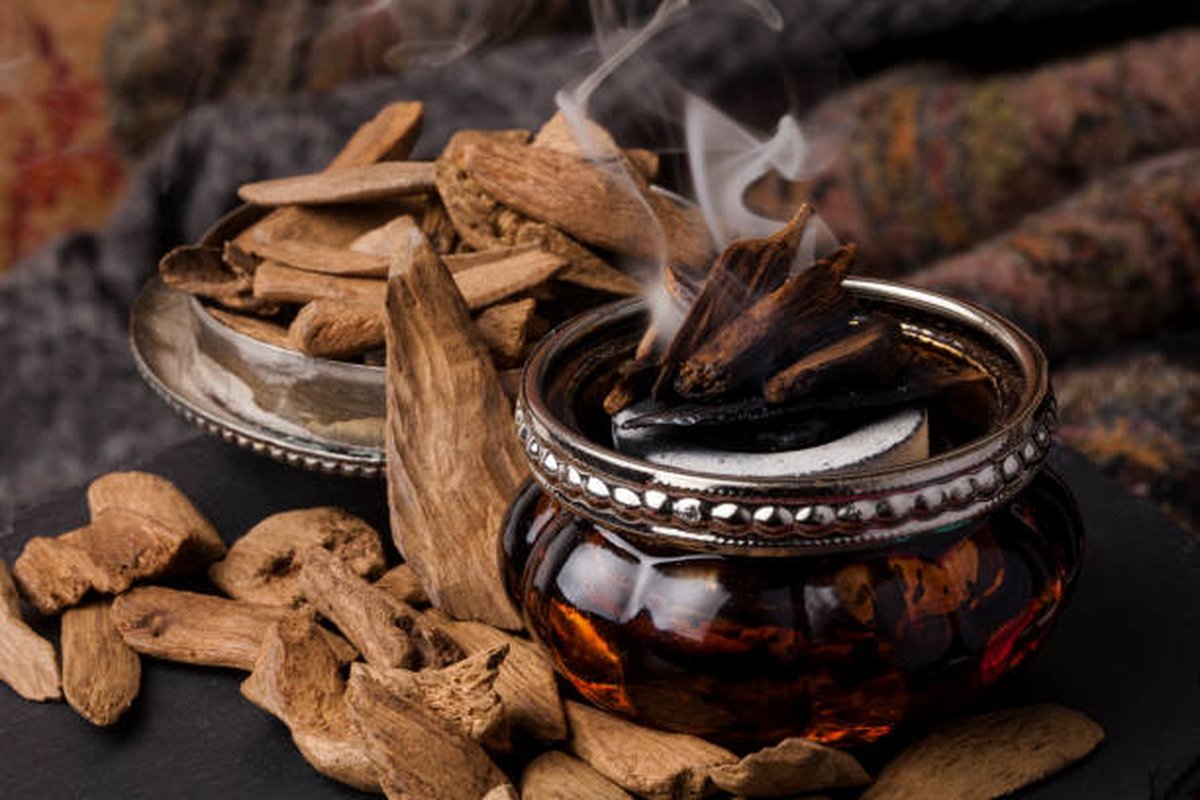
Frankincense vs Oud: Resin Tears, Resinated Wood and How Buyers Use Both
Frankincense and oud sit side by side in Gulf majlis, church censers and incense catalogues, so buyers often treat them as cousins. They are not. Frankincense vs oud is a comparison between a hardened tree sap and a resin-soaked wood, from different plant families, different continents and different trade systems. We grow and grade agarwood at our plantation in Dian Bai, Guangdong, and we do not sell frankincense. This guide explains how the two materials form, burn, smell and price, and what that means when you plan an incense or bakhoor line.

Written by
Founder & Chief Sourcing Officer, AgarwoodTown
15+ years hands-on experience grading plantation agarwood, sourcing directly from Dianbai and Maoming districts in Guangdong — the world's largest Aquilaria sinensis cultivation region. Wang has personally inspected thousands of CITES export shipments and holds plantation certification from China's National Forestry and Grassland Administration. He advises GCC, European and East Asian wholesale buyers on grade selection, CITES compliance and supply chain due diligence.
CITES Certified
In this article
- Frankincense vs Oud: The Short Answer
- What We Supply — and What We Do Not
- Where Do Frankincense and Oud Come From?
- Tears vs Wood: Why the Form Matters
- Frankincense vs Oud on Charcoal: How Do They Burn?
- Heat Control for Each Material
- What Do Frankincense and Oud Smell Like?
- Why Gulf Households Burn Both
- Frankincense and Oud in Bakhoor Blends
- How Does Sourcing Differ?
- Why Oud Costs More Than Frankincense
- Reading Our Price List
- Planning a Line That Uses Both
- Frequently Asked Questions
1. Frankincense vs Oud: The Short Answer
The core of frankincense vs oud is simple: frankincense is a dried resin that bleeds out of Boswellia bark, while oud is wood from Aquilaria trees that has filled with resin on the inside. One is collected from the outside of a living tree. The other is cut out of the trunk itself.
Incense is an everyday habit in the Gulf, not a special-occasion one. According to a survey of 628 households in the United Arab Emirates (Yeatts 2012), 86% burned incense such as oud and bakhoor at least once a week, and 44% burned it daily.[5]
Frankincense, also called olibanum, comes from several Boswellia species in the family Burseraceae. Most of it grows in Oman, Yemen, the Horn of Africa and India.[1] Oud, known in English as agarwood, comes from Aquilaria and related trees in the family Thymelaeaceae, native to South and Southeast Asia and southern China.[2]
Both are burned as incense, and both are distilled into oils. However, the similarity ends there. They differ in chemistry, in scent, in how they behave on charcoal, in regulation and, above all, in price.
What We Supply — and What We Do Not
We should be clear about our position before going further. AgarwoodTown grows, processes and grades agarwood only. We do not grow, buy, blend or sell frankincense.
Everything we say about frankincense in this article is general background, drawn from public sources and cited where it matters. Everything we say about oud comes from our own work since 2014 on a 100+ mu Aquilaria sinensis plantation in Guan Zhu Town, Dian Bai District, Maoming.
Therefore, if you need frankincense, you will need a resin specialist. If you need oud for a line that also uses frankincense, this guide should help you specify the oud side properly.
2. Where Do Frankincense and Oud Come From?
| Feature | Frankincense (Boswellia resin) | Oud (Aquilaria resinated wood) |
|---|---|---|
| Plant family | Burseraceae, genus Boswellia | Thymelaeaceae, genus Aquilaria (and the related Gyrinops) |
| Main growing regions | Arabian Peninsula (Oman, Yemen), Horn of Africa, India | South and Southeast Asia, southern China including Guangdong and Hainan |
| What is harvested | Sap that seeps from cuts in the bark and hardens into tears | Heartwood that has darkened with resin after injury and infection |
| Does the tree survive? | Usually yes; trees are tapped repeatedly over seasons | Harvest normally means cutting the tree or large sections of it |
| Time to a harvest | Tapping cycles measured in weeks to months once a tree is mature | Years of growth, then a long resin-forming period after wounding |
| Traded form | Tears, granules, powder, distilled oil | Chips, logs, powder, beads, carvings, distilled or CO₂-extracted oil |
| Typical sorting | By species, origin, tear size, colour and cleanliness | By resin content, colour, density, aroma and sink behaviour |
The table shows the basic split. Frankincense harvesting is a tapping trade, closer in spirit to collecting rubber or maple sap. Collectors scrape the bark, the tree weeps a milky resin, and after some days the hardened drops are picked off.[1]
Oud works the other way round. A healthy Aquilaria tree is pale and almost scentless inside. Resin only forms where the tree has been wounded and microbes have entered, so the aromatic material is locked inside the wood itself.[2]
On our plantation, that wounding is deliberate. We use artificial inoculation on our own trees, and we also source from more than 100 contracted plantation farmers. Moreover, every piece we sell is plantation material, not wild wood.
Tears vs Wood: Why the Form Matters
Form drives almost every practical difference a buyer meets. A frankincense tear is nearly pure resin with some gum. It melts, bubbles and gives off its scent quickly.
An oud chip, by contrast, is a matrix of wood fibre carrying resin. Even top-grade pieces contain wood, and lower grades contain a lot of it. As a result, the chip releases its aroma more slowly and changes as it heats.
Form also shapes processing. Frankincense needs sorting and cleaning, but not much cutting. Oud needs hand carving to strip away pale wood, then grading piece by piece, which is slow, skilled hand work at any agarwood processor.
3. Frankincense vs Oud on Charcoal: How Do They Burn?
Frankincense melts and smokes fast; oud smoulders and unfolds slowly. That is the most visible difference when you put the two materials on the same charcoal.
Drop a frankincense tear on a hot coal and it softens within seconds. It bubbles, releases a bright plume of white smoke, and is largely spent in a few minutes. What is left is a dark, sticky residue that smells harsh if it keeps burning.
An oud chip behaves differently. It warms, darkens at the edges and releases aroma in stages. A well-resinated chip can keep giving scent for a long session, while a low-grade chip gives a shorter, woodier burn because there is less resin in it.
Both materials belong to a much older family of aromatics burned on embers. Resins, woods and blends have been used this way across many cultures for thousands of years. In practice, though, each needs its own handling.
Heat Control for Each Material
Heat is the single biggest factor in how either material smells. Too much heat burns the resin instead of evaporating it, and the smoke turns acrid.
Frankincense tolerates a hot coal reasonably well because it melts and releases scent quickly. Even so, many users place it on a thin layer of ash or on a metal or mica plate to slow it down.
Oud is more sensitive. Chips set straight onto a glowing coal often scorch, and the sweet middle notes are lost in a burst of smoke. For that reason, many Gulf users let the charcoal settle first, while electric burners let the user set a low, steady temperature.
Japanese practice takes this furthest. In kōdō, a small sliver of agarwood sits on a mica plate above buried charcoal, so it warms rather than burns. We cover that method in our guide to the kōdō incense ceremony.

4. What Do Frankincense and Oud Smell Like?
| Aspect | Frankincense | Oud (agarwood) |
|---|---|---|
| First impression | Bright, fresh, citrus-like and piney | Deep, woody, warm, sometimes sweet or slightly sour |
| Body | Balsamic and resinous, with a light, airy character | Dense and layered; can show honeyed, leathery or animalic facets |
| Dry-down on heat | Fades fairly quickly; can turn sharp if overheated | Evolves over the session; higher grades stay sweet longer |
| Main aroma chemistry | Lighter, more volatile terpenes dominate the oil | Sesquiterpenes and 2-(2-phenylethyl)chromones |
| Variation between lots | Driven by species, region and harvest grade | Driven by species, resin content, formation time and processing |
| As a distilled oil | Thin, light, clear to pale yellow | Thicker, amber to dark brown, much stronger per drop |
Scent descriptions are general. Both materials vary widely by species, origin, grade, age and heat, so always judge a physical sample.
In short, frankincense reads as clean and lifting, while oud reads as dark and grounding. Many perfumers treat frankincense as a top-to-middle note and oud as a base note, which is one reason they pair well.
The chemistry supports that impression. Agarwood’s volatile fraction is dominated by heavier sesquiterpenes and a family of chromones that are rarely found elsewhere in nature.[3] These molecules evaporate slowly, so oud lingers on a smoke trail and on skin.
Oud also varies far more from lot to lot. A grade D chip and an AAA chip from the same plantation can smell like different materials. For a fuller vocabulary of oud scent, see our guide to what oud smells like.
Frankincense varies too, mainly by species and origin. However, buyers usually describe its range as lighter or richer versions of one familiar profile, rather than as different materials.

5. Why Gulf Households Burn Both
In the Gulf, frankincense and oud are not rivals; they do different jobs. Frankincense, known in Arabic as lubān, is the everyday resin, while oud is the material of hospitality, occasions and status.
Frankincense has deep roots in the Arabian Peninsula. Southern Arabia, especially Dhofar in today’s Oman, was a centre of the ancient frankincense trade, and the resin travelled overland and by sea for thousands of years.[1] It remains widely available and relatively affordable in Gulf markets.
Oud reached the same markets from much further east, through long-distance trade with South and Southeast Asia. Because it travelled further and is far scarcer, it has long carried more prestige.
The result is a practical division of labour. A household might burn frankincense to freshen a room on an ordinary day. Then, when guests arrive, the host passes oud or bakhoor smoke around the majlis as a gesture of welcome.
For a buyer supplying this market, that difference matters. Frankincense is a volume product sold at modest margins. Oud chips, by contrast, are a graded, higher-value product where customers judge every lot. If you sell into Saudi Arabia, our Saudi Arabia market page sets out how we support importers there.
Frankincense and Oud in Bakhoor Blends
Bakhoor is where the two materials most often meet. Bakhoor is a scented blend, usually wood chips soaked in fragrant oils and mixed with other aromatics, then burned on charcoal or an electric burner.
Recipes vary by house, city and family. Some blends include resins such as frankincense alongside agarwood, sandalwood, musk-type notes and perfume oils. Others contain no frankincense at all.
Because recipes differ so much, the label tells you little. Therefore, ask any bakhoor supplier for a full ingredient declaration, including which woods and resins are present and whether the oud content is natural agarwood or a fragrance accord.
Our own range includes agarwood-based bakhoor chips made from our plantation wood. For formats, burning styles and how to brief a bakhoor supplier, read our bakhoor sourcing guide.
6. How Does Sourcing Differ?
| Sourcing point | Frankincense | Oud (agarwood) |
|---|---|---|
| Supply base | Mostly wild or semi-managed Boswellia stands tapped by collectors | Wild trees historically; today largely plantation trees that are deliberately inoculated |
| CITES status | Not covered by the Aquilaria listing; check the CITES checklist for the specific species | All Aquilaria species in Appendix II since 2004; annotation #14 exempts some finished retail-packaged products |
| Typical export papers | Commercial invoice, certificate of origin, other documents as the importing country requires | CITES export permit where required, plus a grading note; phytosanitary certificate for live plants |
| Grading language | Trade grades by origin, tear size, colour and cleanliness; names vary by region | Supplier grade scales by resin, colour, density and aroma; ours runs D, C, B, A, AAA, plus Kynam |
| Lot consistency | Fairly uniform within one species and grade | Wide variation even within a grade; samples are essential |
| Lab checks | Identity and purity checks on oils are common in perfumery | GC-MS reports on oil, available from us on request |
| Sustainability concerns | Over-tapping and declining populations reported for some species | Wild Aquilaria over-harvested; plantation supply reduces pressure on wild trees |
Frankincense details are general trade background; AgarwoodTown does not supply frankincense. Check current CITES listings and national rules for any species you import.
Paperwork: one shipment, two rule sets
If you import oud and frankincense together, treat them as separate lines on your paperwork. The agarwood side is regulated under CITES, because all Aquilaria species have been listed in Appendix II since 2004.[4]
- Oud chips, logs, beads and bulk oil: we ship every wholesale order with a CITES Appendix II export permit wherever one is required.
- Finished products: annotation #14 exempts some finished, retail-packaged products. Check the current annotation text before you plan, because annotations change.
- Frankincense: it is not part of the Aquilaria listing, but do not assume no rules apply. Confirm the species and your country’s import requirements with your supplier and your national authorities.
- Mixed blends: a bakhoor that contains agarwood may need agarwood documents, whatever else is in it.
Our step-by-step CITES permit guide walks through the agarwood paperwork in detail.
7. Why Oud Costs More Than Frankincense
Oud costs more because it takes far longer to produce, only part of each tree yields usable material, and quality varies so widely that every lot must be graded. Frankincense, by comparison, is harvested repeatedly from living trees.
Think about what each harvest involves. A frankincense tree can be tapped season after season, and each tapping yields tears that need only sorting. An agarwood tree, on the other hand, must grow for years, be wounded, and then form resin over a further long period before anyone can cut it.
After harvest, the gap widens. Workers carve away the pale wood by hand, and the dark material that remains is often a small share of the trunk. That residue is then sorted into grades, with the top tiers commanding many times the price of entry grades.
As a result, frankincense is usually priced by the kilogram, while good oud is priced by the gram. We do not quote frankincense prices because we do not trade it, and market prices vary with species, origin and grade.
Reading Our Price List
Our current wholesale prices show how wide the oud range runs. Graded oud wood chips start from $0.24/g at a 100 g MOQ, across grades D to AAA. Kynam wood starts from $0.89/g and is offered by allocation only.
For oils, our hydro-distilled oud oil starts from $7.00/g, and CO₂ agarwood oil starts from $1.50/g, both with a 10 g MOQ. Bakhoor chips start from $6/g with a 250 g MOQ.
Notice that the starting price is only the floor. Grade moves the price more than anything else, so compare like with like. Our agarwood grading guide explains what separates a D chip from an AAA chip on the grading table.
The D to AAA scale and the Kynam tier are our internal system. They are not an ISO or CITES standard, and other suppliers grade differently, so always ask a supplier to define its grades.
Step-by-Step Process
8. Planning a Line That Uses Both
Decide what role each material plays
Start with the customer and the occasion. Frankincense often serves as an everyday or volume product, while oud serves as the premium or gifting tier. Some brands instead blend the two in one bakhoor or incense recipe. Each choice leads to a different specification and price point.
Source each material from a specialist
Frankincense and agarwood are separate supply chains with separate expertise. Buy frankincense from a resin specialist who can name the Boswellia species and origin. Buy oud from a grower or processor who can state the Aquilaria species, the grade and the documents that come with each shipment.
Order paid samples before volume
Our samples start from 100 g of chips or 1 g of oil. They are paid and non-refundable, and they let you test burn behaviour and scent against your own reference. Burn frankincense and oud side by side on the same burner at the same heat before you fix a recipe.
Fix a written specification
For oud, write down the grade, form, piece size and aroma reference you approved. For any blend, record the ratio and ingredient list. A written specification protects both sides when later lots arrive, because natural materials always vary somewhat.
Plan documents for each line
List which products need CITES export permits and which need other certificates. Remember that some importing countries add their own rules on top of CITES. Confirm requirements with your national authority before the first shipment rather than at the border.
Scale up with consistent lots
Once a sample is approved, order volume against the agreed grade. We reply to wholesale enquiries within 4 business hours, Monday to Saturday, 9:00 to 18:00 China time, and every wholesale shipment carries a grading note and the CITES documents it requires.
One practical point deserves emphasis. Because oud varies so much more than frankincense, the oud side of any combined product needs closer control. A recipe that smells balanced with one oud lot can tip towards smoke or sourness with another.
For stick incense, the same logic applies. Our Arabic-style agarwood incense sticks start from $2.35–$5.89 per box at a 1 kg MOQ, and they let a retailer offer oud in a format that burns more evenly than loose chips.
Finally, keep your labels honest. If a product contains natural agarwood, say so and keep the paperwork. If it contains a fragrance accord described as oud, or frankincense oil rather than resin, describe it that way. When you are ready to discuss the oud side of a line, contact our wholesale team with your target form, grade and market.
Frequently Asked Questions
No. Frankincense is a hardened resin tapped from the bark of Boswellia trees, mainly in Arabia, the Horn of Africa and India. Oud is resin-impregnated heartwood from Aquilaria trees in Asia. They come from different plant families, smell different and are traded through different supply chains, although both are burned as incense.
On charcoal, frankincense gives a quick, bright burst of smoke, while oud releases a deeper scent more slowly and for longer. As oils, oud is usually far more concentrated per drop and lasts much longer on skin or paper. Strength in both cases depends heavily on grade, origin and heat.
Frankincense trees can be tapped again and again, and the tears need little processing. Oud requires years of tree growth, deliberate or natural wounding, a long resin-forming period, felling, hand carving and grading. Only a share of each trunk becomes usable oud, and the best grades are scarce, so oud is priced by the gram.
Yes, many people do, either mixed in a bakhoor blend or one after the other on the same burner. Because frankincense melts and burns faster, some users add it first and the oud chip later, or use gentle heat for both. Test your combination on the burner your customers will actually use.
No. We grow, process and grade agarwood only, from our Aquilaria sinensis plantation and contracted farmers in Dian Bai, Guangdong. We do not grow, buy, blend or sell frankincense. If your line needs frankincense, source it from a resin specialist, and talk to us about the oud chips, oil, bakhoor or incense side.
Frankincense is not covered by the CITES Appendix II listing that applies to all Aquilaria species. That does not mean no rules apply, so check the CITES checklist for the specific Boswellia species and confirm your country’s import requirements. Agarwood in the same shipment may still need a CITES export permit.
Yes, in most Gulf usage lubān is the Arabic name for frankincense, the Boswellia resin. It is a different material from oud, which Arabic speakers also call ʿūd or oudh. Some shops use the names loosely, so check the product description and, for wholesale, ask the supplier to name the botanical source.
Some do and some do not. Bakhoor recipes vary by maker and region; many combine agarwood chips with perfume oils, sandalwood and other aromatics, and some add resins such as frankincense. Ask for a full ingredient list, including whether the oud content is natural agarwood or a fragrance accord, before you approve a supplier.
It depends on your market and price point. Frankincense is affordable, familiar and consistent, which suits volume products. Oud suits a premium or gifting tier and needs careful grading. Many ranges include both. For the oud side, start with paid samples, from 100 g of chips or 1 g of oil, before committing to volume.
References
- 1
- 2Tan C.S., Isa N., Ismail I., Zainal Z.. Agarwood Induction: Current Developments and Future Perspectives. Frontiers in Plant Science, 2019.View source
- 3Naef R.. The volatile and semi-volatile constituents of agarwood, the infected heartwood of Aquilaria species: a review. Flavour and Fragrance Journal, 2011.View source
- 4
- 5Yeatts K.B., et al.. Indoor air pollutants and health in the United Arab Emirates. Environmental Health Perspectives, 2012.View source
All scientific references are provided for transparency. AgarwoodTown summarises peer-reviewed findings for educational purposes and does not claim to provide medical or regulatory advice.
Wholesale Catalog
Buy the products discussed in this article


Related Articles
Sourcing Reference
Bakhoor Sourcing 2026: 7 Premium Standards GCC Luxury Brands Use to Evaluate Source Suppliers
14 min read
Incense
Agarwood Incense Sticks Guide 2026: Bakhoor, Kyara & Kynam — 5 Proven Uses
20 min read
Essential Oil
Oud Essential Oil 2026: 7 Proven Extraction & Wholesale Insights
12 min read
Source Direct from Origin
Discuss Your Requirements with Our Team
We respond within 24 hours. Share your target grade, quantity and destination — we'll send current pricing, a sample pack option, and CITES documentation details.